
 Call Anytime
833.722.6566
Call Anytime
833.722.6566
Surviving Your PFA Court Hearing with Confidence

What to Expect at a PFA Court Hearing in Pennsylvania
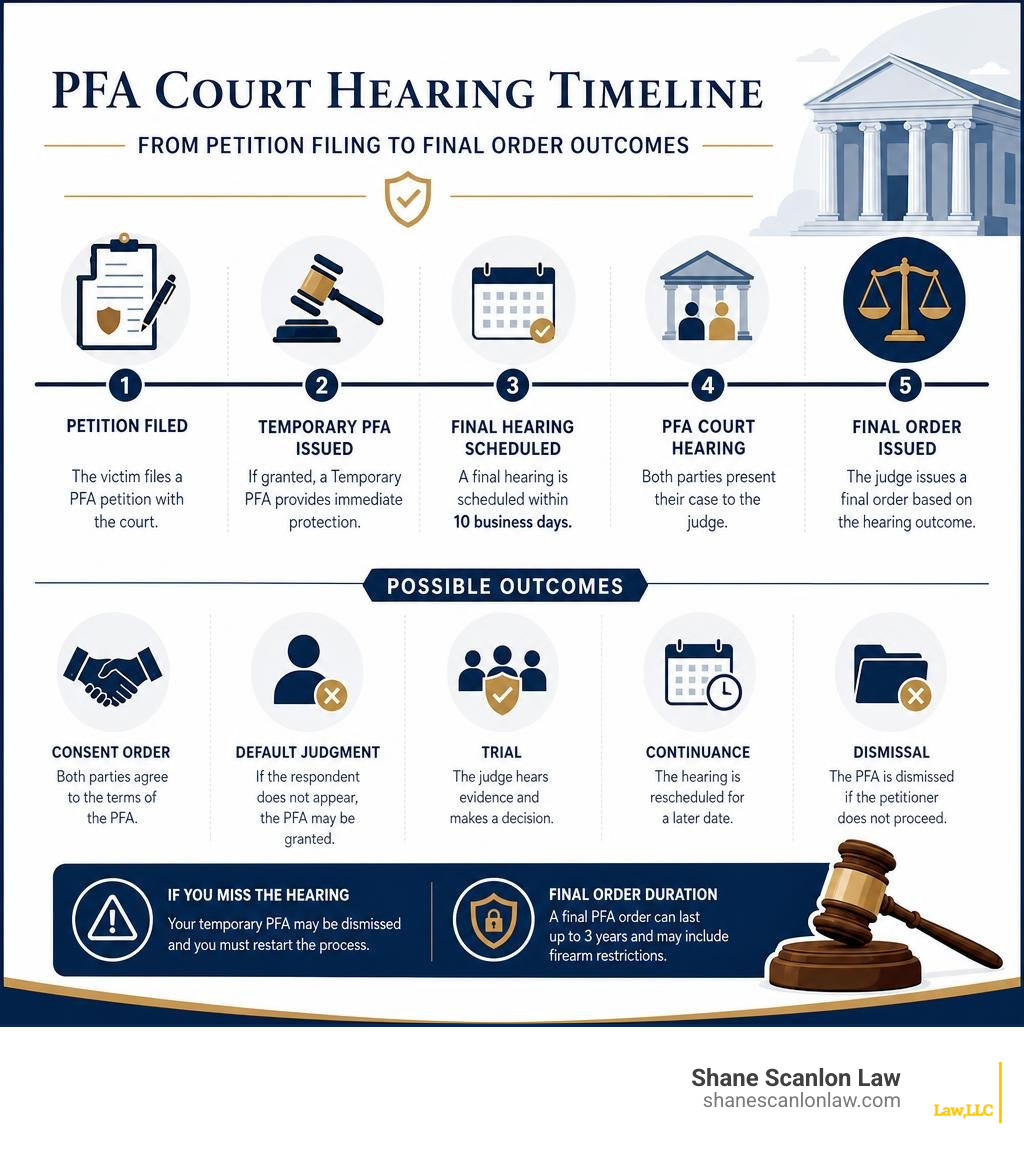
A PFA court hearing is a formal legal proceeding where a judge decides whether to grant a long-term Protection from Abuse order against someone who has committed or threatened abuse. Here is what you need to know at a glance:
- Who can file: Victims of abuse involving a spouse, ex-partner, family member, or intimate partner.
- Timeline: A final hearing is scheduled within 10 business days of a temporary PFA being issued.
- Possible outcomes: Consent order, default judgment, trial, continuance, or dismissal.
- If you miss the hearing: Your temporary PFA may be dismissed and you must restart the process.
- Final order duration: Up to 3 years, with firearm restrictions included.
Walking into court against someone who has hurt you is one of the hardest things a person can do. The room is unfamiliar, the stakes are high, and the other party may be sitting just feet away. Many people show up without knowing what to expect — and that lack of preparation can cost them the protection they need.
This guide breaks down exactly what happens at a PFA hearing, how to prepare, and what your options are at every step.
I’m Shane Scanlon, founder of Shane Scanlon Law and a former Lackawanna County District Attorney with over 20 years of courtroom experience in Pennsylvania — including representing clients in PFA court hearings across Scranton and Northeast PA. If you want to go into your hearing informed and ready, keep reading.
Pfa court hearing vocabulary:
Understanding the PFA Court Hearing Process in Pennsylvania
In Pennsylvania, the Protection from Abuse (PFA) Act is a powerful set of laws designed to protect victims of domestic violence. However, because a PFA carries significant legal consequences—including potential eviction from a home, loss of child custody, and the loss of firearm rights—the law ensures that both parties have a right to be heard. This is where the pfa court hearing comes in.
Under the PFA Act, a PFA is a civil matter, not a criminal one. This means the standard of proof is a “preponderance of the evidence” (meaning the allegations are more likely true than not), rather than the criminal standard of “beyond a reasonable doubt.” However, violating a PFA is a criminal offense, which is why these hearings are treated with immense gravity.
To qualify for a PFA, there must be a specific type of relationship between the person seeking protection (the plaintiff or petitioner) and the person accused of abuse (the defendant or respondent). The law requires a “domestic relationship,” which includes:
- Spouses or ex-spouses
- Current or former sexual or intimate partners (including dating relationships)
- Family members related by blood or marriage
- People who share biological parenthood
If the relationship does not fit into one of these categories, a PFA is not the correct legal tool. Other options, such as a Sexual Violence Protection Order (SVPO) or a Protection from Intimidation (PFI) order, may apply instead. To learn more about how this system functions, read The Pennsylvania PFA Process Explained.
Temporary vs. Final PFA Orders
The PFA process is designed to act quickly when someone is in danger, which is why it is split into two distinct stages: temporary orders and final orders.
When you first file a PFA petition, you will speak with a judge (or a magisterial district judge if it is after hours) for an ex parte hearing. “Ex parte” means the defendant is not present and does not even know the petition has been filed yet. If the judge believes you are in immediate danger, they will issue a Temporary PFA Order. This order provides immediate, short-term safety.
However, a Temporary PFA is only a placeholder. By law, a pfa court hearing for a Final PFA must be scheduled within ten (10) business days of the petition being filed. The temporary order remains active only until this scheduled hearing date.
At the Final PFA hearing, both parties have the right to present their side of the story, submit evidence, and cross-examine witnesses. It is during this formal hearing that a judge decides whether to dismiss the temporary order or issue a Final PFA Order, which can last for up to three years. For a comprehensive look at how these stages transition, consult our Protection From Abuse Orders: A Step-by-Step Guide.
Types of Abuse Covered Under the PFA Act
Not all bad behavior or arguments qualify as “abuse” under Pennsylvania law. To obtain a PFA, the petitioner must prove that the defendant committed acts defined as abuse under the PFA Act. These include:
- Bodily Injury: Intentionally, knowingly, or recklessly causing bodily injury, physical illness, or physical impairment, or attempting to do so.
- Reasonable Fear: Placing another person in reasonable fear of imminent serious bodily injury. This often involves verbal threats, brandishing weapons, or aggressive physical gestures.
- False Imprisonment: Forcefully holding someone against their will or trapping them in a room or home.
- Stalking: Engaging in a course of conduct or repeatedly committing acts under circumstances that place the victim in reasonable fear of bodily injury.
- Sexual Abuse: Statutorily defined sexual assault or abuse, particularly against minor children.
Understanding these legal definitions is crucial because your testimony and evidence at the pfa court hearing must directly address these specific behaviors. General arguments, insults, or relationship incompatibility are not enough to secure a legal protection order. For details on how these specific definitions protect you, see How Pennsylvania’s Protection From Abuse Act Keeps You Safe.
How to Prepare for Your Final PFA Court Hearing
Preparing for court can feel like studying for the most stressful exam of your life. However, being organized and knowing what to expect can significantly lower your anxiety and increase your chances of a favorable outcome.

First, let’s talk about presentation. The courthouse is a formal environment, and judges expect litigants to show respect for the proceedings. You should dress conservatively—think of it as dressing for a job interview or a formal church service. Avoid casual wear like t-shirts, shorts, ripped jeans, or flip-flops.
Next, plan your arrival. If your hearing is at the Lackawanna County Courthouse in Scranton or the Luzerne County Courthouse in Wilkes-Barre, arrive at least 30 minutes early. You will need time to clear courthouse security, find the correct courtroom, and meet with your attorney.
Be prepared for a wait. PFA dockets can be crowded, and you may be at the courthouse for several hours. If you have children, make childcare arrangements well in advance. Children are generally not permitted in the courtroom during these hearings unless they are specifically testifying, and the environment is highly stressful for minors. For a deeper dive into behavioral expectations, you can review THE PFA HEARING: WHAT YOU CAN EXPECT.
Gathering Evidence and Preparing Witnesses for a PFA Court Hearing
Because a pfa court hearing is a formal trial, you cannot rely solely on your word if the other party contests your claims. You must gather and organize your evidence beforehand. Useful evidence includes:
- Digital Communication: Print out text messages, emails, social media messages, and call logs. Do not just rely on showing the judge your phone; physical printouts are much easier to admit into the court record.
- Physical Evidence: Take high-quality, clear photographs of any physical injuries, torn clothing, or property damage caused by the defendant.
- Official Records: Obtain copies of police reports, 911 call logs, and medical records from hospital or doctor visits related to the abuse.
- Witness Testimony: If anyone personally witnessed the abuse, ask them to attend the hearing to testify. Written statements or affidavits from witnesses are usually considered “hearsay” and are rarely accepted by a judge; the witness must be physically present to testify under oath and face cross-examination.
If you do not have third-party eyewitnesses, do not panic. Many domestic violence incidents occur in private. A judge can issue a Final PFA based entirely on your own credible, detailed, and consistent testimony. For a step-by-step framework on organizing your case materials, read Filing and Obtaining a PFA Order.
Courtroom Etiquette and Safety During the PFA Court Hearing
The emotional intensity of a PFA hearing can be overwhelming. You may hear the defendant make statements that are completely untrue. It is absolutely vital that you maintain control of your emotions.
- Never interrupt: Do not speak over the judge, the attorneys, or the other party. You will be given your turn to speak.
- No physical reactions: Avoid sighing loudly, shaking your head, laughing, or making faces when the other party is testifying.
- Address the judge: When speaking, address your answers to the judge, not to the other party. Refer to the judge as “Your Honor.”
If you are worried about your physical safety at the courthouse, you are not alone. Court security officers and bailiffs are present throughout the building. If you feel unsafe waiting in the hallway near the defendant, immediately notify a deputy sheriff or court security officer. They can arrange for you to wait in a separate, secure area or accompany you to your vehicle after the hearing. Learn more about safety and the mechanics of no-contact rules in our guide, No Contact Orders and PFAs Explained Without the Legal Jargon.
What Happens If a Party Fails to Appear?
When a pfa court hearing is scheduled, both the plaintiff and the defendant are expected to attend. However, life—or intentional avoidance—sometimes gets in the way.
If you are unable to attend due to a legitimate, unavoidable emergency (such as a medical crisis), you or your attorney must contact the court’s prothonotary immediately to request a “continuance” (a postponement of the hearing to a later date).
What happens if one of the parties simply fails to show up without a valid legal excuse? The consequences are swift and severe:
| If the Plaintiff Fails to Appear | If the Defendant Fails to Appear |
|---|---|
| The Temporary PFA Order is automatically dismissed. | If there is proof of proper service (notice of the hearing), the judge may issue a default judgment. |
| The plaintiff loses all immediate legal protection. | The judge can grant a Final PFA Order for up to 3 years in the defendant’s absence. |
| The plaintiff must restart the entire filing process from the beginning. | Alternatively, the judge may extend the Temporary PFA and reschedule the hearing. |
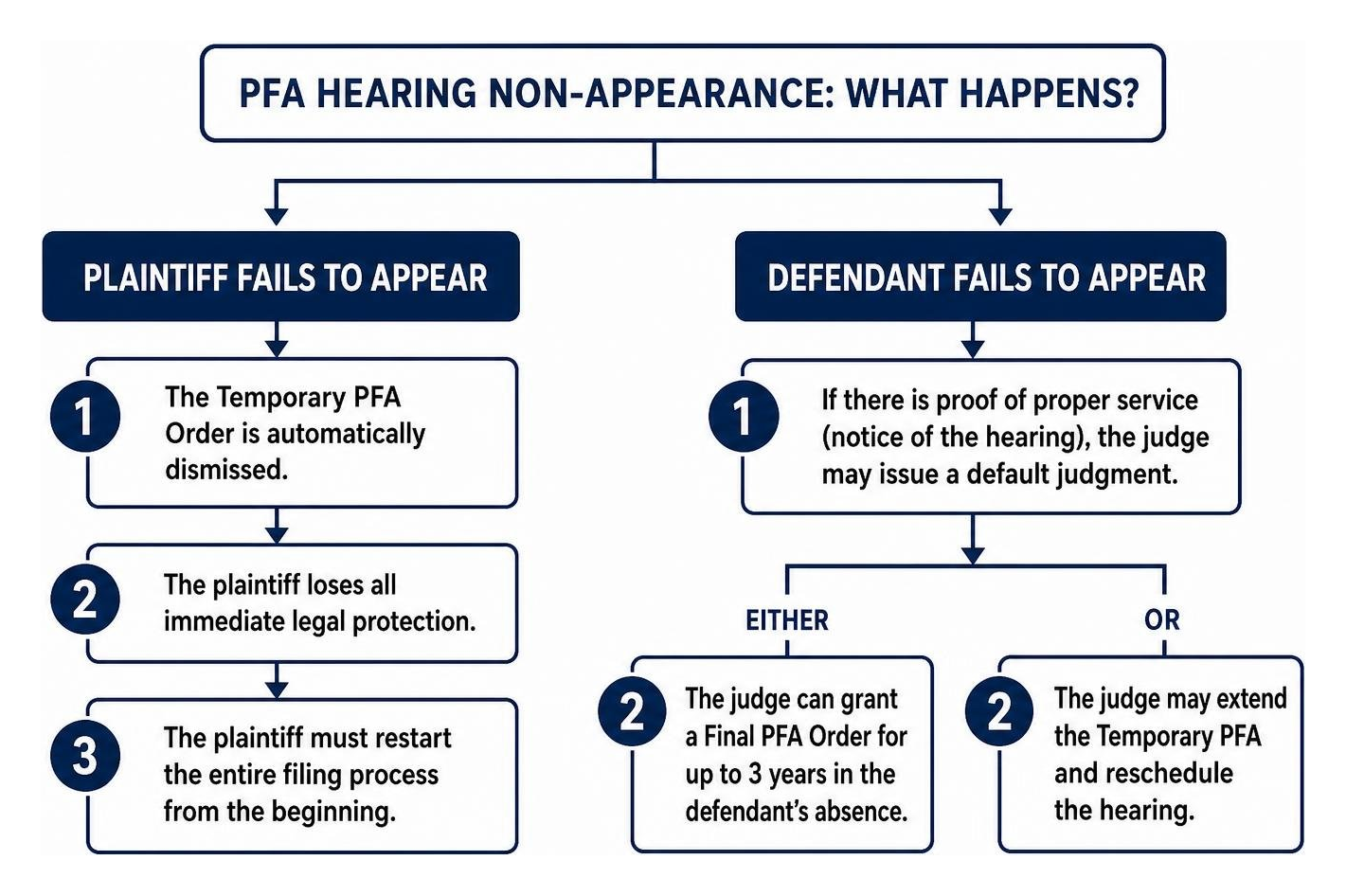
If you are a plaintiff and the defendant fails to show up, do not assume you can just leave. You must present proof to the judge that the defendant was properly served with the PFA paperwork. Once proper service is established, we can request that the judge enter a default order to keep you protected. For more details on these procedural outcomes, check out our guide on the PFA Hearing Process From Petition to Final Order.
Possible Outcomes and Relief in a Final PFA Order
When you sit down for your scheduled pfa court hearing, the case will generally resolve in one of four ways:
- Consent Agreement (Consent Order): This is a highly common outcome. The defendant agrees to the terms of the PFA (such as staying away from the plaintiff and relinquishing firearms) without admitting to any of the physical abuse allegations. This is legally binding and fully enforceable by the police, but it prevents the PFA from being used as an admission of guilt in separate criminal or custody trials.
- Default Judgment: As discussed, if the defendant was properly served but fails to show up, the judge can grant the Final PFA by default.
- Trial Adjudication: If both parties are present and cannot agree to a settlement, the judge will conduct a bench trial. Both sides present their evidence, testify, and call witnesses. The judge then makes a final ruling.
- Dismissal: If the plaintiff fails to prove by a preponderance of the evidence that abuse occurred, or if the plaintiff fails to appear, the judge will dismiss the case and the temporary order will expire.
To understand which of these paths is best for your specific situation, read The Ultimate Pennsylvania PFA Survival Guide.
Protections and Firearm Restrictions in a Final Order
If the judge issues a Final PFA Order (either through a trial, consent, or default), they have the power to order extensive relief to ensure your safety. A Final PFA is not just a piece of paper telling someone to stay away; it can include specific, life-altering mandates:
- Eviction: The judge can order the defendant to immediately vacate a shared residence, even if the lease or deed is solely in the defendant’s name.
- No Contact: Prohibiting the defendant from contacting the plaintiff in person, via phone, text, social media, or through third parties.
- Temporary Custody: The judge can award temporary physical and legal custody of minor children to the plaintiff and establish strict, supervised visitation rules for the defendant.
- Financial Support: Ordering the defendant to pay temporary financial support or continue paying rent/mortgage payments.
- Firearm Relinquishment: Under Pennsylvania law, a Final PFA order typically requires the defendant to immediately surrender all firearms, ammunition, and gun licenses to law enforcement or a licensed dealer for the duration of the order.
These protections can remain in place for up to a maximum of three (3) years. For a deep dive into how gun ownership and domestic violence laws intersect in PA, review our specialized guide: PFA Orders and Firearm Rights in Pennsylvania: What You Need to Know.
Frequently Asked Questions About PFA Hearings
How long does a final PFA order last?
A Final PFA Order in Pennsylvania can be issued for any duration up to a maximum of three (3) years. As the expiration date approaches, if you still feel threatened or if the defendant has violated the order, you can petition the court for an extension. The court can extend the order if you can prove that the threat of abuse still exists. To learn more about how orders are brought to an end or extended, read Lifting a PFA Order: A Guide to Moving On in PA.
Can a PFA order be modified or dismissed later?
Yes. If circumstances change, either party can file a petition to modify the PFA. For example, if you want to change the child custody arrangements or allow for peaceful communication regarding the children, you must ask the judge to modify the order. You should never try to change the terms of a PFA informally on your own—even if both parties agree, violating the written order is still a arrestable offense. For the correct legal process, see Modifying or Terminating a PFA.
Do I need a lawyer for a PFA hearing?
While you are legally allowed to represent yourself, it is highly discouraged. PFA hearings involve complex rules of evidence, formal cross-examination, and strict courtroom procedures. If the other party shows up with an experienced attorney and you do not have one, you will be at a massive disadvantage. An experienced attorney knows how to present evidence clearly, cross-examine the other party without escalating emotions, and negotiate favorable consent orders. If you are preparing for court in Lackawanna County, read our resource, Need a PFA Lawyer in Scranton? Here is Your Guide.
Conclusion

Navigating a pfa court hearing is an emotionally exhausting and legally complex task. The decisions made in that courtroom will shape your safety, your housing, your finances, and your relationship with your children for years to come. You should not have to carry this heavy burden alone.
At Shane Scanlon Law, we provide fierce litigation and trusted local representation for clients throughout Scranton, Wilkes-Barre, Lackawanna County, Luzerne County, Susquehanna County, and Wyoming County. With over 20 years of experience—including serving as a former District Attorney—we understand how the local courts operate and how to build a strong, strategic case for your safety.
Whether you need to secure a final protection order or defend against a false PFA claim, we are here to fight for you. Contact us today to schedule a consultation at our Scranton office and take the first step toward reclaiming your peace of mind.
Protect your future. Visit Shane Scanlon Law PFA Representation to get the local, experienced help you deserve.