
 Call Anytime
833.722.6566
Call Anytime
833.722.6566
Lifting a PFA Order: A Guide to Moving On in PA

What You Need to Know Before Withdrawing a PFA in Pennsylvania
Can a PFA be withdrawn in Pennsylvania? Yes — but only the plaintiff (the person who filed it) can start the process, and a judge must approve it.
Here is a quick summary:
- Who can request withdrawal: Only the plaintiff who originally filed the PFA
- Who cannot: The defendant has no right to withdraw the order
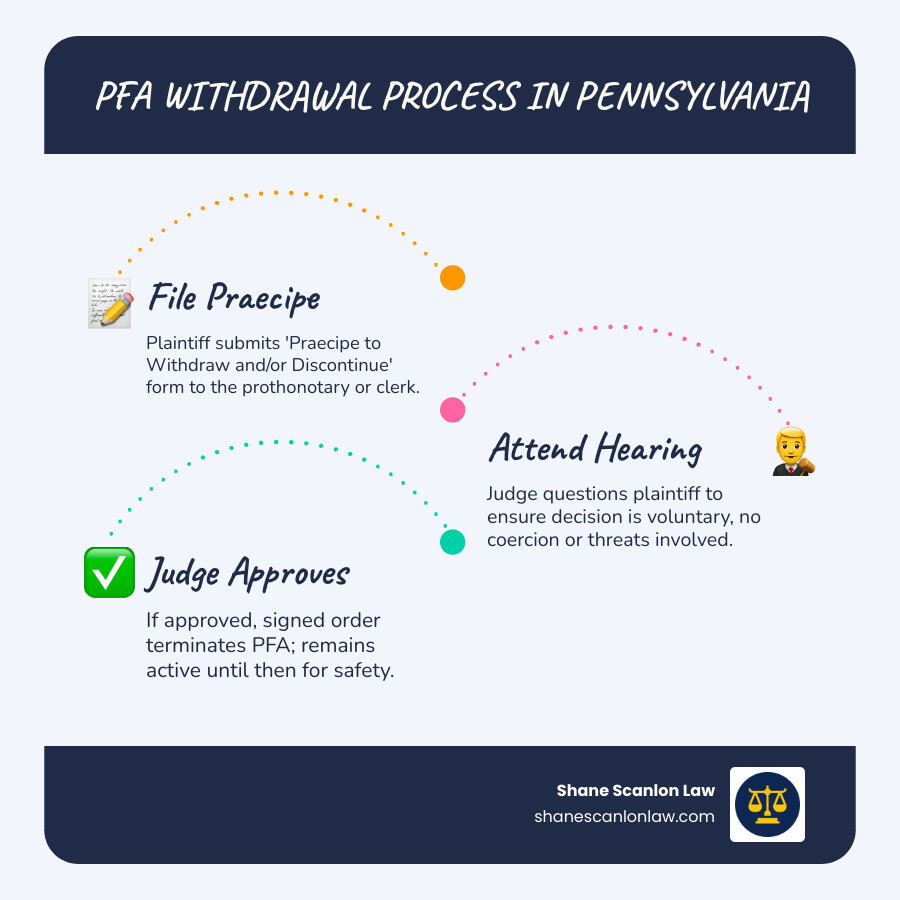
- How it works: The plaintiff files a form (often called a “Praecipe to Withdraw and/or Discontinue”) with the court
- Court hearing required: Yes — a judge must confirm the decision is voluntary and not the result of threats or pressure
- Can the judge say no: Yes — if the judge suspects coercion or ongoing danger, the PFA can stay in place
- Does it vary by county: Yes — each Pennsylvania county has its own procedure
It is not uncommon for someone to get a Protection From Abuse order and later decide they want to drop it — whether due to reconciliation, changed circumstances, or other personal reasons. But in Pennsylvania, there is no simple way to cancel a PFA with a phone call or a private agreement. The court stays involved every step of the way.
I’m Shane Scanlon, a Pennsylvania trial attorney and former Lackawanna County District Attorney with over 20 years of courtroom experience — including handling cases on both sides of the law where questions like can a PFA be withdrawn in Pennsylvania directly shaped the outcome. Understanding this process from the inside gives me a practical edge in helping clients navigate it with confidence.
Can a PFA Be Withdrawn in Pennsylvania?
In Pennsylvania, the Protection From Abuse (PFA) Act was created to provide a legal shield for victims of domestic violence. Because these orders carry significant weight—often involving the removal of a person from their home or the loss of firearm rights—the law does not allow them to be tossed aside lightly.
When people ask, “can a pfa be withdrawn in pennsylvania,” the answer is a qualified “yes.” However, it is a plaintiff-led process. The court views the PFA as a judicial order, not a private contract. Therefore, the same court that issued the protection must be the one to dissolve it. This ensures that the person seeking protection isn’t being pressured into dropping the case by the very person they were afraid of in the first place.
What a Protection From Abuse order means in Pennsylvania
A PFA is more than just a “stay away” order. It is a civil order that provides powerful relief to victims of domestic abuse. In our practice across Lackawanna and Luzerne counties, we see PFAs that include:
- No-contact terms: Prohibiting all forms of communication (text, social media, third parties).
- Eviction relief: Ordering the defendant to leave a shared residence immediately.
- Custody terms: Awarding temporary custody of children to the plaintiff.
- Firearms surrender: Requiring the defendant to hand over all guns and ammunition to the authorities.
A final PFA can last for up to three years, making the decision to withdraw it a significant legal move. For more foundational details, you can read our PFA Explained: Everything You Need to Know About Protection Orders in Pennsylvania.
Who can ask to withdraw it—and who cannot
This is a critical distinction: Only the plaintiff (the victim) can request to withdraw a PFA.
The defendant—the person the order is filed against—has no legal standing to ask the court to “withdraw” the plaintiff’s petition. If you are a defendant, you cannot simply show up at the Prothonotary’s office and ask to have the case dropped. Your role is to defend against the allegations at a hearing, not to manage the plaintiff’s filing. If the plaintiff wants the order gone, they must be the one to initiate the paperwork.
Why courts do not allow “informal” cancellations
You might think that if both parties make up and decide to move back in together, the PFA just “goes away.” This is a dangerous misconception.
Courts do not allow informal or private agreements to override a judge’s order. Judges are deeply concerned about coercion and intimidation. They know that in many domestic violence situations, a defendant might pressure a plaintiff to “drop the charges.” To prevent this, a judge must personally screen the plaintiff to ensure they are acting of their own free will and that their safety is not being compromised. Until a judge signs an order vacating the PFA, the defendant can still be arrested for a violation—even if the plaintiff invited them over for dinner.
Temporary vs. Final Orders: How Withdrawal Works at Each Stage
The process for ending a PFA depends heavily on where you are in the legal timeline. There is a world of difference between dropping a “Temporary PFA” that was just served and dissolving a “Final PFA” that has been in place for a year.
Can a temporary PFA be withdrawn in Pennsylvania before the final hearing?
Yes. A temporary PFA is usually issued ex parte, meaning the judge hears only the plaintiff’s side of the story first. A final hearing is then scheduled (usually within 10 business days).
If the plaintiff decides they no longer want to pursue the matter before that hearing date, they can go to the courthouse and file a request to dismiss the temporary order. In many cases, the judge will still want to speak with the plaintiff briefly to ensure they aren’t being threatened. If the plaintiff simply fails to show up for the final hearing, the temporary order will usually expire or be dismissed by the court, but it is always better to handle it formally to ensure the record is clear.
Withdrawing or dissolving a final PFA order
Once a Final PFA has been signed by a judge, it is “active.” To end it early, the plaintiff must file a formal motion or a “Praecipe to Withdraw.” This is often referred to as “dissolving” or “vacating” the order. Because a final order was based on a finding (or an agreement) of abuse, the court’s scrutiny is even higher here. The judge will want to know what has changed since the order was issued that makes it safe to lift the restrictions now.
What if the defendant wants the case dismissed instead?
If you are the defendant and the plaintiff is not withdrawing the order, your only path to dismissal is winning at the final hearing. This involves contesting the allegations, presenting evidence, and cross-examining the plaintiff. If the judge finds there is no “preponderance of evidence” that abuse occurred, the PFA will be dismissed. To understand what this day in court looks like, check out the PFA Hearing Process: From Petition to Final Order.
| Feature | Temporary PFA | Final PFA |
|---|---|---|
| Duration | Until the final hearing (approx. 10 days) | Up to 3 years |
| How to end | Plaintiff withdraws or fails to appear | Motion to Vacate/Dissolve filed by Plaintiff |
| Judicial Scrutiny | Low to Moderate | High |
| Legal Effect | Temporary restriction | Permanent record of domestic violence order |
How to Withdraw a PFA in Pennsylvania Step by Step
If you are a plaintiff and have decided that you no longer need the protection of the court, you must follow a specific legal path. While we always recommend consulting with an attorney—especially if children are involved—here are the general steps taken in Pennsylvania.
Step 1: Confirm the type of PFA and the county process
Every county in Pennsylvania—from Lackawanna to Luzerne—has its own specific administrative quirks. You need to know your case docket number and which court issued the order. In most counties, you will deal with the Family Court division or the PFA office located within the courthouse.
Step 2: Get the correct form or motion packet
You cannot just write a note on a napkin. You need the official form, which is typically called a “Praecipe to Withdraw and/or Discontinue.” In some jurisdictions, you might need to file a “Motion to Vacate.” These forms ask for the names of the parties, the docket number, and a brief statement of why you want the order dropped.
Step 3: File the paperwork with the right office
Once the form is filled out (and sometimes notarized), it must be filed with the Prothonotary or the Clerk of Judicial Records. In Pennsylvania, there is generally no filing fee for a plaintiff to withdraw a PFA. Once filed, the clerk will schedule a short hearing or present the paperwork to a judge. For those in our local area, you can find more specific guidance on Protection from Abuse in Lackawanna County.
Step 4: Attend the hearing and answer the judge’s questions
You cannot skip this part. The judge will require you to appear in person. They will ask you questions to ensure your decision is:
- Knowing: You understand what rights you are giving up.
- Intelligent: You understand the consequences (e.g., the defendant can contact you again).
- Voluntary: No one is forcing you to do this.
The judge will watch your demeanor closely. If you seem terrified or hesitant, they may deny the request to protect you.
Step 5: Wait for the signed court order before acting
This is the most important step for defendants. Do not resume contact just because the plaintiff told you they “filed the papers.” The PFA remains 100% enforceable until a judge signs the order and it is updated in the police database. If you get caught with the plaintiff before that signature is dry, you can be arrested for indirect criminal contempt. For more on the risks of premature contact, see Enforcement of a PFA Order.
County-by-county differences you should expect
While the PFA Act is a state law, “how” things happen varies. In some counties, there are “walk-in” hours for PFA withdrawals where a judge is available at a specific time every day. In others, you have to file the motion and wait for a scheduled date. If you are in Wilkes-Barre, the process might feel slightly different than in Scranton. We provide localized insights for these areas, such as our guide on Protection from Abuse in Wilkes-Barre, PA. You can also find more general information on how Pennsylvania courts handle PFA dismissal to see how the process works across the Commonwealth.
What Happens at the Withdrawal Hearing—and Why a Judge Might Say No
A withdrawal hearing is usually brief, but it is not a “rubber stamp” process. The judge has a legal responsibility to ensure the safety of the community and the parties involved.

Questions the judge may ask before approving dismissal
Expect the judge to be direct. They may ask:
- “Has the defendant threatened you or your family to get you to drop this?”
- “Has the defendant promised you money or other benefits to withdraw this?”
- “Are you reconciling with the defendant?”
- “Do you understand that if I drop this, the police cannot help you unless a new crime is committed?”
Reasons a judge may deny the request
Believe it or not, a judge can say “no” even if the plaintiff wants the PFA gone. Common reasons for denial include:
- Evidence of Coercion: If the judge sees the defendant’s friends in the back of the courtroom staring the plaintiff down, or if the plaintiff appears visibly coached.
- Ongoing Danger: If there is a long history of severe violence and the judge believes the plaintiff is in immediate peril.
- Pending Violations: If the defendant recently violated the PFA, the judge may refuse to lift it until the contempt charges are resolved.
- Children at Risk: If the PFA included protections for children and the judge feels their safety would be compromised by lifting the order.
Risks if the defendant contacts the plaintiff to ask for withdrawal
If you are a defendant, do not contact the plaintiff to ask them to withdraw the PFA. This is a trap that leads straight to jail. Even if you are being “nice,” any contact is a violation. If the plaintiff wants to withdraw the order, they must do it on their own or through their own legal counsel. If you want to know more about the fallout of a violation, read about Legal Consequences for the Accused: PFAs.
After a PFA Is Withdrawn: What Changes Next?
Once the judge signs the order to vacate or withdraw, the legal landscape shifts immediately.
When protections and restrictions actually end
The restrictions end the moment the judge signs the order. However, it takes time for this to filter through the system. The court must notify the Pennsylvania State Police, who update the National Crime Information Center (NCIC) and the state PFA registry. Until this update happens, a local officer might still see an “active” PFA on their computer screen during a traffic stop. It is always wise for both parties to keep a certified copy of the dismissal order on them for a few weeks.
Can a new PFA be filed later?
Yes. Withdrawing a PFA does not mean you lose the right to protection forever. If a new incident of abuse occurs, the plaintiff can return to court and file a new petition. However, be aware that judges may be more skeptical if a plaintiff has a pattern of filing and withdrawing orders repeatedly without a clear change in circumstances. Learn more about the initial steps here: Filing and Obtaining a PFA Order.
Can PFA records be expunged after withdrawal or dismissal?
This is a common question for defendants. A PFA is a civil record, but it shows up on many background checks.
- If the PFA was withdrawn or dismissed without a finding of abuse, you may be eligible to have the record expunged.
- If a Final PFA was entered (either by a judge’s order or by your consent), it is much harder—and often impossible—to expunge that record in Pennsylvania.
Expungement is a separate legal process that requires its own filing. If you’re worried about your record, it’s best to handle the defense correctly from the start. See Order in the Court: Challenging PFA Allegations in Scranton for more.
Frequently Asked Questions About Can a PFA Be Withdrawn in Pennsylvania
Can a defendant file to withdraw a PFA in Pennsylvania?
No. A defendant cannot file to withdraw a plaintiff’s petition. The defendant can only move to modify the order (e.g., asking for different custody hours) or defend against it at a hearing to have it dismissed.
Does reconciling automatically end a PFA?
Absolutely not. We have seen many people get arrested because they thought “getting back together” made the PFA void. The PFA is a court order; only a judge can end it. If you move back in together while a PFA is active, the defendant is committing a crime every single second they are in the house.
Should you talk to a lawyer before trying to withdraw a PFA?
Yes. Whether you are the plaintiff or the defendant, the stakes are high. A plaintiff needs a safety plan and an understanding of what they are giving up (especially regarding child custody). A defendant needs to ensure the withdrawal is handled legally so they don’t end up with a contempt charge. For tips on finding the right help, see 5 Effective Tips for Finding a PFA Lawyer Scranton PA.
Conclusion
Navigating the question of “can a pfa be withdrawn in pennsylvania” requires more than just a mutual agreement between two people. It requires a formal legal process, judicial oversight, and a clear understanding of the risks involved. Whether you are seeking to lift an order to reconcile or defending yourself against an unjust petition, the procedure must be followed to the letter to avoid criminal consequences.
At Shane Scanlon Law, we understand the complexities of the PFA Act and how it impacts families in Scranton, Wilkes-Barre, and throughout Northeast Pennsylvania. With over two decades of experience, we provide the fierce litigation and local expertise needed to protect your rights and your future. If you need assistance with a PFA matter, don’t navigate the system alone.
For more information or to discuss your case, visit our Protection from Abuse (PFA) page or contact our office today.