
 Call Anytime
833.722.6566
Call Anytime
833.722.6566
PFA Hearing Process: From Petition to Final Order

Understanding the PFA Hearing Process in Pennsylvania
The PFA hearing process is a legal proceeding where a judge decides whether to issue a final Protection from Abuse order against someone accused of abuse. Here’s what you need to know:
Quick Overview of the PFA Hearing Process:
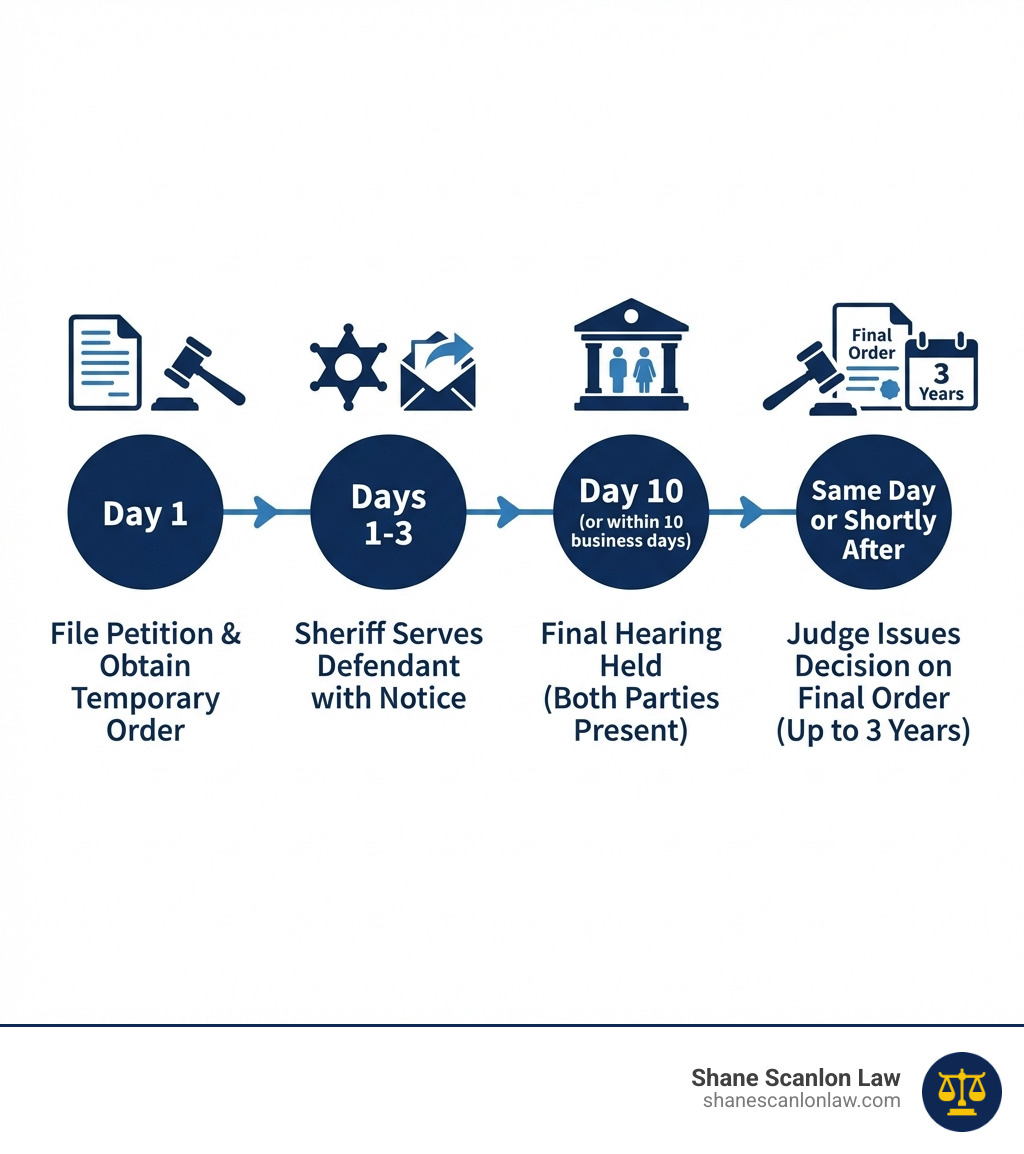
- Temporary Order Issued – After filing your petition, a judge may grant a temporary PFA order immediately
- Service of Notice – The defendant must be officially notified by the sheriff or another authorized person
- Final Hearing Scheduled – The court schedules a hearing within 10 business days of the temporary order
- Evidence Presentation – Both parties present testimony, documents, and witnesses at the hearing
- Judge’s Decision – The judge issues a final order (lasting up to 3 years), dismisses the case, or approves a consent agreement
If you’ve filed for a PFA or received notice that someone filed one against you, the hearing process can feel overwhelming. You’re navigating unfamiliar legal territory while dealing with a highly personal and often frightening situation. The temporary order is just the beginning. At the final hearing, you’ll need to present your case before a judge, potentially face cross-examination, and meet specific legal standards to prove your claims.
The stakes are high. A final PFA order can remove someone from their home, restrict contact with children, require surrender of firearms, and create a legal record that affects employment and reputation. Whether you’re seeking protection or defending against allegations, understanding what happens at each stage helps you prepare effectively.
As Shane Scanlon, a former Lackawanna County District Attorney with over 20 years of trial experience, I’ve handled countless cases involving the PFA hearing process throughout Northeast Pennsylvania. My background as both a prosecutor and defense attorney gives me unique insight into how judges evaluate evidence and what strategies work in these high-stakes proceedings.
Preparing for the PFA Hearing Process
Once a petition is filed and a temporary order is granted, the clock starts ticking. In Pennsylvania, the law requires that a final hearing be scheduled within 10 business days. This short window is designed to ensure that victims receive prompt protection while also protecting the due process rights of the defendant.
The first major hurdle in the PFA hearing process is the “service of process.” The defendant must be officially notified of the hearing and the terms of the temporary order. In Lackawanna and Luzerne counties, this is typically handled by the Sheriff’s Department. If the defendant is not served, the hearing cannot proceed as a final hearing, and the judge will likely have to grant a “continuance” (a rescheduled date) and extend the temporary order to keep the protection in place.
When filing and obtaining a PFA order, the petition itself serves as the foundation of your case. It must clearly outline the relationship between the parties and the specific acts of abuse. Under Pennsylvania law, “abuse” isn’t limited to physical hitting; it can include:
- Attempting to cause or intentionally causing bodily injury.
- Placing another in reasonable fear of imminent serious bodily injury (threats).
- False imprisonment.
- Stalking that creates a reasonable fear of bodily injury.
Preparation is key. You shouldn’t walk into the courthouse expecting a casual conversation. This is a formal evidentiary hearing. You need to know exactly what you are asking the court for—whether that is an eviction of the abuser from a shared home, temporary custody of children, or the relinquishment of firearms.
Gathering Evidence and Witnesses
In the PFA hearing process, the “burden of proof” lies with the plaintiff (the person seeking protection). To win, the plaintiff must prove their case by a preponderance of the evidence. This is a civil standard, meaning you must convince the judge that it is “more likely than not” (greater than 50% chance) that the abuse occurred.
While 50% might sound low compared to the “beyond a reasonable doubt” standard used in criminal trials, don’t be fooled—judges in NEPA take these orders very seriously because of the significant legal consequences for the accused.
To meet this burden, you need tangible evidence. Do not rely on “he-said, she-said” if you can avoid it. Important types of evidence include:
- Medical Records: If you sought treatment for injuries, these records are vital.
- Police Reports: Even if no one was arrested, a report shows you reached out for help at the time of the incident.
- Digital Evidence: This is increasingly common. Save and print text messages, emails, and social media posts containing threats or admissions of guilt.
- Photographs: Photos of physical injuries or property damage (like a kicked-in door) are powerful visual proof.
Witnesses can also be a game-changer. If a neighbor saw the incident or a friend heard the threats, their testimony can corroborate your story. However, choose your witnesses wisely. In the PFA hearing process, quality beats quantity. You want witnesses who have personal knowledge of the specific incidents mentioned in your petition.
Navigating the Day of the Hearing
Arriving at the courthouse can be intimidating. Whether you are at the Lackawanna County Courthouse in Scranton or the Luzerne County Courthouse in Wilkes-Barre, the atmosphere is formal and high-pressure.
What to Wear and Bring We always recommend dressing like you are going to a job interview or a religious service. Conservative, professional attire shows respect for the court and can influence how your credibility is perceived. Avoid clothing with slogans, loud colors, or anything too casual like flip-flops or shorts.
Logistics and Safety
- Arrival Time: Arrive at least 15–30 minutes early. You will need to pass through security, and many PFA cases are scheduled for the same time block. If you aren’t there when your name is called, your case could be dismissed.
- Waiting Areas: Most courthouses provide separate waiting areas for plaintiffs and defendants to prevent intimidation. If you feel unsafe, notify courthouse security or a victim advocate immediately.
- Children: It is highly recommended that you do not bring children to the hearing. There is no childcare provided, and the details discussed in court are often inappropriate for minors. Unless the judge specifically ordered the child to testify (which is rare), leave them with a trusted caregiver.
Navigating protection from abuse in Lackawanna County requires following local protocols. Each county has its own rhythm, and being prepared for a long day is essential. PFA lists can be long, and you might be at the courthouse for several hours before your case is heard.
What to Expect During the PFA Hearing Process
Once you enter the courtroom, the judge is in charge. You will be sworn in, meaning you are under oath to tell the truth. Lying under oath (perjury) carries severe legal penalties.
In many NEPA courtrooms, you may see victim advocates present. While they can provide emotional support and help explain the paperwork, they are not attorneys and cannot represent you or argue your case. A court reporter will also be present, typing a transcript of everything said during the hearing. This transcript is the official record of the proceeding.
If you are seeking protection from abuse in Luzerne County, you will find that the judges expect a high level of decorum. Do not interrupt the judge, and do not speak directly to the other party. All communication should be directed to the bench.
Step-by-Step PFA Hearing Process Procedure
The PFA hearing process generally follows a specific order:
- The Plaintiff’s Case: The plaintiff (or their attorney) presents their evidence first. You will testify about the abuse, and your attorney will guide you through questions to ensure the judge hears the most relevant facts.
- Cross-Examination: The defendant or their attorney has the right to ask you questions. This is often the most stressful part of the hearing. Stay calm, answer truthfully, and don’t get into an argument with the questioner.
- The Defendant’s Case: The defendant then gets their turn to tell their side of the story and present their own evidence or witnesses.
- Rebuttal: The plaintiff may have a brief opportunity to respond to any new information brought up by the defendant.
- The Ruling: The judge will either make a decision immediately or take the matter “under advisement” and issue a written order shortly after.
Comparing Your Options
| Feature | Consent Order (Without Admission) | Final Order (After Trial) |
|---|---|---|
| Admission of Guilt | No admission of abuse is made. | Judge finds that abuse occurred. |
| Enforceability | Fully enforceable by police. | Fully enforceable by police. |
| Firearm Ban | Usually required by federal law. | Required by law. |
| Duration | Up to 3 years. | Up to 3 years. |
| Future Use | Generally cannot be used in other cases. | Can be used as evidence in custody/divorce. |
Understanding the nuances of protection from abuse in Scranton, PA means knowing when to fight in a trial and when a consent agreement might be the safer, more efficient path to protection.
Outcomes and Post-Hearing Actions
If the judge finds that the plaintiff met their burden of proof, they will issue a Final PFA Order. This order can last for a fixed period of up to three years.
What a Final Order Can Include:
- No Contact: Prohibiting the defendant from contacting the plaintiff in person, by phone, through social media, or via third parties.
- Eviction: Ordering the defendant to leave a shared residence immediately.
- Custody: Granting temporary custody of minor children to the plaintiff.
- Weapons Surrender: Requiring the defendant to relinquish all firearms, ammunition, and gun licenses to the sheriff.
Once the order is signed, it is entered into the statewide PFA Registry. This ensures that any police officer in Pennsylvania can verify the order if a violation occurs. Enforcement of a PFA order is critical; if the defendant breaks any rule of the order, they can be arrested for “indirect criminal contempt,” which carries a penalty of up to six months in jail and a $1,000 fine.
As time passes, situations change. You may find it necessary to look into modifying or terminating a PFA if circumstances evolve. Additionally, if the order is nearing its expiration and the threat still exists, you can petition for an extension. There is no limit on the number of extensions a judge can grant if the risk of abuse remains.
Frequently Asked Questions about the PFA Hearing Process
What happens if the defendant fails to appear at the hearing?
If the defendant was properly served and fails to show up, the judge may issue a “default judgment.” This means the judge can grant the final PFA order based solely on the plaintiff’s testimony. However, if there is no proof that the defendant was served, the judge will likely continue the case to a later date. This is why ensuring proper service for protection from abuse is so important.
Can I reach an agreement without a full trial?
Yes. In many cases, the parties reach a “Consent Agreement.” This is a legally binding order where the defendant agrees to follow the PFA rules (no contact, staying away from the home, etc.) but does not admit to the allegations of abuse. This can be a “win-win” as the plaintiff gets immediate protection without the stress of testifying, and the defendant avoids a formal finding of abuse on their record.
Will I have to speak directly to the defendant?
No. In the courtroom, you speak to the judge and the attorneys. You should never engage in a back-and-forth argument with the defendant. If you are representing yourself and the defendant is also unrepresented, the judge will manage the questioning to ensure it remains professional and safe. Having an attorney is the best way to ensure you have a “buffer” between you and the person you are seeking protection from.
Conclusion
The PFA hearing process is a vital tool for safety in Northeast Pennsylvania, but it is a complex legal machine. Whether you are filing a petition in Susquehanna County or defending your rights in Wyoming County, the outcome of this hearing will have a massive impact on your life for years to come.
At Shane Scanlon Law, we understand the fear and uncertainty that comes with these cases. As a former District Attorney with over two decades of experience in NEPA courtrooms, Shane Scanlon knows how to navigate the local systems in Scranton, Wilkes-Barre, and beyond. We provide fierce, trusted representation to ensure your voice is heard and your rights are protected.
If you are facing a Protection From Abuse (PFA) matter, don’t go it alone. Experience matters when your safety and your future are on the line. Contact us today to discuss your case and let us help you navigate the path forward.