
 Call Anytime
833.722.6566
Call Anytime
833.722.6566
Aggravated DUI: Why Your Pennsylvania Charges Just Got Heavier
When a DUI Charge Becomes Something Much More Serious
Aggravated DUI refers to a standard DUI charge that carries enhanced penalties due to one or more aggravating factors under Pennsylvania law. Here is a quick breakdown:
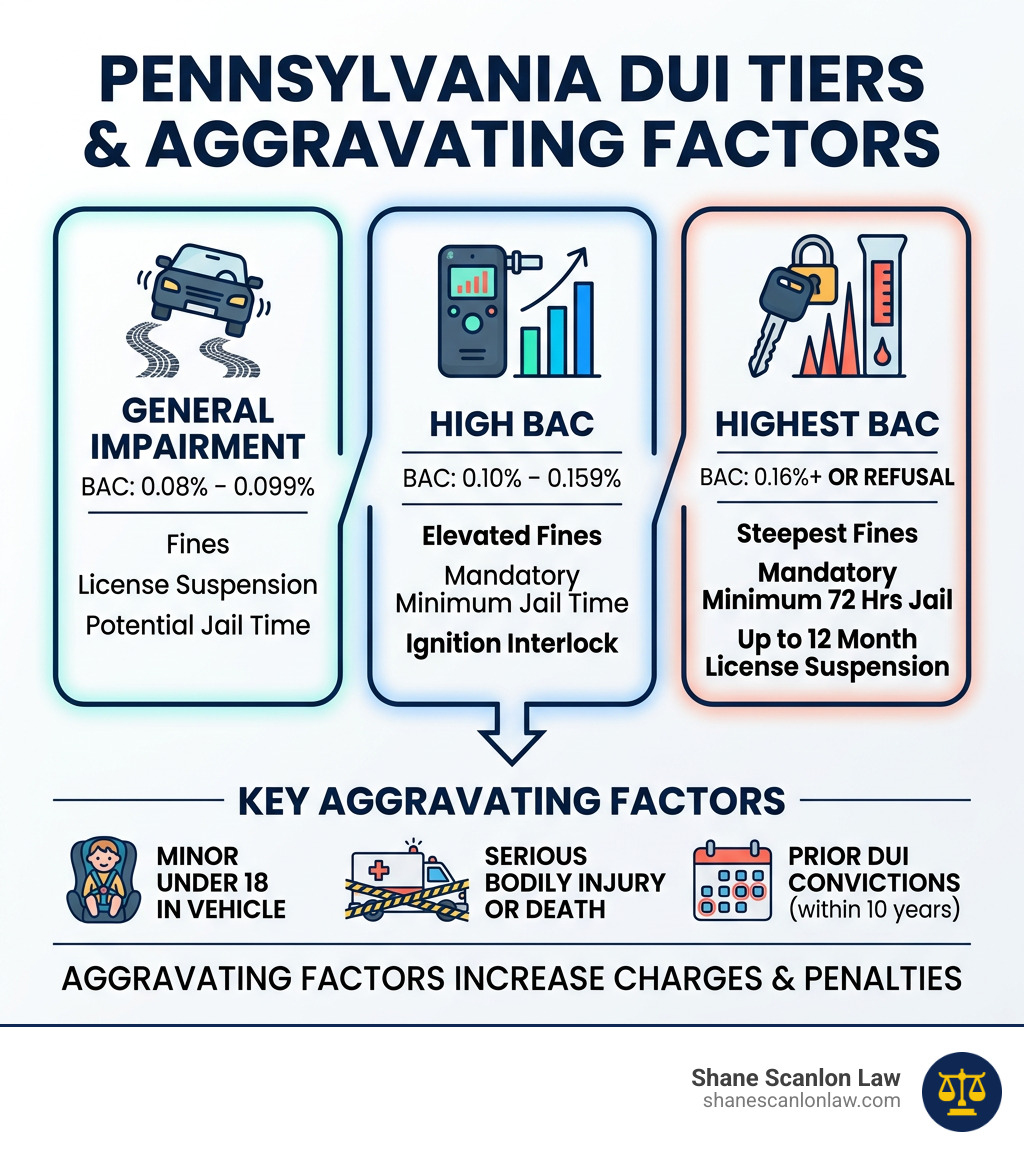
- High BAC (0.10%–0.159%) – elevated fines and jail time
- Highest BAC (0.16%+) – mandatory minimum 72 hours jail, $1,000–$5,000 fine
- Minor under 18 in vehicle – first-degree misdemeanor, up to felony for repeat offenses
- Serious bodily injury or death caused – felony of the second degree, up to 10 years prison
- Prior DUI convictions within 10 years – steeper grading and longer sentences
- Chemical test refusal – treated as highest BAC tier for penalty purposes
Pennsylvania does not use the label “aggravated DUI” as a formal charge. Instead, the law stacks sentencing enhancements on top of a base DUI charge when certain circumstances are present. The result is the same: heavier penalties, longer license suspensions, and in some cases, felony-level consequences.
A DUI charge is already serious. Add any one of these factors and the stakes rise fast.
I’m Shane Scanlon, founder of Shane Scanlon Law and a former Lackawanna County District Attorney with over 20 years of experience handling DUI and criminal cases throughout Northeast Pennsylvania — including cases involving the exact Aggravated DUI circumstances described in this guide. That prosecutorial background gives me a clear view of how these charges are built, and how to challenge them.
What Defines an Aggravated DUI PA Charge?
In Pennsylvania, the term “aggravated” is more of a descriptive label used by lawyers and the public than a specific statute name. However, the legal weight behind it is very real. Under 75 Pa. C.S. § 3802 and § 3803, the Commonwealth classifies DUI offenses into a three-tiered system. When you move out of the “General Impairment” tier due to a high blood alcohol content (BAC) or other dangerous circumstances, you are facing what most consider an aggravated DUI.

These “sentencing enhancements” are designed to punish drivers who the state believes posed a greater risk to the public. For example, a standard first-offense DUI with a low BAC might result in probation and a fine. But if you add an aggravating factor—like a very high BAC or a child in the car—that same “first offense” can suddenly require mandatory jail time and a year-long license suspension.
When we represent clients as a DUI lawyer, we often see how these enhancements catch people off guard. You might think you’re facing a simple misdemeanor, only to find out the prosecution is grading it as a first-degree misdemeanor or even a felony because of an accident or a prior record.
Comparing Standard vs. Aggravated Penalties
| Factor | General Impairment (Standard) | Aggravated (High/Highest/Enhancements) |
|---|---|---|
| BAC Level | 0.08% – 0.099% | 0.10% – 0.16%+ |
| Jail Time (1st Offense) | Up to 6 months probation | 48 hours to 6 months (High) / 72 hours to 6 months (Highest) |
| License Suspension | None (if eligible) | 12 months |
| Fines | $300 | $500 – $5,000 |
| Minor in Vehicle | N/A | Mandatory $1,000 fine & 100 hours community service |
Key Factors That Trigger Enhanced DUI Penalties
Several specific triggers can turn a routine traffic stop into a high-stakes legal battle. Pennsylvania law is particularly strict regarding how much you’ve had to drink and how you behave during the arrest.
The most common trigger is your BAC level. Since the passage of Act 24 Legislation in 2003, Pennsylvania has operated under a tiered system that punishes higher alcohol levels more severely. However, even if your BAC isn’t “highest tier,” a chemical test refusal can automatically bump you into the most severe penalty category.
Another massive factor is your history. Pennsylvania uses a 10-year lookback period. This means the court looks at any DUI convictions or ARD (Accelerated Rehabilitative Disposition) completions within the last decade. If you have a prior on your record, the penalties for second DUI in Pennsylvania become significantly harsher, often involving mandatory jail sentences that a judge cannot waive.
High and Highest BAC Levels in an Aggravated DUI PA Case
The tiered system breaks down as follows:
- High BAC (0.10% to 0.159%): This is the middle tier. It carries mandatory minimum jail time (usually 48 hours for a first offense) and a 12-month license suspension.
- Highest BAC (0.16% or higher): This is the top tier. It also applies to anyone driving under the influence of controlled substances (illegal drugs or certain prescription meds) or those who refuse a breath or blood test.
According to DUI Legislation, the “Highest BAC” category is where the law is most unforgiving. As a DUI Lawyer in Scranton, PA, we frequently defend clients in this tier because the mandatory minimum of 72 hours in jail is a daunting prospect for anyone with a job or family.
DUI with a Minor Occupant
One of the most emotionally charged versions of an Aggravated DUI involves having a passenger under the age of 18 in the vehicle. This doesn’t just increase your DUI penalties; it often leads to additional criminal charges like endangering the welfare of a child.
If you are caught driving under the influence with a minor, a first offense is graded as a first-degree misdemeanor. You’ll face a mandatory $1,000 fine and 100 hours of community service on top of standard DUI penalties. If it’s a second offense, it can jump to a state-level prison sentence. For those facing an underage DUI in Scranton, PA, or a case with a child passenger, the grading can escalate to a third-degree felony if you have two or more prior offenses. This is why having a DUI Lawyer in Luzerne County, PA, is vital—we work to prevent a lapse in judgment from turning into a permanent felony record.
Serious Bodily Injury and Aggravated Assault by Vehicle
The most severe form of an aggravated DUI occurs when the impaired driving results in an accident that hurts someone else. Under Section 3735.1 – Title 75, this is known as “Aggravated Assault by Vehicle while Driving Under the Influence.”
This is a second-degree felony in Pennsylvania. To secure a conviction, the prosecution must prove two things:
- You were driving in violation of the DUI laws (§ 3802).
- You negligently caused “serious bodily injury” to another person as a direct result of that DUI.
If you are charged with this, you aren’t just looking at a license suspension; you are looking at up to 10 years in state prison and fines up to $25,000. As a Scranton DUI attorney, we have seen how the “negligent causation” element is the primary battleground. Just because you were over the limit doesn’t always mean you were the one who caused the crash. Investigating DUI charges in Lackawanna County, PA, requires a deep dive into accident reconstruction and witness statements to protect your rights.
Legal Definition of Serious Bodily Injury in an Aggravated DUI
What qualifies as “serious”? The law defines it as any injury that creates a substantial risk of death or causes serious, permanent disfigurement, or protracted loss or impairment of the function of any bodily member or organ.
Common examples include:
- Broken bones requiring surgery
- Traumatic brain injuries
- Permanent scarring or loss of a limb
- Organ damage
A simple “complaint of pain” or a minor bruise usually won’t trigger the aggravated assault by vehicle charge. However, prosecutors often file the highest possible charge and wait for a medical diagnosis to confirm the severity. This can lead to the consequences of a third DUI in Pennsylvania feeling even more weightier if injuries are involved, as felony status changes everything from firearm rights to employment eligibility.
ARD Eligibility and the 10-Year Lookback Period
For many facing a first time DUI charge in Pennsylvania, the goal is entry into the ARD program. ARD is a diversionary program that, upon successful completion, allows the charges to be dismissed and your record to be expunged. It is a “second chance” that we fight hard to secure for our clients.
However, aggravated DUI factors can act as roadblocks to ARD. You may be disqualified from the program if:
- An accident occurred involving serious bodily injury or death to someone other than the defendant.
- There was a passenger under the age of 14 in the vehicle at the time of the offense.
- You have a prior DUI or ARD within the last 10 years.
Even if you are technically eligible, the District Attorney has wide discretion over who gets in. This is where a DUI lawyer that can help reduce becomes critical. We use our experience as former prosecutors to negotiate with the DA’s office, sometimes working to “downgrade” an aggravated factor to make a client eligible for ARD. If you are dealing with a DUI third or subsequent offense in Scranton, PA, ARD is off the table, and the focus shifts to minimizing mandatory jail time and exploring treatment-based alternatives.
Frequently Asked Questions about Aggravated DUI in Pennsylvania
Can I get ARD if there was an accident involving injuries?
Generally, if there was “serious bodily injury” to another person, you are ineligible for ARD. However, if the injuries were minor or if we can prove you weren’t the negligent cause of the accident, we may be able to negotiate for your entry into the program.
What is the difference between High and Highest BAC penalties?
The main difference is the mandatory minimum jail time and the fine amount. A first-offense “High BAC” (0.10%-0.159%) carries a 48-hour mandatory minimum, while a “Highest BAC” (0.16%+) carries a 72-hour mandatory minimum. Both result in a 12-month license suspension, but the fines for the Highest BAC tier are much higher ($1,000 to $5,000).
How do prior DUI convictions or ARD participation affect my current charges?
Pennsylvania uses a 10-year “lookback.” If you had a DUI conviction or accepted ARD within the last 10 years, your current charge is treated as a second or third offense. This drastically increases the mandatory minimum jail time—often from a few days to several months or even years.
Conclusion
Facing an aggravated DUI charge is one of the most stressful experiences a person can go through. Between the threat of jail time, the loss of your driver’s license, and the potential for a felony record, the consequences are life-altering. But a charge is not a conviction.
At Shane Scanlon Law, we bring a unique perspective to your defense. As a former District Attorney, I know exactly how the prosecution evaluates “aggravating factors” and where the weaknesses in their cases often lie. With over 20 years of experience serving Scranton, Wilkes-Barre, and the surrounding NEPA counties, we provide the fierce litigation and local knowledge you need to protect your future.
Whether you are dealing with a high BAC, an accident, or a repeat offense, don’t face the system alone. A lawyer can help with a second DUI charge in PA by building a strategy that challenges the evidence and seeks the best possible outcome.
Contact us today at Shane Scanlon Law for a consultation. Let’s start working on your defense.