
 Call Anytime
833.722.6566
Call Anytime
833.722.6566
No-Contact Orders and PFAs Explained Without the Legal Jargon
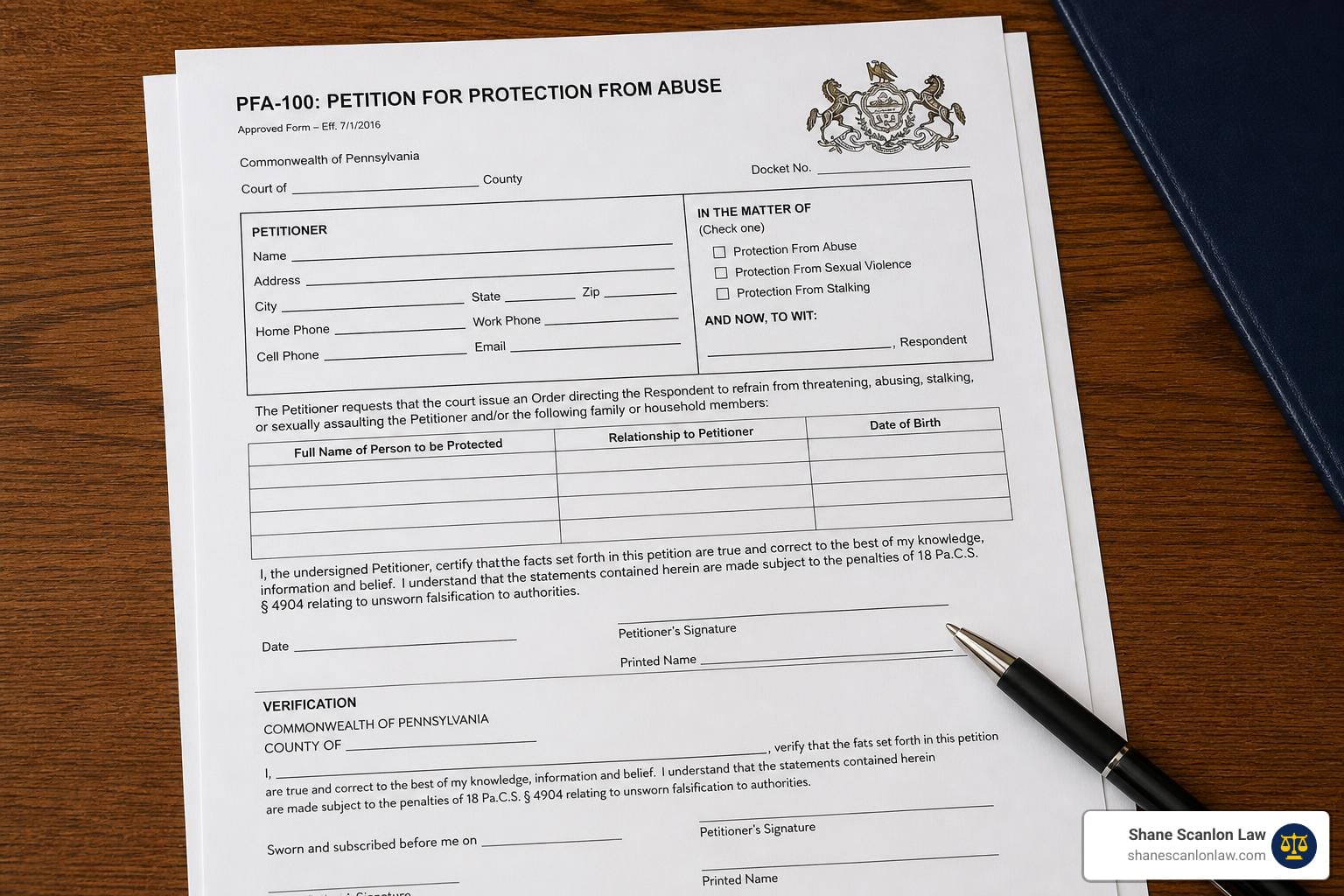
When You Need Protection Fast, Knowing the Difference Matters
Understanding the pfa vs restraining order distinction in Pennsylvania could be the most important thing you do to keep yourself safe right now.
Here is the quick answer:
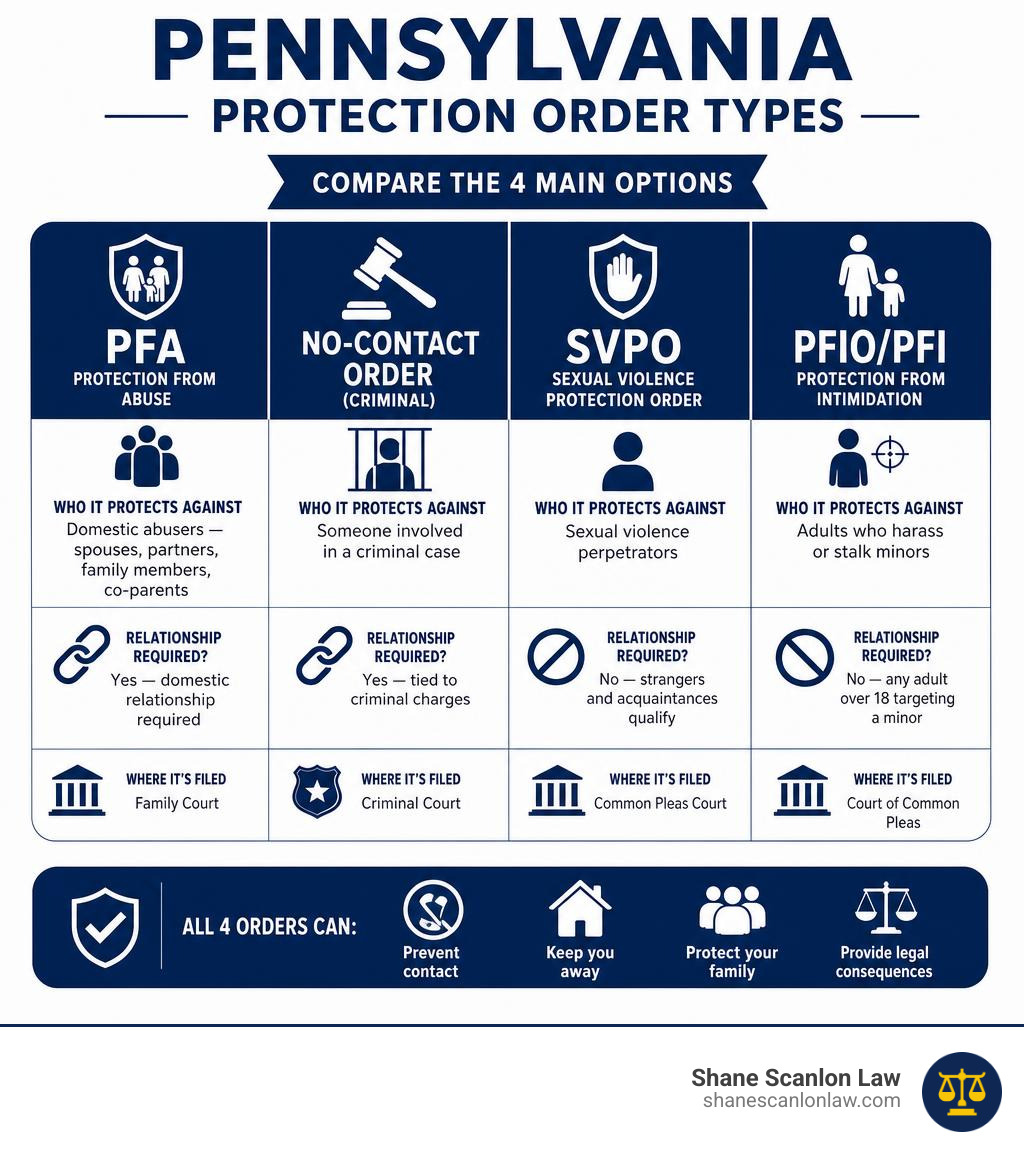
| Order Type | Who It Protects Against | Relationship Required? |
|---|---|---|
| PFA (Protection From Abuse) | Domestic abusers — spouses, partners, family members, co-parents | Yes — domestic relationship required |
| No-Contact Order | Someone involved in a criminal case | Yes — tied to criminal charges |
| SVPO (Sexual Violence Protection Order) | Sexual violence perpetrators | No — strangers and acquaintances qualify |
| PFIO/PFI (Protection From Intimidation) | Adults who harass or stalk minors | No — any adult over 18 targeting a minor |
In Pennsylvania, what most people call a “restraining order” is almost always a PFA. But a PFA is not the only option — and filing for the wrong one can slow down your protection or get your case dismissed.
If you are in immediate danger right now, call 911. Then read on to understand which order fits your situation.
Many people arrive at court confused, scared, and unsure which order to ask for. That confusion is understandable. The legal system uses terms like “PFA,” “protective order,” “no-contact order,” and “restraining order” in ways that do not always match how people use those words in everyday life. The wrong choice can cost you time you may not have.
I’m Shane Scanlon, founder of Shane Scanlon Law and a former Lackawanna County District Attorney with over 20 years of courtroom experience in Pennsylvania. I have handled the pfa vs restraining order question from both sides of the courtroom — as a prosecutor and as a defense attorney — and I will walk you through everything you need to know to make the right call.
PFA vs Restraining Order in Pennsylvania: The Plain-English Difference
To understand how the system works, we have to clear up some vocabulary. In television dramas set in other states, you always hear characters threaten to “get a restraining order.” If you walk into a Pennsylvania county courthouse and ask the clerk for a general “restraining order,” they will likely look at you and ask what kind of relationship you have with the person you are trying to block.
In Pennsylvania, there is no single, catch-all civil “restraining order” for general disputes. Instead, our courts use highly specific civil orders designed for different situations. If you are dealing with domestic violence, the correct legal label is a Protection From Abuse (PFA) order. If your situation involves someone outside your family or romantic circle, you will need a different legal tool entirely.
Why “Restraining Order” Usually Means a PFA in Pennsylvania
When people in Scranton or Wilkes-Barre talk about getting a restraining order, they are almost always referring to a PFA. A PFA is a civil court order issued by the Court of Common Pleas. It is designed to protect a “plaintiff” (the person seeking protection) from a “defendant” (the alleged abuser).
The primary goal of a PFA is abuse prevention. Because it is a civil matter, you do not have to wait for the police to file criminal charges to seek one. You can file a petition yourself, and if a judge agrees that you are in immediate danger, they can grant you temporary relief that very same day. For a deeper dive into how these orders operate, read our comprehensive Protection From Abuse overview.
PFA vs Restraining Order: Relationship Rules Matter Most
The single biggest difference when comparing a pfa vs restraining order in PA is the relationship requirement. Under Pennsylvania law, a PFA is strictly reserved for domestic relationships.
To be eligible for a PFA, the person abusing or threatening you must be:
- A current or former spouse
- A current or former intimate partner (someone you are dating or have dated)
- Someone with whom you share a child
- A parent, child, or sibling
- A relative by blood or marriage
- A current or former household member who lived with you as a family member
If the person harassing you is a stranger, a neighbor, a coworker, or a classmate with whom you have never had a romantic or familial relationship, you cannot get a PFA against them. The court will dismiss your petition out of hand. For those non-domestic situations, you must look to other types of protective orders.
How No-Contact Orders Are Different From PFAs
Another common source of confusion is the “no-contact order.” While both a PFA and a no-contact order keep someone away from you, they belong to completely different legal worlds.
A no-contact order is a criminal court tool, not a civil one. It is typically issued as a condition of bail, probation, or parole. If someone is arrested for a crime against you—such as assault, harassment, or stalking—the judge will often order them to have absolutely no contact with you as a condition of staying out of jail while their criminal case is pending.
There are two major differences here:
- The Trigger: A no-contact order in Pennsylvania can only go into effect after a violent act or criminal incident has occurred and charges have been filed. A PFA, on the other hand, can be sought based on the threat of abuse or reasonable fear of imminent harm, even if the police were never called.
- Mutual vs. One-Way: No-contact orders are sometimes applied mutually by judges to keep both parties from escalating a criminal dispute. A PFA is a one-way street; it restrains the defendant, not the victim.
Who Can File for Each Pennsylvania Protection Order?
Because the law is highly specific, Pennsylvania has created a menu of protection orders. Choosing the right one depends on who you are, how old you are, and who is threatening you. If you are unsure which category you fit into, you can explore the state’s official resources on how to Request a Pennsylvania protection order.
PFA vs Restraining Order Eligibility: Domestic Abuse Cases
Any adult who has been subjected to physical abuse, threats, or stalking by a domestic partner or family member can file for a PFA. If the victim is a minor child, a parent or adult guardian must file the petition on their behalf.
To win a final PFA, you must prove to a judge that the abuse occurred within a qualifying relationship. If you meet these criteria, you can begin the paperwork at your local county courthouse. To understand the exact steps required, see our guide on Filing and obtaining a PFA order.
When to Use an SVPO Instead of a PFA
What happens if you are sexually assaulted or stalked by someone who is not a family member or intimate partner? This is where Pennsylvania’s Protection of Victims of Sexual Violence or Intimidation (PSVI) law steps in.
Under this law, you can file for a Sexual Violence Protection Order (SVPO). An SVPO is designed specifically for victims of sexual violence who do not have a domestic relationship with their abuser. This could be a coworker, classmate, acquaintance, or a complete stranger. To qualify, there must be an allegation of sexual violence, but there is no requirement for a close personal relationship.
When to Use a PFIO or PFI Instead of a PFI/PFA
If the victim is a minor child under the age of 18, and the person harassing them is an adult (18 or older) who is not a family member, a PFA is not the correct path. Instead, a parent or guardian can file for a Protection From Intimidation Order (PFIO or PFI).
PFIOs are specifically designed to protect children from being stalked, harassed, or intimidated by non-family adults—such as neighbors, school employees, or strangers. Like the SVPO, a PFIO bridges the gap for non-domestic threats, ensuring that minors have a direct path to safety when a PFA is legally unavailable.
What Qualifies for a PFA—and What a PFA Can and Cannot Do
A PFA is a powerful legal shield, but it is not a magic wand. It is built to address specific types of safety threats, and understanding its boundaries can help you plan your next steps effectively.

Abuse That May Support a PFA Petition
Under Pennsylvania’s Protection From Abuse Act, “abuse” is defined as more than just physical violence. You can seek a PFA if your domestic partner or family member has engaged in:
- Physical Assault: Attempting to cause, or intentionally causing, bodily injury.
- Imminent Threats: Placing you in reasonable fear of immediate, serious bodily injury (e.g., pointing a weapon or verbally threatening to kill you).
- False Imprisonment: Forcefully holding you in a room or preventing you from leaving.
- Stalking: Engaging in a repeated course of conduct that places you in reasonable fear of bodily injury.
- Sexual Abuse: Forcing you to engage in sexual acts against your will.
What a PFA Cannot Cover
We frequently talk to folks in Lackawanna and Luzerne counties who want to use a PFA to solve non-abuse problems. A PFA is not designed to handle:
- Roommate Disputes: If you and a non-intimate roommate are arguing over rent or chores, a PFA is not the answer.
- Workplace Drama: Disagreements with coworkers belong in HR, not PFA court.
- Property Disputes: You cannot use a PFA solely to argue over who owns a car or a television if there is no physical threat or abuse involved.
- Child Custody Shortcuts: While a PFA can award temporary child custody, you cannot file a PFA simply to bypass the normal family court custody process if no abuse has occurred.
Relief a Pennsylvania PFA Can Provide
If a judge grants a final PFA, the protections can be incredibly broad and life-changing. A final PFA can order the defendant to:
- Cease All Contact: No phone calls, texts, emails, social media messages, or third-party contact.
- Stay Away: Stay entirely away from your home, workplace, school, or your children’s daycare.
- Evict the Abuser: Force the abuser to pack up and move out of a shared residence, even if their name is on the lease or deed.
- Surrender Firearms: Order the defendant to immediately surrender all firearms and ammunition to the sheriff’s department.
- Provide Temporary Support: Order the abuser to pay temporary child support or spousal support.
- Protect Pets: Under Pennsylvania law, a PFA can grant temporary ownership of household pets to the plaintiff and prohibit the defendant from contacting or harming the animals.
To understand how these restrictions impact someone’s life, you can read our detailed breakdown of the Legal consequences of PFAs.
How the PFA Process Works From Filing to Final Hearing
The PFA process moves incredibly fast because safety is on the line. In Pennsylvania, a petition can go from a blank piece of paper to an active, enforceable order in a matter of hours.

To help you navigate this rapid timeline, we have put together a complete PFA hearing process guide. Here is how the stages break down:
Emergency, Temporary, and Final PFAs
The PFA timeline is divided into three distinct phases:
- Emergency PFA (EPFA): If you are in danger after regular courthouse hours (nights, weekends, or holidays), you can get an Emergency PFA. In Northeast Pennsylvania, you do this by contacting your local police department or visiting a Magisterial District Judge. These emergency orders are designed to keep you safe overnight or through the weekend and expire at the close of the next business day.
- Temporary PFA: During normal business hours, you file a petition at the county courthouse. A judge will review your paperwork and interview you briefly. If they believe you are in danger, they will issue a Temporary PFA on the spot. This order remains in effect until your final hearing.
- Final PFA: By law, a final PFA hearing must be scheduled within ten business days of your temporary order. At this hearing, both sides have the opportunity to present their cases. If the judge rules in your favor, they can issue a Final PFA that lasts for up to three years.
What Happens at the Final PFA Hearing
The final hearing is a formal trial. The defendant must be formally served with the paperwork by the sheriff’s department beforehand so they have notice and an opportunity to defend themselves.
At the hearing, the burden of proof is on the plaintiff to show, by a “preponderance of the evidence” (meaning it is more likely true than not), that the abuse occurred. Both sides can testify, call witnesses, and present physical evidence. Often, cases are resolved through a “consent agreement,” where the defendant agrees to the civil stay-away terms without admitting to the abuse. If no agreement is reached, the judge will make the final decision. For a step-by-step roadmap of this day, see our guide on Protection From Abuse Orders step-by-step.
What to Bring and How to Prepare
To give yourself the best chance of success at a final hearing, preparation is key. We recommend gathering the following items:
- Digital Evidence: Print out text messages, emails, and social media threats. Back up voicemails and call logs.
- Physical Evidence: Take clear, color photos of any physical injuries or property damage.
- Official Records: Bring copies of police reports, medical or hospital records, and 911 dispatch logs.
- Witnesses: If anyone saw the abuse or heard the threats, ask them to attend the hearing to testify.
- Financial Documents: If you are asking for temporary child or spousal support, bring proof of income.
Violations, Enforcement, and Out-of-State Protection
A piece of paper is only as good as the teeth behind it. Fortunately, Pennsylvania law treats PFA violations with extreme seriousness.
Consequences for Violating a PFA or No-Contact Order
Violating a PFA is not a minor civil slip-up; it is a crime. If a defendant attempts to contact you, sends a message through a friend, posts about you on social media, or shows up at your house, they can be arrested immediately.
The charge for violating a PFA is indirect criminal contempt. This charge carries severe penalties, including:
- Up to six months in jail for each violation
- Fines ranging from $300 to $1,000
- An extension of the PFA order
- Additional criminal charges if the violation involved a separate crime (like assault or stalking)
If you have been accused of violating an order, or need to understand the defense side of these charges, you can read about our approach to PFA violation defense.
Are Pennsylvania PFAs Enforceable Across State Lines?
Yes. Thanks to the federal Violence Against Women Act (VAWA), PFA orders are granted “full faith and credit” nationwide. This means your Pennsylvania PFA is 100% valid in every county in PA, every other US state, and on tribal lands.
If you travel or move out of state, you should carry a certified copy of your PFA with you. While not strictly required, you can also register your out-of-state PFA with the local courthouse in your new state to ensure local police can see it instantly in their databases.
Local Filing and Enforcement in Northeast Pennsylvania
If you live in NEPA, your filing process will go through your local county’s Court of Common Pleas.
- In Scranton: You will file at the Lackawanna County Courthouse. For local details, check out our guide on Protection From Abuse in Scranton PA.
- In Wilkes-Barre: Your filing will go through the Luzerne County Courthouse. You can read more about local procedures in our guide on Protection From Abuse in Wilkes-Barre PA.
- Other Counties: If you reside in Susquehanna or Wyoming County, the process is similar, though handled by your local county sheriff and court administration. (For those looking for information in other regions of the state, you can also review the Cumberland County PFA information).
Frequently Asked Questions About PFA vs Restraining Order
Is a PFA the Same Thing as a Restraining Order in Pennsylvania?
Yes, in everyday conversation, they are the same thing. However, legally speaking, “restraining order” is a generic term used across the country, while “PFA” is the specific legal tool Pennsylvania uses to protect victims of domestic and family abuse.
How Fast Can Someone Get a PFA in Pennsylvania?
You can get a Temporary PFA or an Emergency PFA on the very same day you file your petition, often within a few hours. This immediate protection will stay in place until your final hearing, which is typically scheduled within ten business days.
Can a PFA Be Changed, Extended, or Dropped?
Yes, but you cannot do this privately. Even if both parties agree to make up, the PFA remains legally active until a judge signs off on a modification. If you need to alter, extend, or terminate an order, you must file a formal petition with the court. Learn more about how this works in our guide to Modifying or terminating a PFA.
Conclusion
Whether you are seeking a PFA to protect yourself and your children, or you are facing false accusations and need to defend your name, the decisions you make in the first 24 hours are critical. The court process moves fast, and the consequences of a final order can last for years.
At Shane Scanlon Law, we bring a unique perspective to these high-stakes cases. As a former District Attorney with over 20 years of experience in Northeast Pennsylvania, I understand how local law enforcement, prosecutors, and judges view these orders. We provide compassionate, fierce, and trusted local representation to help you secure the right outcome.
If you are dealing with a PFA issue in Scranton, Wilkes-Barre, Lackawanna, Luzerne, Susquehanna, or Wyoming County, do not navigate the system alone. Contact us today to Get help with a Pennsylvania PFA.