
 Call Anytime
833.722.6566
Call Anytime
833.722.6566
Car Accident Lawyer: Ultimate Checklist

What a Car Accident Lawyer Does — and Why It Matters
A car accident lawyer helps injured victims navigate the legal system, deal with insurance companies, and pursue fair compensation after a crash. Here’s a quick overview of what they do and when you need one:
Quick Answer: What Does a Car Accident Lawyer Do?
- Investigates the crash and gathers evidence
- Identifies who is at fault and builds your case
- Handles all communication with insurance adjusters
- Negotiates settlements or takes your case to trial
- Pursues compensation for medical bills, lost wages, and pain and suffering
When should you hire one?
- You suffered injuries — even ones that seem minor at first
- The other driver disputes fault
- An insurance company offers a low settlement
- A government vehicle or commercial truck was involved
- You are unsure of your legal rights under Pennsylvania law
Car accidents happen fast, but the legal and financial fallout can drag on for months or years. In 2024, North Carolina alone recorded over 284,000 crashes. Nationally, NHTSA projects 19,515 traffic deaths in a single year. The physical, emotional, and financial toll is enormous — and insurance companies are not on your side.
I’m Shane Scanlon, founder of Shane Scanlon Law and a trial attorney with over 20 years of experience representing injured victims throughout Scranton, Lackawanna County, and Northeast Pennsylvania. As a former Lackawanna County District Attorney, I bring the same aggressive, case-ready approach to car accident lawyer work that I honed prosecuting serious crimes — so you have a genuine fighter in your corner from day one.
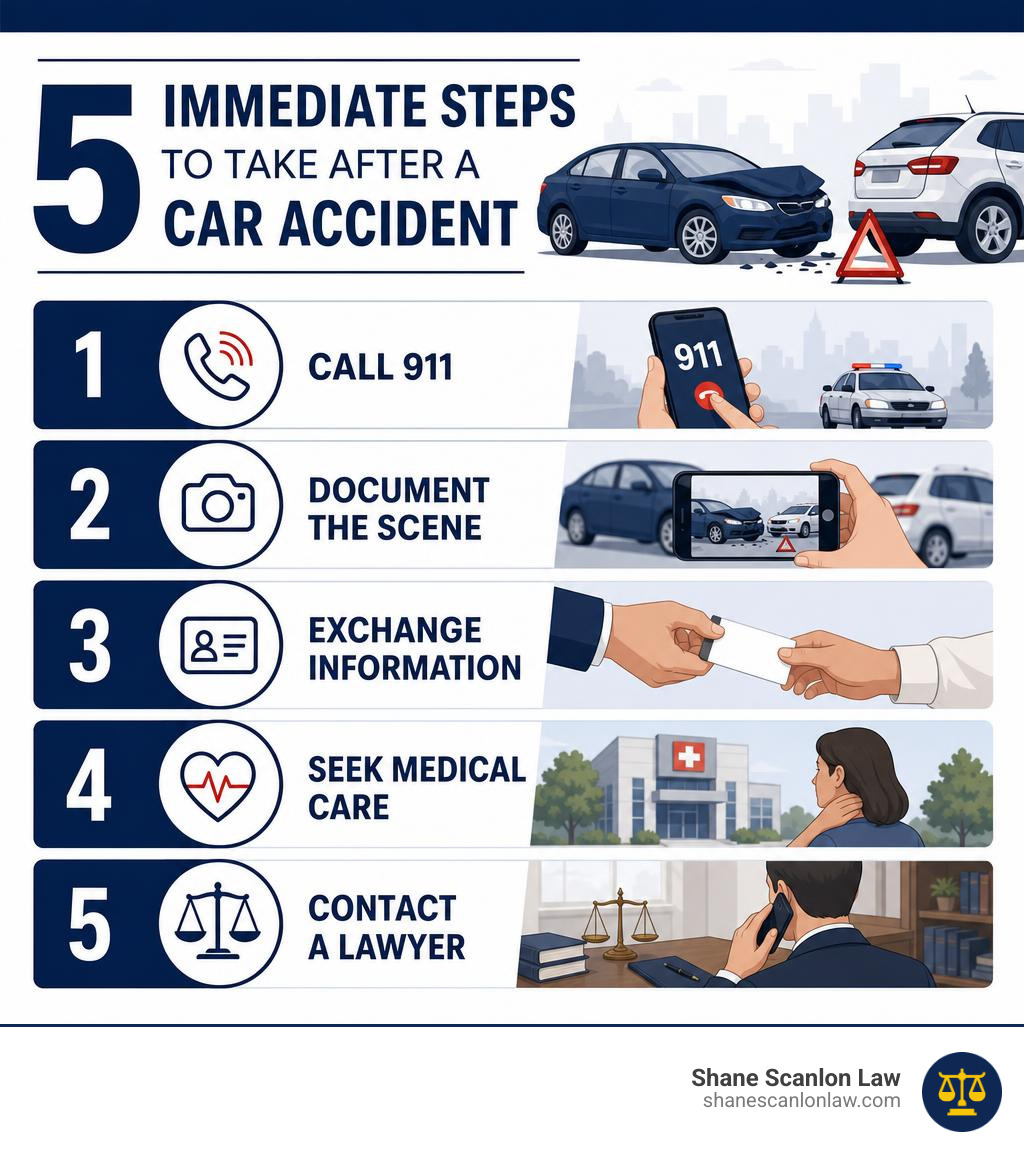
What to Do Immediately After a Crash: The Scene Checklist

The first few minutes after a crash are confusing. Your adrenaline is up, traffic may still be moving, and everyone suddenly becomes an expert in accident law. Spoiler: the guy yelling “this is definitely your fault” is not the judge.
Use this checklist to protect your health, safety, and claim.
Get to safety if you can.
Move vehicles out of active traffic if it is safe and lawful to do so. Turn on hazard lights. If anyone is seriously hurt, do not move them unless there is immediate danger.Call 911.
A police report can become key evidence. Tell the dispatcher where you are, whether anyone is hurt, and whether traffic is blocked.Get medical help.
Some injuries, including whiplash, concussions, back injuries, and internal injuries, may not feel serious right away. Get checked promptly and follow medical advice.Exchange information.
Get the other driver’s:- Name
- Address and phone number
- Driver’s license number
- Insurance company and policy number
- License plate number
- Vehicle make, model, and color
Document everything.
Take photos and video of:- Vehicle damage
- Vehicle positions
- Skid marks
- Road conditions
- Traffic signs and signals
- Debris
- Weather and lighting
- Visible injuries
Get witness names and contact information.
Independent witnesses can make a major difference if the other driver later changes their story.Do not admit fault.
Be polite, but avoid saying things like “I’m sorry” or “I didn’t see you.” Those words can be twisted later.Notify your insurance company.
Report the crash, but keep it factual. Do not guess about fault or injuries.Do not give a recorded statement to the other driver’s insurer without legal advice.
Insurance adjusters may sound friendly, but their job is to protect the insurance company’s money.Contact a lawyer early.
Evidence disappears quickly. Vehicles get repaired, cameras overwrite footage, and witnesses become harder to find.
For a deeper step-by-step breakdown, see our guide: Don’t Get Wrecked: A Guide to Auto Accident Claims.
How a Car Accident Lawyer Maximizes Your Compensation

A car accident lawyer does more than file paperwork. We build the case from the ground up so the insurance company sees the full picture: what happened, who caused it, how badly you were hurt, and what the crash has cost you.
Here is how we help maximize compensation.
We investigate the crash.
We gather police reports, photos, witness statements, medical records, repair estimates, crash data, and other evidence.
We preserve evidence before it disappears.
Surveillance footage, dashcam video, vehicle data, and roadway evidence may be available for only a short time. Early action matters.
We identify every liable party.
Some crashes involve more than one responsible party, such as:
- Another driver
- A vehicle owner
- An employer
- A commercial carrier
- A negligent maintenance company
- A government entity responsible for unsafe road conditions
- A vehicle or parts manufacturer
We calculate the real value of the claim.
A settlement should not cover only today’s emergency room bill. It should account for future medical treatment, lost income, reduced earning capacity, pain, daily limitations, and long-term consequences.
We handle insurance adjusters.
Insurance companies often try to reduce claims by arguing your injuries are not serious, your treatment was unnecessary, or you were partly at fault. We respond with evidence, not emotion.
We negotiate from a trial-ready position.
Most car accident cases settle, but cases usually settle better when the insurance company knows your lawyer is prepared to litigate.
If your settlement has stalled or the offer does not reflect your losses, read: Don’t Let Your Settlement Stall Out Without an Automobile Accident Injury Attorney.
When to Hire a Car Accident Lawyer
You do not need a lawsuit for every fender bender. But you should speak with a lawyer when the crash involves injuries, disputed facts, serious damage, or an insurance company that is dragging its feet.
Hire a car accident lawyer as soon as possible if:
- You went to the hospital or urgent care
- You have neck, back, head, shoulder, knee, or nerve symptoms
- You missed work
- Your vehicle was totaled
- The other driver denies fault
- The police report is wrong or incomplete
- There were multiple vehicles involved
- The crash involved a commercial vehicle, rideshare driver, delivery driver, or government vehicle
- The insurance company asks for a recorded statement
- You receive a quick settlement offer before you know the full extent of your injuries
- A loved one died in the crash
In Pennsylvania, the general deadline to file a personal injury lawsuit after a car accident is two years from the date of the crash. But waiting is risky. The legal deadline is not the same as the evidence deadline. Tire marks fade, cameras reset, and memories get fuzzy.
For more local guidance, see Navigating the Aftermath: A Guide to Scranton Car Accident Lawyers.
How a Car Accident Lawyer Proves Fault and Liability
To recover compensation, we generally need to show that another party was negligent and that negligence caused your injuries.
Negligence may include:
- Speeding
- Tailgating
- Distracted driving
- Texting while driving
- Drunk or drugged driving
- Running a red light or stop sign
- Failing to yield
- Unsafe lane changes
- Fatigued driving
- Driving too fast for weather or road conditions
To prove fault, we may use:
Police reports
These often include driver statements, diagrams, citations, and the officer’s observations.
Photos and video
Scene photos, dashcam footage, traffic cameras, and nearby surveillance footage can be powerful.
Witness statements
Neutral witnesses can confirm speed, traffic light color, lane position, or dangerous behavior.
Vehicle data
Some vehicles store crash-related data, such as speed, braking, throttle position, and seat belt use.
Cell phone records
If distracted driving is suspected, records may help show whether a driver was texting or using a phone.
Medical records
Medical documentation connects the crash to your injuries.
Accident reconstruction experts
In serious or disputed cases, experts can analyze impact angles, vehicle damage, road evidence, and physics to explain how the crash happened.
We handle crashes throughout Northeast Pennsylvania, including rural road, highway, and intersection accidents. For county-specific information, see our page on Car Accidents in Wayne County.
Common types of car accident cases we handle include:
- Rear-end collisions
- Head-on crashes
- T-bone and intersection accidents
- Multi-vehicle pileups
- Hit-and-run accidents
- Uninsured and underinsured motorist claims
- Drunk driving crashes
- Distracted driving crashes
- Speeding accidents
- Rollover crashes
- Pedestrian and bicycle-related vehicle crashes
- Commercial vehicle and truck-related crashes
Understanding Pennsylvania Car Accident Laws and Deadlines
Pennsylvania car accident law has several rules that can affect your claim, including insurance choice, comparative negligence, and filing deadlines.
For a broader explanation, read Understanding Pennsylvania Car Accident Laws: Fault, No-Fault, and Deadlines Explained.
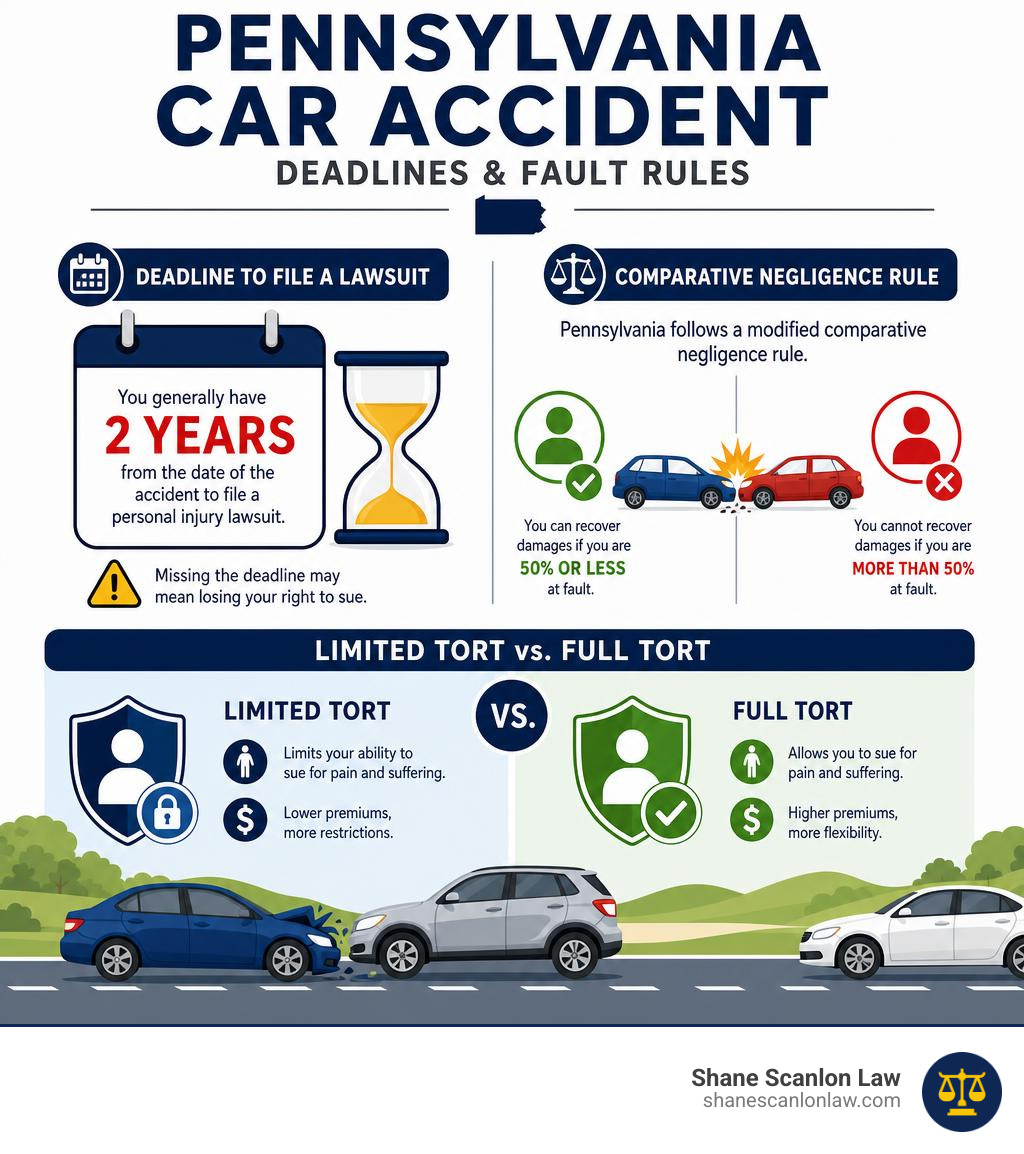
Limited Tort vs. Full Tort in Pennsylvania
Pennsylvania drivers often choose between limited tort and full tort coverage. This choice can affect whether you can recover compensation for pain and suffering.
| Issue | Limited Tort | Full Tort |
|---|---|---|
| Usually costs | Lower premiums | Higher premiums |
| Medical bills and wage loss | Can still be pursued under applicable coverage | Can still be pursued under applicable coverage |
| Pain and suffering | Restricted unless an exception applies | Generally preserved |
| Serious injury exception | May allow pain and suffering recovery | Not needed in the same way |
| Best for | Lower insurance cost | Stronger protection after serious injury |
Limited tort does not mean you have no claim. It means your ability to recover non-economic damages, such as pain and suffering, may be limited unless an exception applies. Exceptions may involve serious injuries or certain conduct by the at-fault driver.
Pennsylvania Modified Comparative Negligence
Pennsylvania follows a modified comparative negligence rule, often called the 51% rule.
Here is the plain-English version:
- If you are 0% at fault, you may recover full damages.
- If you are partly at fault but less than 51%, your compensation is reduced by your percentage of fault.
- If you are 51% or more at fault, you cannot recover damages from the other party.
Example: If your damages are $100,000 and you are found 20% at fault, your recovery may be reduced to $80,000.
This is one reason insurance companies focus so much on blaming the injured person. Even a small shift in fault can reduce what they pay. Learn more here: How Comparative Negligence Works in Pennsylvania Car Accidents.
Pennsylvania Statute of Limitations
In most Pennsylvania car accident injury cases, you have two years from the date of the crash to file a lawsuit.
Important deadline issues include:
- Personal injury claims: generally two years
- Property damage claims: generally two years
- Wrongful death claims: generally two years from the date of death
- Claims involving government entities: special notice requirements may apply, often as short as six months
If a government vehicle, public employee, municipal vehicle, or dangerous public road condition may be involved, speak with a lawyer immediately. These cases have special rules, and missing the notice deadline can damage the claim before it really begins.
Types of Damages and Compensation You Can Recover
A car accident claim is not only about the damage to your vehicle. It is about restoring, as much as the law allows, what the crash took from you.
Compensation may include economic damages, non-economic damages, and in rare cases punitive damages.
Economic Damages
Economic damages are financial losses that can often be documented with bills, receipts, pay records, or expert reports.
They may include:
- Ambulance bills
- Emergency room treatment
- Hospital stays
- Surgery
- Doctor visits
- Physical therapy
- Chiropractic care
- Medication
- Medical equipment
- Future medical treatment
- Lost wages
- Lost overtime or bonuses
- Reduced earning capacity
- Vehicle repair or replacement
- Rental car costs
- Towing and storage
- Out-of-pocket expenses
Non-Economic Damages
Non-economic damages compensate for human losses that do not come with a neat receipt.
They may include:
- Pain and suffering
- Emotional distress
- Anxiety
- Loss of sleep
- Loss of enjoyment of life
- Scarring or disfigurement
- Permanent limitations
- Loss of consortium
- Daily inconvenience and disruption
These damages are often heavily disputed by insurance companies. That is why medical documentation, consistent treatment, witness statements, and a clear explanation of how the injury affects daily life are so important.
Punitive Damages
Punitive damages are not available in every case. They are meant to punish especially reckless or outrageous conduct. In a car accident case, this might be considered where the facts involve extreme misconduct, such as drunk driving or intentional wrongdoing.
Wrongful Death and Survival Claims
When a crash causes a death, surviving family members may have claims for losses connected to their loved one’s death. These cases can involve funeral expenses, lost financial support, medical bills before death, and the deep personal losses suffered by the family.
If your family is facing this situation, we encourage you to learn more about how we help as a Wrongful Death Lawyer in Scranton.
Frequently Asked Questions About Car Accident Claims
Car accident claims raise a lot of questions, especially when medical bills are arriving and the insurance company is already calling. Here are answers to the questions we hear most often.
How much does it cost to hire an attorney?
Most car accident lawyers, including personal injury firms, work on a contingency fee basis.
That means:
- You do not pay attorney fees upfront
- The consultation is typically free
- The lawyer is paid only if compensation is recovered for you
- The fee is usually a percentage of the settlement or verdict
- The fee agreement should be explained in writing before representation begins
This arrangement allows injured people to get legal help without paying hourly fees while they are already dealing with medical bills, missed work, and vehicle repairs.
What is the statute of limitations for a PA car accident?
In most Pennsylvania car accident injury cases, the deadline is two years from the date of the accident.
However, do not wait two years to call a lawyer. A strong case often depends on evidence gathered early.
Special rules may apply if:
- A government vehicle was involved
- A municipal employee caused the crash
- A defective roadway or unsafe public property contributed
- The injured person is a minor
- The case involves a death
Claims involving government entities can require formal notice within six months, so quick action is critical.
Can I still get compensation if I was partially at fault?
Yes, as long as you were not 51% or more at fault under Pennsylvania’s modified comparative negligence rule.
If you were partly responsible, your compensation may be reduced by your percentage of fault.
Example:
- Total damages: $50,000
- Your fault: 10%
- Potential recovery: $45,000
Insurance companies often try to assign more blame to injured people than the facts support. A lawyer can challenge those arguments with evidence.
Should I talk to the insurance company?
You should notify your own insurance company after a crash, but be careful. Keep your report factual and avoid guessing.
Before speaking with the other driver’s insurance company, giving a recorded statement, or signing anything, it is wise to speak with a lawyer. Adjusters may ask questions designed to minimize your claim, such as:
- “You feel fine today, right?”
- “You could have avoided the crash, correct?”
- “You had back pain before this accident, didn’t you?”
- “Can we settle this quickly?”
The safest answer is often: “I would like to speak with my attorney first.”
How long does a car accident case take?
It depends on:
- How serious the injuries are
- How long medical treatment takes
- Whether fault is disputed
- Whether multiple parties are involved
- Whether the insurance company negotiates fairly
- Whether a lawsuit becomes necessary
Some claims settle in a few months. Serious injury cases can take longer because we need to understand the full medical picture before discussing settlement. Settling too early can leave you paying for future care out of your own pocket.
What if the other driver has no insurance?
You may still have options. Your own policy may include uninsured motorist or underinsured motorist coverage, often called UM/UIM coverage.
This coverage can help when:
- The at-fault driver has no insurance
- The at-fault driver has too little insurance
- The crash was a hit-and-run
These claims are made through your own insurer, but that does not mean the process is automatically easy. Your insurance company may still dispute the value of your claim.
Do I need a lawyer for a minor crash?
Maybe. If there are no injuries and only minor property damage, you may be able to handle the claim yourself.
But speak with a lawyer if:
- Pain appears later
- Your car damage is more serious than expected
- The other driver changes their story
- The insurer denies fault
- You are asked to sign a release
- You are offered money before you finish medical treatment
A “minor” crash can cause major problems if symptoms develop days later.
Conclusion: Protect Your Rights with Trusted Local Representation
After a crash, you do not have to figure everything out alone. The right car accident lawyer can protect your rights, deal with insurance companies, preserve evidence, prove fault, and fight for the compensation you need to move forward.
At Shane Scanlon Law, we represent injured people throughout Scranton, Lackawanna County, Wilkes-Barre, Luzerne County, Susquehanna County, Wyoming County, and surrounding Northeast Pennsylvania communities. We bring more than 20 years of legal experience, local courtroom knowledge, and the perspective of a former District Attorney to every case we handle.
If you were hurt in a crash, talk to us before accepting an insurance settlement. We will review your situation, explain your options, and help you decide what comes next.
Start here: Car Accident Lawyer in Scranton.