
 Call Anytime
833.722.6566
Call Anytime
833.722.6566
Your License is Taking a Month-Long Vacation
What a 30 Days Driver License Suspension Actually Means for You
A 30 days driver license suspension is a temporary withdrawal of your driving privileges — typically lasting one calendar month — after which you may be eligible to reinstate your license by meeting specific requirements.
Quick answers:
- What triggers it? Point accumulation, speeding violations, minor alcohol offenses, unpaid tickets, or certain first-offense programs like Pennsylvania’s ARD
- How long does it last? Exactly 30 days, starting from the effective date on your suspension notice
- Can you drive at all? In some cases, yes — through a limited or hardship license, depending on your state and the reason for suspension
- How do you get your license back? Pay a reinstatement fee, resolve the underlying cause, and confirm your eligibility date with your state’s DMV
- What if you drive anyway? Driving while suspended can result in criminal charges, additional suspension time, and vehicle impoundment
Losing your license — even for just a month — can turn everyday life upside down. Getting to work, picking up your kids, managing appointments: all of it becomes harder fast. And if you make the wrong move during that 30 days, you can turn a short suspension into a much bigger legal problem.
This guide breaks down exactly why 30-day suspensions happen, what the restoration process looks like, and what your options are if you need to drive during that period.
I’m Shane Scanlon, founder of Shane Scanlon Law and a former Lackawanna County District Attorney with over 20 years of Pennsylvania courtroom experience — including DUI cases, traffic offenses, and the kinds of charges that lead to a 30 days driver license suspension. Understanding both sides of the system means I can help you navigate it more effectively.
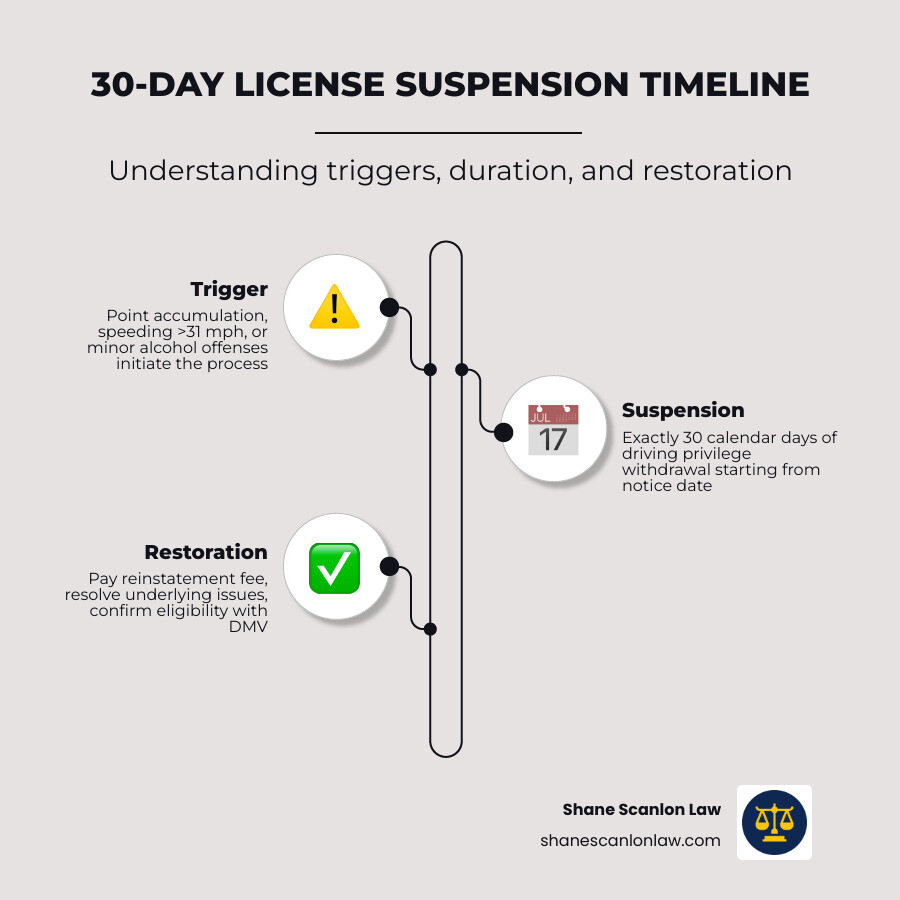
Common Triggers for a 30 Days Driver License Suspension
In our experience serving clients throughout Lackawanna and Luzerne Counties, we’ve found that a 30 days driver license suspension rarely happens by accident. It is usually the result of a specific statutory trigger or a series of smaller violations that finally “tip the bucket.”
One of the most common reasons we see in Northeastern Pennsylvania involves high-speed violations. For example, if you are caught speeding more than 31 mph over the posted limit, PennDOT often requires a departmental hearing. Depending on your driving record, this can easily result in a 15 to 30-day suspension.

Another frequent trigger involves the Accelerated Rehabilitative Disposition (ARD) program. While ARD is a fantastic way for first-time DUI offenders in Scranton or Wilkes-Barre to avoid jail time and a permanent criminal record, it often comes with a mandatory license suspension. Depending on your Blood Alcohol Content (BAC) at the time of the arrest, that suspension is frequently set at exactly 30 days.
Underage drivers also face unique risks. In many jurisdictions, a minor in possession of alcohol—even if they weren’t driving at the time—can face a 30-day “vacation” from the driver’s seat. If you find yourself facing these charges, consulting a Speeding Ticket Lawyer in Lackawanna County Pennsylvania can help you understand if there are ways to mitigate the damage to your record.
Point Systems and the 30 Days Driver License Suspension
Most states use a point system to track driver behavior. In Pennsylvania, PennDOT adds points to your record for various moving violations. While a single ticket might only add 2 or 3 points, they add up quickly.
While different states have different thresholds, the general rule is that reaching a certain number of points within a 12-month or 24-month window triggers administrative action. For instance, some neighboring states like New Jersey have specific statutes, such as 2024 New Jersey Revised Statutes Section 39:5-30.8, which outline how accumulating 12 or more points in a two-year period can lead to a suspension ranging from 30 to 180 days.
In Florida, reaching 12 points within 12 months results in an automatic 30-day suspension. While the laws vary by state line, the lesson is the same: the government keeps a tally, and once you hit the limit, your driving privileges are paused. If you are a PA driver who received a ticket out of state, don’t assume it won’t affect you back home in Scranton.
Alcohol-Related Offenses and the 30 Days Driver License Suspension
Alcohol is the most common “fast track” to a license suspension. In Pennsylvania, the length of your suspension is often tied to the “Tier” of your DUI offense:
- Tier 1 (General Impairment): BAC of .08% to .099%. If you qualify for ARD, you might actually face no license suspension.
- Tier 2 (High Rate): BAC of .10% to .159%. This is the “sweet spot” for a 30 days driver license suspension under the ARD program.
- Tier 3 (Highest Rate): BAC of .16% or higher, or controlled substances. This typically jumps to a 60-day suspension under ARD.
For those not in the ARD program, a conviction for a second or third DUI offense can lead to suspensions of 12 or 18 months. This highlights why the 30-day window is often viewed as a “second chance” for first-time offenders to get their act together without losing their livelihood. We frequently help clients navigate these Traffic Tickets & Driving Suspended License issues to ensure they don’t lose more time on the road than absolutely necessary.
Navigating the Restoration Process After a 30-Day Suspension
The biggest mistake we see drivers make is assuming that once the 30 days are up, they can simply hop back behind the wheel. This is not true. A suspension does not “expire” automatically; you must take active steps to restore your privileges.

In Pennsylvania, the process revolves around your Restoration Requirements Letter. This is the “Golden Ticket” that tells you exactly what you need to do to get back on the road. PennDOT usually mails this to you about 30 days before your eligibility date, but you can also access it online.
If you are confused by the requirements or feel the suspension was issued in error, it may be wise to ask: Should I Obtain a Lawyer for a Traffic Ticket in Pennsylvania? In many cases, having an expert look at your driver history can save you weeks of administrative headaches.
Steps to Reclaim Your Driving Privileges
To make things easier, we’ve broken down the restoration steps into a simple checklist. Whether you are in Wilkes-Barre or Scranton, these PennDOT procedures remain the same.
| Step | Action Required | Notes |
|---|---|---|
| 1. Obtain Letter | Access your Restoration Requirements Letter online or via mail. | If you view it online, print it! PennDOT won’t mail a second copy. |
| 2. Pay Fees | Pay the restoration fee (typically around $100+ depending on the offense). | Can be paid online for faster processing. |
| 3. Proof of Insurance | Ensure PennDOT has your current valid insurance on file. | Lapses in insurance can trigger additional suspensions. |
| 4. Resolve Citations | Ensure all fines and “Failure to Appear” issues are cleared. | You can’t restore a license if you have unpaid tickets in other counties. |
| 5. Wait for Confirmation | Receive official notice that your privileges are restored. | Do not drive until you have this confirmation in hand. |
For those dealing with more complex legal issues, such as being Charged with a Non-Traffic Offense in Pennsylvania, the restoration process might involve additional steps, such as completing a court-ordered program or drug and alcohol evaluation.
Limited Driving Options and Hardship Licenses
We know that for most people in NEPA, not driving for 30 days isn’t just an inconvenience—it’s a threat to their job. If you are facing a 30 days driver license suspension, you might be eligible for a “Limited License.”
The most common options include:
- Ignition Interlock Limited License (IILL): Often available for DUI-related suspensions. It allows you to drive as long as your vehicle is equipped with a device that measures your breath alcohol content before the engine starts.
- Occupational Limited License (OLL): This is a “work permit” that allows you to drive to work, school, or medical appointments. However, it is important to note that OLLs are generally not available for 30-day suspensions resulting from ARD or certain speeding violations. They are typically reserved for longer suspensions.
- Probationary License (PL): This is for drivers with much longer suspension histories (5+ years) and wouldn’t typically apply to a standard 30-day stint.
If you are caught speeding in Luzerne County and are worried about how you’ll get to work, contacting a Speeding Ticket Lawyer in Luzerne County Pennsylvania is the best way to see which (if any) limited driving privileges you qualify for.
The Legal and Financial Risks of Driving While Suspended
It is incredibly tempting to “cheat” and drive just a few blocks to the grocery store during your suspension. We strongly advise against this. The risks far outweigh the rewards.
In Pennsylvania, driving while your operating privilege is suspended or revoked is a serious offense under the vehicle code. If you are caught, you aren’t just looking at a ticket; you are looking at:
- Extended Suspension: PennDOT will often tack on an additional period of suspension (sometimes up to a year) to your existing 30 days.
- Criminal Charges: Depending on the reason for your initial suspension (like a DUI), driving while suspended can be a summary offense or even a misdemeanor, carrying mandatory jail time and heavy fines.
- Vehicle Impoundment: Police have the authority to tow and impound your vehicle on the spot.
- Insurance Spikes: Your insurance company will view you as a high-risk driver. A 30 days driver license suspension is bad enough; a conviction for driving during that suspension can make your premiums triple or lead to policy cancellation.
Other states have even harsher penalties. For example, under Virginia Code § 46.2-301, driving while suspended is a Class 1 misdemeanor. Similarly, the 2024 Ohio Revised Code Section 4510.11 allows for vehicle immobilization for up to 30 days for repeat offenders.
Frequently Asked Questions about 30-Day Suspensions
How can I check the current status of my driver’s license?
You should never guess whether your license is valid. You can check your status through the PennDOT Driver and Vehicle Services website. We recommend requesting a “Certified Driver History Report.” This document provides a full look at your points, past violations, and the exact date your current suspension is set to end.
What is the difference between a 30-day suspension and a revocation?
Think of a suspension like a “time-out.” It is a temporary withdrawal of your right to drive for a fixed period (like 30 days). Once the time is up and you pay your fees, your license is returned.
A revocation, however, is the formal termination of your driving privilege. To get back on the road after a revocation, you usually have to wait a much longer period (often years) and re-apply for a license from scratch, which may include taking the permit and road tests again. Some serious offenses, like those mentioned in the New Zealand 28-day roadside suspension rules, show how international jurisdictions handle immediate, severe penalties for dangerous driving.
Can I appeal a 30-day suspension notice?
Yes, but you have to act fast. Usually, you only have 30 days from the date on the notice to file an appeal in the Court of Common Pleas. In some states, like Wisconsin under Statute 343.30(1q)(c)2, there are very specific administrative windows to challenge a revocation or suspension.
In Pennsylvania, an appeal can sometimes “stay” (pause) the suspension while the court reviews the case, allowing you to keep driving in the meantime. However, appeals are technical and require specific legal grounds—simply “needing to drive” is usually not enough to win.
Conclusion
A 30 days driver license suspension might feel like a short time, but in a place like Lackawanna or Wyoming County, 30 days without a car can feel like an eternity. Whether your suspension stems from a few too many points or a first-time DUI, the way you handle this month will determine how quickly you move past it.
At Shane Scanlon Law, we’ve spent two decades helping our neighbors in Scranton, Wilkes-Barre, and throughout NEPA protect their rights. As a former District Attorney, Shane Scanlon understands the prosecution’s playbook and uses that knowledge to provide fierce, local representation for our clients.
Don’t let a simple mistake turn into a permanent roadblock. If you are facing a suspension and don’t know where to turn, we are here to help you find the best path forward.
Contact a lawyer for help with your 30 days driver license suspension today for a consultation.