
 Call Anytime
833.722.6566
Call Anytime
833.722.6566
How Pennsylvania’s Protection From Abuse Act Keeps You Safe
What Pennsylvania’s Protection From Abuse Act Means for You
The protection from abuse act pennsylvania establishes is one of the most important legal tools available to victims of domestic violence in the state. Here is a quick overview of what it does:
- What it is: A civil law (23 Pa.C.S. § 6101 et seq.) that lets victims seek a court order protecting them from an abuser
- Who can file: Spouses, domestic partners, family members, and current or former intimate partners
- What it covers: Physical violence, threats, stalking, sexual assault, and child abuse
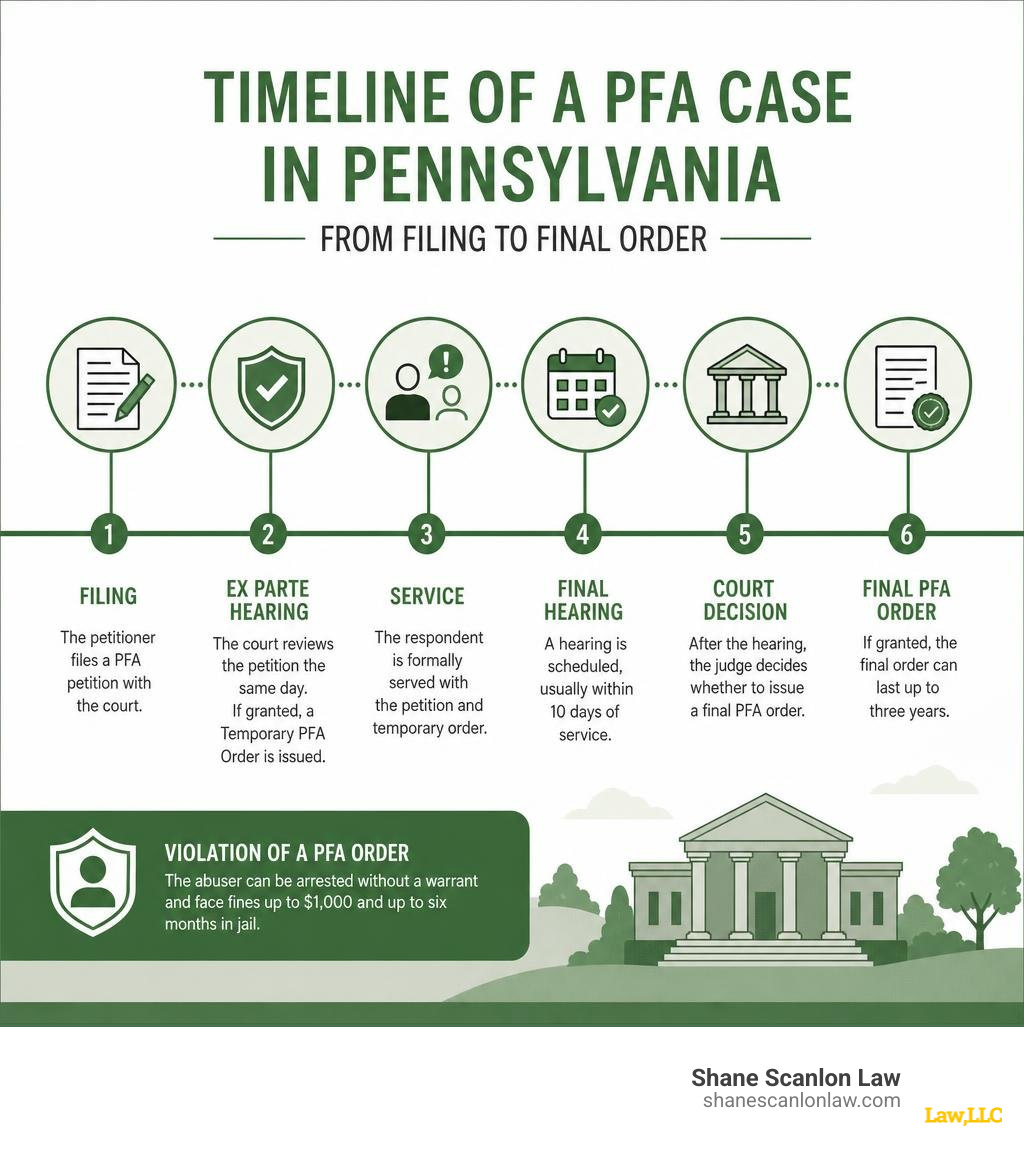
- How long it lasts: Temporary orders last up to 10 days; final orders last up to three years
- Cost to file: Free for the person seeking protection
- What happens if violated: The abuser can be arrested without a warrant and face fines up to $1,000 and up to six months in jail
In 2022 alone, Pennsylvania courts processed over 38,000 PFA petitions statewide. Behind each of those numbers is a real person trying to stay safe. If you or someone you love is in that situation, understanding how this law works is the first step toward protection.
I’m Shane Scanlon, a trial lawyer with over 20 years of experience in Pennsylvania courts and a former Lackawanna County District Attorney — experience that gives me a clear view of how the protection from abuse act in Pennsylvania is applied and enforced at every level. Whether you are seeking protection or navigating the legal process, I can help you understand your rights and options.
Understanding the Protection From Abuse Act Pennsylvania
The protection from abuse act pennsylvania implements is codified under Chapter 61. – Title 23 – DOMESTIC RELATIONS. Unlike criminal laws, which focus on punishing an offender after a crime has occurred, the PFA Act is a civil remedy designed to prevent future abuse and keep victims safe in real-time.
The legislative intent of the Act is to provide immediate, flexible protection to individuals experiencing domestic abuse. Because it is a civil proceeding, a victim can obtain a PFA order without filing criminal charges, though criminal charges can absolutely run parallel to a PFA.
At Shane Scanlon Law, we understand that stepping forward to seek court intervention is a massive, stressful decision. If you are trying to figure out how to navigate this system, you can find More info about PFA orders to help clarify your options.
Who Qualifies as a Petitioner Under the Act?
To seek a PFA, there must be a specific relationship between the victim (the petitioner) and the abuser (the defendant). The Act does not cover disputes between strangers, casual acquaintances, or standard roommates who have never had an intimate relationship.
Under the law, you can file for a PFA against:
- Current or former spouses
- Persons who have lived together as spouses or domestic partners
- Parents, children, or other individuals related by consanguinity (blood) or affinity (marriage)
- Current or former sexual or intimate partners (including dating relationships)
If your situation involves a non-intimate roommate or a neighbor, a PFA is not the correct legal route. Instead, you may need to look into other protective options, such as a Protection from Sexual Violence or Intimidation (PSVI) order. You can learn more about finding the right type of protective legal tools from How to Get a Restraining Order – PCADV.
What Constitutes Abuse Under the Protection From Abuse Act Pennsylvania?
Under 23 Pa. C.S. § 6101 et seq., “abuse” is defined as the occurrence of one or more of the following acts between family or household members, sexual or intimate partners:
- Bodily Injury: Intentionally, knowingly, or recklessly causing bodily injury, serious bodily injury, rape, involuntary deviate sexual intercourse, sexual assault, statutory sexual assault, aggravated indecent assault, indecent assault, or incest.
- Reasonable Fear: Placing another in reasonable fear of imminent serious bodily injury. This means actual physical contact is not required; a credible threat that makes you fear for your physical safety is enough.
- False Imprisonment: Restricting another person’s freedom of movement by force, threats, or coercion.
- Child Abuse: Physically or sexually abusing minor children.
- Stalking: Engaging in a course of conduct or repeatedly committing acts toward another person under circumstances which place the person in reasonable fear of bodily injury.
In PFA proceedings, the petitioner must prove that abuse occurred by a preponderance of the evidence—meaning it is “more likely than not” that the abuse occurred. This is a lower standard of proof than the “beyond a reasonable doubt” standard used in criminal courts.
Pennsylvania case law has established that past abuse can be used to show why a victim has a reasonable fear of imminent bodily injury in a current petition. For example, even a series of threatening phone calls, when combined with a known history of physical violence, can be legally sufficient to establish reasonable fear and secure a protective order.
The Step-by-Step Process of Filing and Obtaining a PFA Order

The process of obtaining a PFA order involves navigating the local county court system. While the law is statewide, local court practices in Northeast Pennsylvania (NEPA) can vary slightly. Knowing what to expect can help demystify the process. For an in-depth breakdown of the initial filing stages, read our guide on Filing and Obtaining a PFA Order.
Emergency, Temporary, and Final Orders
The PFA process generally moves through three distinct stages depending on when and how you seek help:
- Emergency PFA Orders: If you are in danger when the county courthouse is closed (such as on weekends, holidays, or late at night), you can seek an Emergency PFA. In NEPA, these are typically issued by a Magisterial District Judge (MDJ). These orders are short-term and only last until the next business day when the Court of Common Pleas opens.
- Temporary PFA Orders: When the courthouse is open, you can file a formal petition. A judge will review your paperwork and conduct an ex parte hearing (meaning only you are present, and the defendant is not there to defend themselves yet). If the judge agrees that you are in immediate danger, they will issue a Temporary PFA. Roughly 65% of PFA petitions filed in Pennsylvania result in the successful issuance of a temporary protection order.
- Final PFA Orders: A temporary order is only a stopgap. By law, a hearing for a Final PFA must be scheduled within 10 business days of filing your petition. At this hearing, both you and the defendant have the right to present evidence, call witnesses, and testify. If the judge finds that the abuse occurred, they can issue a Final PFA that lasts for up to three years.
To learn more about how these hearings function and what evidence you should bring, check out The Pennsylvania PFA Process Explained.
Relief and Protections Under the Protection From Abuse Act Pennsylvania
A PFA order is much more than a simple “stay away” directive. The court has broad authority to grant various forms of relief to ensure your safety and financial stability.
To help you understand the differences in what a court can grant at different stages of the process, we have outlined the relief available under Temporary versus Final PFA orders:
| Type of Protection / Relief | Temporary PFA Order (Ex Parte) | Final PFA Order (After Hearing) |
|---|---|---|
| No-Contact Provision | Yes (ordering no contact, harassment, or abuse) | Yes (can include specific stay-away distances) |
| Eviction of Abuser | Yes (immediate possession of joint residence) | Yes (can grant exclusive possession for up to 3 years) |
| Temporary Child Custody | Yes (temporary, non-prejudicial custody) | Yes (formal temporary custody/visitation rules) |
| Financial Support | No (usually deferred to the final hearing) | Yes (temporary child or spousal support orders) |
| Firearm Relinquishment | Yes (if immediate threat is shown) | Yes (mandatory if abuse involved weapons or by court order) |
| Duration | Up to 10 business days | Up to 3 years (can be extended or modified) |
For a deeper dive into these protections, read PFA Explained: Everything You Need to Know About Protection Orders in Pennsylvania.
Court Procedures and County-Specific Resources
If you are filing for a PFA in Northeast Pennsylvania, you will need to go to the Family Court or Prothonotary’s office in your specific county:
- Lackawanna County: If you live in Scranton or surrounding areas, you will file your petition at the Lackawanna County Courthouse. You can find more information directly from the Family Court – Welcome to Lackawanna County, PA page.
- Luzerne County: For residents in Wilkes-Barre and surrounding municipalities, PFA petitions are handled through the Luzerne County Court of Common Pleas.
- Wyoming County: If you are filing in Tunkhannock or nearby areas, you can access helpful procedural forms, such as the Custody Packet with Instructions – Wyoming County, which helps explain how custody issues are structured in local family court proceedings.
- Susquehanna County: Filing takes place at the courthouse in Montrose, where specialized victim advocates are available to guide you.
Firearm Relinquishment and Law Enforcement Enforcement

One of the most critical aspects of the protection from abuse act pennsylvania enforces is its strict stance on firearms. Domestic violence incidents involving firearms are statistically far more likely to turn fatal. To combat this, Pennsylvania law provides clear mandates for law enforcement and courts to disarm abusers under Section 6101.0 – Title 23 – DOMESTIC RELATIONS.
In 2021, firearm relinquishment was ordered in over 12,000 PFA cases across Pennsylvania. Once a PFA order is issued, local police departments and sheriff’s offices are responsible for serving the order on the defendant and enforcing its terms immediately.
Firearm Safekeeping and Return Procedures
When a judge orders a defendant to relinquish their firearms, the rules are strict and immediate:
- The 24-Hour Deadline: The defendant must surrender all firearms, other weapons, and ammunition listed in the PFA order within 24 hours of being served.
- Where Weapons Go: Weapons must be relinquished to the county sheriff’s office, an authorized local law enforcement agency, or a licensed commercial firearms dealer for safekeeping. Under modern PA law, relinquishing firearms to a casual “third-party” friend or family member is generally prohibited to prevent the abuser from easily accessing them.
- Return of Weapons: Once a PFA expires or is dismissed, the defendant must go through a formal background check and petition process to prove they are legally allowed to have their weapons returned.
To see what a formal relinquishment order looks like, you can review the official template for a Weapon Ordered Relinquished.
Statewide Registry and Interstate Enforcement
To make sure a PFA order is enforceable no matter where you go, Pennsylvania utilizes the Protection From Abuse Database (PFAD).
- The 24-Hour Registry Rule: When a court issues a PFA, the county prothonotary must transmit the order to the statewide registry within 24 hours.
- The 8-Hour Police Rule: Once received, the Pennsylvania State Police must enter the order into their database within 8 hours. This ensures that any officer in the state can instantly verify the existence of an active PFA during a traffic stop or emergency call.
- Interstate Enforcement (Full Faith and Credit): Under the federal Violence Against Women Act (VAWA), a PFA issued in Pennsylvania is legally valid and enforceable in every county in PA, all 50 states, Washington D.C., tribal lands, and U.S. territories. You do not need to register your PA order in another state for police there to enforce it, though doing so can speed up their response time if an issue arises.
Consequences of Violating a PFA Order
A PFA order is not a piece of paper to be taken lightly. Violating any provision of a temporary or final PFA order—whether by showing up at the victim’s house, sending a text message, or having a friend deliver a message—carries immediate and severe legal consequences. For a detailed breakdown of what happens to those who ignore court orders, read our article on the Legal Consequences for the Accused: PFAs.
Indirect Criminal Contempt and Penalties
If a defendant violates a PFA order, the police can arrest them immediately without a warrant. The violation is prosecuted as Indirect Criminal Contempt (ICC).
Because the original PFA is a civil order, violating it is treated as a criminal offense against the authority of the court. The penalties for an ICC conviction include:
- Up to six months in jail for each individual violation
- Fines ranging from $300 to $1,000
- Extension of the active PFA order
- Potential federal criminal charges if the defendant crossed state lines to commit the violation
In 2021, violations of PFA orders led to over 8,500 arrests for contempt or related charges in Pennsylvania. This shows that law enforcement takes PFA enforcement seriously.
Confidentiality and Address Disclosure Rules
The PFA Act prioritizes the safety of the victim by allowing them to keep their new address, workplace, and children’s schools completely confidential.
When filing a PFA, you do not have to list your physical address on the paperwork that is served to the abuser. Instead, you can use an alternative mailing address or work with local county support offices, such as the Victim/Witness Office – Susquehanna County, to keep your location entirely off the public record.
Frequently Asked Questions about Pennsylvania PFA Orders
How long does a final PFA order last in Pennsylvania?
A final PFA order can be issued for any length of time up to a maximum of three years.
Before the order expires, the petitioner can file a motion to extend the PFA if the defendant has continued to engage in threatening behavior or if the threat of abuse still exists. The court can also modify the terms of the PFA during its lifespan if circumstances change. For a complete guide on timelines and modifications, read Protection From Abuse Orders: A Step-by-Step Guide.
Does it cost money to file for a PFA order?
No. There is absolutely no cost for a victim to file, issue, register, or serve a PFA petition.
The law ensures that financial limitations never stand in the way of a victim’s safety. Instead, the court assesses a mandatory $100 surcharge against the defendant if a final PFA is granted after a hearing. This surcharge helps fund the statewide registry and domestic violence victim services.
Can a final PFA order be canceled or modified?
Yes. A PFA order can be modified or dismissed entirely, but it requires formal court action.
A petitioner cannot simply tell the defendant “it’s okay to come home” and ignore the order. Doing so puts the defendant at risk of immediate arrest because only a judge has the authority to cancel or modify a court order. If a petitioner wishes to withdraw or modify a PFA, they must file a petition with the court, and a judge will conduct a safety assessment hearing before granting the request.
Conclusion
The Pennsylvania Protection From Abuse Act is a powerful shield, but navigating the court system during a highly emotional and stressful time can feel overwhelming. Whether you need to secure a PFA to protect your family or find yourself facing an unjust petition, having an experienced legal advocate in your corner is invaluable.
At Shane Scanlon Law, we bring more than 20 years of local legal experience to your side. As a former District Attorney in Lackawanna County, I understand how local police, prosecutors, and judges handle domestic violence allegations in Scranton, Wilkes-Barre, and throughout NEPA. We are committed to providing compassionate, strategic, and fierce representation to ensure your rights and safety are fully protected.
If you have questions about the PFA process or need trusted representation in Lackawanna, Luzerne, Susquehanna, or Wyoming County, we are here to help. Contact Shane Scanlon Law for PFA Representation today to schedule a confidential consultation.