
 Call Anytime
833.722.6566
Call Anytime
833.722.6566
Can You Undo a Restraining Order? How to Dismiss a PFA
What You Need to Know Before Dropping a PFA in Pennsylvania
Dropping a PFA in Pennsylvania is possible, but it is not as simple as calling the court and asking them to cancel it. Here is a quick overview of how the process works:
- File a motion or notice with the court — You cannot drop a PFA by contacting the other party. All requests must go through the court.
- Attend a hearing — A judge will review your request and determine whether the dismissal is voluntary and free from coercion.
- Get written confirmation — Once the judge approves, you should receive documentation that the order has been withdrawn.
- Understand the limits — You can only file two PFAs within a 12-month period, so dropping one has consequences for future filings.
The process differs depending on whether you have a temporary or final PFA order, and the rules can vary by county.
A Protection From Abuse (PFA) order is a civil court order. It is designed to protect someone from domestic violence, harassment, or threats. But circumstances change. People reconcile. Sometimes an order was filed under pressure or based on a situation that has since resolved. Whatever the reason, the law provides a path to dismissal — but it requires going through the court, not around it.
Understanding your rights and the proper procedure can save you from serious mistakes, including contempt charges or a denied motion.
I’m Shane Scanlon, founder of Shane Scanlon Law and a former Lackawanna County District Attorney with over 20 years of Pennsylvania courtroom experience — I have seen how the PFA process plays out on both sides, and I regularly help clients navigate dropping a PFA safely and correctly. In the sections below, I will walk you through exactly what to expect.
Basic dropping a pfa glossary:
The Legal Process of Dropping a PFA in Pennsylvania

When it comes to dropping a pfa, many people assume that because the plaintiff initiated the action, they have the absolute right to end it at any moment. While the plaintiff’s wishes carry immense weight, Pennsylvania law treats domestic violence and protective orders with the utmost seriousness. Once the court system is involved, a judge must sign off on any modification or dismissal.
To understand the legal mechanics of this process, it helps to read through The Ultimate Pennsylvania PFA Survival Guide, which details how these civil orders operate under the PA Protection from Abuse Act. Because the court’s primary directive is to ensure public safety, any attempt to dismiss or withdraw a PFA must follow formal legal channels. You cannot simply shake hands, agree to move back in together, and consider the matter resolved. Doing so without a formal court order leaves the defendant in extreme legal jeopardy.
How Quickly Can You Achieve Dropping a PFA?
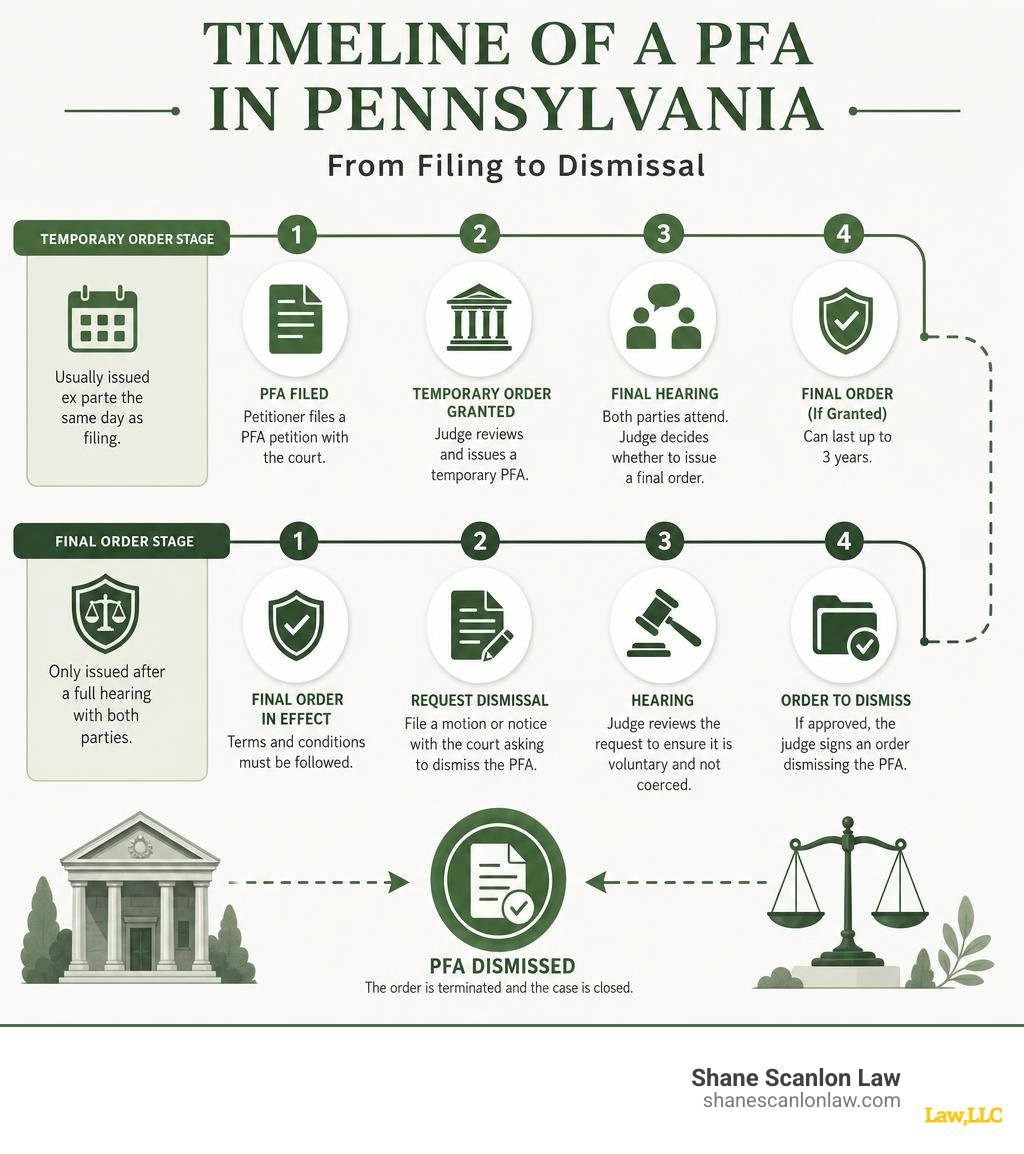
The timeline for dropping a pfa depends heavily on what stage the case is in. If you are dealing with a Temporary PFA, the process can move relatively quickly. In Pennsylvania, temporary PFA orders last roughly ten days until the final hearing is scheduled. If the plaintiff decides they do not want to pursue the matter, they can request a dismissal at or before that ten-day hearing.
However, if a final PFA order has already been issued—which typically lasts for at least three years and can be extended an unlimited number of times—the timeline slows down. If you file a petition to modify or dismiss a final order, the court must schedule a new hearing. Depending on the county’s docket backlog in 2026, this hearing could be scheduled weeks or even months away.
If a hearing is months away and the parties need immediate relief (for example, to coordinate housing or child custody), an attorney can file a motion for an expedited or immediate hearing, though there is no guarantee the court will grant it. For a deeper look at navigating this timeline, see Lifting a PFA Order: A Guide to Moving On in PA.
The Court’s Discretion: Can a Judge Refuse to Dismiss?
Yes, a judge can absolutely refuse to drop a PFA. This is one of the most surprising aspects of the process for many families. Even if both the plaintiff and the defendant stand before the judge hand-in-hand and ask for the order to be lifted, the court has the final say.
The judge’s primary concern is coercion. The court must screen the plaintiff to ensure they are not being threatened, pressured, or financially blackmailed into dropping the protection order. If the judge suspects that the defendant has pressured the plaintiff to request the dismissal, or if the history of abuse is severe enough that the judge believes the plaintiff remains in imminent danger, the motion to dismiss will be denied.
To learn more about the legal limits of dropping these orders, you can read about the baseline rules in Can a Temporary PFA Be Dropped in Pennsylvania? – Law Basics.
Temporary vs. Final Orders: Steps and Required Forms

The exact steps and required paperwork to dismiss a PFA depend entirely on whether the order is a temporary (ex parte) order or a final, multi-year order. Misunderstanding these differences can lead to filing the wrong forms and delaying your case. To get a clear picture of how these two stages differ, check out The Pennsylvania PFA Process Explained.
Filing a Motion to Dismiss a Temporary PFA
If a temporary PFA was recently issued and the final hearing has not yet occurred, the plaintiff can withdraw the petition before the court date.
To do this, the plaintiff must:
- Go to the courthouse where the temporary PFA was filed (usually the Prothonotary’s office or the domestic relations division).
- Request and complete a Notice of Dismissal or a Petition to Withdraw.
- Present the form to the court clerk, who will route it to a judge for review.
- Appear before a judge or court master, if required, to confirm that the withdrawal is voluntary.
For those looking at the initial paperwork required to set up or understand these filings, reviewing the How to File a Petition for a Temporary Protection from Abuse Order packet from Lackawanna County can provide valuable context on how the court structures these petitions from day one.
Modifying or Terminating a Final PFA Order
Once a judge has signed a Final PFA Order, the legal standard for dismissing it rises significantly. Under Pennsylvania law, specifically Section 6108(d) and Section 6117(a) of the Protection from Abuse Act, either party may petition the court to modify, amend, or terminate a PFA order during its pendency.
To dismiss a final order, the following steps must be taken:
- File a Petition to Modify or Terminate: The plaintiff (or the defendant, though it is highly recommended the plaintiff initiates or consents) must file a formal petition with the clerk of courts.
- Serve the Opposing Party: The petition must be formally served on the other party so they have notice of the requested change.
- Attend a Evidentiary Hearing: The court will schedule a hearing where both parties must testify. The judge will evaluate the current circumstances, whether the environment is safe, and whether any reconciliation is genuine and free of duress.
Unlike civil cases where a simple Rule 229 discontinuance can easily end a lawsuit before trial, a final PFA requires a judicial order to be dissolved. You can explore the mechanics of this specific motion in our detailed guide on Modifying or Terminating a PFA.
County-Specific Procedures and Where to File
While the Protection from Abuse Act is a state-wide Pennsylvania law, local county courts have their own specific administrative procedures, filing locations, and hours. If you live in Northeastern Pennsylvania (NEPA), you must file in the county where the original PFA was issued.
- Lackawanna County: Filings are handled through the Family Court department and the Prothonotary’s office in Scranton. You can learn more about local court expectations in our resource on Protection From Abuse in Lackawanna County.
- Luzerne County: In Wilkes-Barre, PFA petitions and dismissal requests are processed through the PFA department. You can find their official directory and instructions at Protection From Abuse | Luzerne County, PA.
- Wyoming County: If your case is in Tunkhannock, filings go through the Wyoming County Prothonotary. Their local guidelines can be accessed at Prothonotary – Clerk of Courts and Clerk of Orphans Courts.
- Susquehanna County: In Montrose, the court administration and local victim advocates work closely to handle these petitions.
While some counties like Lehigh County use highly specific digital portals (such as their own online PFA dismissal links), NEPA counties rely heavily on in-person filings at the Prothonotary’s office followed by a scheduled appearance before a Court of Common Pleas judge.
Risks, Coercion, and the Consequences of Informal Agreements
One of the most dangerous mistakes a defendant can make is relying on an “informal agreement.” If a plaintiff tells a defendant, “I called the courthouse and told them to drop it, so you can come back home,” but the judge has not signed a formal dismissal order, the PFA remains 100% active and enforceable.
PFAs are strict liability orders. This means that if the defendant contacts the plaintiff—even if the plaintiff initiated the contact, invited the defendant over, or sent a friendly text message—the defendant is committing a crime.
A first violation of a PFA order carries severe consequences under Pennsylvania law:
- Up to 6 months in jail
- A fine of up to $1,000
- Potential extension of the PFA order for several more years
If the police are called to a residence and find a defendant there, they are legally required to arrest the defendant for indirect criminal contempt, regardless of whether the plaintiff wants them arrested.
Impact on Custody, Child Support, and Criminal Charges
Dropping a PFA does not happen in a vacuum. It often has a massive ripple effect on other family law and criminal matters:
- Child Custody and Visitation: Temporary PFAs often contain temporary custody provisions. If the PFA is dropped, those temporary custody terms disappear. The parties must then rely on existing custody orders, or file a new custody complaint in family court.
- Child Support: If the PFA ordered temporary child support or spousal maintenance, dismissing the PFA will terminate those temporary financial orders, requiring the parties to file through the domestic relations office instead.
- Criminal Charges: If the incident that triggered the PFA also resulted in criminal charges (such as simple assault, harassment, or terroristic threats), dropping the civil PFA will not dismiss the criminal charges. The District Attorney’s office prosecutes criminal charges, not the victim. Even if the victim requests to drop the criminal case, the DA can—and often will—continue to prosecute the defendant.
For those navigating these overlapping issues in Susquehanna County, the Victim/Witness Office can provide guidance on how criminal cases proceed independently of civil protection orders.
Safety Considerations Before Dropping a PFA
Before making the decision to drop a PFA, safety must be the primary consideration. If you are a plaintiff considering dropping an order, ask yourself:
- Is my desire to drop this order truly voluntary, or am I facing financial, emotional, or physical pressure?
- Do I have a comprehensive safety plan in place if the behavior resumes?
- Have I spoken with a local domestic violence advocate or a knowledgeable family law attorney?
Additionally, filing a PFA based on false allegations simply to gain an advantage in a custody battle or divorce is a serious offense. If a court discovers that a plaintiff filed a completely fraudulent PFA, they could potentially face criminal charges for unsworn falsification to authorities.
Frequently Asked Questions about Dismissing a Protection Order
| Feature / Requirement | Temporary PFA Dismissal | Final PFA Dismissal / Modification |
|---|---|---|
| Who Can File | Plaintiff (Petitioner) | Either Plaintiff or Defendant |
| Typical Form Used | Notice of Dismissal / Petition to Withdraw | Petition to Modify or Terminate under § 6108(d) |
| Court Hearing Required | Sometimes (often resolved quickly or at the 10-day hearing) | Yes, a formal evidentiary hearing is mandatory |
| Coercion Screening | Minimal to Moderate | Intensive judicial review |
| Impact on Firearms | Returns weapons if dismissed (subject to PICS check) | Returns weapons if dismissed (subject to PICS check) |
Can a dismissed PFA be refiled later?
Yes, but there are strict legal limitations. In Pennsylvania, plaintiffs are only allowed to file two PFAs within a twelve-month period. This rule is designed to prevent abuse of the court system.
If a PFA is dismissed, it can only be refiled if there are fresh allegations of abuse or a new, distinct threat of violence. The court will evaluate the new petition entirely on its own merits. You cannot simply refile the exact same petition with the same historical allegations if a judge has already dismissed it.
What happens if my motion to dismiss is denied?
If a judge denies a motion to dismiss a PFA, the existing order remains fully in effect. The defendant must continue to follow every single restriction—including no contact, staying away from the shared home, and relinquishing firearms.
If your motion is denied, your next step should be to consult with an experienced attorney. We can help you identify why the judge denied the motion (e.g., lack of clear evidence, safety concerns, or procedural errors) and help you prepare for a subsequent petition to modify or appeal the decision if appropriate.
Do I have to relinquish firearms if the PFA is dropped?
Under Pennsylvania’s Act 79, any individual served with a PFA that includes a firearm restriction must relinquish all firearms, ammunition, and other weapons to the sheriff, a licensed dealer, or a commercial armory within 24 hours of service.
If the PFA is formally dropped or expires, those firearms are not automatically handed back. Under the guidelines enforced by the Pennsylvania State Police, the defendant must go through a formal return process.
This process requires:
- Proof of the court order dismissing or vacating the PFA.
- A clean Pennsylvania Instant Check System (PICS) background check to ensure the defendant is not otherwise prohibited from owning firearms.
For detailed instructions on how to legally manage these weapons during and after a PFA, refer to the Commonwealth’s guide on how to Relinquish Firearms in Accordance with the Pennsylvania Protection from Abuse Act or Conviction of a Misdemeanor Crime of Domestic Violence | Commonwealth of Pennsylvania.
Conclusion
Navigating the PFA process in Pennsylvania is emotionally exhausting and legally complex. Whether you are a plaintiff looking to safely withdraw an order to reunite your family, or a defendant trying to clear your name and protect your rights, attempting to handle this process without professional legal counsel is highly risky. One wrong step can lead to criminal charges, a permanent record, or the loss of your constitutional rights.
At Shane Scanlon Law, we provide fierce, trusted local representation across Lackawanna, Luzerne, Wyoming, and Susquehanna counties. As a former District Attorney with over two decades of courtroom experience in Northeastern Pennsylvania, I understand how local judges and prosecutors evaluate these cases. We can help you navigate the system safely, legally, and effectively.
If you need assistance with modifying, defending, or dropping a PFA, do not leave your future to chance. Reach out to us today to schedule a confidential consultation.