
 Call Anytime
833.722.6566
Call Anytime
833.722.6566
How to Survive Your Final Protection From Abuse Hearing

What You Need to Know Before Your Final Protection From Abuse Hearing
A final protection from abuse hearing is one of the most important court dates you will face. The outcome can change where you live, who has custody of your children, and whether you have long-term legal protection.
Here is a quick overview of what to expect:
- What it is: A court hearing where a judge decides whether to issue a long-term Protection From Abuse (PFA) order
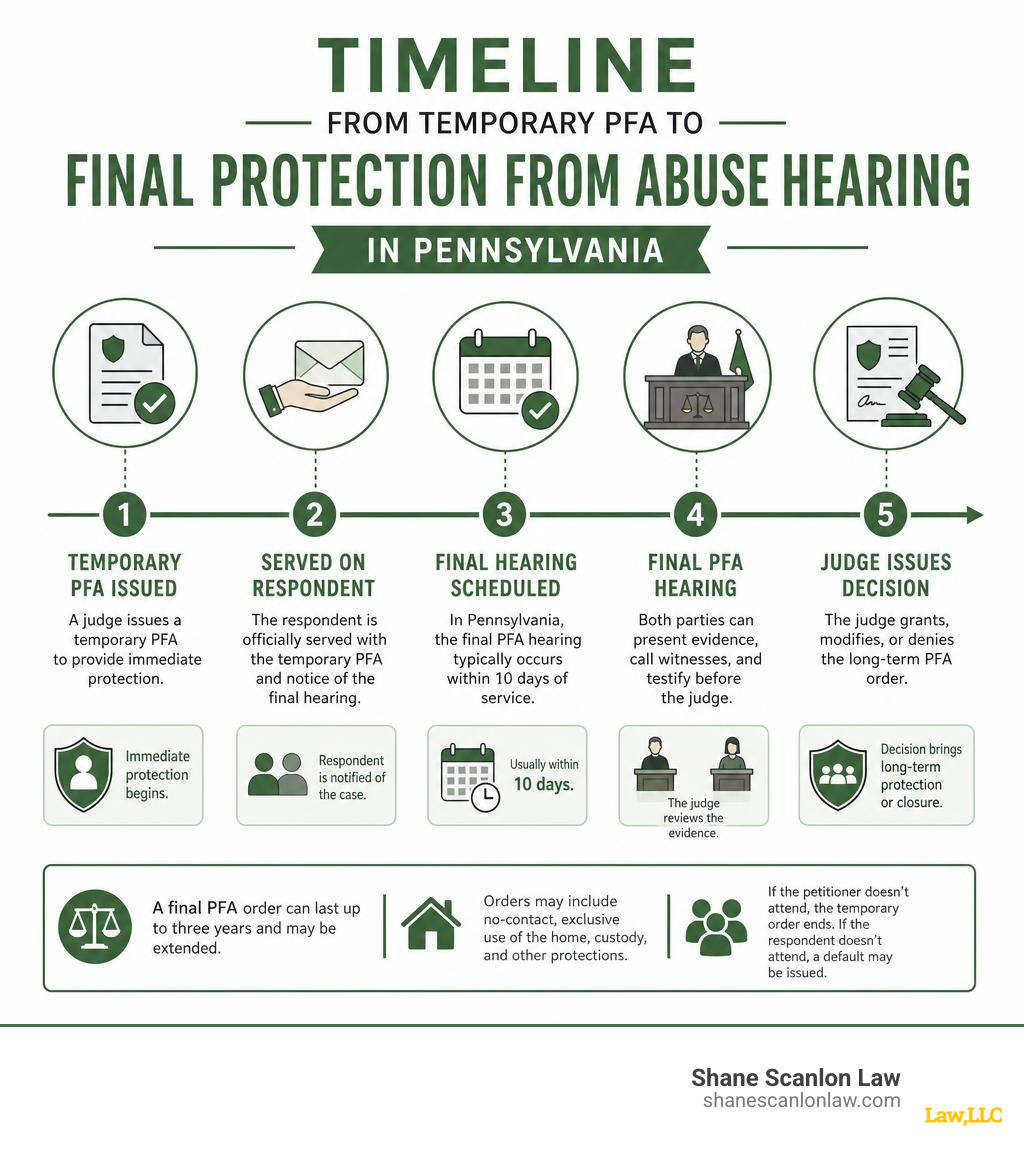
- When it happens: In Pennsylvania, typically within 10 days of a temporary PFA being served on the defendant
- Who can attend: Both the petitioner and the respondent have the right to appear, present evidence, and testify
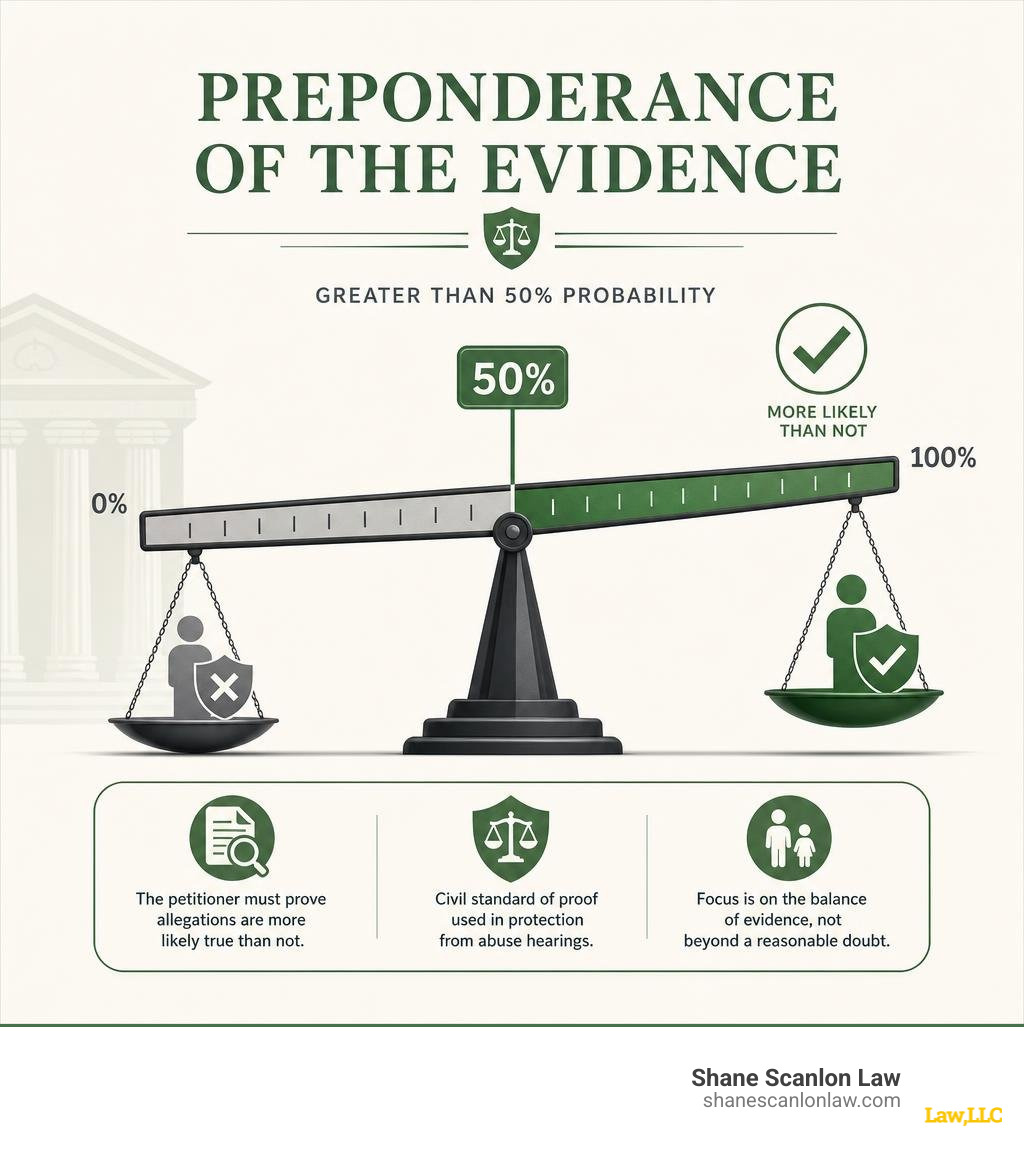
- Burden of proof: The petitioner must prove abuse occurred by a “preponderance of the evidence” — meaning it is more likely true than not
- What is at stake: No-contact orders, exclusive use of the home, temporary child custody, firearm restrictions, and more
- If you skip it: Petitioners who do not attend lose their temporary order immediately. Defendants who do not show up may face a default judgment against them
- How long it lasts: In Pennsylvania, a final PFA order can last up to three years and may be extended
This guide walks you through every step — from gathering evidence to walking into the courtroom — so you are not caught off guard.
I’m Shane Scanlon, founder of Shane Scanlon Law and a former Lackawanna County District Attorney with over 20 years of courtroom experience in Pennsylvania. My background on both sides of the justice system gives me a direct understanding of how judges evaluate evidence and make decisions at a final protection from abuse hearing. Whether you are seeking protection or responding to a petition, the sections below will help you prepare.
Terms related to final protection from abuse hearing:
- protection from abuse act pennsylvania
- protection from abuse defense attorney
- protection from abuse lawyer scranton
What is a Final Protection from Abuse Hearing?

A final protection from abuse hearing is a formal civil court proceeding where a judge determines whether a long-term Protection From Abuse (PFA) order should be granted. In Pennsylvania, this hearing takes place in the Court of Common Pleas. If you live in Lackawanna, Luzerne, Susquehanna, or Wyoming County, your case will be heard by a judge at your county’s courthouse.
Unlike the initial emergency or temporary PFA, which is granted ex parte (meaning the judge only hears from the petitioner to provide immediate, short-term safety), the final hearing is a full trial. This means both the petitioner (the person seeking protection) and the defendant (the person accused of abuse) have a constitutional right to be present, present physical evidence, call witnesses, and cross-examine each other.
To understand the progression of these legal steps, it is helpful to look at the entire PFA Hearing Process From Petition To Final Order. Generally, once a temporary PFA is issued and served on the defendant by the sheriff, a final hearing must be scheduled. Under Pennsylvania law, this trial is typically set within 10 business days of the filing date. For more details on the state’s court-mandated processes, you can review the resources provided by the Unified Judicial System of Pennsylvania on Protection Orders | Learn.
The Purpose of a Final Protection From Abuse Hearing
The primary purpose of this hearing is to establish long-term safety and boundaries. If the judge finds that abuse occurred, they will issue a final PFA order to prevent future contact and harassment.
However, a final PFA is not just a simple stay-away mandate. It acts as a powerful legal tool that can reshape domestic relations. In practice, a final PFA order can function similarly to a temporary legal separation. The judge has the authority to make major decisions regarding:
- Who gets to live in the shared family residence (and who must move out immediately).
- Who keeps the family car and other personal property.
- Temporary child custody and visitation parameters.
- Direct financial support or emergency maintenance for a spouse or children.
Because these outcomes have immediate, life-altering consequences, the court treats these hearings with the utmost seriousness.
What Happens if a Party Fails to Attend the Final Protection From Abuse Hearing?
Showing up to your scheduled court date is not optional. The legal consequences of missing the hearing are swift and severe for both sides:
- If the Petitioner fails to attend: The temporary PFA order will immediately expire and be dismissed. The court will not grant a final protective order, and the petitioner loses all court-ordered protections. Additionally, missing the hearing without a highly compelling reason makes it much more difficult to obtain a temporary PFA in the future, as the court may question the urgency or credibility of subsequent petitions.
- If the Defendant fails to attend: If the defendant was properly served with notice of the hearing and fails to appear, the judge will not postpone the case to wait for them. Instead, the judge will likely move forward with a default hearing. Based solely on the petitioner’s testimony and evidence, the judge can issue a final PFA by default, granting all requested relief—including eviction from the home, loss of child custody, and firearm relinquishment.
The Legal Standard and Burden of Proof in Court
Because a PFA is a civil matter rather than a criminal prosecution, the court uses a lower standard of proof than “beyond a reasonable doubt.”
In a final protection from abuse hearing, the legal standard of proof is the preponderance of the evidence. This means the petitioner must prove that their allegations of abuse are more likely true than not (essentially, a greater than 50% probability).
While a civil standard is easier to meet than a criminal one, a judge will not grant a final order based on vague accusations. The court must look closely at the credibility of both parties and the weight of the evidence presented. To understand the exact definitions of abuse and the statutory framework governing these decisions, you can read the full text of the Chapter 61. – Title 23 – DOMESTIC RELATIONS statute. For a practical breakdown of how this standard plays out in local courts, check out The Ultimate Pennsylvania Pfa Survival Guide.
Presenting Evidence and Witness Testimony
Relying solely on “he-said, she-said” testimony is risky for both petitioners and defendants. To meet or defeat the preponderance of the evidence standard, you must gather and organize physical and digital evidence.
Admissible evidence in a PFA hearing includes:
- Digital Communications: Text messages, emails, social media messages, and voicemail recordings.
- Physical & Medical Evidence: Photos of physical injuries, photos of damaged household property or torn clothing, police reports, and medical or hospital records.
- Live Witness Testimony: Eyewitnesses who personally saw or heard the abusive behavior.
It is crucial to understand that written affidavits from witnesses are generally not accepted as evidence in a final hearing. Because the opposing party has a constitutional right to cross-examine witnesses, any witness you want the judge to consider must physically attend the hearing and testify under oath.
If a key witness is hesitant to attend or needs legal clearance to miss work, you can request that the court clerk or your attorney issue a formal court summons. For detailed step-by-step guidance on organizing your exhibits and preparing witnesses, read the guide on Preparing for the Final Protective Order Hearing.
What a Final PFA Covers and How to Prepare

If the judge rules in favor of the petitioner, the final PFA order can include highly customized terms designed to protect the victim and any minor children. These terms carry the full weight of the law, and violating any of them can result in immediate arrest and criminal charges.
A final PFA order in Pennsylvania can include:
- Strict No-Contact Provisions: Prohibiting the defendant from calling, texting, emailing, messaging on social media, or sending messages through third parties.
- Stay-Away Mandates: Ordering the defendant to stay a specific distance away from the petitioner’s home, workplace, school, or local relatives.
- Exclusive Possession of the Residence: Ordering the defendant to move out of a shared home immediately, regardless of whose name is on the lease or deed.
- Temporary Division of Property: Awarding the petitioner temporary use of a joint vehicle or specific personal belongings.
- Emergency Financial Support: Ordering the defendant to pay temporary child support or spousal maintenance to ensure the petitioner is not financially stranded.
For defendants, understanding these outcomes is critical, as a final order has long-lasting professional and personal repercussions. You can read more about these impacts in our guide on the Legal Consequences For The Accused PFAS.
Child Custody and Visitation Protocols
When the petitioner and defendant share minor children, the final PFA hearing will address temporary child custody and visitation. The court’s primary focus is always the safety and well-being of the children.
The judge can establish highly specific visitation protocols, including:
- Supervised Visitation: Requiring that all visits between the defendant and the children be supervised by a trusted, mutually agreed-upon third party or a professional agency.
- Monitored Exchange Programs: Requiring that child drop-offs and pick-ups occur at neutral, safe locations, such as a local family services center or a police station parking lot, to prevent face-to-face conflict between the parents.
- Communication Restrictions: Limiting all parental communication strictly to child-related logistics, often mandating the use of specific co-parenting apps where all messages are recorded and visible to the court.
Firearm Restrictions Under Federal and State Law
One of the most immediate and non-negotiable consequences of a final PFA order involves firearm ownership.
Under the federal Lautenberg Amendment (18 U.S.C. § 922(g)(8)), once a qualifying protective order is issued after a hearing where the respondent had notice and an opportunity to be heard, the respondent is federally prohibited from possessing, shipping, or receiving any firearms or ammunition.
In Pennsylvania, the law is equally strict. Upon the issuance of a final PFA order, the defendant is subject to the mandatory relinquishment of all firearms, other weapons, and ammunition in their possession or control. These items must be surrendered to the local sheriff’s department or a licensed firearms dealer within the timeframe ordered by the court (often 24 hours). There is no judicial discretion on this matter; a final finding of abuse triggers this restriction automatically.
Logistical and Safety Preparation for Court
Walking into a courthouse for a final protection from abuse hearing can be stressful. Proper logistical planning can ease anxiety and keep you safe.
- Arrive Early: Plan to arrive at the courthouse at least 30 to 45 minutes before your scheduled hearing. This gives you plenty of time to go through security, locate your courtroom, and avoid running into the other party in the parking lot or lobby.
- Dress Professionally: Wear clean, conservative clothing (such as business casual attire). Avoid extremely casual wear, shorts, t-shirts, or clothing with controversial graphics. Showing respect for the court through your appearance helps your credibility.
- Bring a Support Person: Most Pennsylvania courts allow you to bring a supportive friend, family member, or domestic violence advocate to sit near you in the gallery. While they cannot speak for you or act as your lawyer, their physical presence can provide emotional comfort.
- Prepare Your Digital Devices: If you plan to present text messages, emails, or photos from your cell phone, you must print them out beforehand. You cannot simply hand your phone to the judge, as the court must keep physical copies of all admitted evidence in its permanent file.
For more courtroom logistics and behavioral expectations, read What Happens at a Protective Order Hearing? What to Expect in Court – Law Interpretation.
Navigating the Courtroom Structure
PFA hearings follow a structured, orderly process. Understanding this sequence of events can keep you calm and focused:
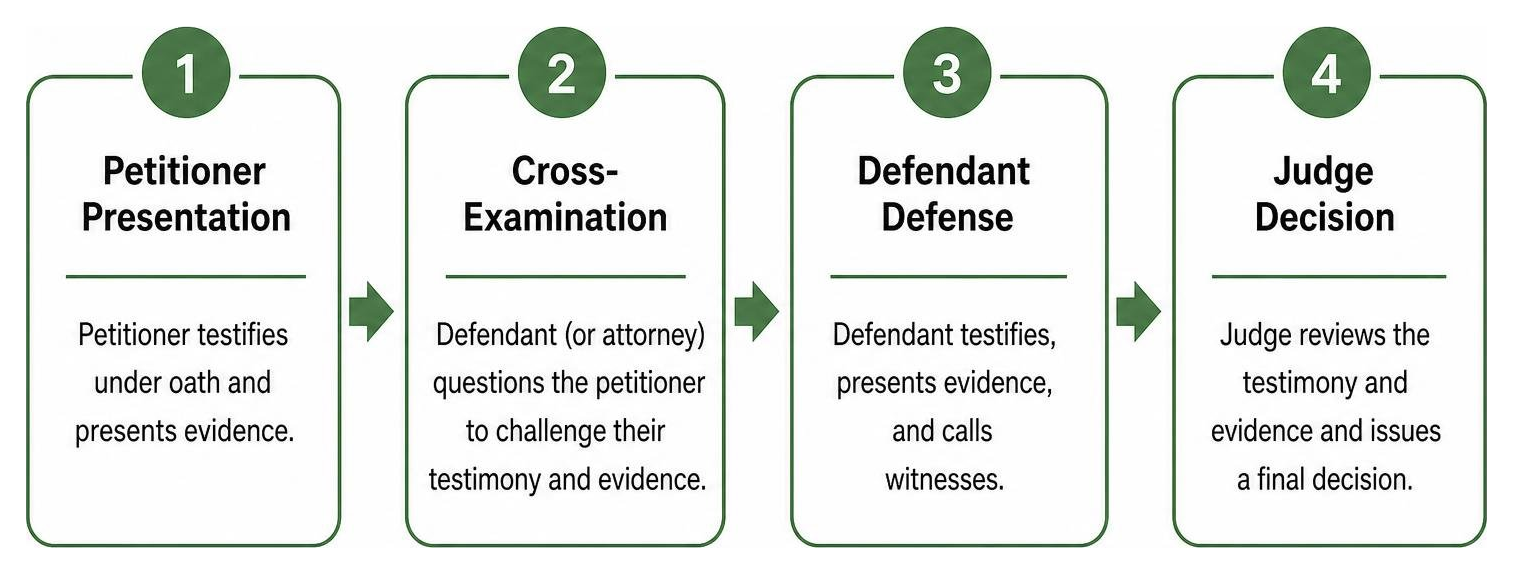
- The Petitioner’s Case: Because the petitioner bears the burden of proof, they present their case first. The petitioner will testify under oath, describing the specific events of abuse.
- Cross-Examination: Once the petitioner finishes testifying, the defendant (or their attorney) has the right to cross-examine them by asking questions designed to challenge their timeline, consistency, or credibility.
- Petitioner’s Witnesses & Evidence: The petitioner then calls their witnesses and introduces physical evidence (photos, text messages, etc.). The defendant has the right to cross-examine each witness.
- The Defendant’s Case: The defendant then takes the stand to present their side of the story, present their own evidence, and call their own witnesses.
- Cross-Examination of the Defendant: The petitioner (or their attorney) cross-examines the defendant and their witnesses.
- The Judge’s Decision: After hearing all testimonies and reviewing the physical evidence, the judge will issue a ruling, usually on the same day.
If either party shows up to court unprepared, or if one party unexpectedly hires a lawyer and the other needs time to find representation, they can ask the judge for a continuance (a formal request to postpone the hearing to a later date). To learn more about how to handle unexpected courtroom situations, read Order In The Court Challenging Pfa Allegations In Scranton.
Frequently Asked Questions About PFA Hearings
How long does a final PFA order last in Pennsylvania?
In Pennsylvania, a final PFA order can last for a fixed period of up to three years. However, if the petitioner remains in reasonable fear of abuse as the expiration date approaches, they can petition the court to extend or renew the order. In cases involving severe, repeat offenses, or if the defendant is convicted of a serious crime related to the abuse, the court can extend the protection indefinitely.
Can a final PFA order be modified, appealed, or dismissed?
Yes. A final PFA is a binding legal order, but it is not entirely set in stone:
- Modification: Either party can petition the court to modify the terms (such as adjusting custody exchange locations or communication boundaries) if there has been a significant change in circumstances.
- Appeals: If a defendant wants to challenge the judge’s final ruling, they have two main legal paths. They can file a Motion for Reconsideration with the local Court of Common Pleas within 10 days of the order, or they can file a formal appeal to the Pennsylvania Superior Court within 30 days.
- Dismissal: Only a judge can officially dismiss or lift a final PFA. Even if the petitioner decides they want to reconcile and “drop” the order, the PFA remains active and legally enforceable until a judge signs an official order dismissing it. If you are looking to navigate this process, read our detailed guide on Lifting A Pfa Order A Guide To Moving On In Pa.
Do I need a lawyer for a final PFA hearing?
While the law does not strictly require you to have an attorney, navigating a final protection from abuse hearing without legal representation puts you at a significant disadvantage.
Courtrooms are governed by strict rules of evidence, civil procedures, and cross-examination protocols. If the other party shows up with an experienced trial lawyer and you are representing yourself, you may struggle to get your evidence admitted or properly cross-examine witnesses. Having a skilled advocate by your side ensures your rights are protected, your evidence is properly presented, and your voice is heard. If you are preparing for an upcoming court date in NEPA, read our guide on how to find the right advocate: Need A Pfa Lawyer In Scranton Here Is Your Guide.
Conclusion
Whether you are seeking long-term safety from an abuser or defending yourself against false allegations, a final protection from abuse hearing is a high-stakes legal battle. The decisions made in that courtroom will impact your home, your children, and your freedom for years to come. You should not have to face this challenging process alone.
At Shane Scanlon Law, we provide strong, strategic, and compassionate representation to clients throughout Northeastern Pennsylvania, including Lackawanna, Luzerne, Susquehanna, and Wyoming counties. As a former District Attorney with over 20 years of local courtroom experience in Scranton and Wilkes-Barre, Shane Scanlon understands how Pennsylvania judges evaluate PFA cases and how to build a powerful courtroom strategy for you.
We are here to stand by your side, protect your family, and fight for the best possible outcome. Contact us today to schedule a confidential consultation and take control of your legal future.
To learn more about how we can help you navigate your PFA case, visit our Shane Scanlon Law PFA Services page.