
 Call Anytime
833.722.6566
Call Anytime
833.722.6566
Accused of Abuse? Why You Need a PFA Defense Attorney

When a PFA Is Filed Against You, Every Hour Counts
If you are searching for a protection from abuse defense attorney, here is what you need to know right now:
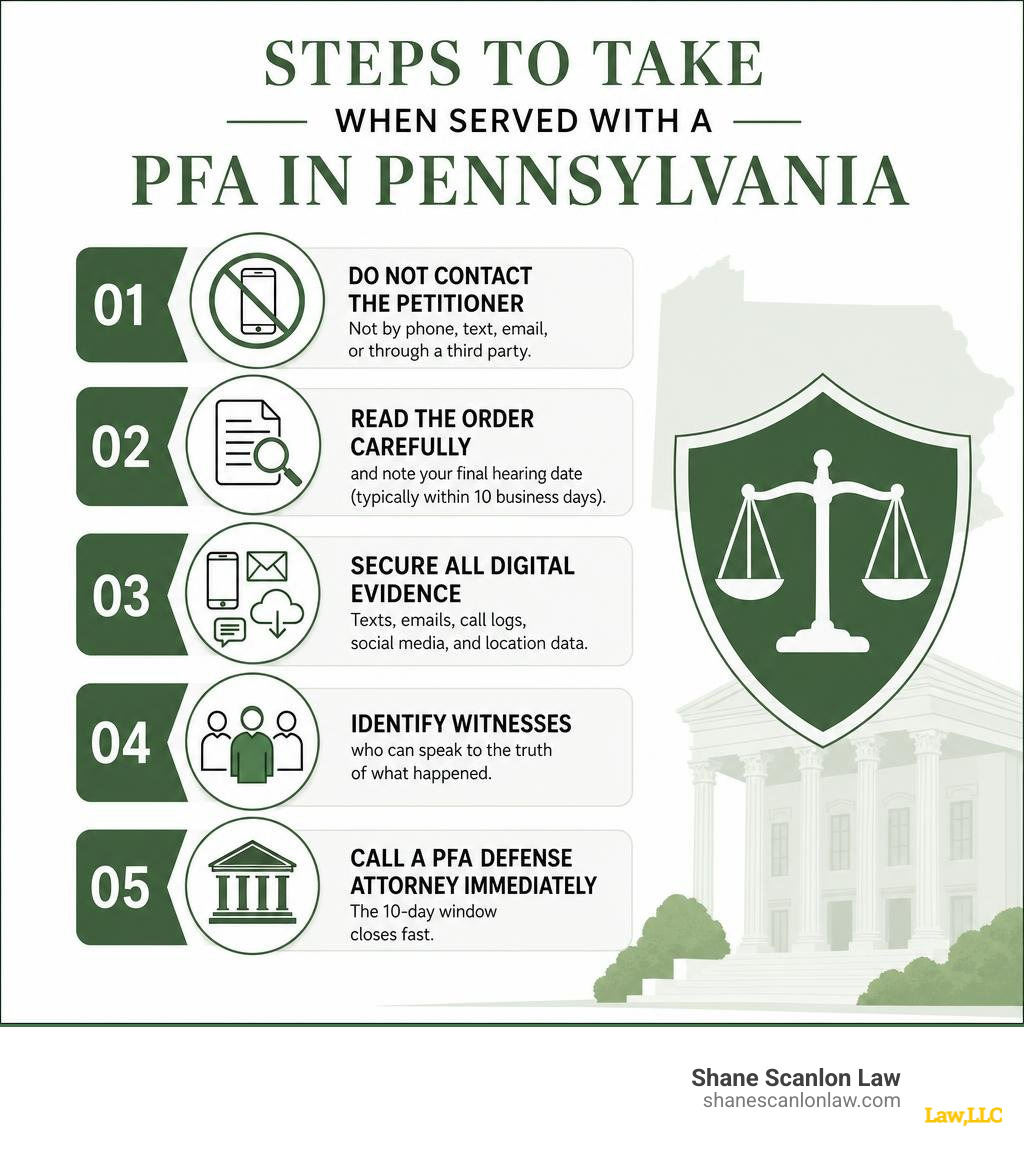
Immediate steps after being served with a PFA in Pennsylvania:
- Do not contact the petitioner — not by phone, text, email, or through a third party
- Read the order carefully and note your final hearing date (typically within 10 business days)
- Secure all digital evidence — texts, emails, call logs, social media, and location data
- Identify witnesses who can speak to the truth of what happened
- Call a PFA defense attorney immediately — the 10-day window closes fast
A Protection from Abuse order in Pennsylvania can remove you from your home, cut off access to your children, force you to surrender your firearms, and appear on background checks — all before you have said a single word to a judge. That is how the process works. The initial order is issued ex parte, meaning the court hears only the petitioner’s side.
The stakes are real. A final PFA order can last up to three years and carry consequences that reach into your job, your professional licenses, and your parental rights. And if the allegations are false or exaggerated — as they sometimes are, particularly in contentious divorces or custody disputes — you need to act fast to protect yourself.
I’m Shane Scanlon, founder of Shane Scanlon Law and a former Lackawanna County District Attorney with over 20 years of trial experience on both sides of the courtroom. I have built my practice as a protection from abuse defense attorney in Scranton and throughout Northeast Pennsylvania, using the same insider knowledge of local courts and judges that I developed as a prosecutor to fight hard for the accused. The section below walks you through everything you need to know.
Protection from abuse defense attorney word list:
Understanding Pennsylvania PFA Orders vs. Restraining Orders
When people face allegations of domestic abuse, they often use the term “restraining order” as a catch-all phrase. However, in Pennsylvania, the legal system relies on a specific framework established under the Protection from Abuse Act. Understanding how these civil orders function and how they differ from other legal protections is the first step in building a strategic defense.
What is a Protection from Abuse (PFA) Order in PA?
A Protection from Abuse (PFA) order is a specialized civil court order issued under Pennsylvania law (23 Pa.C.S. § 6101 et seq.) designed to protect victims of domestic violence. However, a PFA is not available to just anyone. To qualify for a PFA, there must be a specific qualifying relationship between the petitioner (the person filing) and the respondent (the person accused).
Under the How Pennsylvania’s Protection from Abuse Act Keeps You Safe guidelines, qualifying relationships include:
- Current or former spouses
- Current or former sexual or intimate partners (including dating relationships)
- Family members related by blood or marriage (such as siblings, parents, or children)
- Individuals who share biological children
- Current or former household members who live together as a family unit
Furthermore, the petitioner must prove that “abuse” occurred as defined by Pennsylvania law. Under the statute, abuse is not limited to physical violence like hitting or kicking. It also includes:
- Placing another in reasonable fear of imminent serious bodily injury (threats of violence)
- False imprisonment or holding someone against their will
- Stalking or persistent harassment that places a person in reasonable fear of bodily injury
- Sexual assault or involuntary deviate sexual intercourse
If the relationship does not meet these criteria—such as a dispute between neighbors, coworkers, or strangers—a PFA cannot be filed. In those cases, individuals must look to other legal remedies, such as a Protection from Sexual Violence or Intimidation (PSVI) order or traditional civil injunctions.
PFA Orders vs. Restraining Orders: Key Differences
While a PFA functions similarly to what other states call a “restraining order,” Pennsylvania does not have a general “civil restraining order” for everyday personal disputes. If a neighbor is harassing you, you cannot simply go to family court and get a PFA.
The table below highlights the crucial differences between a PFA order and a standard civil restraining order:
| Feature | Protection from Abuse (PFA) Order | Civil Restraining Order / Injunction |
|---|---|---|
| Relationship Requirement | Strict (family, household, or intimate partners) | None (can be neighbors, strangers, or coworkers) |
| Governing Court | Family Court / Court of Common Pleas | Civil Court |
| Standard of Proof | Preponderance of the evidence (more likely than not) | Clear and convincing evidence (typically higher) |
| Firearm Restrictions | Mandatory relinquishment upon final order | Discretionary, rarely automatic |
| Enforcement | Immediate arrest for violations (criminal contempt) | Civil contempt or police intervention for trespass |
Because the PFA system is designed to act rapidly to protect family and household members, the entry barrier is relatively low. This ease of filing makes the system highly vulnerable to misuse, which is why having an experienced protection from abuse defense attorney on your side is critical.
The Severe Legal Consequences of a Pennsylvania PFA
Many defendants make the mistake of treating a PFA as “just a family matter.” Because PFA petitions are handled in civil court, some believe they do not carry the same weight as criminal charges. This is a dangerous misconception. The Legal Consequences for the Accused: PFAs are immediate, severe, and can permanently alter your life.

Impact on Child Custody, Divorce, and Support
One of the most devastating aspects of a PFA is how it interacts with ongoing family law matters. In Pennsylvania, a PFA judge has the authority to make temporary custody and child support determinations right on the spot. If a temporary PFA is granted, you can be completely cut off from your children without a full hearing.
This dynamic became even more complex with the implementation of Kayden’s Law (which went into effect in 2024). Kayden’s Law significantly alters how Pennsylvania courts handle child custody when abuse is alleged. It requires judges to prioritize child safety above all else, expanding the definition of abuse and placing strict limits on custody and visitation for any parent with a history of abusive behavior or an active PFA.
If a PFA is granted against you:
- Supervised Visitation: The court may strip you of unsupervised custody, requiring all visits with your children to be monitored by a professional or an approved third party.
- Losing Custody Leverage: In active divorce proceedings, a final PFA order can be used as leverage by the opposing party to secure a highly unfavorable permanent custody arrangement.
- Temporary Support Orders: The PFA judge can order you to pay temporary financial support to the petitioner, even before your formal support hearing in domestic relations.
For a deeper dive into these interactions, read The Legal Lowdown on PFAs: What You Need to Know About Protection from Abuse.
Consequences for Housing, Employment, and Firearm Rights
The consequences of a PFA extend far beyond your family structure. A final PFA order can strip you of your home, your career, and your constitutional rights in an instant:
- Immediate Eviction: If you share a residence with the petitioner, a PFA order can evict you immediately. It does not matter if your name is the only one on the deed or lease; the court will order you to pack a single bag of personal belongings and leave under police supervision.
- Mandatory Firearms Relinquishment: Under Pennsylvania law, a final PFA order requires you to immediately surrender all firearms, other weapons, and ammunition to the sheriff’s office or an approved third party. A federal law (the Lautenberg Amendment) also prohibits anyone subject to an active domestic violence protective order from possessing firearms. For hunters, gun owners, or law enforcement officers in Northeast Pennsylvania, this is a devastating blow.
- Career Damage and Professional Licensing: While a civil PFA does not give you a criminal record, final orders are entered into the Pennsylvania State Police (PSP) registry. Employers, landlords, and professional licensing boards (such as those for nurses, teachers, real estate agents, and commercial drivers) can easily find this information during background checks. This can lead to job loss, suspension of professional licenses, or denial of security clearances.
Navigating the Pennsylvania PFA Legal Process
Navigating the local legal system in Northeast Pennsylvania requires quick thinking and strict compliance with court procedures. Whether your case is heard at the Lackawanna County Courthouse in Scranton, the Luzerne County Courthouse in Wilkes-Barre, or the courthouses in Susquehanna and Wyoming Counties, the basic timeline remains the same. Understanding The Pennsylvania PFA Process Explained can keep you from making critical mistakes.
What to Do Immediately After Being Served with a PFA
The moment a sheriff’s deputy or police officer hands you a temporary PFA petition, your life is put on hold. What you do in the next 24 hours will directly impact your defense.
According to The Ultimate Pennsylvania PFA Survival Guide, you must immediately take the following actions:
- Obey the Order to the Letter: Even if the allegations are complete lies, do not attempt to contact the petitioner to “work things out.” If they text you, do not reply. If they call, hang up. Any contact—including liking a social media post or sending a message through a mutual friend—is a violation of the order and can result in immediate arrest.
- Secure Your Property Safely: If the PFA evicts you from your home, do not go back to get your things alone. You must request a police escort to accompany you to retrieve essential personal items.
- Preserve All Communication: Do not delete text threads, emails, or call logs. These digital records are often the single most powerful tools we have to prove your innocence.
- Retain Counsel Immediately: Do not wait until the day before your hearing to hire an attorney. Building a solid defense, subpoenaing records, and preparing witnesses takes time.
The Ex Parte Hearing and the Final PFA Hearing
The PFA process in Pennsylvania operates in two distinct stages:
- The Ex Parte (Temporary) PFA: When a petitioner files for a PFA, they go before a judge (or a magisterial district judge if it is after hours) for an ex parte hearing. “Ex parte” means only one party is present. The judge hears only the petitioner’s side of the story. Because the court errs on the side of safety, temporary PFAs are almost always granted based on the petitioner’s written statement alone.
- The 10-Day Window and the Final Hearing: Once you are served with the temporary PFA, the court must schedule a final hearing within ten business days. This is your first opportunity to present your defense. At the final hearing, both parties appear before a Court of Common Pleas judge. The petitioner must prove their case by a “preponderance of the evidence.” You have the right to testify, present physical evidence, call witnesses, and—most importantly—have your attorney cross-examine the petitioner.
For a step-by-step breakdown of how these hearings unfold in local courthouses, see our guide on the PFA Hearing Process: From Petition to Final Order.
How to Defend Against False or Exaggerated Abuse Allegations
It is a sad reality of family law that PFA orders are sometimes used as weapons. Spouses in contentious divorces or custody battles may file false or highly exaggerated petitions to gain exclusive possession of the marital home, secure temporary custody of children, or simply damage the other party’s reputation. If you are facing fabricated claims, you need to know Why You Need a Strong Lawyer to Fight False PFA Claims.

Gathering Crucial Evidence to Disprove False Claims
When defending against false PFA claims in Northeast Pennsylvania, your word against theirs is rarely enough. Courts look for objective, corroborating evidence. As your defense team, we work closely with you to gather and organize the following:
- Digital Communication Records: Text messages, emails, and direct messages on social media are incredibly powerful. If the petitioner claims you threatened them on a specific night, but text messages show a friendly, normal conversation, we can destroy their credibility.
- GPS and Location Data: Cell phone location history, Google Maps timelines, or security system logs can prove you were nowhere near the petitioner at the time of an alleged incident.
- Eyewitness Testimony: Friends, neighbors, coworkers, or family members who witnessed the interactions in question can provide vital testimony to counter false claims.
- Prior Inconsistent Statements: If the petitioner gave one story to the police and a completely different story in their PFA petition, we will expose those contradictions during cross-examination.
Every county has its own local rules and courtroom cultures. Having a local defense strategy tailored for Protection from Abuse in Lackawanna County or Luzerne County ensures your evidence is presented cleanly and in strict compliance with the Pennsylvania Rules of Evidence.
Criminal Penalties for Filing a Knowingly False PFA Petition
Filing a false PFA is not just unfair; it is a crime. Under Pennsylvania law, a petitioner who knowingly lies under oath in a written petition or during a court hearing can face severe criminal charges, including:
- Perjury (18 Pa.C.S. § 4902): A third-degree felony punishable by up to 7 years in prison.
- False Swearing (18 Pa.C.S. § 4903): A misdemeanor offense for making false statements under oath.
- Unsworn Falsification to Authorities (18 Pa.C.S. § 4904): A misdemeanor charge for misleading public officials.
- False Reports to Law Enforcement (18 Pa.C.S. § 4906): A misdemeanor for falsely implicating another in a crime.
While local prosecutors are sometimes hesitant to file these charges, exposing a petitioner’s lies in court is the fastest way to get your PFA dismissed and protect your record from permanent damage.
Why You Must Hire a Protection from Abuse Defense Attorney Immediately
Representing yourself in a PFA hearing is a massive gamble. The rules of evidence apply, the proceedings are , and the petitioner may have free legal representation provided by local advocacy groups or pro bono programs. To level the playing field, you need a dedicated advocate who knows how to navigate the system. Review The Definitive Guide to PFA Order to understand why professional representation is non-negotiable.
How a Protection from Abuse Defense Attorney Protects Your Rights
An experienced defense attorney does far more than just stand next to you in court. We take control of the entire process:
- Conducting a Thorough Investigation: We look for loopholes, inconsistencies, and ulterior motives in the petitioner’s filing.
- Mastering Cross-Examination: This is where cases are won or lost. As a former District Attorney, Shane Scanlon has spent over two decades cross-examining witnesses in high-stakes trials. We know how to ask the tough questions that reveal the truth without making the defendant look aggressive.
- Negotiating Consent Agreements Wisely: In some cases, fighting a PFA to the bitter end is not the best strategic move. We can sometimes negotiate a “civil agreement” or “consent order without a finding of abuse.” This allows you to resolve the matter with customized boundaries, avoiding a formal finding of abuse on your record and protecting your long-term rights.
The High Stakes of PFA Violations and Indirect Criminal Contempt
If a temporary or final PFA is active against you, any violation is treated as a criminal offense known as Indirect Criminal Contempt (ICC).
Under Pennsylvania law, a PFA Violation Defense Lawyer in Northeast Pennsylvania will tell you that the penalties for violating a PFA are severe:
- Up to 6 months in jail for each violation
- Fines of up to $1,000
- An extension of the active PFA order for up to an additional three years
Even a “technical” or accidental violation—such as running into the petitioner at a grocery store in Wilkes-Barre and not leaving immediately, or having a mutual friend send a text on your behalf—can result in your immediate arrest. Do not take chances. Let us help you keep your record clean and your freedom secure.
Frequently Asked Questions About PFA Defense in Pennsylvania
Navigating a PFA can be confusing. To help you understand your rights, we have compiled answers to some of the most common questions we hear at our firm. For a broader overview, check out PFA Explained: Everything You Need to Know About Protection Orders in Pennsylvania.
How long does a PFA order last in Pennsylvania?
A final PFA order in Pennsylvania can last for up to three years. The judge has the discretion to set the duration based on the severity of the allegations, meaning an order could be set for six months, one year, or the maximum three-year limit. For more details on how these timelines work, read No Contact Orders and PFAs Explained Without the Legal Jargon.
Can a PFA order be modified, extended, or lifted?
Yes. PFA orders are not set in stone.
- Modification: Either party can petition the court to modify the terms of the PFA (for example, to adjust custody exchange locations or allow communication regarding the children).
- Extension: The petitioner can request an extension before the order expires if they can demonstrate that the respondent engaged in a pattern of harassment or poses an ongoing threat.
- Lifting/Dismissal: If the parties reconcile, the petitioner cannot simply “drop” the PFA on their own. They must file a formal petition to vacate the order, and a judge must sign off on it. Learn more about this process in Lifting a PFA Order: A Guide to Moving On in PA.
Does a PFA show up on a background check or criminal record?
Because a PFA is a civil order, it does not give you a criminal record. However, it is entered into the statewide Pennsylvania State Police (PSP) registry. This database is accessible to law enforcement, and the active order will show up on standard background checks used by employers, landlords, and licensing boards. If you are facing a PFA in Lackawanna County, review our guide on Protection from Abuse in Scranton, PA to understand how to keep your public record clean.
Conclusion
Facing a PFA petition can feel incredibly isolating. Within a matter of hours, you can be forced out of your home, cut off from your family, and stripped of your basic rights. But you do not have to face this crisis alone. With the right legal strategy, you can tell your side of the story, expose false claims, and reclaim your life.
Choosing the Right Protection from Abuse Defense Attorney in Northeast Pennsylvania
When your home, your children, and your reputation are on the line, local experience matters. At Shane Scanlon Law, we defend clients facing PFA allegations in Scranton, Wilkes-Barre, and across Lackawanna, Luzerne, Susquehanna, and Wyoming Counties.
Led by Shane Scanlon, a former District Attorney with over 20 years of local courtroom experience, we bring a deep understanding of how local judges and prosecutors evaluate these cases. We know how to build a strong, evidence-backed defense to protect your rights.
If you have been served with a PFA, do not wait for the 10-day clock to run out. Protect your rights and secure your future with Shane Scanlon Law by contacting our Scranton office today for a free, confidential consultation.