
 Call Anytime
833.722.6566
Getting a PFA Order in Pennsylvania Made Simple
When You Need a PFA Order in PA: What You Should Know First
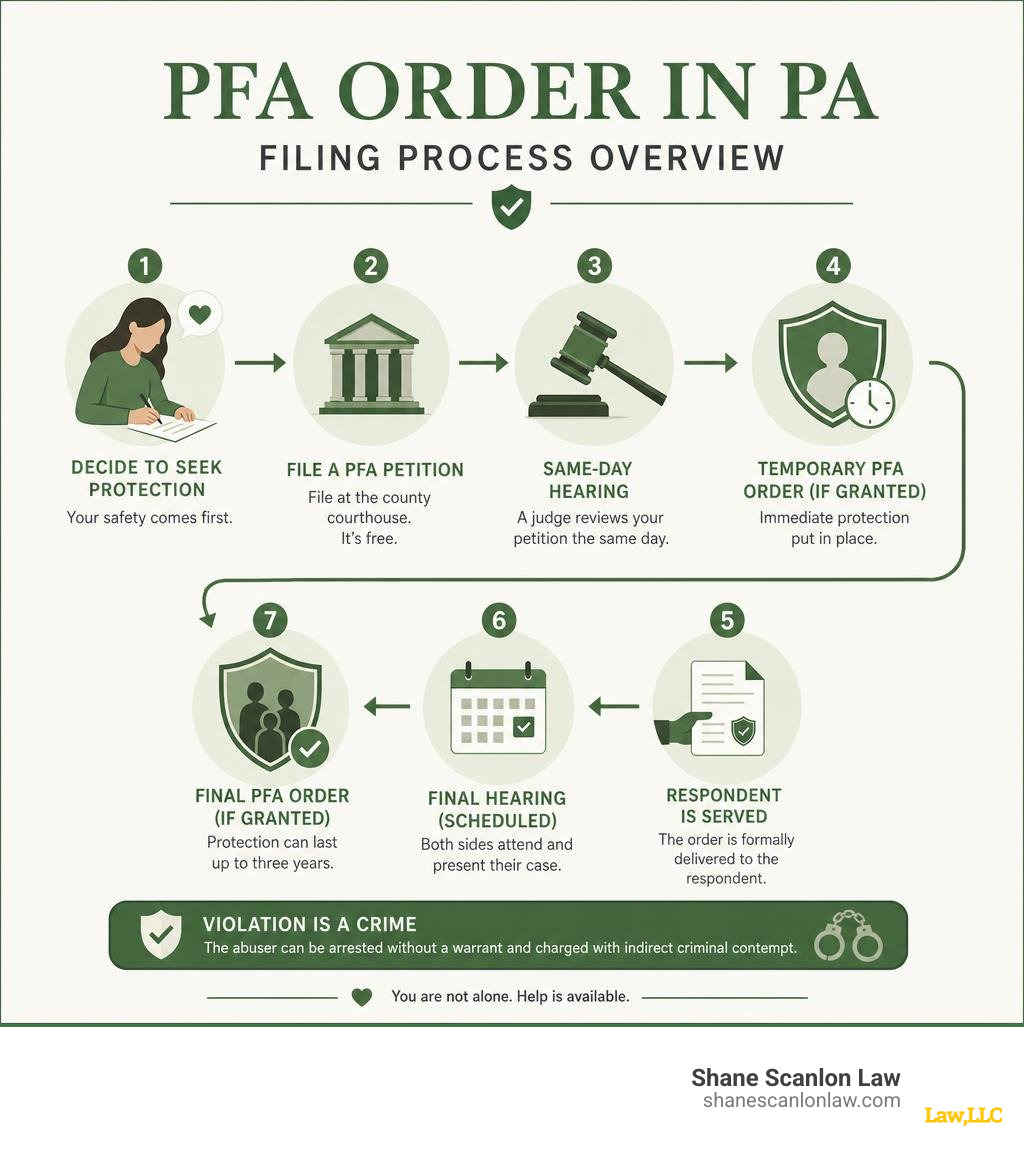
A PFA order in PA is a civil court order that tells an abuser to stop contact with you and, in most cases, leave your shared home. Here is what you need to know right away:
- What it is: A Protection from Abuse (PFA) order is a legal tool that protects victims of domestic abuse from further harm.
- Who can file: Spouses, ex-partners, family members by blood or marriage, and intimate partners.
- Cost: Free to file. Pennsylvania law prohibits charging victims any filing fees.
- How fast: A temporary order can be granted the same day you file. If courts are closed, an emergency order is available through an on-call magisterial district judge.
- How long it lasts: A final PFA order can remain in effect for up to three years.
- If violated: The abuser can be arrested without a warrant and charged with indirect criminal contempt.
Facing abuse is already overwhelming. Navigating the legal system on top of that can feel impossible. Whether you are trying to protect yourself and your children, or you have just been served with a PFA and do not know what comes next, understanding how this process works is the first step.
I am Shane Scanlon, founder of Shane Scanlon Law and a former Lackawanna County District Attorney with over 20 years of courtroom experience in Pennsylvania — including extensive work with PFA orders in PA at every stage, from filing to enforcement. This guide walks you through everything you need to know, clearly and without legal jargon.
Handy pfa order in pa terms:
Understanding the PFA Order in PA: Definition and Eligibility
If you are dealing with a volatile situation at home, the legal system can feel like a maze of complex rules and confusing courtrooms. To protect yourself effectively, you must understand what a PFA is, who qualifies, and what actions cross the line into legally defined abuse.
What is a Protection from Abuse (PFA) Order?
A Protection from Abuse (PFA) order is a civil court order issued under Pennsylvania’s Protection from Abuse Act (23 Pa.C.S. Chapter 61). It is designed to provide rapid, legally binding protective relief to individuals suffering from domestic violence.
Because it is a civil order rather than a criminal charge, the standard of proof required to obtain one is a “preponderance of the evidence” (meaning the abuse is more likely true than not), which is a lower threshold than the “beyond a reasonable doubt” standard used in criminal trials. However, violating a PFA carries severe criminal consequences. To understand the deeper legal mechanics behind these protections, you can read The Legal Lowdown on PFAs.
Who is Eligible to File for a PFA Order in PA?
You cannot file a pfa order in pa against just anyone. The law specifically restricts PFAs to “family or household members” or intimate partners. This means you can file against:
- Current or former spouses
- Current or former sexual or intimate partners (including dating relationships)
- Individuals who share biological parenthood
- Siblings, parents, children, or other relatives related by blood or marriage
A PFA is not the correct legal tool for disputes between roommates who have never been intimately involved, neighbors, coworkers, or strangers. If you need to know more about how these specific relationship requirements function under the law, check out How Pennsylvania’s Protection From Abuse Act Keeps You Safe.
Under the Act, any adult or emancipated minor can file a petition for themselves. Parents, adult household members, or legally appointed guardians can also file on behalf of minor children or incompetent adults. Crucially, leaving your shared home to escape violence does not impact your eligibility; under 23 Pa.C.S. § 6103, your right to seek relief remains completely intact even if you have fled the residence.
Types of Abuse Covered Under the PFA Act
Under Pennsylvania law, “abuse” is defined as specific intentional acts between household or family members. These acts include:
- Causing, or attempting to cause, physical bodily injury, rape, sexual assault, or involuntary deviate sexual intercourse.
- Placing another person in reasonable fear of imminent serious bodily injury (such as raising a hand to strike, brandishing a weapon, or making verbal death threats).
- False imprisonment (holding someone in a room or home against their will).
- Physically or sexually abusing minor children.
- Engaging in a course of conduct or repeatedly committing acts—such as stalking, constant unwanted surveillance, or harassment—that places the victim in reasonable fear of bodily injury.
To explore how Pennsylvania courts interpret these behaviors, you can review the detailed breakdown of Pennsylvania Restraining Order Laws (2026).
The Three Types of PFA Orders and Their Lifespans
The Pennsylvania court system recognizes that domestic violence crises do not keep regular business hours. To ensure immediate safety while protecting due process, the law establishes three distinct tiers of PFA orders.
Emergency PFA Orders
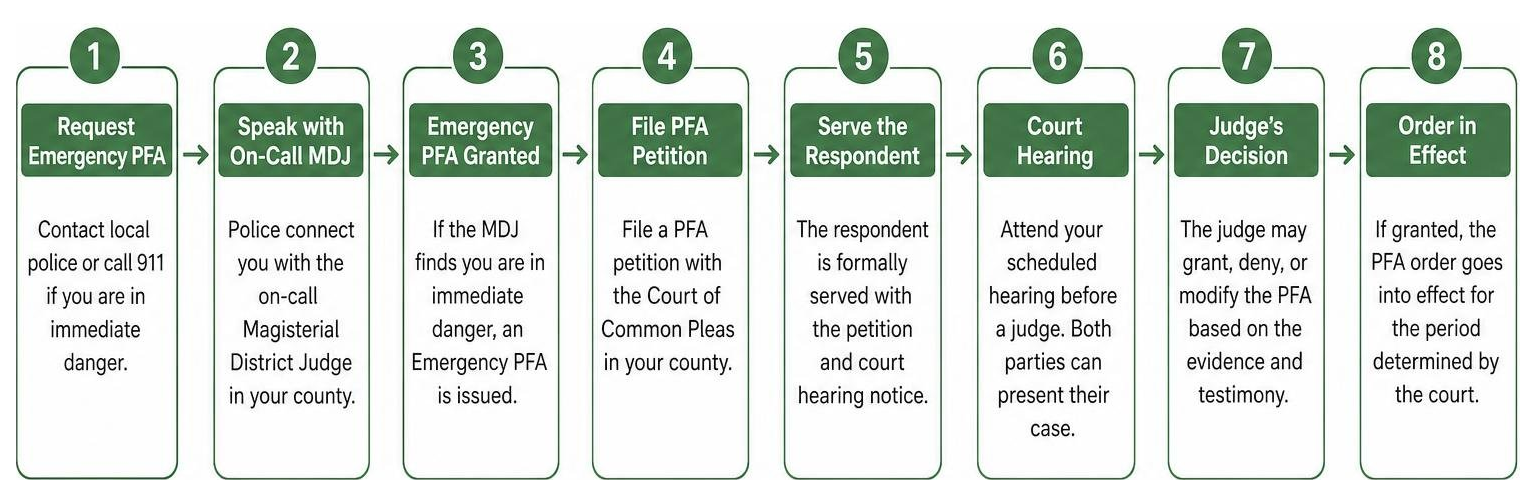
Abuse frequently escalates during nights, weekends, or holidays when the county Court of Common Pleas is closed. In these high-risk moments, an Emergency PFA (EPFA) can be requested.
To obtain an EPFA, you must contact your local police department or call 911. The police will connect you with the on-call Magisterial District Judge (MDJ) in your county (whether you are in Lackawanna, Luzerne, Susquehanna, or Wyoming County). If the MDJ believes you are in immediate danger of abuse, they will grant an emergency order.
Lifespan: An Emergency PFA is temporary. It only lasts until the end of the next business day when the Court of Common Pleas opens. You must go to the courthouse the following business day to file for a Temporary PFA, or your protection will lapse. If you are facing an emergency situation or need to defend against an immediate order, read more about Emergency and Temporary PFA Defense.
Temporary PFA Orders
When you file a PFA petition during normal business hours at the courthouse, you will participate in an ex parte hearing. Ex parte means the judge hears only your side of the story; the defendant is not present and does not yet know you are filing.
If your petition outlines a clear, immediate danger of abuse, the judge will issue a Temporary PFA. This order goes into effect immediately, but it is not legally enforceable until the county sheriff’s department formally serves the defendant with a copy of the order.
Lifespan: A Temporary PFA remains in effect until your scheduled final hearing. By law, the final hearing must be scheduled within ten (10) business days from the date the temporary order is filed. For a complete guide on how this transition works, see The Pennsylvania PFA Process Explained.
Final PFA Orders
A Final PFA Order can only be issued after a full court hearing where both the plaintiff and the defendant have the opportunity to present evidence, call witnesses, and testify under oath.
There are three ways a Final PFA is established:
- By Agreement: Both parties agree to the terms of the PFA without a contested hearing.
- By Agreement Without Admission: The defendant agrees to follow the protective terms but does not admit to the allegations of abuse.
- Contested Hearing: The judge listens to both sides and decides whether the abuse occurred by a preponderance of the evidence.
Lifespan: A Final PFA can be issued for a maximum duration of three (3) years. If the defendant fails to appear at the final hearing despite receiving proper legal notice, the judge can issue a Final PFA by default for up to three years. Final PFAs can also be renewed before they expire if the plaintiff demonstrates a continued risk of abuse. For a comprehensive legal breakdown of these orders, consult The Definitive Guide to PFA Orders.
How to File and What to Expect at the Final Hearing
Filing legal paperwork can feel intimidating when you are already dealing with the trauma of domestic violence. Knowing exactly where to go, what forms to fill out, and what to expect in the courtroom can help you regain control.

Step-by-Step: How to File for a PFA Order in PA
If you are seeking a pfa order in pa during normal business hours (typically Monday through Friday, 8:00 a.m. to 4:30 p.m.), follow these steps:
- Go to the Courthouse: Visit the Prothonotary or Family Court Clerk’s office in the county where you live, where the abuse occurred, or where you are temporarily staying to escape abuse.
- Lackawanna County: Lackawanna County Courthouse, Scranton, PA.
- Luzerne County: Luzerne County Courthouse, Wilkes-Barre, PA.
- Susquehanna County: Susquehanna County Courthouse, Montrose, PA.
- Wyoming County: Wyoming County Courthouse, Tunkhannock, PA.
- Complete the Petition: Fill out the PFA petition forms. You must use the official standardized forms prescribed by Pa.R.C.P. Rule 1905. Be highly descriptive and specific. Instead of writing “he was abusive,” write the exact details, such as “he grabbed my arm, choked me, and threatened to kill me on [Date].” Include any active child abuse investigations.
- Do Not Sign Yet: Wait to sign the petition until you are in the presence of a prothonotary, notary, or judge.
- Ex Parte Presentation: You will be escorted to a courtroom or hearing officer to review your petition. The judge will ask you a few questions and decide whether to grant a Temporary PFA.
- Sheriff’s Service: If granted, the Prothonotary will transmit the order to the Sheriff’s Department. You must complete a sheriff’s service form with the defendant’s physical description, home address, work address, and vehicle details so deputies can safely locate and serve them.
For a detailed walkthrough of this entire process, refer to our guide on Filing and Obtaining a PFA Order.
What Protections Can You Receive?
A PFA is a highly flexible tool. A judge can tailor the final order to include a wide range of protective provisions, including:
- No Contact: Ordering the abuser to cease all direct, indirect, electronic, or third-party contact with you, your children, your workplace, or your school.
- Exclusive Possession: Evicting the abuser from a shared home and granting you exclusive possession of the residence, regardless of whose name is on the deed or lease.
- Temporary Custody: Granting you temporary physical and legal custody of your minor children. (Note: Long-term custody disputes must eventually be resolved through family court).
- Financial Support: Ordering the abuser to pay temporary financial support or rent. However, support provisions will lapse automatically if a formal complaint for support is not filed with the Domestic Relations Section within 14 days (two weeks).
- Property Retrieval: Allowing the defendant a single, police-escorted opportunity to retrieve personal clothing and essential effects.
- Companion Animals: Under Pennsylvania law, the court can grant you exclusive possession of companion animals (pets) to prevent the abuser from using them as leverage.
To learn more about how these provisions are structured, read No Contact Orders and PFAs Explained.
What Happens at the Final PFA Hearing?
The final hearing is a formal court proceeding. Both parties have the right to be represented by legal counsel.
If you are the plaintiff, the burden of proof is on you. You must present evidence—such as threatening text messages, emails, photos of physical injuries, medical records, police reports, or witness testimony—to prove the abuse occurred. If the defendant has hired an attorney, your attorney can cross-examine them and present your case.
If the plaintiff fails to appear at the final hearing, the Temporary PFA will be dismissed immediately. If the defendant fails to appear but there is proof of proper legal service, the judge can issue a Final PFA by default. To prepare yourself for what lies ahead in the courtroom, review the PFA Hearing Process from Petition to Final Order.
Enforcement, Violations, and Comparing PFA, SVPO, and PFI
Obtaining a court order is only half the battle. A PFA is only effective if it is aggressively enforced. Fortunately, Pennsylvania law provides police and courts with strong enforcement powers.
What Happens If the Abuser Violates the Order?
If a defendant violates any of the core protective provisions of a PFA (Paragraphs 1 through 7 on the official court form, such as contact, harassment, or entering your home), they are committing a crime.

- Warrantless Arrest: Under 23 Pa.C.S. § 6114, law enforcement officers can make a warrantless arrest based solely on probable cause that a violation occurred. They do not need to witness the violation firsthand.
- Indirect Criminal Contempt: Violating a PFA is prosecuted as indirect criminal contempt. This charge is punishable by a fine of up to $1,000 and/or a jail sentence of up to six (6) months per violation.
- The Plaintiff Cannot Waive the PFA: A common trap occurs when a plaintiff contacts the defendant or invites them over, leading the defendant to believe the order is suspended. This is false. Only a judge can modify or dismiss a PFA order. Any contact by the defendant while the PFA is active remains a criminal violation, regardless of who initiated it.
For more details on how police enforce these orders in Northeastern Pennsylvania, read about the Enforcement of a PFA Order.
Are Pennsylvania PFA Orders Valid Across State Lines?
Yes. Under the federal Violence Against Women Act (VAWA), PFA orders issued in Pennsylvania are valid and enforceable in every county in PA, every state across the country, and on tribal lands.
You do not need to register your PA PFA in another state for it to be enforced, although you can choose to do so with a local court clerk. However, be aware that some states automatically notify the defendant when an out-of-state order is registered, which could compromise your safety if you are hiding. Always carry a certified copy of your PFA (stamped with a raised seal) when traveling.
The Pennsylvania State Police is legally mandated to maintain a Statewide registry of protection orders, which must be updated within eight hours of receiving notice from a county prothonotary. You can read more about these data standards in the Pennsylvania State Police Act 79 Training.
Comparing PFA, SVPO, and PFI Orders
Not all protection orders are the same. Pennsylvania law provides three distinct tracks depending on your relationship with the abuser and the nature of the crime.
| Feature | Protection from Abuse (PFA) | Sexual Violence Protection Order (SVPO) | Protection From Intimidation (PFI) |
|---|---|---|---|
| Relationship Required | Family, household, or intimate partner | None (can be a stranger, acquaintance, or roommate) | None (can be a stranger or neighbor) |
| Primary Grounds | Domestic abuse, physical injury, stalking, false imprisonment | Sexual assault, rape, or sexual harassment | Stalking, harassment, or intimidation |
| Age Restrictions | Adults and minors | Adults and minors | Victim must be under 18; Defendant must be 18 or older |
| Statutory Reference | 23 Pa.C.S. Chapter 61 | 42 Pa.C.S. Chapter 62A | 42 Pa.C.S. Chapter 62A |
For more official guidelines on choosing the correct protective order for your situation, visit the Commonwealth’s portal on how to Request a Protection Order for Crime Victims.
Frequently Asked Questions
How much does it cost to file a PFA in Pennsylvania?
It costs zero dollars for a plaintiff to file, serve, modify, or appeal a PFA in Pennsylvania. Under state law and federal VAWA regulations, courts cannot charge victims any fees. Instead, the court shifts these costs to the defendant. If a final, non-consensual PFA is granted, the defendant is assessed a mandatory $100 surcharge to help fund the state registry and local domestic violence programs. Learn more about these financial protections at Pennsylvania Protection From Abuse Orders.
Can a PFA order force the defendant to give up their firearms?
Yes. Pennsylvania has strict firearm-surrender laws under Act 79. When a PFA is issued, the judge can order the defendant to relinquish all firearms, ammunition, and firearm licenses.
- Timeline: Relinquishment must occur within 24 hours of service of the order.
- Where to surrender: Weapons must be turned over to the county sheriff, a local law enforcement agency, or a licensed commercial firearms dealer.
- Proof: The defendant must file a certification of compliance on the court docket within 48 hours.
- Federal Law: Under federal law (18 U.S.C. § 922(g)(8)), possessing a firearm or ammunition while subject to an active, qualifying domestic PFA is a federal felony, regardless of state allowances. You can view an official template of a relinquishment order at Weapon Ordered Relinquished.
Can a PFA order be modified or dismissed after it is issued?
Yes. A PFA is not set in stone. Either the plaintiff or the defendant can file a petition to modify, extend, or dismiss a PFA order. This requires a formal petition filed with the Prothonotary and a subsequent hearing before a judge. A plaintiff cannot simply tell the defendant the PFA is over; the court must formally sign an order dismissing it. For details on how to navigate this process, see Modifying or Terminating a PFA.
Conclusion: Trusted Local Representation in NEPA
Navigating a PFA order in Pennsylvania is incredibly high-stakes. Whether you are a victim seeking immediate safety for your family, or you are a defendant facing false accusations that threaten your custody rights, your home, and your constitutional right to own firearms, you should not walk into a courtroom alone.
At Shane Scanlon Law, we provide fierce litigation and trusted local representation throughout Northeastern Pennsylvania. With offices in Scranton, we represent clients across Lackawanna, Luzerne, Susquehanna, and Wyoming counties. Founder Shane Scanlon brings over 20 years of courtroom experience, including serving as a former District Attorney, giving our firm a deep understanding of both sides of the courtroom.
If you need help securing protection, modifying an order, or defending your rights against a PFA in NEPA, contact us today to schedule a confidential consultation. Visit our Shane Scanlon Law PFA Services page to learn how we can protect your future.