
 Call Anytime
833.722.6566
Call Anytime
833.722.6566
Scranton PFA Dismissal: How to Make the Charges Disappear

How to Secure a PFA Case Dismissal in Scranton
To get a Protection From Abuse (PFA) order dismissed in Scranton, you must challenge the petitioner’s claims through the Lackawanna County court system before a temporary order becomes a multi-year final order.
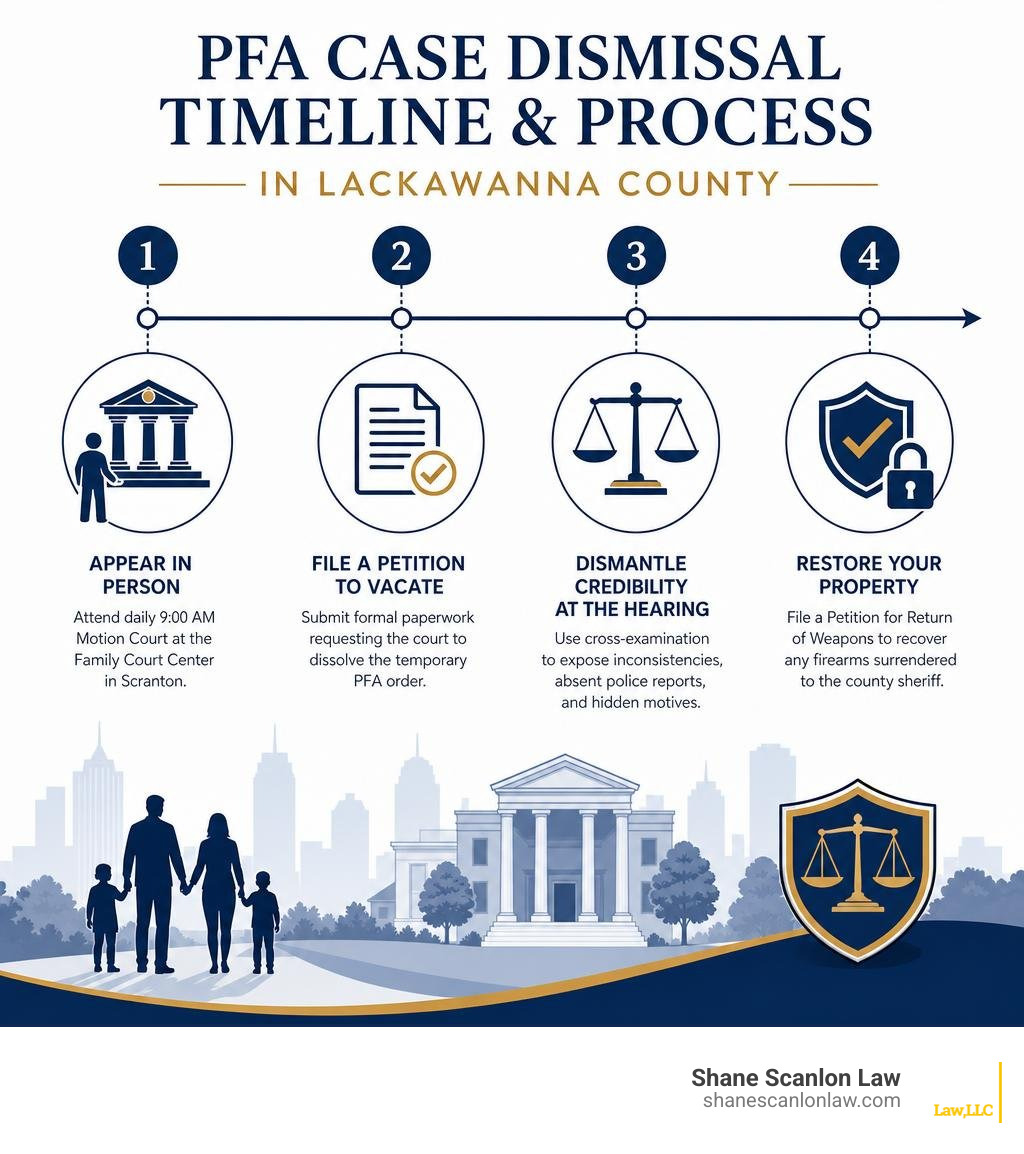
Here are the key steps to achieve a case dismissal:
- Appear in person: Present all contested motions at the Family Court Center (123 Wyoming Avenue, 1st Floor, Scranton) during daily 9:00 AM Motion Court. Lackawanna County does not accept emailed emergency motions.
- File a Petition to Vacate: Submit formal paperwork requesting the court to dissolve the temporary PFA.
- Dismantle credibility at the hearing: Use cross-examination during the final evidentiary hearing to expose inconsistencies, absent police reports, and hidden custody motives.
- Restore your property: File a Petition for Return of Weapons to recover any firearms surrendered to the county sheriff.
I am Shane Scanlon, founder of Shane Scanlon Law and former Lackawanna County District Attorney with over 20 years of trial experience. I draw on my prosecutorial background to build the aggressive defense strategies required for a successful pfa case dismissal scranton residents rely on to protect their families, records, and rights.
Related content about pfa case dismissal scranton:
- protection from abuse defense attorney
- protection from abuse expungement pennsylvania
- pfa false accusation defense
Step-by-Step Procedure for a PFA Case Dismissal in Scranton

When an ex parte temporary PFA is entered against you, the clock starts ticking immediately. The court grants these temporary orders based entirely on the petitioner’s one-sided statement, often leaving you barred from your home, restricted from seeing your children, and stripped of your Second Amendment rights. To dismantle these restrictions, you must follow the strict local filing protocols established by the Lackawanna County Family Court.
Under the Administrative Order issued by President Judge Trish Corbett, all emergency and contested family court motions must be presented in person. The court will not accept or review emergency filings submitted via email. The Family Court Center sits at 123 Wyoming Avenue, 1st Floor, Scranton, PA 18503, and contested family motions are heard promptly at 9:00 AM daily Motion Court. Missing these mandatory appearances can result in default rulings against you. Working with counsel who understands this local rhythm is vital; check out our guide on how to Need a PFA Lawyer in Scranton Here Is Your Guide to learn more about selecting representation.
Filing Local Petitions for PFA Case Dismissal in Scranton
Obtaining a dismissal requires filing formal, standardized county paperwork rather than informal requests. If circumstances have changed, or if both parties agree to resolve the matter outside of an active court order, you must file a formal Petition to Vacate PFA.
If the temporary order required you to surrender your registered firearms to the Lackawanna County Sheriff, a dismissal order does not automatically return your property. You must present a formal Petition for Return of Weapons (PFA) before the court. Once the judge signs the order and the sheriff’s department completes a mandatory background check, your property is restored. If you are exploring options for lifting an active order, review our detailed guides on Can You Undo a Restraining Order How to Dismiss a PFA and Lifting a PFA Order A Guide to Moving On in PA.
Preparing for the Final Evidentiary Hearing
The final PFA hearing is a formal civil bench trial where the petitioner carries the burden of proof. Under the Pennsylvania Protection From Abuse Act (23 Pa.C.S. § 6101 et seq.), the petitioner must establish that abuse occurred by a preponderance of the evidence—meaning it is more likely than not that their claims are true.
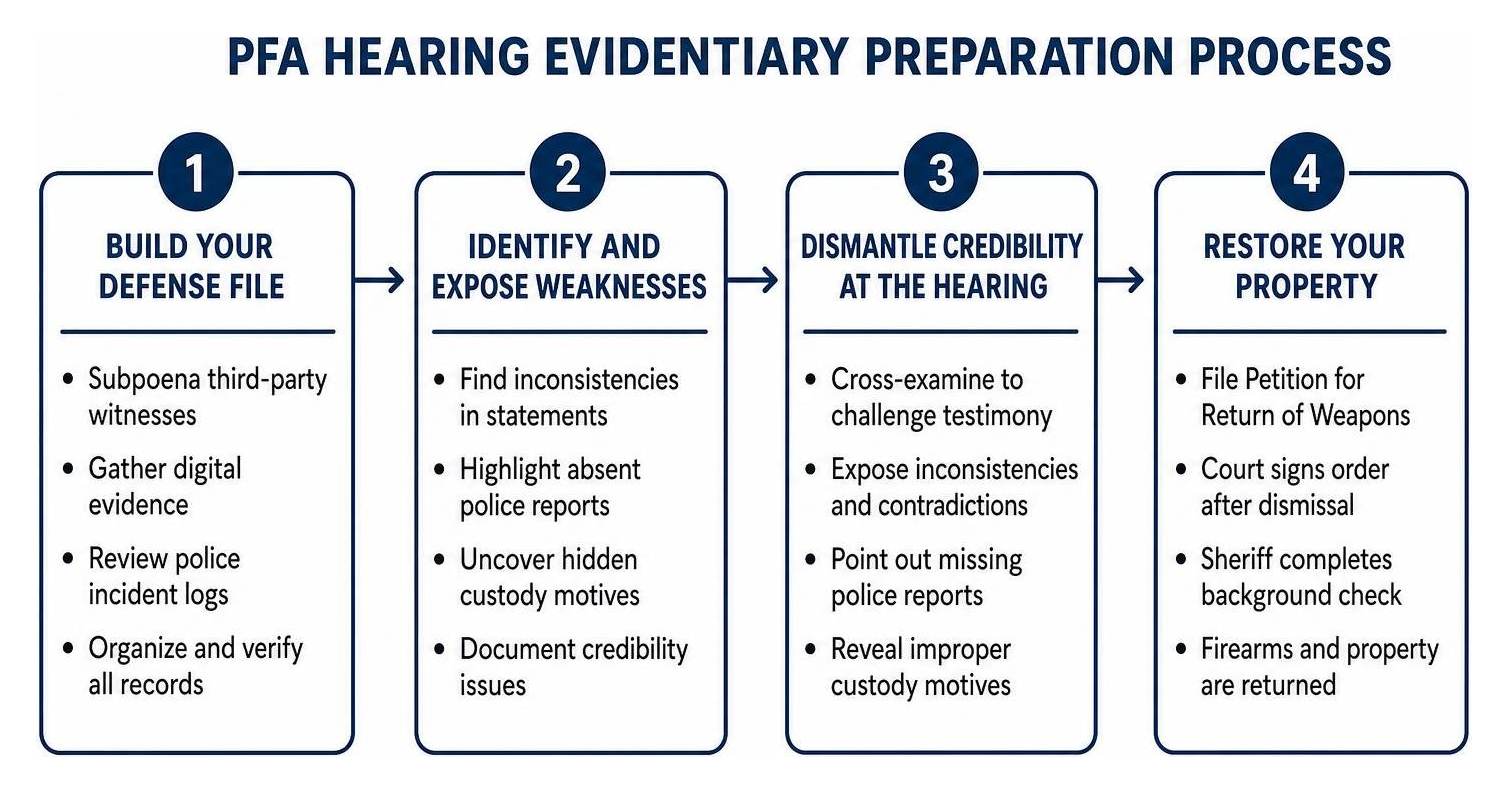
To secure a dismissal, your preparation must focus on dismantling the petitioner’s evidentiary claims:
- Subpoenaing third-party witnesses: Securing testimony from neutral bystanders, law enforcement officers, or workplace supervisors who can confirm your whereabouts or disprove the alleged incident.
- Gathering digital forensics: Pulling time-stamped text messages, call logs, emails, GPS records, and home surveillance footage that contradict the petitioner’s timeline.
- Reviewing police incident logs: Requesting dispatches and 911 audio recordings to verify whether law enforcement was ever contacted during the alleged dates of abuse.
Entering court without proper preparation places your future at serious risk. Read our insights on Surviving Your PFA Court Hearing With Confidence and How to Survive Your Final Protection From Abuse Hearing to understand what to expect at trial.
Strategic Defenses to Dismantle False Abuse Allegations

PFA petitions are often filed during volatile emotional breakups, contentious divorces, or disputed property divisions. When allegations are fabricated or exaggerated, mounting a strategic defense is the only way to safeguard your reputation and rights. Understanding Why You Need a Strong Lawyer to Fight False PFA Claims is critical when facing uncorroborated allegations in Northeastern Pennsylvania.
How Cross-Examination Secures a PFA Case Dismissal in Scranton
The most powerful weapon in a PFA defense is aggressive, surgical cross-examination. A well-executed cross-examination can force a dismissal before the defense even calls a single witness or requires the defendant to testify.
A clear example of this dynamic occurred in a high-profile Northeast Pennsylvania case involving political candidate Teddy Daniels. A temporary PFA order had been granted against Daniels, evicting him from his home, ordering the surrender of his firearms to the sheriff, and stripping him of temporary child custody. During the subsequent 90-minute evidentiary hearing, the petitioner testified and alleged severe, violent verbal threats.
However, cross-examination exposed critical weaknesses in the petitioner’s story:
- The petitioner alleged violent threats in court that were entirely absent from her written petition.
- No contemporaneous police reports or emergency calls were ever made regarding these alleged incidents.
- The sudden escalation of claims during live testimony severely undermined the petitioner’s overall credibility.
Because cross-examination exposed these fatal contradictions, the judge dismissed the temporary PFA completely, returning custody and lifting all restrictions without Daniels having to testify. When dealing with unsubstantiated claims, knowing that When I Didn’t Do It Isn’t Enough Defending Against False PFA Claims helps frame your legal strategy.
Defeating Bad-Faith PFAs in Child Custody Battles
Unfortunately, emergency PFA filings are sometimes used tactically to gain immediate, sole physical custody of children and bypass the standard family court conciliation process. When an ex-partner uses a PFA as leverage, they often combine it with reports to Children and Youth Services (CYS) or local police departments.
To defeat a bad-faith PFA filed during a custody dispute:
- Expose past agency reporting patterns: If the petitioner has a history of making unfounded complaints to CYS or local police departments in Scranton or Wilkes-Barre that were closed without findings, those records reveal a motive to manipulate the legal system.
- Highlight timeline opportunism: Demonstrating that the PFA was filed immediately after you requested a custody modification, served divorce paperwork, or disputed child support exposes tactical motivation.
- Establish immediate custody restoration: Once the PFA petition is exposed as an end-run around the custody process, the court will dismiss the order, clearing the way for family court to establish a fair custody schedule.
If you suspect an order was filed against you purely for leverage, consult our resources on working with a False Accusations PFA Defense Lawyer in Lackawanna County Pennsylvania and navigating Order in the Court Challenging PFA Allegations in Scranton.
Procedural Pitfalls, Court Deadlines, and Post-Dismissal Steps
Securing and maintaining a dismissal requires absolute compliance with local court deadlines, procedural rules, and appellate standards. Failing to observe local rules can ruin an otherwise strong defense.
Local Court Deadlines and Failure to Prosecute
In Pennsylvania practice, strict adherence to motion deadlines is mandatory. In federal and municipal litigation within the Middle District of Pennsylvania, for example, Local Rule 7.6 requires opposition briefs to be filed within 14 days; failure to respond permits the court to treat the motion as unopposed.
As demonstrated in Morgan v. The City of Scranton (trial court document), District Court, M.D. Pennsylvania, 2025, the federal court applied the six-factor Poulis balancing test to dismiss claims with prejudice after a plaintiff failed to submit required briefs, relying instead on non-responsive correspondence. The Poulis factors evaluate:
- The party’s personal responsibility;
- Prejudice to the adversary;
- A history of dilatoriness;
- Willful or bad-faith conduct;
- The effectiveness of alternative sanctions; and
- The substantive merits of the claim.
In family court matters, procedural defaults carry equally severe consequences. If you fail to file proper responsive pleadings, fail to appear at 9:00 AM Motion Court, or fail to follow local scheduling orders, the court can enter adverse judgments or deny motions to dismiss. For a complete procedural breakdown, read The Ultimate Pennsylvania PFA Survival Guide.
Docket Activity and Appellate Preservation
When a civil or domestic action is dismissed due to inactivity or procedural default, Pennsylvania law imposes strict procedural remedies. Under Pennsylvania Rule of Civil Procedure 3051, any challenge to a judgment of non pros (dismissal for inactivity) must begin by filing a petition to open in the trial court.
As established in Cardona, M. v. Buchanan, C., Superior Court of Pennsylvania, 2020, taking a direct appeal to the Superior Court without first filing a Rule 3051 petition in the trial court waives all substantive claims on appeal—even if the trial court held an evidentiary hearing before entering judgment.
Once your PFA case is dismissed at the trial level, your work is not finished. A dismissed PFA petition remains visible on statewide court dockets and background check databases unless you take affirmative steps to remove it. You must file a formal petition for expungement to clear your public record entirely. Learn how this process works in our guide to Clearing Your Name PFA Record Expungement in Pennsylvania.
Frequently Asked Questions About PFA Dismissal in Scranton
Can emergency PFA motions be submitted via email in Lackawanna County?
No. Under the Administrative Order enacted by President Judge Trish Corbett, all emergency and contested PFA motions must be presented in person at the Family Court Center, located at 123 Wyoming Avenue, 1st Floor, Scranton, PA 18503. Contested motions are heard daily during 9:00 AM Motion Court. The court will not accept or process emailed emergency filings.
Can a PFA case be dismissed without the defendant testifying?
Yes. If cross-examination of the petitioner and their witnesses exposes irreconcilable contradictions, uncorroborated allegations, or a complete lack of credible evidence, the judge can dismiss the PFA petition at the close of the petitioner’s case. The defendant is not legally required to testify if the petitioner fails to meet their statutory burden of proof.
What steps are required to recover firearms after a PFA dismissal?
Firearms surrendered to the Lackawanna County Sheriff are not released automatically upon dismissal. You must file a formal “Petition for Return of Weapons (PFA)” with the Lackawanna County Family Court. Once the judge signs the order granting the return, the sheriff’s office will perform a standard background check to verify eligibility before releasing your property.
Conclusion
Facing a Protection From Abuse order can disrupt your life, separate you from your children, and threaten your personal freedom. Navigating the courtroom procedures at 123 Wyoming Avenue requires strategic preparation, aggressive cross-examination, and command of local rules.
At Shane Scanlon Law, we bring over 20 years of courtroom experience—including insight gained serving as Lackawanna County District Attorney—to defend clients across Scranton, Lackawanna County, Luzerne County, Susquehanna County, and Wyoming County. If you are facing false allegations, reach out to us today for experienced Protection From Abuse representation to protect your name and future.