
 Call Anytime
833.722.6566
Call Anytime
833.722.6566
Clearing Your Name: PFA Record Expungement in Pennsylvania

What You Need to Know About Protection from Abuse Expungement in Pennsylvania
Protection from abuse expungement in Pennsylvania is only available in limited circumstances — and most people don’t realize how permanent a PFA record can be until it’s too late.
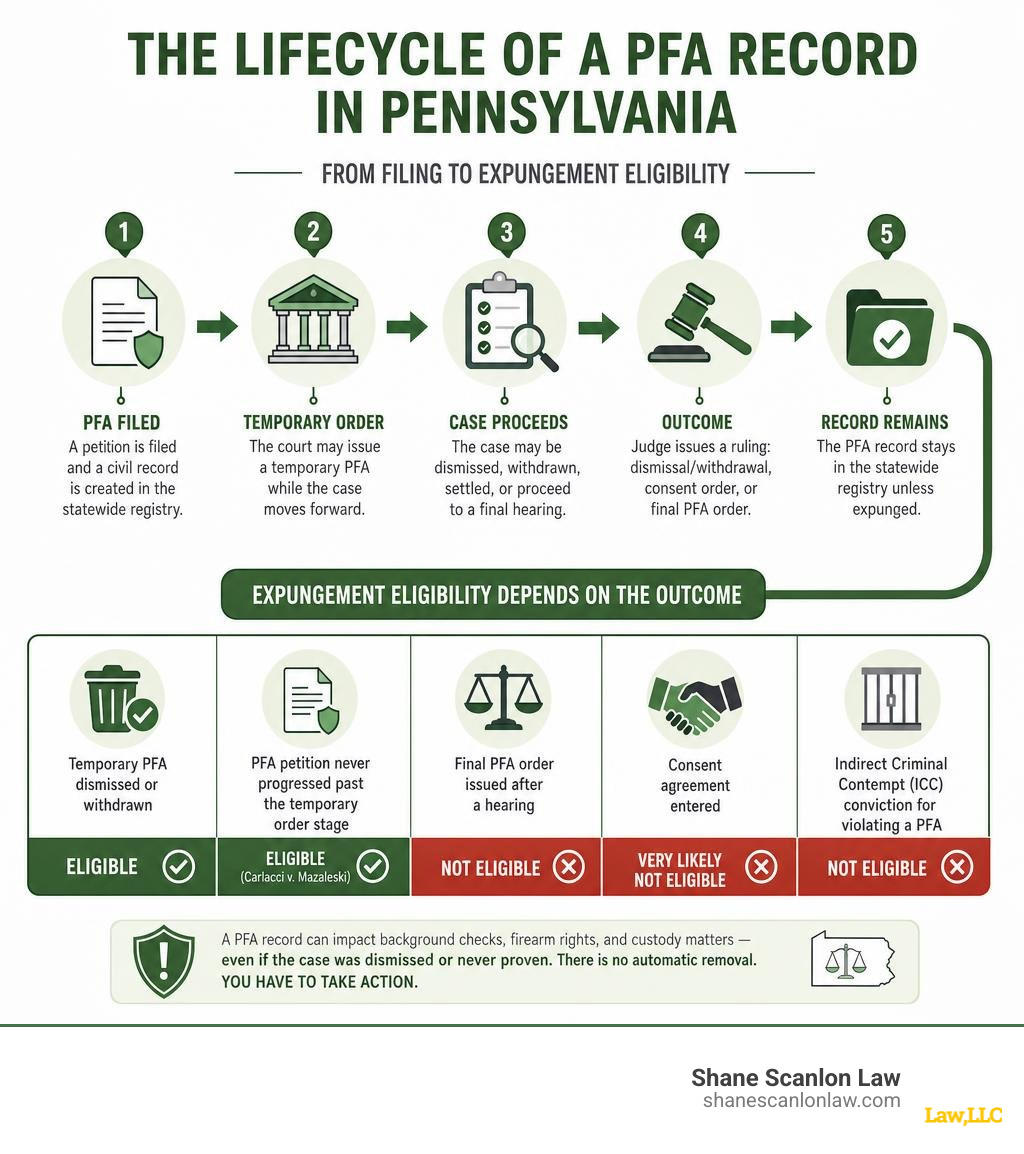
Here is a quick answer to who qualifies:
- Temporary PFA dismissed or withdrawn — You are generally entitled to expungement as a matter of law
- PFA petition never progressed past the temporary order stage — Eligible for expungement under Carlacci v. Mazaleski
- Final PFA order issued after a hearing — Not eligible for expungement under current Pennsylvania law
- Consent agreement entered — Very likely not eligible for expungement, even with no admission of abuse
- Indirect Criminal Contempt (ICC) conviction for violating a PFA — Not eligible for expungement
The moment a PFA petition is filed in Pennsylvania, a civil record is automatically created in a statewide registry. That record can show up on background checks, affect your ability to own a firearm, and follow you into custody hearings — even if the case was dismissed or never proven. There is no automatic removal. You have to take action.
I’m Shane Scanlon, founder of Shane Scanlon Law and a former Lackawanna County District Attorney with over 20 years of courtroom experience in Pennsylvania — including handling protection from abuse expungement in Pennsylvania matters across Scranton, Lackawanna County, and the surrounding NEPA region. If you have a PFA record you want to clear, the sections below walk you through exactly what the law allows and how the process works.
Protection from abuse expungement pennsylvania vocab to learn:
- PFA False Allegations Lawyer
- Protection From Abuse Act Pennsylvania
- Protection From Abuse Defense Attorney
Understanding the Pennsylvania PFA Process and Record Creation
The Pennsylvania Protection from Abuse Act (PFAA) is designed to protect victims of domestic violence by providing a fast-track legal pathway to keep alleged abusers away. It is a civil process, but it carries heavy criminal-like consequences. You can read a complete breakdown of this statutory framework in Chapter 61. – Title 23 – DOMESTIC RELATIONS.
The moment an individual files a PFA petition in a Pennsylvania county court, the gears of the state’s administrative databases start turning. The prothonotary of the county has 24 hours to send a copy of the filing to the statewide registry, and the Pennsylvania State Police (PSP) must enter it into their active database within 8 hours of receipt.
This means that before you even have a chance to tell your side of the story in court, a civil record is generated. This registry tracks temporary orders, final orders, consent agreements, and even out-of-state “foreign” protection orders. To understand how these records start, we recommend reading The Pennsylvania PFA Process Explained.
Temporary vs. Final PFA Orders
The PFA process is divided into two distinct stages: temporary and final. This division is critical because it dictates whether you can pursue a protection from abuse expungement in Pennsylvania.
- Temporary PFA Orders: When a plaintiff files a petition, a judge holds an immediate ex parte hearing. This means only the plaintiff speaks to the judge; the defendant is not present and receives no notice beforehand. If the judge believes there is an immediate danger of abuse, they issue a Temporary PFA. Because you had no opportunity to defend yourself at this stage, the law is much more forgiving when it comes to eventually expunging these temporary records. If you are currently facing one of these orders, read our guide on Emergency and Temporary PFA Defense in Northeast Pennsylvania.
- Final PFA Orders: Within 10 business days of the temporary order, the court must hold a full evidentiary hearing. Both parties are present, can testify, call witnesses, and present evidence. If the plaintiff proves the allegations by a “preponderance of the evidence” (meaning it is more likely than not that the abuse occurred), the judge issues a Final PFA. This order can remain active for up to 3 years.
| Feature | Temporary PFA Order | Final PFA Order |
|---|---|---|
| Hearing Type | Ex Parte (Defendant not present) | Bilateral (Both parties present) |
| Duration | Up to 10 business days (until final hearing) | Up to 3 years (can be extended) |
| Standard of Proof | Immediate/imminent danger of abuse | Preponderance of the evidence |
| Expungement Eligibility | Eligible (if dismissed, withdrawn, or expired) | Ineligible (if granted after a full hearing) |
The Negative Consequences of a PFA Record
Many defendants assume that once a PFA expires or is dismissed, it simply vanishes. Unfortunately, that is a myth.

Unless you actively petition for a protection from abuse expungement in Pennsylvania, that record remains visible to law enforcement, courts, and often the public. This can derail your life in several major ways:
- Employment Background Checks: Most modern employers run comprehensive background checks. A PFA record—even a dismissed one—can signal to a hiring manager that you are a potential liability. This is especially devastating if you work in healthcare, education, law enforcement, or any field requiring a professional state license.
- Firearm Ownership & Second Amendment Rights: Under federal law (specifically the Lautenberg Amendment) and Pennsylvania state law, an active PFA strips you of your right to possess, transfer, or own firearms. If you have a PFA record, even an expired one can cause major delays or denials when attempting to purchase a firearm. Learn more about these restrictions in our article on Legal Consequences for the Accused PFAs.
- Child Custody Disputes: If you are locked in a bitter custody battle in Lackawanna or Luzerne County, a past PFA record is gold for the other side. Family court judges can look at historical PFA filings to determine custody arrangements, using even unproven allegations to argue that you present a risk to your children.
- Housing Applications: Landlords routinely screen applicants. A civil record showing a domestic violence petition is an easy excuse for a landlord to deny your rental application.
Eligibility for Protection from Abuse Expungement Pennsylvania
Because Pennsylvania has no written statutory law that explicitly outlines how to expunge a PFA, eligibility is governed entirely by appellate court case law.

Generally, you are eligible to expunge a PFA record if:
- The PFA petition was dismissed by a judge at the final hearing because the allegations were unproven.
- The plaintiff voluntarily withdrew the PFA petition before a final order was entered.
- The temporary PFA expired without the plaintiff pursuing a final order.
If your case fits one of these scenarios, you can take steps to clear your name. For a deeper look at how these cases are resolved, read Can You Undo a Restraining Order How to Dismiss a PFA.
Why Final PFA Orders Are Ineligible for Protection from Abuse Expungement Pennsylvania
What happens if a judge ruled against you at the final hearing and issued a Final PFA? Under current Pennsylvania case law—specifically the landmark Superior Court ruling in Commonwealth v. Charnik—you cannot expunge a final PFA order.
The courts view a final PFA order, entered after a full evidentiary hearing and supported by a preponderance of the evidence, as analogous to a criminal conviction. Because a judicial finder of fact determined that abuse did occur, the state maintains a strong public safety interest in keeping that record active and accessible. Even if the victim later petitions the court to withdraw or vacate the active order, the historical record of its existence cannot be expunged.
The Problem with Consent Agreements and Protection from Abuse Expungement Pennsylvania
In many domestic relations cases, attorneys attempt to resolve PFA disputes by negotiating a “Consent Agreement.” Under a consent agreement, the defendant agrees to abide by the protective terms of the PFA (such as staying away from the plaintiff) for a set period, but does so without admitting to any of the alleged abuse.
This seems like a great compromise at the time because it avoids a high-stakes trial. However, there is a massive trap here.
As analyzed in the “PFA” Record Expungement as a Tool for Settlement article by the Dickinson Law Review, a consent agreement is technically a final court-approved order. Because it is a final order, Pennsylvania courts have consistently ruled that consent agreements are ineligible for expungement.
Defendants often sign these agreements thinking their record remains completely clean because they didn’t admit to abuse, only to discover years later that they have a permanent civil PFA record that cannot be expunged. This is why we strongly advise consulting with an experienced attorney before signing any PFA agreements.
Landmark Case Law: Carlacci v. Mazaleski and the Wexler Balancing Test
If there is no statutory law allowing PFA expungements, how do we do it? We rely on constitutional principles and landmark court rulings.
The most important case in this field is the 2002 Pennsylvania Supreme Court decision in OPINION (Carlacci v. Mazaleski, 798 A.2d 186).
This landmark case actually originated right here in Lackawanna County. In Carlacci, the parties resolved a temporary PFA by signing a stipulation that declared the temporary order null and void ab initio (from the beginning). When the defendant later sought to expunge the record, the lower courts balked.
The Pennsylvania Supreme Court ultimately ruled that because the PFA proceedings never progressed beyond the temporary stage, the defendant had a constitutional right to protect his reputation under Article I, Section 1 of the Pennsylvania Constitution. The Court established that in cases where a PFA never evolves into a final order, expungement is available as a matter of law, meaning the court does not need to perform a complicated balancing test to grant the request.
When Does the Wexler Balancing Test Apply?
In cases where expungement is not a matter of right but the petition was dismissed or withdrawn under more complex circumstances, the court may apply the “Wexler balancing test.” First applied to PFA records in the case of P.E.S. v. K.L. (720 A.2d 487), this test requires the court to weigh:
- The Commonwealth’s interest in maintaining an accurate record of the domestic dispute for public safety.
- The petitioner’s individual interest in protecting their reputation, employment, and civil rights.
Because a PFA is a civil matter, if the allegations were never proven, the state’s interest in keeping the record is incredibly weak, while your interest in protecting your livelihood is incredibly strong. Citing these constitutional due process arguments is the key to winning a contested expungement hearing.
How to File a Petition for PFA Expungement in PA
If you meet the eligibility criteria, you must actively file a formal petition to clear your record. The process is highly procedural and requires absolute precision.
Here is the step-by-step sequence to get your PFA record expunged:

- Obtain Your Court Records: Gather the original PFA petition, the temporary order, and the final order of dismissal or withdrawal from the county where the PFA was filed.
- Draft the Petition for Expungement: Prepare a formal “Petition for Expungement of PFA Record” citing Carlacci v. Mazaleski and outlining why you are entitled to have the record cleared.
- File with the Family Court Prothonotary: Submit your petition to the family court division in the county where the original PFA was filed. If you are in Scranton, this is the Lackawanna County Family Court. If you are in Wilkes-Barre, you will file through the Protection From Abuse | Luzerne County, PA office.
- Serve the Plaintiff: You must serve a copy of your expungement petition to the original plaintiff via certified mail to give them an opportunity to object.
- Serve Relevant Law Enforcement Agencies: You must also serve copies of the petition to the Pennsylvania State Police, the local police department that handled the service, and the county sheriff.
- Attend the Court Hearing: If the District Attorney or the plaintiff objects to the expungement, a judge will schedule a hearing. You (or your attorney) must present evidence showing why the record should be expunged. If the petition is unopposed, the judge may sign the order without a hearing.
- Verify Destruction of Records: Once the judge signs the Expungement Order, copies must be sent to the Pennsylvania State Police and local law enforcement. We always follow up with these agencies to ensure they have officially purged and destroyed their copies of the record.
Frequently Asked Questions About PFA Expungements
Does a dismissed PFA automatically disappear from my record in Pennsylvania?
No. This is one of the most common misconceptions we hear. While the statewide registry is supposed to “purge” expired or vacated orders from its active registry system, the underlying court dockets, police incident reports, and local sheriff records remain completely visible on public and law enforcement databases. The only way to completely destroy these files is by obtaining a signed court order through an active expungement petition.
Can I expunge a PFA violation or Indirect Criminal Contempt (ICC) conviction?
No. If you are accused of violating a PFA, you face a charge of Indirect Criminal Contempt (ICC). An ICC conviction is a criminal offense that carries up to six months in jail and a $1,000 fine. Because it is a criminal conviction resulting from a violation of a court order, it is entirely ineligible for expungement under Pennsylvania law. If you are facing these charges, it is vital to defend against them immediately with a PFA Violation Defense Lawyer in Northeast Pennsylvania.
How long does the PFA expungement process take in 2026?
In 2026, the timeline for a PFA expungement depends heavily on the county court’s backlog and whether the petition is opposed. Generally, from the moment we file the petition to the day the judge signs the order, the process takes between 60 and 90 days. If a formal hearing is required because the DA or plaintiff objects, it can take slightly longer.
Conclusion
Your reputation is everything. A single unproven or dismissed PFA allegation from years ago shouldn’t have the power to block your career path, strip away your Second Amendment rights, or complicate your child custody arrangements.
At Shane Scanlon Law, we understand the nuances of Pennsylvania domestic relations law and the administrative systems that track these records. With over 20 years of trial experience—including Shane Scanlon’s unique background as a former District Attorney—we provide the fierce, strategic advocacy you need to successfully navigate the court system.
We proudly serve clients throughout Scranton, Wilkes-Barre, Lackawanna County, Luzerne County, Susquehanna County, and Wyoming County. If you are ready to take control of your future and clear your public record, Protection From Abuse PFA representation is just a phone call away. Contact us today to schedule your consultation.