
 Call Anytime
833.722.6566
Call Anytime
833.722.6566
Can You File a PFA Online? Yes, and Here is How

Can You Really File a PFA Online? Here Is What You Need to Know First
If you need to file a PFA online, the short answer is yes — and in Pennsylvania, you have real options to get started from your phone or computer right now.
How to file a PFA online in Pennsylvania (quick overview):
- Go to LegalAtoms — a free tool that walks you through Pennsylvania PFA forms step by step.
- Complete the guided questionnaire to prepare your Petition for Protection from Abuse.
- Optionally consult a domestic violence advocate to review your documents.
- Submit your forms by e-filing through the platform or printing and delivering them to your local courthouse.
- If you need protection immediately outside of court hours, submit your emergency information online before visiting a Magisterial District Court.
Filing a PFA is free — there are no court filing fees for plaintiffs in Pennsylvania.
Right now, you may be scared, overwhelmed, or unsure where to start. That is completely understandable. A Protection from Abuse (PFA) order is a civil court order that can stop an abuser from contacting you, force them out of your home, and even address custody of your children — all without requiring a police report or prior criminal case. The process has become more accessible in recent years, with online tools making it possible to prepare your paperwork safely from home, at a library, or anywhere with internet access.
I am Shane Scanlon, founder of Shane Scanlon Law and a former Lackawanna County District Attorney with over 20 years of courtroom experience in Pennsylvania — including extensive work with Protection from Abuse cases on both sides of the courtroom. If you need guidance on how to file a PFA online or want legal representation through the process, this article will walk you through everything you need to know.
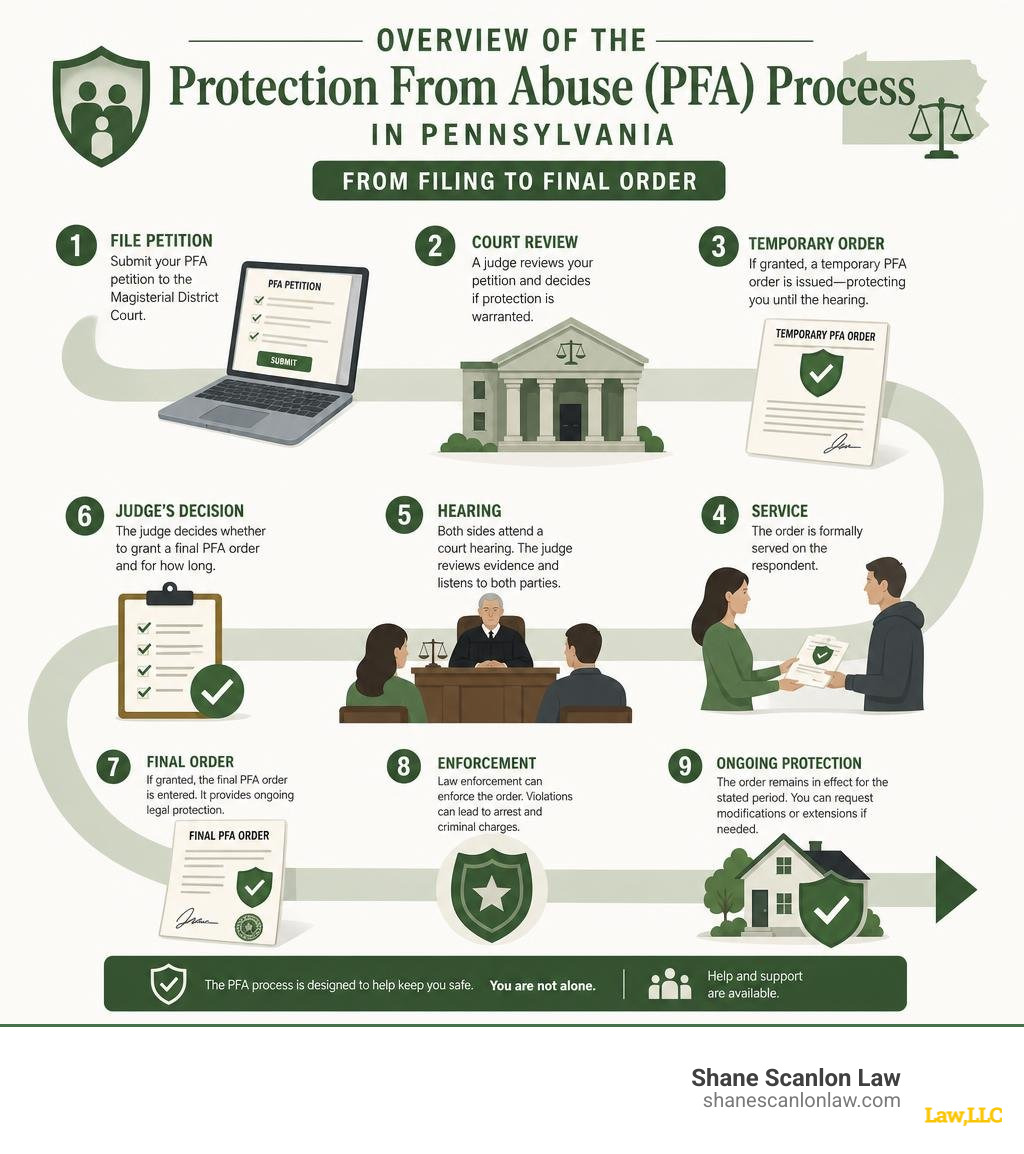
Important file a pfa online terms:
Understanding the Types of Protection From Abuse Orders
Before we dive into the technical clicks of how to file a pfa online, we must establish what a PFA actually is. In Pennsylvania, a PFA is a highly specific civil restraining order designed to protect victims of domestic abuse. It is not a broad, catch-all restraining order for neighbor disputes or bad business partners. It is strictly designated for people who have a close, domestic, or familial relationship.
To learn more about the legal foundation of these orders, you can read More info on the Pennsylvania PFA process.

Who is Eligible to File a PFA Online?
You cannot file a PFA against just anyone. To be eligible under Pennsylvania’s Protection From Abuse Act, the person abusing you must fall into one of the following categories:
- Intimate Partners: Current or former spouses, current or former sexual or intimate partners, dating partners, or co-parents.
- Family Members: Blood relatives, or relatives by marriage (like in-laws).
- Household Members: People you currently live with or have lived with as family.
The conduct must also meet the legal definition of abuse. This includes physical abuse (bodily injury, assault), threats of imminent physical harm, stalking, harassment, false imprisonment, or child abuse. If you are dealing with someone who does not fit these relationship requirements—like a coworker or a landlord—other legal avenues exist, but a PFA is not one of them.
For a deeper dive into relationship requirements and qualifying behaviors, you can Learn about filing and obtaining a PFA.
Emergency, Temporary, and Final PFAs
The legal system moves in phases to balance your immediate safety with the constitutional rights of the accused. There are three distinct tiers of PFA orders in Pennsylvania:
- Emergency PFA (EPFA): This is your immediate lifeline when the regular courts are closed—such as overnight, on weekends, or during holidays. In Lackawanna, Luzerne, Susquehanna, or Wyoming County, an Emergency PFA is issued by a Magisterial District Judge. It only remains in effect until the next business day when the Court of Common Pleas opens.
- Temporary PFA: When you file during regular court hours, a judge reviews your petition. If they determine there is an immediate and present danger, they will grant a Temporary PFA. You do not need the abuser present for this. It lasts about 10 business days until your final hearing is scheduled.
- Final PFA: This is the permanent order. It can only be granted after a full court hearing where both you and the defendant have the right to present evidence, call witnesses, and cross-examine each other. A Final PFA can last up to three years.
To learn more about defending or navigating these early stages, you can Read about emergency and temporary PFA defense. For administrative context on court operations, you can also review the How to Obtain a PFA – Fifth Judicial District of Pennsylvania guidelines.
How to File a PFA Online in Pennsylvania
Over the last few years, Pennsylvania’s court systems have worked hard to bring the PFA process into the digital age. This is incredibly important for safety; sometimes, going to a physical courthouse to sit in a lobby for hours is too dangerous or logistically impossible if your abuser monitors your movements.
At the state level, authorized legal professionals and courts utilize the secured Home Page – Protection From Abuse System, also known as the Protection From Abuse Database (PFAD). This electronic database automates the PFA process in Pennsylvania courts and makes active records immediately available 24/7 to law enforcement officers. While the public cannot log directly into PFAD to file themselves, public-facing tools like LegalAtoms bridge the gap.
Step-by-Step Instructions to File a PFA Online
If you want to prepare and submit your paperwork online, follow this step-by-step sequence:
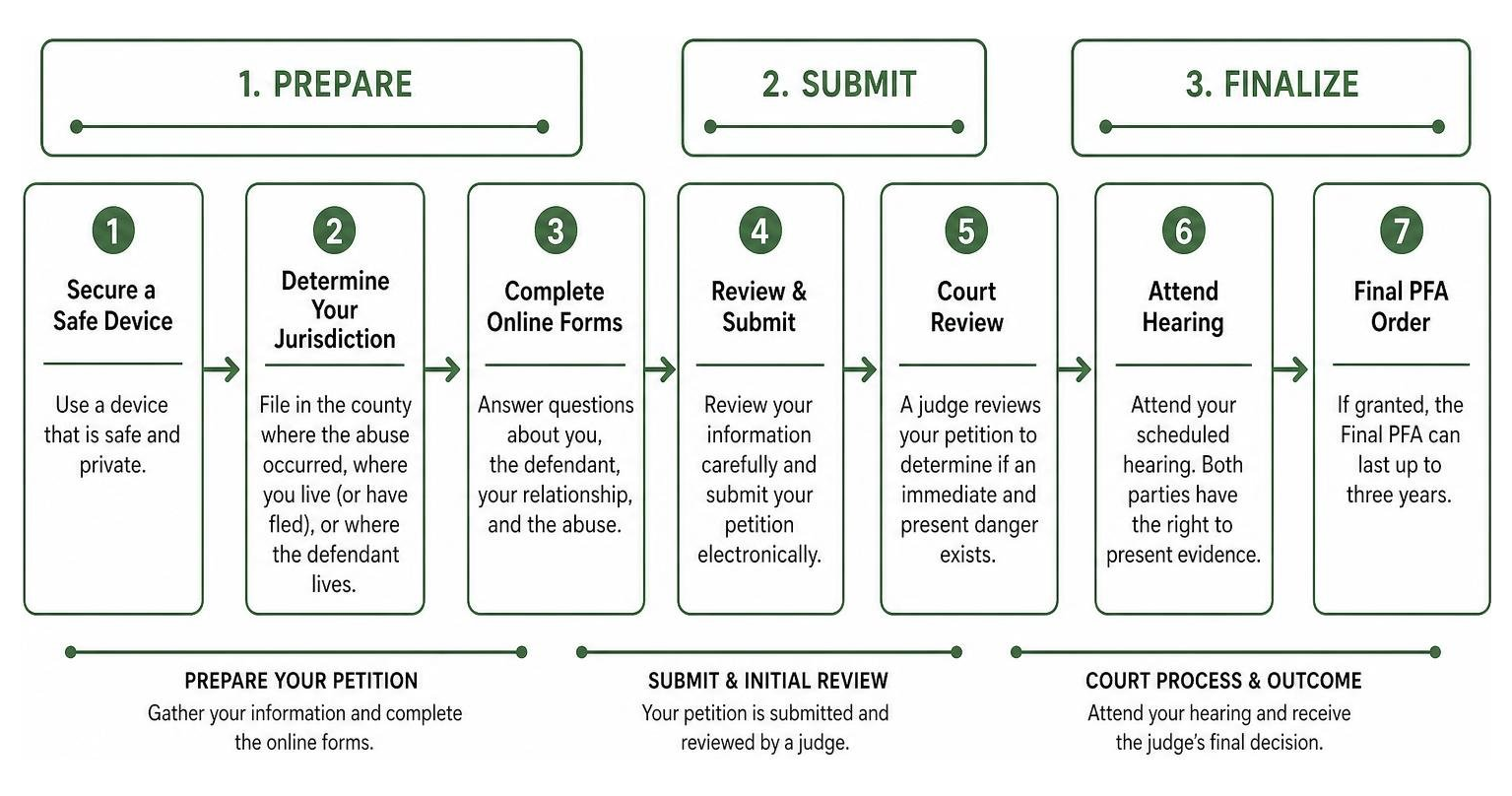
Step 1: Secure a Safe Device
Before typing anything, ensure you are using a safe computer, tablet, or phone. If your abuser has physical or remote access to your device, they may see your search history or keystrokes. If necessary, use a computer at a local public library, a trusted friend’s house, or a domestic violence shelter.
Step 2: Determine Your Jurisdiction
You must file your PFA in the county where the abuse occurred, where you live (or have fled to for safety), or where the defendant lives. If you reside in Scranton, you will file through Lackawanna County. If you are in Wilkes-Barre, you will file in Luzerne County.
Step 3: Access the Portal and Complete the Screening
Go to LegalAtoms to begin. The platform will ask you a series of simple screening questions to verify that your relationship and the incidents of abuse meet Pennsylvania’s legal requirements.
Step 4: Complete the Guided Questionnaire
You will be guided through a series of questions written in plain, non-legal English. You will need to provide:
- The defendant’s full name, physical description, and current location.
- Highly specific details of the abuse (dates, times, locations, and what was said or done).
- Information regarding children you share, your living situation, and whether the defendant has access to firearms.
Step 5: Review and Submit
Once the system generates your official Pennsylvania court forms (including the Petition for Protection from Abuse), you can review them. Many counties allow you to e-file these forms directly through the portal. If your local county court requires physical submission, you can print the completed forms and bring them straight to the PFA office at the courthouse, dramatically cutting down your waiting time.
What Protections Can a PFA Order Provide?
A PFA is a powerful legal shield. It is not just a piece of paper telling someone to stay away; it can fundamentally restructure your living and family arrangements to keep you safe.
| Protection Feature | Temporary PFA | Final PFA (Up to 3 Years) |
|---|---|---|
| No-Contact Provision | Yes (No physical, digital, or third-party contact) | Yes (Comprehensive contact ban) |
| Exclusive Possession of Home | Yes (Evicts abuser from shared residence) | Yes (Evicts abuser and grants exclusive residency) |
| Temporary Child Custody | Yes (Temporary safety-focused custody) | Yes (Formal custody schedules and terms) |
| Child & Spousal Support | No | Yes (Can order temporary support payments) |
| Firearm Relinquishment | Yes (If a judge finds weapon risk exists) | Yes (Mandatory surrender of weapons/licenses) |
No-Contact, Custody, Support, and Firearm Relinquishment
When you fill out your petition, you can request specific protections. A judge can order the defendant to move out of your shared home immediately, even if their name is the only one on the lease or deed.
If you share children, the court can grant you temporary custody to prevent the abuser from taking them. Furthermore, the judge can order the defendant to pay temporary child or spousal support. For long-term support coordination, you can access the Pennsylvania Child Support Program portal.
Finally, firearm safety is a critical component of Pennsylvania PFA laws. If the court grants a PFA that includes a firearm restriction, the defendant must relinquish all firearms, other weapons, and their ammunition to law enforcement or a licensed gun dealer.
What Happens After You File and How to Handle Violations
Filing the paperwork online is only the first phase. For the PFA to become legally enforceable, the defendant must be formally notified.
Service of Process and the Final Hearing
Once a judge signs a Temporary PFA, the county Sheriff’s department must serve the defendant with a copy of the petition, the temporary order, and the notice of the final hearing. There is absolutely no fee for this service.
While the temporary order is legally active the moment the judge signs it, the police cannot criminally charge the defendant with violating it until they have received “actual notice” or have been officially served.
At the final hearing—usually scheduled within 10 business days—both parties will present their cases. This is a formal court proceeding. Having a skilled trial attorney by your side is crucial to ensuring your evidence (text messages, photos, medical records) is properly admitted under Pennsylvania rules of evidence.
For more details on keeping yourself safe during this transition, read about Enforcing a PFA order.
Enforcing the Order and Handling Violations
If the defendant violates any term of a temporary or final PFA, call 911 immediately.
A PFA violation is not a minor civil matter; it is a crime. In Pennsylvania, violating a PFA is charged as Indirect Criminal Contempt. Law enforcement has the authority to arrest the defendant immediately without a warrant if they have probable cause to believe the order was violated. If convicted of violating a PFA, the defendant can face up to six months in jail and significant fines.
Frequently Asked Questions About Filing a PFA
Are there any fees associated with filing a PFA?
No. Under Pennsylvania law, there are absolutely no fees or court costs assessed to a plaintiff who files a Protection From Abuse action. Filing, processing, and sheriff service are completely free of charge.
How long does a PFA order last and can it be modified?
A Temporary PFA lasts until your final hearing (typically about 10 business days). A Final PFA can be issued for a maximum of three years. As circumstances change, either party can petition the court to modify, extend, or terminate the order early. To understand how these adjustments work, read our guide on How to modify or terminate a PFA.
What resources and support are available for victims?
You do not have to do this alone. Excellent local advocacy groups in Northeastern Pennsylvania can assist you with safety planning, accompany you to court, and help you file your paperwork:
- Lackawanna County: Women’s Resource Center (Scranton)
- Luzerne County: Domestic Violence Service Center (Wilkes-Barre)
- National Domestic Violence Hotline: Call 1-800-799-SAFE (7233) or text “START” to 88788 for 24/7 confidential support.
Conclusion
Taking the step to file a pfa online is a powerful act of self-preservation. While the digital tools available in Pennsylvania make drafting the petition much simpler, the legal system can still feel incredibly complex and intimidating, especially when you have to face your abuser in a courtroom for a final hearing.
We at Shane Scanlon Law are dedicated to standing beside our neighbors in Scranton, Wilkes-Barre, Lackawanna County, Luzerne County, Susquehanna County, and Wyoming County. With over 20 years of local litigation experience—including Shane Scanlon’s unique perspective as a former District Attorney—we understand how the local courts operate and how to build a strong, evidence-backed case to protect you and your family.
If you have questions about filing a PFA, need representation for an upcoming hearing, or want to ensure your voice is heard in court, contact us today for a private, compassionate consultation.