
 Call Anytime
833.722.6566
Fighting a PFA in Pennsylvania with the Right Defense Lawyer
When a PFA Order Turns Your Life Upside Down in Pennsylvania
If you need a PFA defense attorney in Pennsylvania, here is what you should know right away:
- A Protection From Abuse (PFA) order is a civil order, but it can remove you from your home, cut off access to your children, and strip your firearm rights — sometimes within hours of being filed.
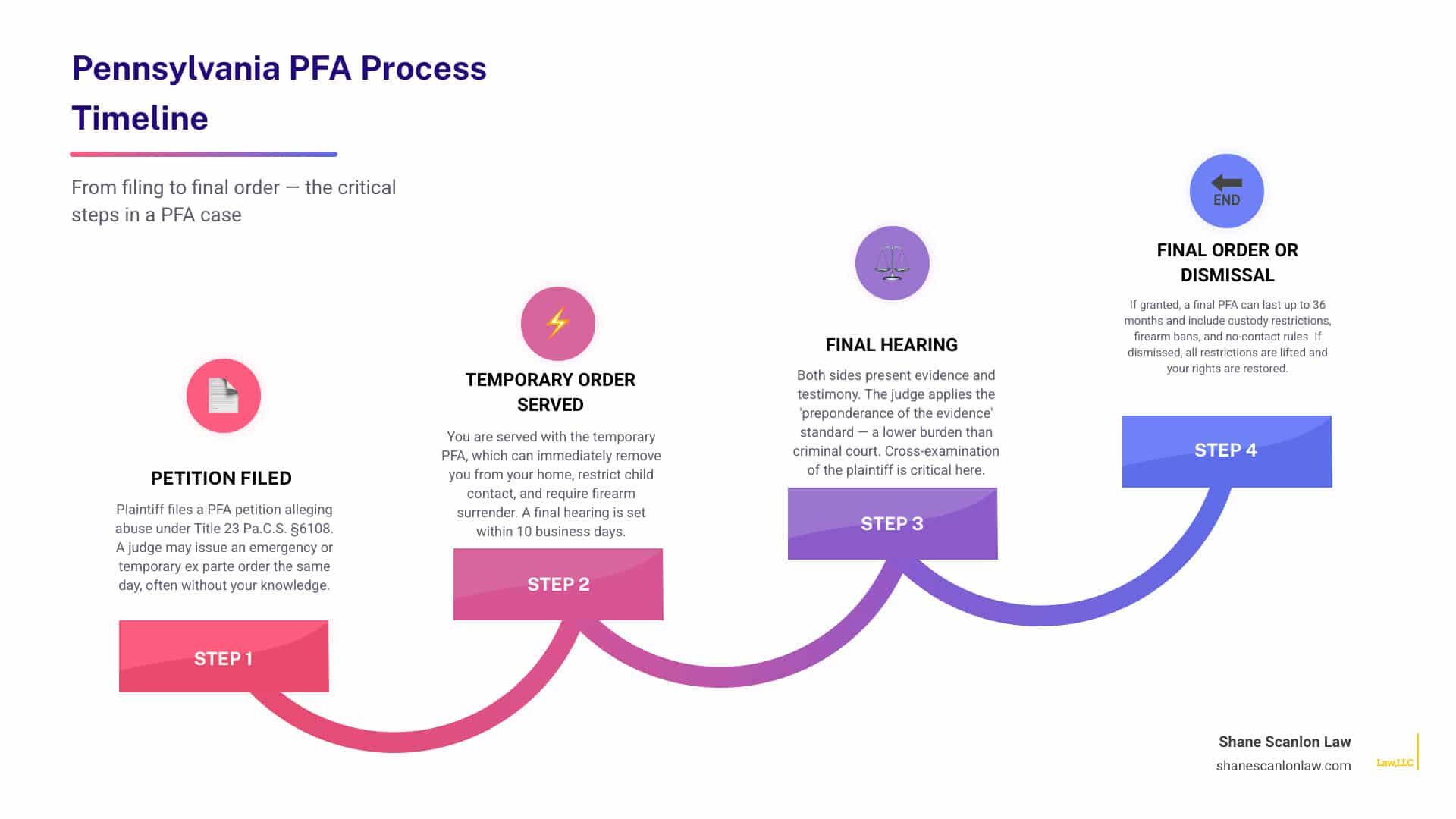
- You have the right to defend yourself at a final hearing, typically scheduled within 10 business days of the temporary order being issued.
- The standard of proof is “preponderance of the evidence” — lower than a criminal trial — meaning the judge only needs to believe the allegations are more likely true than not.
- Violating a PFA, even by sending a single text message, can result in up to six months in jail and a $1,000 fine.
- Getting an experienced PFA defense attorney involved immediately — before the final hearing — is the single most important step you can take.
Being served with a PFA order in Pennsylvania can feel like the ground has dropped out from under you. In an instant, you may be locked out of your own home, separated from your children, and ordered to surrender your firearms — all before you’ve had any chance to tell your side of the story. And in contested divorce or custody situations, PFA filings are sometimes used as a tactical move rather than a genuine safety measure.
This guide explains exactly how Pennsylvania PFA proceedings work, what the consequences are, and how a skilled defense attorney can protect your rights.
I’m Shane Scanlon, founder of Shane Scanlon Law, LLC and a former Lackawanna County District Attorney with over 20 years of courtroom experience — including as a pfa defense attorney pennsylvania — giving me a unique inside view of how these cases are built and how to challenge them. If you have been served with a PFA, the steps you take in the next few days will define the outcome.
Understanding Pennsylvania PFA Orders and What Constitutes Abuse
A Protection From Abuse (PFA) order is a civil court order authorized under the Pennsylvania Protection From Abuse Act (Title 23 Pa.C.S. Chapter 61). Its primary purpose is to protect individuals from domestic violence or harassment by family or household members. However, because it carries immediate, severe restrictions on your personal freedom, it behaves in many ways like a criminal penalty.
Under §6102 of the PFA Act, “abuse” is legally defined as more than just physical violence. In Pennsylvania, a plaintiff can secure a PFA by proving any of the following actions occurred between family or household members:
- Causing, or attempting to cause, physical injury, sexual assault, or serious bodily harm.
- Placing another person in reasonable fear of imminent serious bodily injury (such as verbal threats or intimidating gestures).
- False imprisonment (holding someone in a room or home against their will).
- Stalking or repeatedly committing acts that place another person in reasonable fear of bodily injury.
- Physical or sexual abuse of minor children.
Because the legal definition of abuse is broad, it is surprisingly easy for an accuser to file a petition based on a single heated verbal argument. To understand the step-by-step process of how these orders are requested and issued, you can read our comprehensive Protection From Abuse orders a step by step guide.
Who Can File for a PFA in Pennsylvania?
Not just anyone can file a PFA against you. The law restricts PFA filings to individuals who share a specific domestic or familial relationship. Under Pennsylvania law, a plaintiff can file a PFA petition against you if they are your:
- Current or former spouse.
- Current or former sexual or intimate partner (including dating relationships).
- Parent, child, sibling, or other relative by blood or marriage.
- Co-parent (someone with whom you share a child).
If you do not share one of these relationships—for instance, if the dispute is with a neighbor, coworker, or landlord—the plaintiff cannot file a PFA. They would have to seek a different civil remedy, such as a Sexual Violence Protection Order (SVPO) or a Protection from Intimidation (PFI) order.
If you are dealing with a domestic allegation in Scranton, Wilkes-Barre, or the surrounding areas, review our local resources on Protection From Abuse in Lackawanna County to see how local courts handle these relational boundaries.
The Three Types of PFA Orders
The PFA process moves quickly, transitioning through up to three distinct stages depending on when and how the petition is filed:
- Emergency PFA: If an individual alleges they are in danger when the county courts are closed (such as on weekends, holidays, or late at night), they can seek an Emergency PFA from a Magisterial District Judge. These orders are temporary and only remain in effect until the next business day when the Court of Common Pleas opens.
- Temporary PFA: When the courts are open, a plaintiff can file a petition for a Temporary PFA. A judge of the Court of Common Pleas will review the petition ex parte—meaning they will hear only the plaintiff’s side of the story, without you being present or notified. If the judge believes the plaintiff is in immediate danger, they will issue a Temporary PFA, which remains active until a formal, final hearing can be held.
- Final PFA: This order can only be issued after a formal court hearing where both sides have the opportunity to present evidence, call witnesses, and cross-examine the other party. A Final PFA can last for up to three years and can be extended under certain circumstances.
To help you visualize the differences between these three types of orders, we have summarized them below:
| Feature | Emergency PFA | Temporary PFA | Final PFA |
|---|---|---|---|
| Who Issues It? | Magisterial District Judge | Court of Common Pleas Judge | Court of Common Pleas Judge |
| Is the Accused Present? | No (Ex Parte) | No (Ex Parte) | Yes (Both parties present) |
| How Long Does It Last? | Until the next business day | Up to 10 business days (until hearing) | Up to 3 years (can be extended) |
| Standard of Proof | Immediate danger assertion | Immediate danger assertion | Preponderance of the evidence |
If you are facing an unexpected filing, you can learn more about local court processes by reading about Protection From Abuse in Scranton PA.
The Immediate and Collateral Consequences of a PFA for the Accused
The moment a Temporary PFA is served on you by a law enforcement officer, your life changes instantly. Even though you have not been convicted of any crime, the civil court has the power to impose immediate, life-disrupting restrictions.
Under PA Consolidated Statutes Title 23 § 6108, a judge has broad authority to grant immediate relief to the plaintiff. This includes evicting you from your shared residence, even if you are the sole owner of the property or the only person listed on the lease. You may be given only a few minutes to gather some basic personal belongings under police supervision before being forced to find alternative housing.
The collateral damage of a active PFA goes far beyond your living arrangements:
- Employment Issues: Background checks for new jobs, promotions, or security clearances will reveal the active PFA.
- Professional Licensing: If you are a doctor, nurse, teacher, real estate agent, or lawyer, a PFA can trigger disciplinary reviews by state licensing boards.
- Reputational Harm: PFAs are public records, meaning neighbors, colleagues, and employers can easily find them.
For a deeper dive into how these restrictions can affect your day-to-day life, check out our guide on the legal consequences for the accused PFAs.
How PFAs Affect Child Custody and Housing
When a PFA order is issued, it frequently disrupts parental rights. A judge can grant temporary, sole physical and legal custody of your children to the plaintiff. The order can completely suspend your visitation rights or mandate that any visitation be strictly supervised by a third party or a professional facility.
These temporary custody determinations can remain in place for the entire duration of the PFA. Furthermore, a family court judge handling a subsequent, permanent custody dispute may view the existence of a PFA as evidence of parental unfitness. For details on protecting your parental rights, see our analysis of PFA orders involving child custody in Pennsylvania.
Financially, the housing consequences are equally severe. In addition to evicting you from the home, the court can order you to continue paying the rent or mortgage, utility bills, and even temporary child support or spousal maintenance to the plaintiff while you are barred from the property.
Firearm Relinquishment and Second Amendment Rights
One of the most immediate federal and state consequences of a PFA is the loss of your right to possess, own, or carry firearms. Under Pennsylvania law, a PFA order typically requires you to temporarily relinquish all firearms, other weapons, and your license to carry firearms.
You must surrender these items directly to the county sheriff’s department or a designated law enforcement agency within a strict timeframe (often 24 hours). Failure to do so is a direct violation of the court order and can result in immediate criminal charges.
This restriction is particularly devastating for law enforcement officers, military personnel, security guards, and avid hunters, as it can lead to immediate suspension or termination of employment. You can read more about how these federal and state laws interact in our resource on PFA orders and firearm rights in Pennsylvania what you need to know.
The Pennsylvania PFA Hearing Process and Standard of Proof
The final PFA hearing is your “day in court.” By law, this hearing must be scheduled within 10 business days of the filing of the temporary petition, though it can sometimes be continued (postponed) by either party for valid legal reasons.
Because a PFA is a civil proceeding, you do not have a right to a public defender. If you show up without an attorney, you will be expected to represent yourself, cross-examine the plaintiff, and present your evidence in strict compliance with the Pennsylvania Rules of Evidence.
The hearing follows a structured courtroom sequence:
- The Plaintiff’s Case: The plaintiff (or their attorney) presents their testimony, introduces physical evidence (such as text messages, photos of injuries, or police reports), and calls any witnesses.
- Cross-Examination: You or your defense attorney have the opportunity to cross-examine the plaintiff and their witnesses to expose inconsistencies, exaggerations, or falsehoods.
- The Defense’s Case: You have the opportunity to present your version of events, introduce your own physical evidence, and call witnesses to testify on your behalf.
- Closing Arguments & Ruling: Both sides present a brief summary of their arguments, and the judge makes an immediate ruling on whether to issue a Final PFA.
If you are facing a hearing in Northeast Pennsylvania, you can read our localized guides for Protection From Abuse in Luzerne County and Protection From Abuse in Wilkes Barre PA to understand how local judges manage these dockets.
Preponderance of the Evidence Standard
Unlike a criminal trial, where the prosecution must prove guilt “beyond a reasonable doubt” (roughly 99% certainty), a PFA hearing uses a much lower standard of proof: preponderance of the evidence.
Under this standard, the judge only needs to find that the allegations of abuse are “more likely true than not” (essentially a 51% level of certainty). This low threshold means that if a case comes down to a “he-said, she-said” argument without clear physical evidence, a judge may lean toward issuing the PFA out of an abundance of caution.
This makes having a skilled pfa defense attorney pennsylvania on your side absolutely vital; your attorney’s job is to systematically undermine the credibility of false claims so the plaintiff cannot meet even this low standard of proof. You can learn more about how this legal threshold impacts your defense strategy in our article explaining the Pennsylvania PFA process explained.
Penalties for Violating a PFA Order (Indirect Criminal Contempt)
A PFA is a civil order, but violating it is a criminal offense known as Indirect Criminal Contempt (ICC) under Title 23 § 6114. If the plaintiff alleges that you contacted them, showed up at their workplace, or violated any other provision of the PFA, the police can arrest you immediately without a warrant.
Under Pennsylvania law, the penalties for a PFA violation are severe:
- A fine of up to $1,000.
- Up to six months in prison for each individual violation.
- An automatic extension of the active PFA order for up to an additional three years.
Even a minor, non-threatening contact—such as liking a social media post, sending a birthday text, or asking a mutual friend to pass along a message—constitutes a violation. To understand how to defend against these serious charges, consult our guide on working with a PFA violation defense lawyer in Northeast Pennsylvania.
Why You Need a PFA Defense Attorney Pennsylvania
Attempting to represent yourself in a PFA hearing is highly risky. The rules of evidence are complex, emotions run incredibly high, and the long-term consequences of a final order can impact your life for years.
An experienced pfa defense attorney pennsylvania understands how to navigate the local court systems in Lackawanna, Luzerne, Susquehanna, and Wyoming counties. Our firm handles cases across Northeast Pennsylvania, ensuring that your rights are protected at every stage of the process.
A dedicated local defense lawyer will help you by:
- Analyzing the plaintiff’s petition for legal inconsistencies or exaggerations.
- Subpoenaing critical evidence, such as cell phone records, GPS data, or surveillance footage.
- Preparing you and your witnesses for courtroom testimony.
- Negotiating alternative resolutions, such as a “civil agreement” (a no-contact agreement that resolves the dispute without a formal finding of abuse).
To learn more about how a defense lawyer protects your rights, read our article on accused of abuse why you need a PFA defense attorney.
How a PFA Defense Attorney Pennsylvania Challenges False Allegations
It is a frustrating reality of family law that PFA petitions are sometimes filed for reasons other than personal safety. During heated divorce proceedings or child custody battles, a party may file false or highly exaggerated allegations of abuse to gain instant leverage. By securing a Temporary PFA, they can legally evict the other parent from the home and secure sole custody of the children before the divorce even gets underway.
We know how to spot these tactics and expose them in court. By carefully cross-examining the plaintiff, we can highlight ulterior motives, point out conflicting statements, and present digital evidence (such as friendly text messages sent immediately after the alleged “abuse” occurred) that refutes their claims.
If you believe you are the victim of a tactical filing, review our targeted regional guides on working with a false accusations PFA defense lawyer in Lackawanna County Pennsylvania and a false accusations PFA defense lawyer in Luzerne County Pennsylvania.
What to Do Immediately After Contacting a PFA Defense Attorney Pennsylvania
If you have just been served with a PFA, your immediate actions will directly impact your defense. Follow these steps carefully:
- Strictly Obey the Order: Do not contact the plaintiff under any circumstances, even if they reach out to you first. No texts, no calls, no social media messages, and no third-party contact.
- Preserve All Evidence: Do not delete any text messages, emails, call logs, or social media interactions between you and the plaintiff. Save them to an external drive or cloud storage.
- Identify Witnesses: Write down a list of anyone who witnessed the alleged incident or who can testify to your character and the nature of your relationship.
- Avoid the Plaintiff’s Location: Do not go near the plaintiff’s home, workplace, or school, even if you need to retrieve personal items. Let your attorney handle property retrieval legally.
For a complete checklist of how to protect yourself during this stressful time, read the ultimate Pennsylvania PFA survival guide.
Frequently Asked Questions About Pennsylvania PFAs
Can a PFA order be dismissed or modified?
Yes. A PFA order can be modified or dismissed, but it requires formal court action. The plaintiff cannot simply “forgive” you and declare the order void; if you contact them based on their verbal assurance, you can still be arrested for a violation.
To safely lift or modify an active order, either party must file a formal petition with the court, and a judge must sign an order approving the change. For more on this process, see our guides on can you undo a restraining order how to dismiss a PFA and lifting a PFA order a guide to moving on in PA.
What happens if the plaintiff contacts me while a PFA is active?
If the plaintiff contacts you, do not respond. The PFA order restricts your behavior, not the plaintiff’s. If they send you a text message and you reply, you are the one committing a criminal violation of the court order.
Save the message as evidence of their attempt to contact you, and immediately notify your defense attorney. To learn more about this double standard, read our article on what if the plaintiff violates a PFA in Pennsylvania.
Can a PFA record be expunged in Pennsylvania?
Whether a PFA can be expunged depends entirely on the outcome of your case. If the PFA petition was dismissed by a judge, withdrawn by the plaintiff, or resolved via a temporary agreement without a finding of abuse, you may be eligible to have the record expunged.
However, if a judge issues a Final PFA after a hearing, that civil record generally cannot be expunged and will remain accessible on public databases. You can read more about clearing your record in our guide on clearing your name PFA record expungement in Pennsylvania.
Conclusion
A Protection From Abuse order can disrupt your life, separate you from your family, and threaten your career in an instant. When the stakes are this high, you should not walk into a Pennsylvania courtroom alone.
At Shane Scanlon Law, we provide fierce, strategic litigation and trusted local representation to clients throughout Scranton, Wilkes-Barre, Lackawanna County, Luzerne County, Susquehanna County, and Wyoming County. With over 20 years of experience, including serving as a former District Attorney, Shane Scanlon understands how both sides of the legal system operate and knows how to build a strong defense against false or exaggerated allegations.
Do not let a PFA define your future. Contact us today to protect your rights with a PFA defense lawyer and let us help you reclaim your peace of mind.