
 Call Anytime
833.722.6566
Call Anytime
833.722.6566
Don’t Get Stuck in the Keystone State’s Legal Gears
What You Need to Know About DUI Pennsylvania Law Right Now
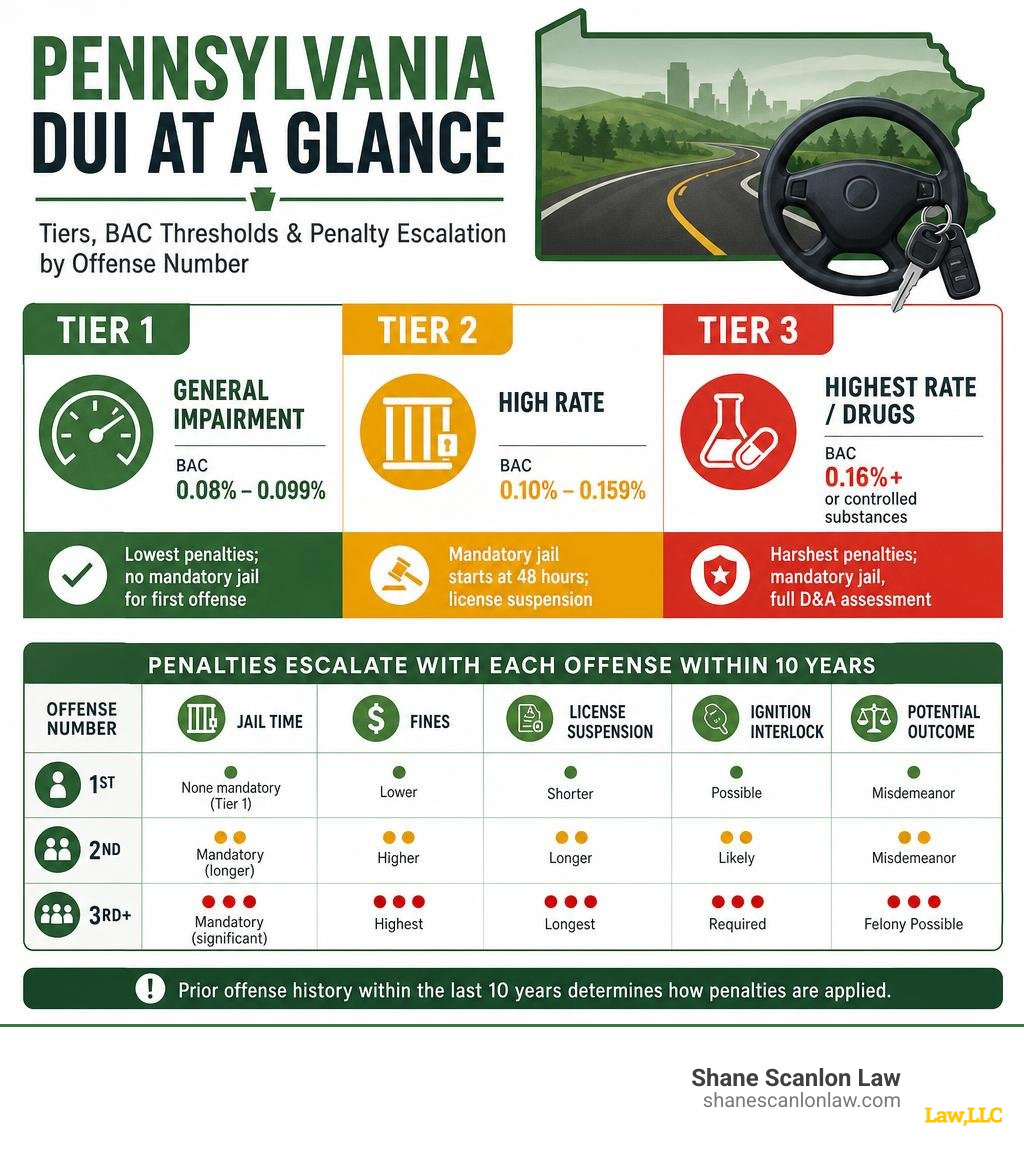
DUI Pennsylvania law organizes drunk and impaired driving offenses into three tiers based on your blood alcohol concentration (BAC) and the circumstances of the stop. Here is a quick breakdown:
| Tier | Offense Type | BAC Level | Key Drivers |
|---|---|---|---|
| Tier 1 | General Impairment | 0.08% – 0.099% | Lowest penalties; no mandatory jail for first offense |
| Tier 2 | High Rate | 0.10% – 0.159% | Mandatory jail starts at 48 hours; license suspension |
| Tier 3 | Highest Rate / Drugs | 0.16%+ or controlled substances | Harshest penalties; mandatory jail, full D&A assessment |
Your prior offense history within the last 10 years determines how those tiers translate into fines, jail time, license suspension, and ignition interlock requirements. A first offense at Tier 1 may result in nothing more than probation and a small fine. A third offense at Tier 3 can mean years in prison and a felony on your record.
Pennsylvania recorded over 45,000 DUI arrests in 2023 alone. If you are facing charges, the stakes are real — and the law is more layered than most people expect.
I am Shane Scanlon, founder of Shane Scanlon Law and a former Lackawanna County District Attorney who began my legal career prosecuting DUI offenses starting in 2003 — the same year Pennsylvania’s current DUI statute was signed into law. That prosecutorial background gives me a direct, inside view of how DUI Pennsylvania law is built and how it is enforced, which I now use to defend clients throughout Scranton and Northeast Pennsylvania.
Understanding the Three Tiers of DUI Pennsylvania Law

Pennsylvania does not treat all blood alcohol concentration (BAC) levels equally. To understand how a single mistake can impact your life, you have to look closely at the statutory framework established under 75 Pa. C.S. § 3802. This statute divides driving under the influence into three distinct, escalating tiers.
The Commonwealth’s approach focuses on the level of impairment or chemical concentration in your system within two hours of operating a motor vehicle. It is also helpful to understand the terminology here: while many states use “DWI” (Driving While Intoxicated), Pennsylvania officially charges drivers with “DUI” (Driving Under the Influence). If you are curious about how these terms match up, you can read our guide on decoding the difference between DUI and DWI.
Tier 1: General Impairment (BAC 0.08% – 0.099%)
This is the baseline level for adult drivers in Pennsylvania. You can be charged under Tier 1 if your BAC is between 0.08% and 0.099%, or if you are deemed “incapable of safe driving” even without a chemical test result. For a first-time offender, this tier is designed to be rehabilitative, focusing on probation and education rather than hard jail time.
Tier 2: High Rate of Alcohol (BAC 0.10% – 0.159%)
If your BAC falls within this middle range, the law assumes a significantly higher risk to public safety. Consequently, the penalties jump. This tier also automatically applies to specific drivers regardless of their actual BAC, including minors (under 21) with a BAC of 0.02% or higher, commercial drivers with a BAC of 0.04% or higher, and school bus drivers with a BAC of 0.02% or higher. Additionally, if you are involved in an accident that causes property damage, bodily injury, or death, your penalties are automatically elevated to this tier.
Tier 3: Highest Rate of Alcohol / Controlled Substances (BAC 0.16% and Above)
This is the most severe tier. It applies to drivers with a BAC of 0.16% or higher, those who refuse chemical testing (breath, blood, or urine), and anyone operating a vehicle under the influence of controlled substances (including illegal drugs, unprescribed prescription pills, or their metabolites).
Understanding these tiers is the first step in building a defense. The prosecution must prove your BAC level fell within these specific ranges within the strict statutory guidelines, which is often where an experienced local attorney can find critical procedural errors.
Grading and Penalties for PA DUI Offenses

In Pennsylvania, the grading of a DUI charge ranges from an ungraded misdemeanor to a third-degree felony. How your specific charge is graded—and the penalties that follow—depends entirely on two factors: which BAC tier you fall into, and how many prior DUI offenses you have accumulated within the 10-year lookback period.
Under Section 3804.0 – Title 75 – VEHICLES, the sentencing matrix is rigid. Judges have very little discretion when it comes to mandatory minimum sentences, making it essential to have a defense strategy that targets the grading of the offense itself.
First-Time Offender Penalties Under DUI Pennsylvania Law
If you have a completely clean record with no prior DUI offenses in the last 10 years, a first-time arrest is stressful, but there are paths to protect your future. The penalties for a first offense depend directly on your BAC tier:
- Tier 1 (General Impairment): This is graded as an ungraded misdemeanor. The penalties include a mandatory 6 months of probation, a $300 fine, mandatory attendance at an Alcohol Highway Safety School (AHSS), and a drug and alcohol evaluation. Crucially, there is no license suspension for a first-offense Tier 1 DUI, making it the only tier that allows you to keep driving immediately.
- Tier 2 (High Rate): Also graded as an ungraded misdemeanor. However, the penalties increase to a mandatory minimum of 48 consecutive hours in jail (up to 6 months), fines ranging from $500 to $5,000, a 12-month license suspension, and mandatory AHSS.
- Tier 3 (Highest Rate / Drugs / Refusal): Graded as an ungraded misdemeanor. The mandatory minimum jail sentence increases to 72 consecutive hours (up to 6 months), fines range from $1,000 to $5,000, and you face a 12-month license suspension along with mandatory drug and alcohol treatment.
To fully understand your options during an initial arrest, read our comprehensive article on first-time DUI rights.
Second and Subsequent Offenses Under DUI Pennsylvania Law
Once you enter repeat-offender territory, Pennsylvania’s legal system shifts from a focus on rehabilitation to strict punishment. The penalties escalate dramatically for a second or third offense within the 10-year lookback window:
- Second Offense:
- Tier 1: Graded as an ungraded misdemeanor. Mandatory minimum of 5 days in jail (up to 6 months), a $300 to $2,500 fine, a 12-month license suspension, and 1 year of an ignition interlock device (IID).
- Tier 2: Graded as an ungraded misdemeanor. Mandatory minimum of 30 days in jail (up to 6 months), a $750 to $5,000 fine, a 12-month license suspension, and 1 year of an IID.
- Tier 3: Graded as a first-degree misdemeanor. Mandatory minimum of 90 days in jail (up to 5 years), a minimum fine of $1,500, an 18-month license suspension, and 1 year of an IID.
- Third Offense:
- Tier 1: Graded as a second-degree misdemeanor. Mandatory minimum of 10 days in jail (up to 2 years), a $500 to $5,000 fine, a 12-month license suspension, and 1 year of an IID.
- Tier 2: Graded as a first-degree felony or misdemeanor depending on specific circumstances. Mandatory minimum of 90 days to 1 year in jail, an 18-month license suspension, and heavy fines.
- Tier 3: Graded as a third-degree felony. Mandatory minimum of 1 year in state prison (up to 7 years), a minimum fine of $2,500, an 18-month license suspension, and 1 year of an IID.
Facing a repeat charge requires aggressive defense strategies. You can learn more about how we fight these cases by reading about second DUI defense and the severe third DUI consequences.
Special DUI Categories and Aggravating Factors
Not every DUI involves an adult driver in a standard passenger vehicle on a clear night. Pennsylvania law carves out strict rules for specific groups of drivers and applies heavy enhancements when aggravating factors like accidents are involved.
Underage DUI and Commercial Driver Limits
Pennsylvania enforces a “zero tolerance” policy for minors. If you are under the age of 21, the legal limit of 0.08% does not apply to you. Instead, you can be charged with a DUI with a BAC of 0.02% or higher. Minors represent roughly 4% of licensed drivers in the Commonwealth but accounted for 8% of all DUI arrests in 2022. An underage DUI conviction carries mandatory license suspensions and can derail academic and career opportunities before they even begin.
For commercial driver’s license (CDL) holders and school bus drivers, the stakes are equally high. Because of the size and responsibility of their vehicles, CDL holders are subject to a 0.04% BAC limit, while school bus drivers are limited to 0.02%. A DUI conviction—even while driving your personal vehicle—can result in an immediate disqualification of your commercial driving privileges, effectively ending your career. If you are facing charges in our local courts, read about how these rules are applied to DUI charges in Lackawanna County.
Accidents, Injuries, and Aggravated Charges
If a DUI involves an accident that results in property damage, bodily injury, or death, the legal landscape changes instantly. Under Pennsylvania law, any accident involving injury or property damage automatically elevates a Tier 1 (General Impairment) offense to the penalties of Tier 2 (High Rate).
If the accident causes serious bodily injury, the charges can be upgraded to Aggravated Assault by Vehicle While DUI, which is a second-degree felony carrying a mandatory prison sentence. If a fatality occurs, you face Homicide by Vehicle While DUI, a first-degree felony carrying a mandatory minimum of 3 years in prison per death.
To learn more about how a simple accident can escalate your legal jeopardy, explore our guides on aggravated DUI charges and drunk driving accident defense.
Implied Consent, Refusals, and Ignition Interlock Rules
Pennsylvania’s vehicle code contains strict administrative rules designed to make chemical testing mandatory and to keep repeat offenders from starting their vehicles while impaired.
Chemical Test Refusal Consequences
When you obtain a driver’s license in Pennsylvania, you automatically give “implied consent” to undergo chemical testing (breath, blood, or urine) if a police officer has reasonable grounds to believe you are driving under the influence.
If you refuse to submit to a chemical test:
- Automatic Civil Suspension: PennDOT will automatically suspend your driver’s license for a mandatory 12 months (for a first refusal) or 18 months (if you have prior DUI offenses or refusals). This suspension is civil, meaning it occurs independently of whether you are actually convicted of the criminal DUI charge in court.
- Criminal Penalty Enhancement: If you are prosecuted for the DUI, your refusal automatically places you into Tier 3 (Highest Rate) penalties. This means you face the highest mandatory fines and jail times if convicted.
Challenging a refusal or the chemical test itself requires technical and scientific knowledge. To see how these breath and blood tests can be contested, read our insights on challenging breathalyzer results.
Ignition Interlock Device (IID) Mandates
An Ignition Interlock Device (IID) is a breathalyzer wired directly into your vehicle’s ignition system. The vehicle will not start unless you blow into the device and register a BAC below 0.025%.
Under Pennsylvania law, an IID is mandatory for:
- All second and subsequent DUI offenders.
- First-time offenders in Tier 3 (Highest BAC of 0.16%+ or controlled substances).
- First-time offenders who refused chemical testing.
The device must be installed on all vehicles you own or operate for a mandatory period of 1 year. Between 2018 and 2022, Pennsylvania’s ignition interlock program successfully prevented an estimated 12,000 DUI recidivism incidents.
There are limited exemptions to this rule. For example, an employment exemption may allow you to operate an employer-owned vehicle during work hours without an IID, provided your employer is formally notified and you carry the proper PennDOT documentation. To see how these rules impact drivers locally, read about DUI penalties in Luzerne County.
Diversion Programs, Assessments, and Legislative Updates
Pennsylvania’s legal system is constantly evolving, balancing the need for public safety with opportunities for rehabilitation.
Accelerated Rehabilitative Disposition (ARD) Eligibility
For many first-time DUI offenders, the Accelerated Rehabilitative Disposition (ARD) program is the best path forward. ARD is a diversionary program run by local District Attorneys (such as in Lackawanna, Luzerne, Susquehanna, and Wyoming counties) that allows qualified, non-violent offenders to bypass the trial process.
Upon successful completion of the ARD program—which typically involves probation, community service, restitution, and Alcohol Highway Safety School—the original DUI charges are dismissed, and you can petition the court to have your arrest record expunged.
However, ARD is not automatic. You are generally ineligible if:
- You have a prior DUI conviction or ARD placement within the last 10 years.
- The DUI involved an accident causing serious injury or death.
- You had a passenger under the age of 14 in the vehicle at the time of your arrest.
The total cost of entering the ARD program is estimated to be around $2,500 (excluding attorney fees), but the long-term benefit of keeping your record clean is invaluable. To explore local options, see how we can assist you with DUI Charges | Scranton Criminal Defense Lawyers .
Mandatory CRN Evaluations and Treatment
Every single person arrested for a DUI in Pennsylvania must undergo a Court Reporting Network (CRN) evaluation before sentencing or entering a diversion program. The CRN evaluation is a standardized questionnaire designed to assess your drug and alcohol consumption habits and determine if a clinical drug and alcohol assessment is necessary.
If the CRN evaluation or your BAC level (especially Tier 3) indicates a potential substance abuse issue, the court will order a full drug and alcohol assessment. You must comply with any recommended treatment program, which may include outpatient counseling or inpatient rehabilitation, to satisfy your sentencing requirements. If you’ve just been arrested and are wondering what steps to take next, read our survival guide for morning after.
Legislative Evolution: Act 24 to Act 58 of 2025
Pennsylvania’s DUI laws have undergone massive shifts over the last two decades. The foundation of modern enforcement began with Act 24 of 2003, which lowered the legal limit from 0.10% to 0.08% and established the three-tiered penalty structure we use today. You can read the full statutory framework under Chapter 38. – Title 75 – VEHICLES .
More recently, Act 58 of 2025 was enacted to close legal loopholes and align Pennsylvania’s statutes with recent federal and state supreme court rulings regarding chemical test refusals and sentencing. Most notably, Act 58 established strict, mandatory sentencing guidelines for individuals caught driving with a suspended license due to a prior DUI:
- A first violation of driving under a DUI-related suspension carries a mandatory 60 days in prison.
- A second violation carries a mandatory 90 days in prison.
This legislative update ensures that repeat offenders face immediate, meaningful consequences while preserving rehabilitation options like ARD for eligible first-time defendants. If you need help navigating these recent updates, read our guide on finding NEPA DUI defense.
Frequently Asked Questions About Pennsylvania DUI Law
Can a Pennsylvania DUI charge be dismissed or reduced?
Yes. DUI charges are not open-and-shut cases. An experienced defense attorney can challenge the legality of the initial traffic stop, the accuracy of field sobriety tests, and the calibration and administration of blood or breathalyzer tests. If the police violated your constitutional rights or failed to follow strict testing protocols, the evidence against you may be suppressed, leading to a dismissal or reduction of charges. Learn more about how a lawyer reduces charges.
What is the 10-year lookback period in PA?
The lookback period is the window of time the court looks at to determine if you are a repeat offender. In Pennsylvania, the lookback period is exactly 10 years, calculated from the date of your previous DUI arrest to the date of your current DUI arrest. Any DUI conviction or ARD completion within that 10-year window will elevate the grading and penalties of your new charge.
How does a DUI affect my out-of-state license?
Pennsylvania is a member of the Interstate Driver’s License Compact, an agreement among states to share information about driving offenses. If you are an out-of-state driver arrested for a DUI in Scranton or Wilkes-Barre, PennDOT will report the conviction or chemical test refusal to your home state. Your home state’s licensing authority will then apply its own laws to suspend or restrict your license.
Conclusion
Facing a DUI charge under Pennsylvania law can feel like being caught in an overwhelming, unforgiving machine. Between the rigid three-tier system, mandatory jail sentences, and the complex rules of implied consent, a single mistake can put your career, your license, and your freedom in immediate jeopardy.
At Shane Scanlon Law, we understand what is at stake. Serving clients across Lackawanna, Luzerne, Susquehanna, and Wyoming counties, we bring unmatched local experience to your defense. As a former District Attorney who began prosecuting DUI cases in 2003, I have spent over two decades analyzing how law enforcement builds these cases. Today, we use that deep prosecutorial insight to identify weaknesses in the state’s evidence, protect your rights, and secure the best possible outcome for your future.
If you are facing a DUI in Northeast Pennsylvania, do not navigate the system alone. Contact a Scranton DUI attorney today for a confidential consultation, or explore our legal directories to find the Best DUI Lawyers in Wilkes-Barre, PA – Justia and the Best DUI Lawyers in Wyoming County, PA – Justia. Let us help you keep your life moving forward.