
 Call Anytime
833.722.6566
Call Anytime
833.722.6566
DUI Dismissals: The Science of Beating a Bad Breathalyzer

What You Need to Know About Getting DUI Charges Dismissed
DUI charges dismissed outcomes are more common than most people realize. Here are the most frequent grounds that lead to dismissal:
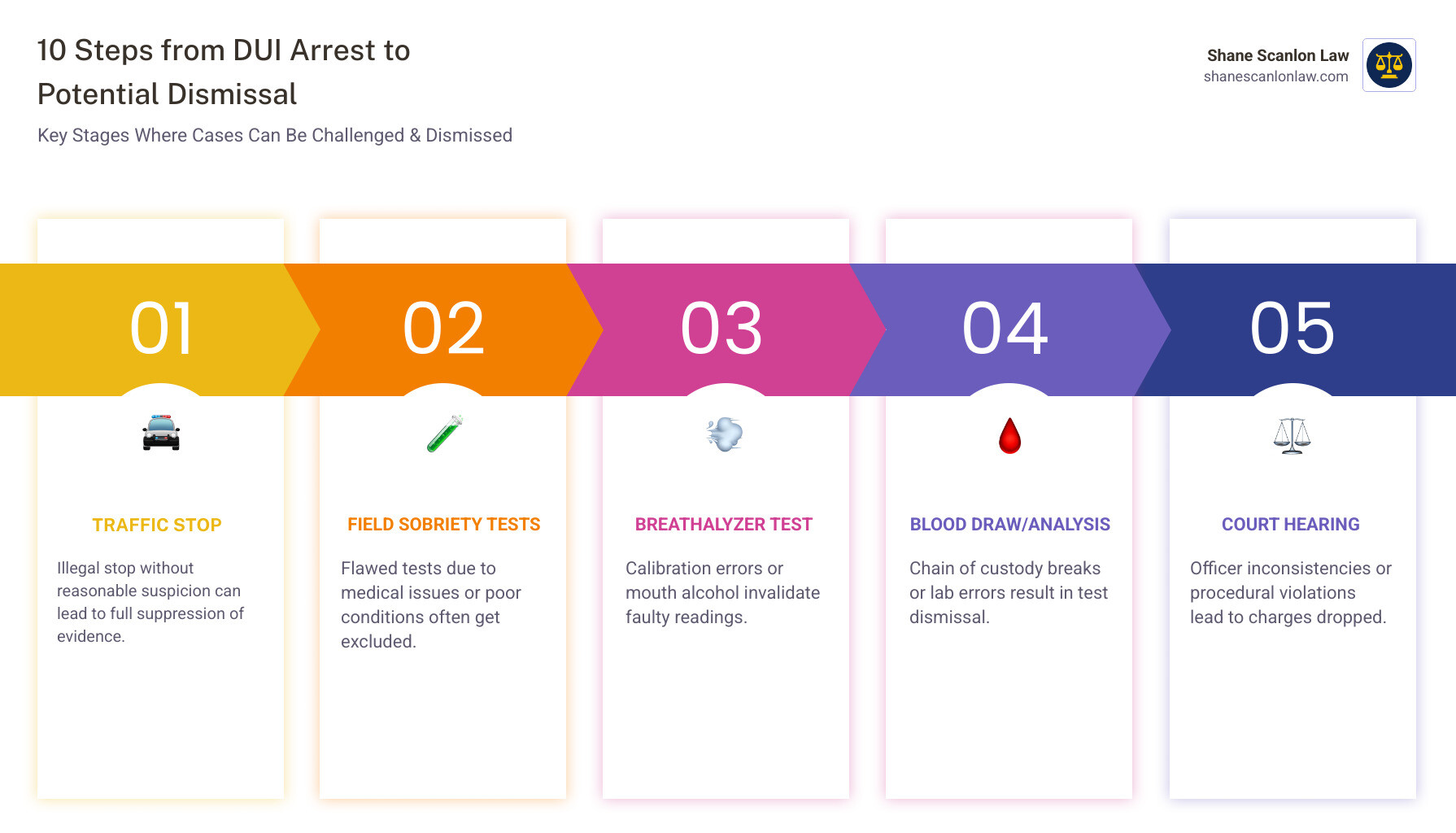
- Illegal traffic stop – No reasonable suspicion to pull you over
- Faulty breathalyzer – Improper calibration or expired operator certification
- Flawed field sobriety tests – Medical conditions, fatigue, or poor test administration
- Blood test errors – Broken chain of custody or improper storage
- Constitutional violations – Miranda rights not read, or unlawful arrest
- Officer inconsistencies – Dashcam footage contradicts the police report
- Diversion programs – First-time offenders may qualify for ARD, leading to dismissal
About 1 in 4 DUI cases is dismissed outright. Another 30-40% are reduced to lesser charges like reckless driving. So if you’ve been arrested, the case is far from over.
A DUI arrest is frightening. The penalties are serious – jail time, heavy fines, license suspension, and a record that can follow you for decades. Most people assume a failed breath test means an automatic conviction. It doesn’t.
The truth is that breathalyzers break down, officers make mistakes, and police procedures don’t always hold up to scrutiny. Any one of those cracks in the case can be enough to get charges reduced or dropped entirely.
I’m Shane Scanlon, founder of Shane Scanlon Law and a former Lackawanna County District Attorney with over 20 years of courtroom experience – including years prosecuting DUI cases before switching to defense. That insider perspective is exactly what I bring to every DUI charges dismissed case I handle, and in this guide I’ll show you the specific tools and strategies that actually work.
Explore more about DUI charges dismissed:
Can You Get DUI Charges Dismissed? Understanding the Legal Thresholds

When we talk about getting DUI charges dismissed, we are looking for the “weak links” in the prosecution’s chain. In Pennsylvania, the law is strict, but so are the requirements for the police. Under the Commonwealth’s DUI statutes, the prosecution carries the heavy burden of proving every element of the crime beyond a reasonable doubt.
In Lackawanna and Luzerne Counties, DUI cases are generally categorized into three tiers based on your Blood Alcohol Content (BAC). Tier 1 is the “General Impairment” level (0.08% to 0.099%), Tier 2 is “High Rate” (0.10% to 0.159%), and Tier 3 is the “Highest Rate” (0.16% and up, or controlled substances). The higher the tier, the harsher the mandatory minimum penalties.
However, a high BAC number on a piece of paper isn’t a finished case. We look at the “Prima Facie” case—meaning, did the officer have the legal right to stop you, and did they have probable cause to arrest you? If the initial stop was based on a “hunch” rather than observable traffic violations or reasonable suspicion, the entire case may crumble. As a DUI Lawyer in Scranton PA, we often find that if the foundation of the stop is illegal, the evidence that follows—including the breathalyzer—is inadmissible.
The Probability of Success: Statistics on Dismissals and Reductions
Many people feel hopeless after a DUI arrest, but the numbers tell a different story. Research suggests that approximately one in four DUI cases eventually end up getting dismissed. Furthermore, in many jurisdictions, around 30-40% of DUI cases are reduced to a lesser charge, such as reckless driving.
A reduction to reckless driving is often a massive win. While a DUI conviction in Pennsylvania can carry a 75-year shadow on your record, a reduced charge may avoid the mandatory jail time and the long-term stigma associated with “drunk driving.” These reductions usually happen when we expose flaws in the evidence that make a prosecutor realize they might lose at trial.
Real-World Examples of DUI Charges Dismissed
To understand how DUI charges dismissed outcomes happen in the real world, let’s look at some common scenarios we see in Northeast Pennsylvania courts:
| Scenario | Primary Ground for Dismissal |
|---|---|
| Driver stopped for “weaving” within a lane | No reasonable suspicion; dashcam showed safe driving |
| Breathalyzer machine missed its monthly calibration | Technical violation of maintenance standards |
| Officer fails to appear for the preliminary hearing | Lack of prosecution/witness availability |
| Driver found asleep in a parked car | Lack of “actual physical control” of the vehicle |
| Blood sample sat in a warm police car for two days | DUI conviction overturned due to unauthorized blood draw or storage errors |
In one notable case, a defendant’s charges were dropped because the officer failed to sign the criminal complaint properly. In another, a medical condition—specifically a knee injury—was used to prove that the “failed” field sobriety test was actually due to physical pain, not alcohol.
The Science of Suppression: Challenging Breath, Blood, and Field Tests
The “science” of a DUI arrest is often much shakier than the police want you to believe. Most breathalyzer machines, like the Intoxilyzer series, rely on infrared spectrometry. While they are sophisticated, they are not infallible. They must be calibrated, tested, and maintained according to strict schedules.
In our practice, we subpoena the calibration logs. If the machine hasn’t been serviced according to the manufacturer’s specs or state regulations, the results can be suppressed. We also look for “mouth alcohol” issues. If you burped, vomited, or even had acid reflux (GERD) within 20 minutes of the test, the machine might read the alcohol vapors from your stomach rather than your deep lung air, resulting in a falsely high BAC. To learn more about these tactics, see our guide on how to Beat the Breathalyzer: Smart Ways to Challenge DUI Charges.
Challenging Subjective Field Sobriety Tests
Field Sobriety Tests (FSTs) are designed to be “divided attention” tasks. However, they are highly subjective. The National Highway Traffic Safety Administration (NHTSA) has strict standards for how these tests must be administered. If the officer gave poor instructions or performed the tests on an uneven, gravelly shoulder of I-81 in the rain, the results are essentially meaningless.
We also consider medical factors. Obesity, inner ear infections, or even simple fatigue can cause a perfectly sober person to “fail” a one-leg stand. There are even instances where high-profile cases, such as the Lawyer for Kathleen Kane, have highlighted how FSTs can sometimes be used as “fishing expeditions” rather than legitimate diagnostic tools.
Blood Test Inaccuracies and Chain of Custody
Blood tests are often seen as the “gold standard,” but they are prone to human error. If the lab technician isn’t properly certified, or if the vial wasn’t treated with the correct amount of anticoagulant and preservative, the blood can ferment. Fermentation actually creates alcohol in the vial, making your BAC look higher than it was at the time of the stop.
Furthermore, the “chain of custody” must be perfect. If there is a gap in the records showing where that blood was every minute from the needle to the lab, we can argue the evidence has been compromised. This is a common strategy used by any experienced DUI Lawyer in Wilkes-Barre PA.
Constitutional Violations and Illegal Traffic Stops
The Fourth Amendment protects you from unreasonable searches and seizures. In the context of a DUI, this means the police cannot pull you over just because they have a “feeling” you might be drinking. They need reasonable suspicion—a specific, articulable reason to believe a crime or traffic violation is occurring.
If you were driving perfectly and the officer pulled you over because you were leaving a bar late at night, that stop is likely illegal. Any evidence gathered after an illegal stop—the smell of alcohol, your statements, and the breath test—is “fruit of the poisonous tree” and cannot be used against you.
Using Evidence to Expose Officer Inconsistencies
Police reports are the officer’s version of the truth, but dashcam and bodycam footage provide the objective truth. We often find discrepancies where an officer writes that a driver was “stumbling and slurred,” yet the video shows a person standing perfectly straight and speaking clearly.
By filing a Motion to Suppress, we ask the judge to throw out evidence because of these inconsistencies or constitutional violations. This is one of the most effective ways to see DUI charges dismissed. You can read more about this process in our article on How a DUI Lawyer Can Help Reduce or Dismiss Your DUI Charge.
Can a First-Time DUI Charges Dismissed Outcome Happen?
Yes, especially in Pennsylvania. If you are a first-time offender with a clean record, you may be eligible for the Accelerated Rehabilitative Disposition (ARD) program. While technically a diversion program, the end result of successfully completing ARD is that your DUI charges dismissed and your record is expunged.
ARD typically involves a period of probation, a brief license suspension (depending on your BAC), and alcohol safety classes. It is a “second chance” program designed for people who made a one-time mistake. For more details, check out First Time DUI Charge in Pennsylvania: Your Legal Rights Explained.
Strategic Alternatives: Plea Bargains and Diversion Programs
Sometimes, the evidence is strong enough that a full dismissal isn’t likely. In these cases, we pivot to Plea-bargaining. This might involve a “wet reckless” plea or negotiating for a lower tier of DUI to avoid jail time.
In Scranton and surrounding areas, the ARD program remains the most popular path for first-timers. However, eligibility is strict. If there was an accident involving serious injury or if a child under 14 was in the car, ARD is usually off the table. We work closely with the District Attorney’s office to present you in the best light possible to secure these First-Time DUI in Scranton PA options.
The Impact of Refusing a Breath Test
Under Pennsylvania’s Implied Consent Law, by driving on our roads, you have already “consented” to chemical testing. If you refuse the breath or blood test at the station, you face an automatic 12-month license suspension, regardless of whether you are eventually found guilty of the DUI.
However, from a defense standpoint, a refusal creates “evidentiary gaps.” The prosecutor won’t have a BAC number to show the jury. While the refusal can be used against you in court to suggest “consciousness of guilt,” it also prevents the state from proving a Tier 3 offense based on numbers alone. Navigating this requires a specific strategy, often discussed when looking at How a Lawyer Can Help with a Second DUI Charge in PA.
Long-Term Consequences of a DUI Conviction
If you don’t fight to get your DUI charges dismissed, the consequences are enduring. In some states, a DUI can stay on your record for 75 years. This affects background checks for jobs, increases your insurance rates by thousands of dollars, and can even prevent you from traveling to countries like Canada.
This is why we place such a heavy emphasis on Expungements. Even if your case is dismissed, the arrest record remains until you take the legal steps to wipe it clean. We ensure that if we win your case, we finish the job by clearing your name entirely.
Frequently Asked Questions about DUI Charges Dismissed
Can a DUI be dismissed if the officer didn’t read my Miranda rights?
It depends. Miranda rights only apply to “custodial interrogation.” If the officer didn’t read them, any statements you made after being arrested (like admitting to how many drinks you had) might be suppressed. However, the physical evidence—like the breathalyzer result—is usually not affected by a Miranda violation. Still, suppressing your admissions can significantly weaken the prosecution’s case.
Why is a private attorney more effective than a public defender for dismissal?
Public defenders are often excellent lawyers, but they are incredibly overburdened. A private Scranton DUI Attorney has the time and resources to subpoena maintenance logs, hire expert toxicologists, and meticulously review every second of dashcam footage. We focus on the “small details” that lead to dismissals, which requires hours of investigation that a public defender simply might not have.
What should I do immediately after a DUI arrest to help my case?
- Write everything down: Note the weather, the road conditions, and exactly what the officer said.
- Don’t post on social media: Anything you say online can be used against you.
- Preserve evidence: If you have a medical condition or a witness who saw you weren’t impaired, get those records or contact info immediately.
- Hire counsel: The sooner we can get to work, the better our chances of preserving dashcam footage before it is deleted. This is critical for DUI Charges in Lackawanna County PA.
Conclusion
At Shane Scanlon Law, we don’t just “process” cases; we deconstruct them. With over 20 years of experience and the unique perspective of a former District Attorney, I know exactly where the cracks in a DUI case usually hide. We are proud to serve the communities of Scranton, Wilkes-Barre, and the surrounding counties of Lackawanna, Luzerne, Susquehanna, and Wyoming.
If you are facing a DUI, don’t assume the worst. There is a science to beating a bad breathalyzer, and we have the expertise to apply it to your case. Whether it’s through aggressive litigation, a Motion to Suppress, or navigating the ARD program, we fight for the best possible outcome for our neighbors in NEPA.
Contact a Scranton DUI Attorney for a Free Consultation today and let us start building your defense.