
 Call Anytime
833.722.6566
Call Anytime
833.722.6566
Decoding the Difference Between DUI and DWI in Pennsylvania

The DUI vs. DWI Pennsylvania Difference Explained in Plain English
Understanding the DUI vs. DWI Pennsylvania difference is simpler than most people expect — because Pennsylvania only uses one term.
Quick Answer:
| Term | Used in Pennsylvania? | What It Means |
|---|---|---|
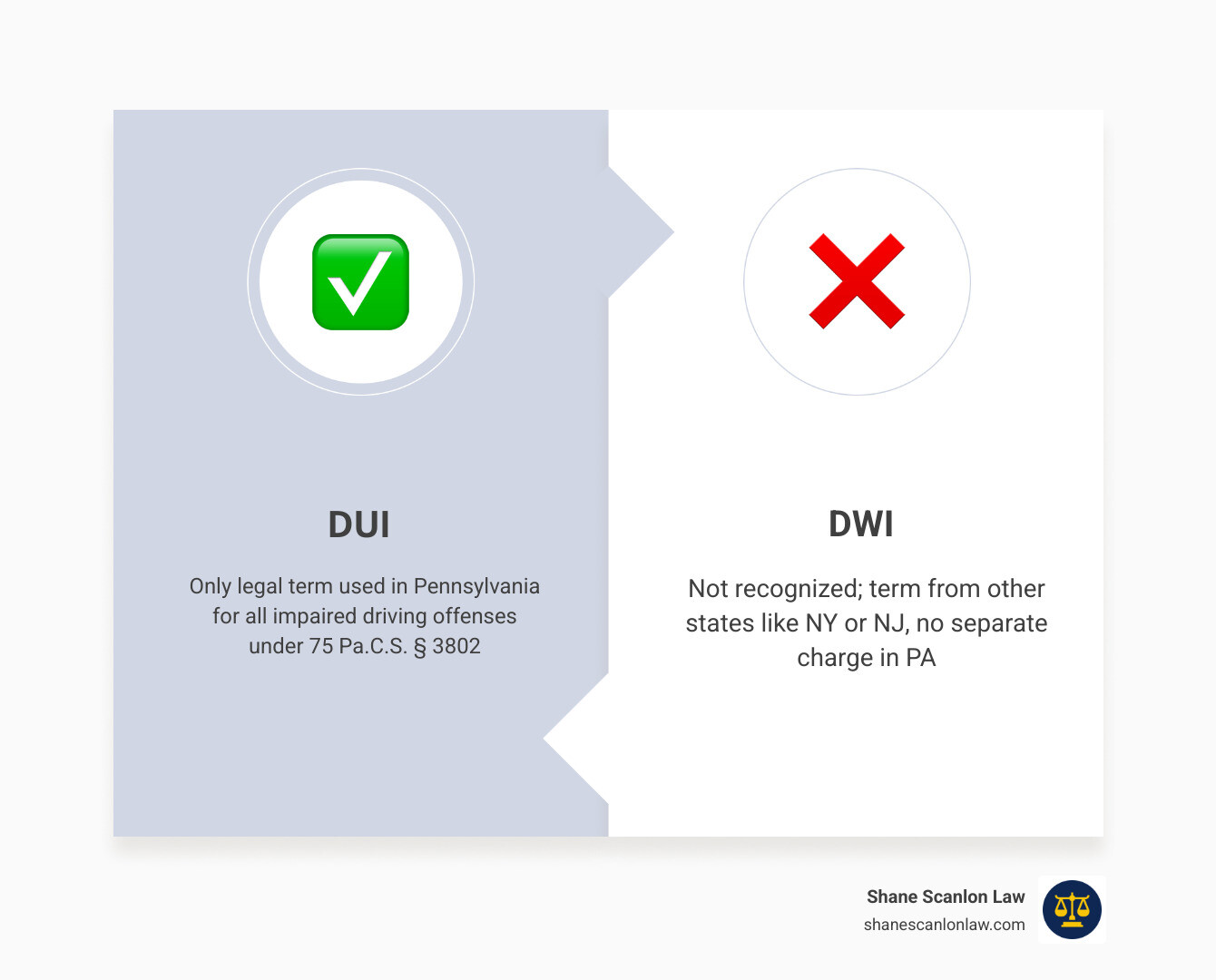
| DUI (Driving Under the Influence) | Yes | The only legal term PA uses for impaired driving |
| DWI (Driving While Intoxicated/Impaired) | No | Used in other states; not a separate charge in PA |
| DWAI (Driving While Ability Impaired) | No | Not recognized under Pennsylvania law |
Pennsylvania law — specifically 75 Pa.C.S. § 3802 — covers all impaired driving under a single DUI statute. That includes alcohol, illegal drugs, prescription medications, and combinations of all of them. There is no separate DWI charge, no DWAI category, and no lesser impairment tier with a different name. If you were charged with impaired driving in Pennsylvania, the charge is a DUI, period.
That said, not all DUIs are treated the same. Pennsylvania divides DUI offenses into three tiers based on your blood alcohol content (BAC) and the substance involved. Those tiers carry very different penalties — ranging from probation with no jail time to mandatory prison sentences and felony charges.
If you are facing a DUI charge right now, or you were hurt by an impaired driver, the terminology matters less than what happens next.
I’m Shane Scanlon, founder of Shane Scanlon Law and a former Lackawanna County District Attorney with over 20 years of Pennsylvania courtroom experience — including years of handling DUI prosecutions firsthand, which gives me a unique edge in understanding the DUI vs. DWI Pennsylvania difference from both sides of the courtroom. That experience shapes everything I do for clients facing these charges today.
DUI vs DWI Pennsylvania Difference: What the Law Actually Calls It
If you’ve spent any time watching police procedurals or news from neighboring states like New York or New Jersey, you’ve likely heard a alphabet soup of acronyms: DWI, DWAI, OUI, or OWI. This often leads people in Scranton or Wilkes-Barre to ask us about the dui vs dwi pennsylvania difference.
In the Commonwealth of Pennsylvania, we keep things unified. Under the Pennsylvania Vehicle Code, specifically 75 Pa.C.S. § 3802, the only term that matters is DUI (Driving Under the Influence). Whether you are accused of having too many beers at a RailRiders game or being under the influence of a prescription medication, the charge remains “DUI.”
Is there a legal distinction between DUI and DWI in Pennsylvania?
No. There is absolutely no legal distinction between DUI and DWI in Pennsylvania because the term “DWI” (Driving While Intoxicated) does not exist in our state’s criminal statutes.
In some other states, a DWI might be a more serious felony charge while a DUI is a lesser misdemeanor. In Pennsylvania, we don’t play that game. We use a single, broad DUI statute that covers every type of impairment. If you are pulled over in Lackawanna or Luzerne County, the officer isn’t deciding between a DUI or a DWI; they are investigating a DUI.
Does Pennsylvania recognize DWAI or other out-of-state labels?
Pennsylvania does not recognize DWAI (Driving While Ability Impaired). In states like New York, DWAI is often a “lesser” charge for drivers with a BAC between .05% and .07%. Pennsylvania doesn’t have this “middle ground” charge. If you are impaired, you are charged with DUI.
However, if you have a prior conviction from another state for an OWI (Operating While Intoxicated) or OUI (Operating Under the Influence), Pennsylvania courts will typically treat those as “prior offenses” when calculating your penalties here. For more on how these terms vary across the country, check out this DUI vs. DWI vs. DWAI explanation.
Pennsylvania DUI Tiers, BAC Limits, and Zero-Tolerance Rules
While the name is always the same, the severity of the charge changes based on your Blood Alcohol Content (BAC). Think of it as a ladder: the higher your BAC, the higher the penalties.
The three DUI tiers in Pennsylvania and how BAC changes the charge
The dui vs dwi pennsylvania difference is really found in these three specific tiers. Pennsylvania uses a “tier-based” system to punish drivers more severely as their level of intoxication increases:
- General Impairment (.08% to .099%): This is the lowest tier. Even if you don’t “feel” drunk, if your BAC is in this range, you are legally impaired.
- High Rate of Alcohol (.10% to .159%): This middle tier carries stiffer fines and mandatory jail time, even for some first-time offenders.
- Highest Rate of Alcohol (.16% and above): This is the “aggravated” tier. It also applies to all controlled substance (drug) DUIs and those who refuse a chemical test.
BAC limits for adult, commercial, and under-21 drivers
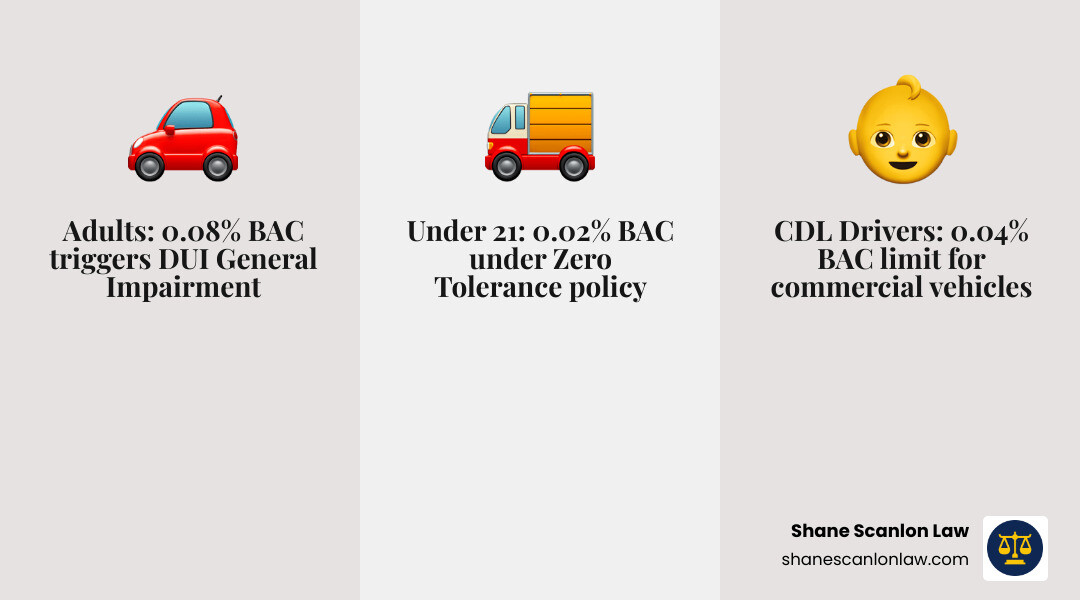
The limit isn’t .08% for everyone. Depending on who you are and what you’re driving, the threshold for a DUI arrest changes:
- Standard Drivers: .08% BAC.
- Commercial Drivers (CDL): .04% BAC. If you’re behind the wheel of a big rig in Susquehanna County, the law holds you to a much higher standard.
- Minors (Under 21): .02% BAC. This is effectively “Zero Tolerance.”
Can you get a DUI in Pennsylvania below .08 BAC?
Yes, you absolutely can. Under Section 3802(a)(1), you can be charged with “General Impairment” if the Commonwealth can prove you were “incapable of safely driving” due to alcohol consumption, regardless of your BAC. If an officer observes erratic driving, slurred speech, and failed field sobriety tests, they can charge you even if you blow a .07%.
How Zero Tolerance affects drivers under 21
Pennsylvania’s Zero Tolerance policy is strict. For drivers under 21, a BAC of just .02% — which can be reached with a single drink — triggers a DUI. This results in an automatic license suspension and can derail a young person’s future, affecting college applications and employment.
Alcohol, Drugs, and Refusal Cases Under Pennsylvania DUI Law
In May 2026, we are seeing more drug-related DUI cases than ever before in Northeast Pennsylvania. Whether it’s marijuana, opioids, or even legally prescribed medications, the law treats these cases very seriously.
DUI vs DWI Pennsylvania difference for alcohol cases versus drug cases
Again, there is no separate “Drug DWI.” In PA, if you are impaired by a controlled substance, it is charged as a Highest Tier DUI. This is a crucial point: Pennsylvania law views drug impairment as being just as dangerous as having a BAC of .16% or higher.
How Pennsylvania treats controlled substances and drug metabolites
Pennsylvania has a “per se” law for many controlled substances. This means you can be charged with a DUI simply for having metabolites of a Schedule I drug (like marijuana) in your system, even if you smoked days ago and aren’t currently “high.” For Schedule II and III drugs, the state must usually prove you were actually impaired or that the drug wasn’t legally prescribed to you.
What happens if you refuse a breath or blood test in PA?
When you got your driver’s license, you gave “implied consent” to chemical testing. If you refuse a breath or blood test after a lawful DUI arrest:
- PennDOT Suspension: You face an automatic 12-month license suspension (independent of the criminal case).
- Highest Tier Penalties: If convicted, you are automatically sentenced at the highest BAC tier (.16%+), even if you were actually stone-cold sober.
First-Offense vs Repeat-Offense DUI Penalties in Pennsylvania
The consequences of a DUI conviction in Scranton or Wilkes-Barre depend heavily on your prior record within the last 10 years (the “look-back” period).

Penalties for a first-time DUI offense
For a first-time offender at the General Impairment level, you might face:
- 6 months of probation.
- A $300 fine.
- Alcohol safety school.
- No license suspension (in most cases).
However, if you are in the Highest Tier (over .16% or drugs), even a first offense carries a mandatory minimum of 72 hours in jail and a 12-month license suspension. Many first-time offenders are eligible for the ARD (Accelerated Rehabilitative Disposition) Program, which allows you to earn a dismissal of the charges and an expungement of your record.
Penalties for repeat offenses and aggravated circumstances
Repeat offenses escalate quickly. A second DUI at the highest tier carries a mandatory minimum of 90 days in jail. A third offense can be graded as a felony, punishable by years in state prison.
Aggravated circumstances that increase penalties include:
- Having a minor passenger (under 18) in the car.
- Causing an accident that results in injury or property damage.
- Homicide by Vehicle While DUI (which carries a 3-year mandatory minimum prison sentence per victim).
When an Ignition Interlock Device (IID) is mandatory
An Ignition Interlock Device (IID) is a breathalyzer installed in your car that prevents the engine from starting if alcohol is detected. In Pennsylvania, an IID is mandatory for:
- All repeat offenders.
- First-time offenders in the High and Highest BAC tiers.
- Individuals who refused a chemical test.
You must generally have the device for 12 months before your full driving privileges are restored.
Insurance, Tort Rights, and Out-of-State Convictions
A DUI doesn’t just affect your freedom; it affects your finances and your legal rights in ways most people don’t realize.
How a DUI conviction can affect insurance rates and civil claims
Expect your car insurance premiums to skyrocket. Many carriers will drop you entirely after a DUI conviction, forcing you into “high-risk” pools where rates are double or triple what you previously paid.
Why a DUI crash can expand tort rights in Pennsylvania
This is a vital point for victims of drunk drivers. Pennsylvania is a “choice no-fault” state, meaning many drivers choose “Limited Tort” insurance to save money. Normally, Limited Tort prevents you from suing for “pain and suffering” unless your injuries are permanent or severe.
The Exception: If you are hit by a driver who is convicted of a DUI (or enters the ARD program), the Limited Tort restriction is waived. You automatically gain “Full Tort” rights, allowing you to seek full compensation for your pain, suffering, and emotional distress. In 2024 alone, there were over 7,700 DUI accidents in PA, leading to 244 fatalities. We fight to make sure victims in these cases get every penny they deserve.
How Pennsylvania handles out-of-state DWI or OWI convictions
If you get a DWI in New York and then get a DUI in Scranton, the New York offense will count as a “prior” for sentencing purposes. Pennsylvania belongs to the Driver License Compact, meaning states share information about traffic arrests and convictions. For a deeper dive into these naming conventions, see this Pennsylvania DUI terminology overview.
Frequently Asked Questions About the DUI vs DWI Pennsylvania Difference
Is DWI worse than DUI in Pennsylvania?
Since Pennsylvania doesn’t use the term DWI, one isn’t “worse” than the other. However, a Highest Tier DUI (BAC .16%+) is the most serious level of impaired driving in our state.
Can you be charged with DUI for marijuana in PA?
Yes. Pennsylvania has a zero-tolerance approach to marijuana metabolites in a driver’s blood. Even if you have a medical marijuana card, you can still be charged with a DUI if the prosecution can prove you were impaired while driving.
Will a Pennsylvania DUI stay on your record forever?
A DUI conviction is a criminal record that stays with you forever unless it is expunged. The ARD program is the most common way to achieve expungement for first-time offenders. If you are convicted of a second or third offense, expungement is generally not an option.
Conclusion
Navigating the dui vs dwi pennsylvania difference is the first step in protecting your future. While the terminology is simple — it’s always a DUI — the legal reality is incredibly complex. Between the three BAC tiers, the mandatory minimum jail sentences, and the impact on your insurance and tort rights, you cannot afford to walk into court alone.
At Shane Scanlon Law, we provide the fierce litigation and trusted local representation that residents of Scranton, Wilkes-Barre, and the surrounding counties need. Whether you are facing charges and need a defense that understands the “DA’s playbook,” or you were a victim of a drunk driver and need to exercise your full tort rights, we are here to help.
Don’t let a DUI define your future. More info about criminal defense services is just a click away, or you can call us today to discuss your case.