
 Call Anytime
833.722.6566
Call Anytime
833.722.6566
Police and Protection: A Guide to PFA Enforcement

When a Court Order Isn’t Enough on Its Own: Understanding PFA Enforcement
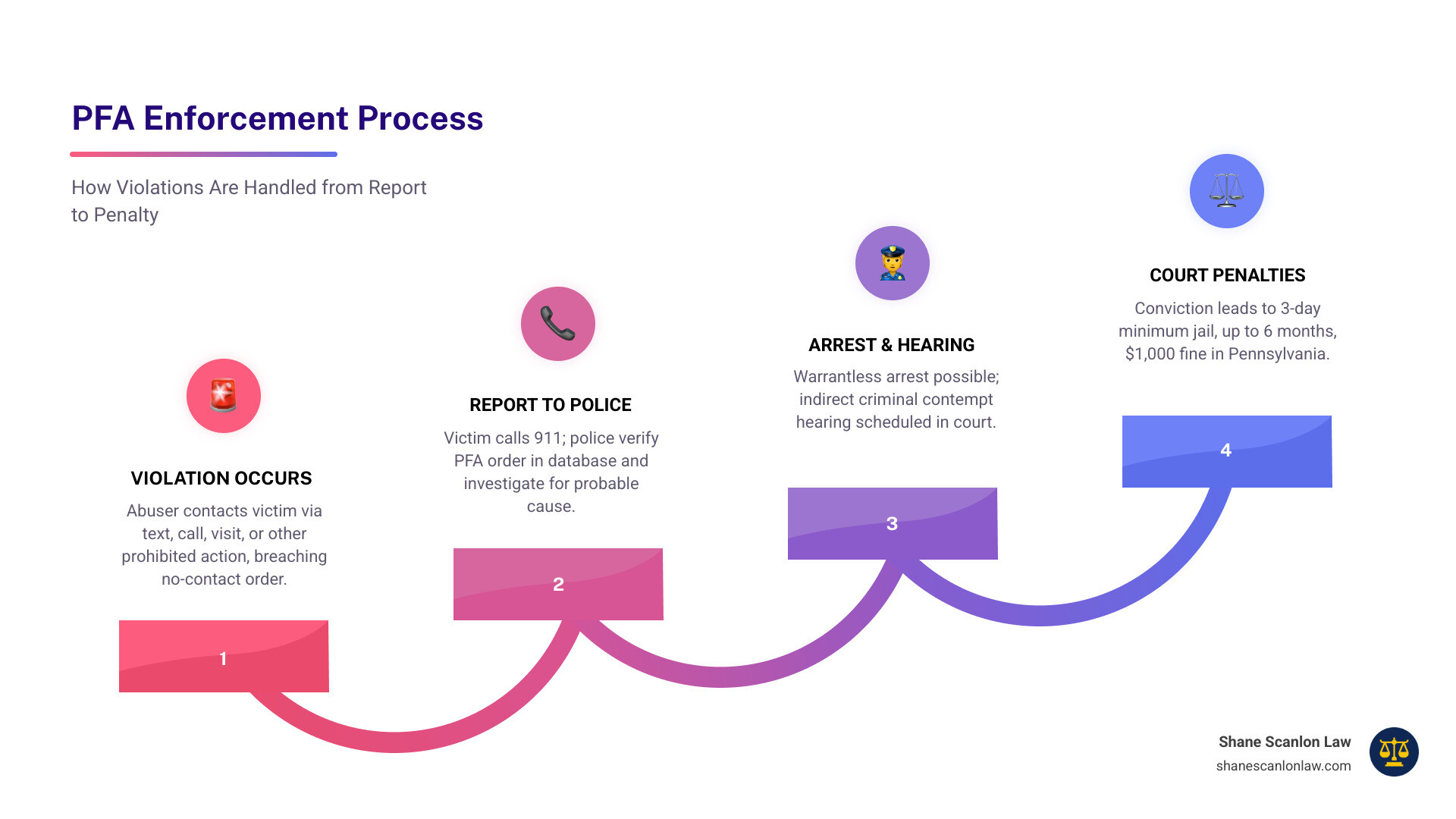
Enforcement of a PFA order is the process by which courts and police give legal teeth to a Protection From Abuse order — turning a piece of paper into real protection.
Here is a quick overview of how it works:
- A PFA is issued by a judge, ordering the abuser to stay away and stop all contact.
- Any violation — a text, a visit, a phone call — can be reported to police immediately.
- Police can arrest the violator on the spot without a warrant if they have probable cause.
- A contempt hearing is held in court, where the violator faces criminal penalties.
- In Pennsylvania, penalties include a mandatory minimum of 3 days in jail, up to 6 months imprisonment, and fines up to $1,000.
- PFA orders travel with you — they are enforceable in all 50 states under federal law.
A PFA can feel like a lifeline — but only if you know how to use it. Too many people are unsure what counts as a violation, what to do when one happens, or how police and courts are supposed to respond. That uncertainty can leave victims vulnerable at exactly the wrong moment.
This guide breaks down the entire enforcement process in plain language, from the moment a violation occurs to what happens inside a courtroom.
I’m Shane Scanlon, founder of Shane Scanlon Law, LLC and a former Lackawanna County District Attorney with over 20 years of Pennsylvania courtroom experience — including prosecuting and defending cases that turned on the enforcement of a PFA. That background gives me a ground-level view of how law enforcement, judges, and prosecutors actually handle these situations, which I’ll share throughout this guide.
What a PFA Is and Why the Enforcement of a PFA Matters
A Protection From Abuse order, usually called a PFA, is a civil court order designed to prevent abuse and reduce danger in certain qualifying domestic relationships. In Pennsylvania, a judge can use a PFA to order someone not to abuse, threaten, stalk, harass, or contact the protected person.
That sounds simple. In real life, it is only effective when violations are taken seriously and enforced quickly.
A PFA is not just a warning. It is a court command. If the defendant ignores it, the case can shift from family court protection into criminal contempt consequences. That is why enforcement of a PFA matters so much in Scranton, Wilkes-Barre, Lackawanna County, Luzerne County, Susquehanna County, and Wyoming County.
For a fuller background on PFA basics, see Protection from Abuse / PFA and Protection from Abuse – PFA Explained.
What a Protection From Abuse order can require
A Pennsylvania PFA can include a wide range of protections, depending on the facts of the case. Common terms include:
- No abuse, threats, stalking, or harassment
- No contact by phone, text, email, social media, or through other people
- Stay-away provisions for home, work, school, or other places
- Removal from a shared residence
- Temporary custody terms for children
- Support-related provisions in some cases
- Firearm surrender requirements
- Protection for pets in appropriate cases
A lot of people think a PFA only means “don’t go near the house.” Not even close. The order may reach communications, custody exchanges, weapons, and daily routines. That is why everyone involved should read the exact language carefully.
If you want more on how these orders are obtained and structured, visit filing and obtaining a PFA order.
Types of orders and duration in Pennsylvania
Pennsylvania PFAs usually come in three forms:
- Emergency PFA: often available after hours and typically lasts until the next business day
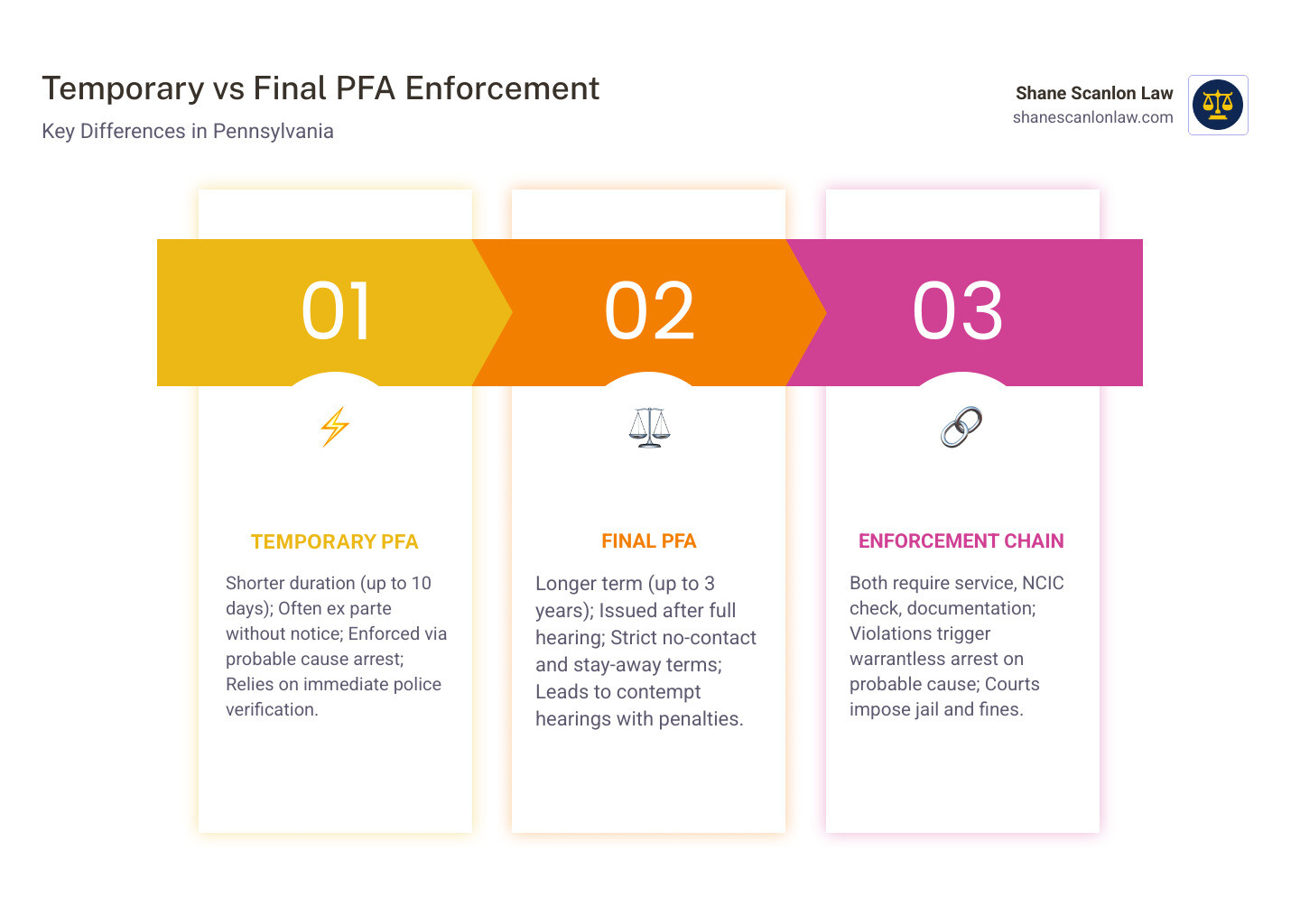
- Temporary PFA: usually lasts up to 10 days until the final hearing
- Final PFA: can last up to 3 years
Those timelines matter because enforcement starts as soon as an order is valid and served or otherwise enforceable under the circumstances.
Pennsylvania courts continue to handle a large number of these cases. Statewide PFA filings were:
- 2018: 39,048
- 2019: 39,132
- 2020: 35,993
- 2021: 38,765
- 2022: 40,623
- 2023: 41,736
That upward trend shows PFAs are not rare paperwork events. They are a regular part of court and police practice across Pennsylvania in 2026.
For more on emergency and temporary orders, see emergency and temporary PFA defense in Northeast Pennsylvania.
Enforcement of a PFA: What Counts as a Violation
A violation happens when the defendant does something the order forbids. In Pennsylvania, violating a PFA is commonly handled as indirect criminal contempt.
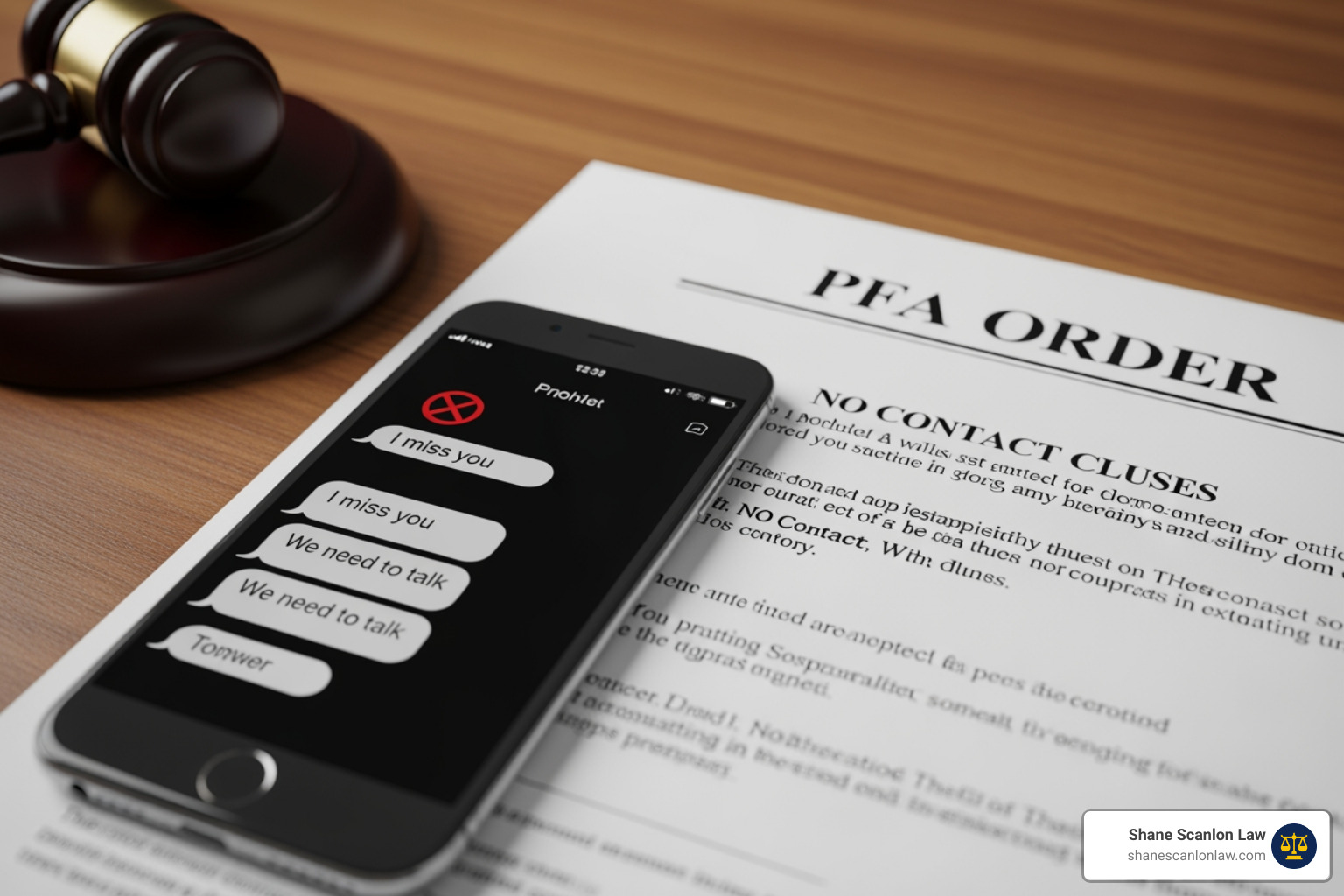
Some violations are obvious, like showing up at the protected person’s house. Others are sneakier, like sending a friend to pass along an “I miss you” message. Courts are not usually impressed by technical gamesmanship.
Direct and indirect contact that violates a PFA
Common examples of PFA violations include:
- Text messages
- Phone calls
- Voicemails
- Emails
- Social media messages or comments
- Gifts or letters
- Showing up at home, work, school, or a child’s activity
- Asking friends or family to make contact
- Tracking someone’s location
- “Apology” messages
- Repeated drive-bys
- Harassment or threats online
Even contact that seems harmless can still be a violation. “I just wanted closure” is not a legal defense. Neither is “I only sent one message.” One prohibited contact can be enough.
Third-party contact also counts if the order bans contact directly or indirectly. So if a defendant tells a sibling, neighbor, or mutual friend to deliver a message, that can still violate the order.
Enforcement of a PFA when firearms or custody terms are violated
Some of the most serious PFA enforcement issues involve guns and children.
If a final PFA requires firearm surrender, the defendant may have to give up guns, other weapons, licenses, or ammunition within the time set by the order. Failure to surrender can lead to contempt consequences and may also trigger additional criminal exposure depending on the facts.
Likewise, if the PFA sets temporary custody rules, exchange locations, or no-contact restrictions involving children, ignoring those terms can become part of the enforcement case. For example:
- Refusing to return a child as ordered
- Showing up at an exchange location not authorized by the order
- Using custody exchanges as an excuse for personal contact
- Bringing a firearm where the order prohibits possession
For more on the consequences facing the accused, see legal consequences for the accused in PFA cases.
Common misconceptions about alleged consent or mutual contact
This is one of the biggest trouble spots in PFA cases.
Common myths include:
- “She answered my text, so it was okay.”
- “He invited me over, so the order didn’t matter.”
- “We both wanted to talk.”
- “It was accidental because I saw her in public.”
Usually, the order controls unless and until the court changes it. The protected person cannot simply cancel a court order by private agreement. If the defendant believes contact should be allowed, the proper step is to ask the court to modify the order, not freelance a reunion.
Accidental encounters can be more complicated. If two people happen to enter the same grocery store, context matters. But staying, approaching, speaking, or following can quickly turn “accidental” into “violation.”
For more on common misunderstandings, see the legal lowdown on PFAs: what you need to know about Protection From Abuse.
What to Do Immediately if a PFA Is Violated
When a violation happens, speed matters. So does calm documentation. We know those two things do not naturally go together in a crisis, but they should.
Steps protected parties should take right away
If a PFA is violated, take these steps as quickly as possible:
- Call 911 if there is immediate danger.
- Contact local police even if the contact seems “minor.”
- Do not respond to the violator.
- Save texts, voicemails, emails, and social media messages.
- Take screenshots showing dates, times, and usernames.
- Photograph injuries, damage, gifts left behind, or vehicle sightings if safe to do so.
- Write down an incident timeline while details are fresh.
- Get witness names and contact information.
- Seek medical care if needed.
- Keep a copy of the PFA with you if possible.
A documented phone screen, a voicemail, or Ring footage can become powerful evidence later.
How police reports and documentation support enforcement of a PFA
Police reports often become the backbone of an enforcement case. They can capture:
- The victim’s immediate statement
- Officer observations
- Bodycam footage
- Dispatch logs
- Timestamps
- Witness statements
- Physical evidence at the scene
Documentation matters because judges often have to decide what happened based on credibility and detail. A prompt report usually carries more weight than a vague memory raised weeks later.
Helpful evidence may include:
- Screenshots
- Call logs
- Voicemails
- Security camera footage
- GPS or location data
- Photos of injuries or property damage
- Hospital or treatment records
- Copies of prior reports showing a pattern
Can police arrest for a PFA violation without a warrant?
Yes, in Pennsylvania, police can arrest for a PFA violation without a warrant when they have probable cause to believe the order was violated. That is one of the most important practical enforcement tools.
Probable cause does not mean the officer saw the violation personally. It means the available facts reasonably support the conclusion that a violation occurred. That can be based on messages, witness statements, visible evidence, admissions, dispatch information, or the officer’s own investigation at the scene.
For a plain-language overview of Pennsylvania filing, hearings, and enforcement, see Pennsylvania PFA filing, hearings, and enforcement.
How Law Enforcement and Courts Enforce a PFA
Enforcement is a chain. If one link breaks, protection weakens. The order must be served, police must verify it, the violation must be documented, and the court must hold the violator accountable.
How officers verify and enforce a PFA order
When police respond to a possible violation, they usually work through several questions:
- Is there an active PFA order?
- Has the defendant been served or otherwise placed on notice?
- What exactly does the order prohibit?
- What conduct is being reported?
- Is there evidence supporting probable cause?
Officers may verify the order through dispatch, court records, or law enforcement databases. They will often review a copy of the order on scene if one is available. Service matters because a person generally must know about the order before being punished for violating it.
If officers find probable cause, they may make an immediate arrest. They may also separate the parties, secure the scene, gather statements, and preserve evidence for court.
For general background, see Protection From Abuse overview.
What happens in court for a violation hearing
In Pennsylvania, PFA violations are typically heard as contempt matters. The hearing focuses on whether the defendant knowingly violated the order.
At the hearing, the court may consider:
- Testimony from the protected party
- Testimony from police officers or witnesses
- Screenshots, messages, call records, photos, and videos
- Proof of service or notice
- The language of the PFA itself
- Defense explanations, including identity or misunderstanding issues
Possible outcomes include:
- A finding of no violation
- A continuance for more evidence
- A finding of contempt with sentencing
- Additional orders or stricter conditions
These hearings move fast compared with many other court matters. That makes preparation critical. Sloppy screenshots and scattered facts rarely help anyone.
For a deeper look at hearings, see PFA hearing process from petition to final order.
Criminal penalties for violating a PFA in Pennsylvania
In Pennsylvania, violating a PFA can lead to serious consequences. Research and Pennsylvania practice reflect that a violation can result in:
- A mandatory minimum sentence of 3 days in jail for a first offense
- Up to 6 months in jail
- A fine of up to $1,000
Those penalties are substantial for what some defendants wrongly assume is “just a text.”
A contempt finding can also affect:
- Future bail decisions
- Credibility in custody disputes
- Related criminal investigations
- Plea negotiations in other cases
- Firearm rights
For defense-side issues and penalties, see PFA violation defense lawyer in Northeast Pennsylvania.
Interstate Enforcement, State Differences, and Ongoing Protection
PFAs do not stop at the county line, and they do not disappear at the state border either.
Are PFA orders enforceable across state lines?
Yes. Under federal law, qualifying protection orders are generally enforceable across all 50 states. In plain English, if a Pennsylvania PFA was properly issued and the defendant received the notice and hearing opportunity required by law, another state should give it full faith and credit.
That means a person protected in Pennsylvania can still seek enforcement while traveling or relocating.
Practical tips include:
- Carry a certified copy of the order
- Keep a photo of the order on your phone
- Notify the issuing court of address changes when appropriate
- Learn local police procedures in the new location
Registration in the new state may help with easier enforcement, but federal protection does not usually depend on registration alone.
For more, see Interstate enforceability of Pennsylvania PFAs.
Differences in enforcement by state, including Pennsylvania
Pennsylvania treats PFA violations as criminal contempt matters with the penalties discussed above. Other states may label and punish violations differently.
For example, the research shows Maine treats a first violation as a Class D crime and later violations as Class C offenses, with mandatory arrest on probable cause. That is a good reminder that while the order may travel, local enforcement procedures and labels can vary.
Within Pennsylvania, county practice can also differ in pacing and administration, even though the underlying law is statewide. In our region, local courts and law enforcement in Lackawanna, Luzerne, Susquehanna, and Wyoming Counties may handle scheduling, evidence presentation, and follow-up procedures somewhat differently.
One local trend noted in the research is that PFA cases in Wheeling have increased by 5% over the past five years, but that location is outside our service area and does not control Pennsylvania practice.
Extending or modifying a PFA for continued enforcement
A PFA does not enforce itself forever. If danger continues and the order is about to expire, the protected party may need to seek an extension or modification before the order lapses.
Reasons to modify or extend may include:
- Continued threats or stalking
- New custody concerns
- A move to a new residence
- School or workplace changes
- Need for clearer no-contact language
- Ongoing firearm concerns
If the order expires without renewal, enforcement becomes much harder because there is no active order left to violate. Timing matters here.
For more, see modifying or terminating a PFA.
How PFA violations can affect custody and related legal matters
A PFA violation can spill into other court matters fast.
Judges deciding custody issues focus on the best interests of the child and safety concerns. If one parent violates a PFA, that can influence:
- Whether exchanges must be supervised
- Whether custody should be limited or suspended
- Whether communication must go through a third party or app
- Whether a parent is seen as credible and compliant
- How related divorce or support litigation unfolds
Firearm restrictions can also carry over into practical family consequences, especially where the original order was based on threats, violence, or intimidation.
Frequently Asked Questions About the Enforcement of a PFA
What evidence is most useful to prove a PFA violation?
The most useful evidence is usually the evidence that is clear, dated, and easy to verify. That often includes:
- Screenshots showing full messages and timestamps
- Call logs
- Voicemails
- Ring or surveillance footage
- Witness statements
- Police reports
- Photos
- GPS or location evidence
- Hospital or medical records when relevant
The best evidence is not always dramatic. Sometimes one boring, time-stamped voicemail beats an emotional retelling every time.
Does the protected person have to press charges for enforcement of a PFA to happen?
Not necessarily. Once police are involved, enforcement can move forward based on officer investigation, probable cause, and the court’s contempt process. In that sense, the case is not purely controlled by the protected person.
That surprises many people. They assume the case can be turned on or off like a light switch. It usually cannot.
What if the order is about to expire but the danger continues?
Act before the expiration date if possible. The protected party may need to file for renewal or modification so protection remains in place without a gap. Waiting until after expiration can create unnecessary risk and procedural complications.
You can also review Protection from Abuse / PFA for guidance on changing or extending an order.
Conclusion
A PFA is one of the most important safety tools Pennsylvania courts can issue, but the paper alone is not the protection. Prompt reporting, strong documentation, and fast police response are what give the order real force.
If you are dealing with the enforcement of a PFA in Scranton, Wilkes-Barre, Lackawanna County, Luzerne County, Susquehanna County, or Wyoming County, it helps to understand both sides of the courtroom: what police need, what judges look for, and how violations can affect criminal, custody, and firearm issues all at once.
At Shane Scanlon Law, we bring more than 20 years of Pennsylvania courtroom experience, including former District Attorney insight into how these matters are actually handled in NEPA courts. For more information, visit Protection from Abuse / PFA.