
 Call Anytime
833.722.6566
Call Anytime
833.722.6566
How to File for a Protection From Abuse Order in Family Court

What to Expect in PFA Family Court
PFA family court is where a person can ask a Pennsylvania judge for a Protection From Abuse order against an eligible family or household member, intimate partner, or former partner. The court may issue temporary protection quickly, then schedule a final hearing where both sides can present evidence before the judge decides whether a final order is needed.
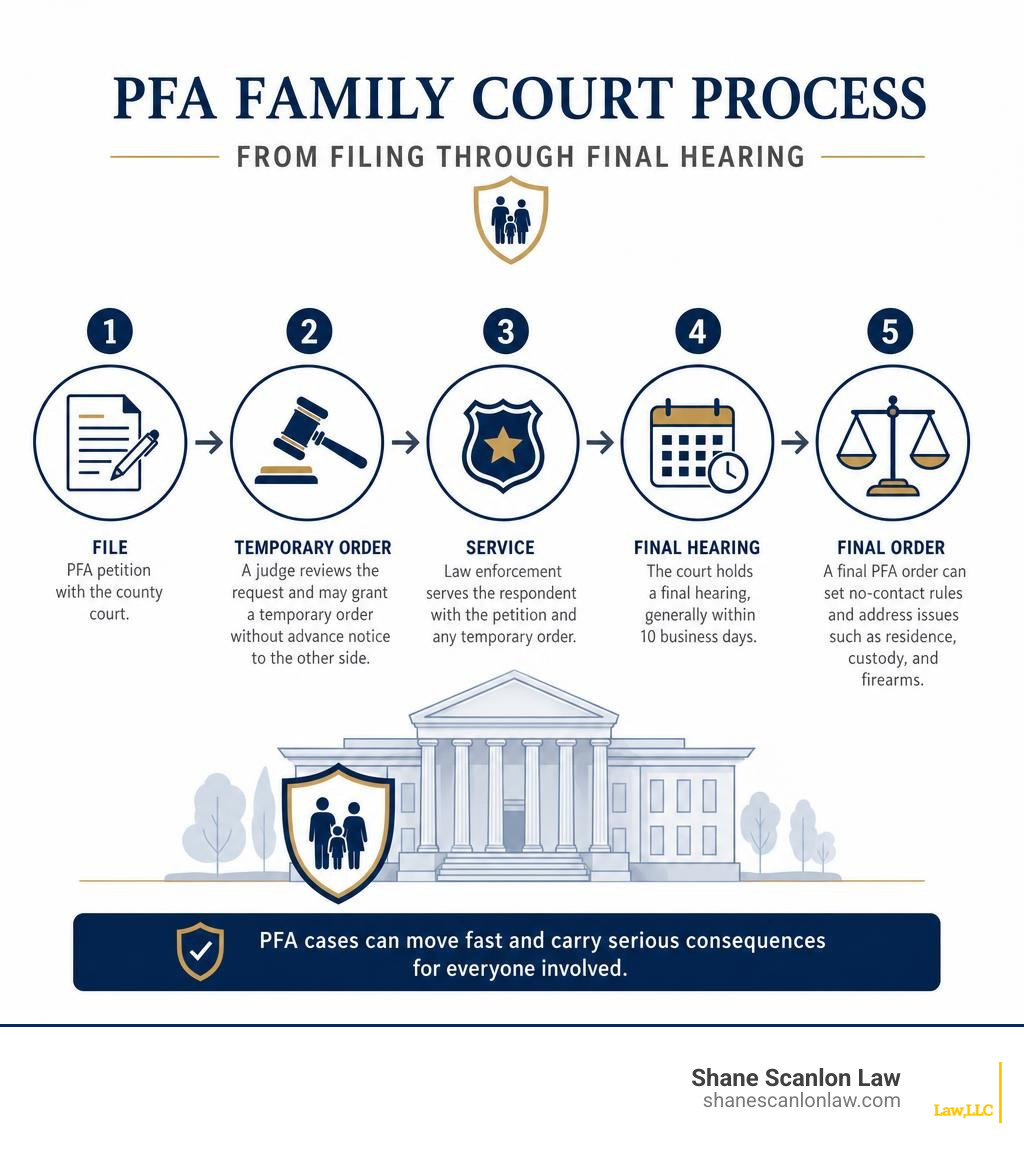
- File a PFA petition with the county court.
- A judge reviews the request and may grant a temporary order without advance notice to the other side.
- Law enforcement serves the respondent with the petition and any temporary order.
- The court holds a final hearing, generally within 10 business days.
- A final PFA order can set no-contact rules and address issues such as residence, custody, and firearms.
A PFA case can move fast and carry serious consequences for everyone involved. I am Shane Scanlon, a Pennsylvania trial lawyer with more than 20 years of courtroom experience, including service as Lackawanna County District Attorney; I use that background to help clients understand and prepare for PFA family court proceedings.
Easy pfa family court glossary:
Understanding Protection From Abuse Orders and Eligibility
In Pennsylvania, Protection From Abuse (PFA) orders are civil court orders created specifically to protect victims of domestic abuse from further harm, harassment, or intimidation. While these matters are civil in nature, the proceedings take place in the Family Court division of the Court of Common Pleas in counties across Northeast Pennsylvania—such as Lackawanna, Luzerne, Susquehanna, and Wyoming counties.
It is important to note that a PFA order is separate from criminal charges, even though the conduct behind it may involve criminal acts. PFA family court focuses directly on personal safety, housing arrangements, temporary child custody, and immediate preventive relief. For detailed procedural overviews, individuals often review General Information – Fifth Judicial District of Pennsylvania.
Understanding Eligibility and Filing Requirements in PFA Family Court
Not every dispute or interpersonal disagreement qualifies for a PFA order. Under Pennsylvania statutory law, a specific qualifying domestic or intimate relationship must exist between the person requesting protection (the plaintiff) and the person accused of abuse (the respondent).
Qualifying domestic relationships under Pennsylvania PFA statutes include:
- Current or former spouses
- Intimate partners or individuals who have dated
- Persons who share a biological child together
- Family members related by blood or marriage (such as parents, siblings, or adult children)
- Individuals who live together or have lived together as sexual or intimate partners
If the parties do not share one of these relationships—for instance, if the dispute involves non-related neighbors, co-workers, or strangers—the case falls outside PFA jurisdiction. In those instances, other legal avenues such as Sexual Violence Protection Orders (SVPO) or Protection From Intimidating Orders (PFIO) may apply.
Types of Abuse Covered Under State Statutory Laws
To secure a PFA order in pfa family court, the petition must demonstrate that statutory abuse occurred. Under state law, abuse is not limited solely to severe physical harm; it encompasses a broad spectrum of conduct that threatens physical safety or psychological well-being.
Statutory forms of abuse include:
- Physical Injury: Intentional physical harm, bodily injury, or attempts to cause injury.
- Sexual Assault: Non-consensual sexual contact, rape, or sexual coercion.
- Stalking and Threats: Engaging in a course of conduct or repeated acts that place a victim in reasonable fear of imminent serious bodily injury.
- Financial Exploitation: Coercive control designed to restrict financial independence or access to basic living resources when combined with threats or physical harm.
- Animal Cruelty: Threatening or harming family pets as a means to intimidate or control a victim or family member.
- Human Trafficking and False Imprisonment: Unlawfully restraining or holding a family member against their will.
Step-by-Step Process for Filing a PFA Petition
Navigating the pfa family court process requires following specific statutory steps to ensure court petitions are correctly drafted, reviewed, and served. Understanding how to navigate Filing and Obtaining a PFA Order helps streamline an otherwise overwhelming situation.
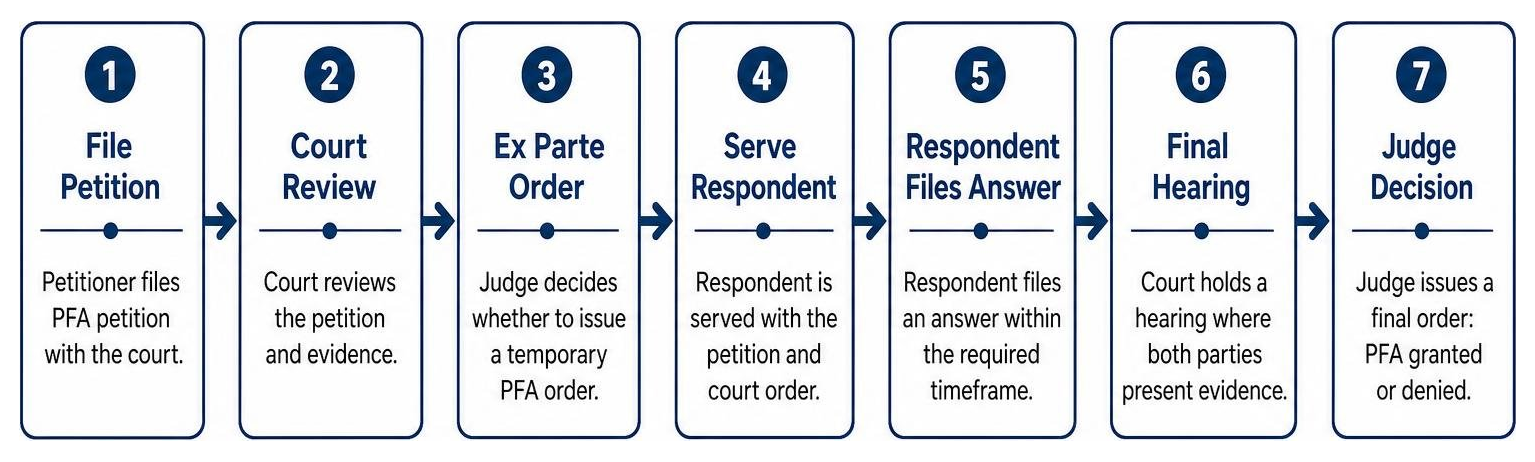
Filing Emergency Ex Parte Petitions and Temporary Protection

When an immediate threat exists outside regular courthouse operating hours—such as during nights, weekends, or holidays—a petitioner can seek an Emergency PFA order. Emergency orders are handled by a Magisterial District Judge (MDJ) and remain effective only until the Court of Common Pleas opens on the next business day.
Once regular court hours resume, the petitioner must complete a formal PFA petition at the county courthouse intake unit. The petition must detail recent incidents of abuse, including dates, locations, and specific details. A judge then conducts an ex parte hearing—meaning the judge reviews the paperwork and hears brief testimony from the petitioner without the respondent being present.
If the judge finds that an immediate danger of abuse exists, the court will grant a Temporary PFA order. This order grants immediate protective relief and sets a court date for the final hearing. Anyone preparing or defending against these initial orders can learn more about Emergency and Temporary PFA Defense in Northeast Pennsylvania.
Service of Process and Official Notice Requirements
Due process under the United States Constitution requires that the respondent receives official notice of the allegations and the upcoming court date. A Temporary PFA order is not legally enforceable against the respondent until proper service of process occurs.
In Pennsylvania, service is typically performed by the local sheriff’s department or designated law enforcement officers. The police serve the respondent with:
- A copy of the PFA petition
- The temporary protective order (if granted)
- A notice detailing the date, time, and courtroom location for the final hearing
Law enforcement officials complete an affidavit of service and file it with the court clerk. If the respondent cannot be located or served prior to the scheduled hearing date, the court must reschedule the final hearing and extend the temporary order to ensure proper notice.
Navigating PFA Family Court Hearings: Case Review to Final Orders
The final PFA hearing is a formal judicial proceeding where both parties have the right to present testimony, offer physical evidence, and call witnesses. Pennsylvania law generally requires this hearing to take place within 10 business days of filing the initial petition. Guidance regarding judicial considerations in these matters can be reviewed in judicial resources like Deciding Child Custody When There Is Domestic Violence.
Case Review, Consent Agreements, and Default Judgments
When parties arrive in pfa family court, they often have an opportunity to confer with counsel or court mediators prior to standing before the judge. Many PFA matters resolve without a full evidentiary hearing through a Consent Agreement.
A Consent Agreement is a negotiated settlement where the respondent agrees to specific protective terms—such as staying away from the petitioner or surrendering weapons—without admitting guilt or abuse.
Key aspects of consent orders include:
- No Finding of Abuse: The court record indicates the agreement was mutual, avoiding a formal finding of statutory abuse against the respondent.
- Enforceability: Once signed by the judge, a consent agreement carries the full legal force of a court order.
- Default Rulings: If a properly served respondent fails to appear in court, the judge may issue a default PFA order granting all relief requested in the petition.
Preparing for the Final Hearing and Presenting Evidence
If the parties do not agree on a consent order, the case proceeds to a full trial before the judge. Preparing thoroughly for this hearing is critical because the burden of proof rests on the petitioner to establish allegations of abuse by a preponderance of the evidence (meaning it is more likely than not that the abuse occurred).
Key evidence presented in final hearings includes:
- Witness Subpoenas: Testimony from eyewitnesses, neighbors, or responding police officers.
- Police Reports: Official incident summaries filed by local or state police departments.
- Medical Records: Hospital or doctor reports detailing injuries sustained during alleged incidents.
- Digital Evidence: Text messages, voicemails, social media posts, or photos of injuries and property damage.
Knowing how to organize evidence effectively is crucial, as explained in our guide on How to Survive Your Final Protection From Abuse Hearing.
The Impact of PFA Orders on Child Custody and Best Interests
When children are involved, pfa family court actions significantly overlap with existing or prospective custody arrangements. Courts carefully balance the urgent need for child safety with statutory custody factors. Out-of-state frameworks, such as the California Courts Domestic Violence Guidelines, reflect similar legal principles regarding protective custody orders nationwide.
How PFA Family Court Decisions Impact Child Custody and Visitation
A Temporary or Final PFA order can immediately suspend, modify, or restrict an existing child custody order. If a judge finds that children were exposed to abuse or domestic violence, the court may award temporary sole legal and physical custody to the non-abusive parent.
To understand these dynamics, petitioners and respondents should review PFA Orders Involving Child Custody in Pennsylvania.
Common temporary custody provisions ordered by family court judges include:
- Supervised Visitation: Requiring the respondent’s visits with children to occur at a professional facility or under the supervision of an approved family member.
- Neutral Exchange Locations: Directing child exchanges to occur at safe, public locations such as local police department lobbies.
- Third-Party Communication: Mandating that all communication regarding the children take place via court-monitored mobile applications or through designated family intermediaries.
Legal Presumptions, Evaluators, and Statutory Custody Factors
Pennsylvania family law mandates that courts consider evidence of domestic violence as a primary factor when determining the best interests of a child. Under state child custody statutes (23 Pa.C.S. § 5328), a judicial finding of abuse creates a significant hurdle for any parent seeking shared or primary physical custody.
In complex cases involving severe allegations, the court may appoint:
- Guardian ad Litem (GAL): An attorney appointed to represent the independent best interests of the minor children.
- Forensic Custody Evaluators: Psychological professionals who evaluate family dynamics, conduct home visits, and issue recommendations to the judge.
Appellate guidance regarding custody considerations and safety factors can be observed in rulings such as the P.F. v. N.C. D.C. Court of Appeals Ruling.
Relief Provisions, Violations, Extensions, and Appeals
A Protection From Abuse order offers comprehensive legal remedies customized to the specific circumstances of each case. It also details strict legal restrictions regarding modern firearm ownership, as detailed in PFA Orders and Firearm Rights in Pennsylvania.
Protective Provisions, Order Duration, Extensions, and Appeals
The table below summarizes the key differences between Temporary and Final PFA Orders in Pennsylvania:
| Feature | Temporary PFA Order | Final PFA Order |
|---|---|---|
| Duration | Up to 10 business days (until final hearing) | Up to 3 years (renewable) |
| Notice Requirement | Ex Parte (granted without prior notice) | Requires full hearing with notice |
| Firearm Restrictions | Court discretion based on immediate threat | Mandatory surrender of all firearms |
| Eviction Provisions | Can order immediate temporary eviction | Can grant exclusive possession of home |
| Child Custody | Temporary emergency protective custody | Formal temporary custody/visitation rules |
A final PFA order can remain in effect for up to three years. If the respondent continues to engage in threatening conduct as the expiration date approaches, the plaintiff can petition the court for an extension. If circumstances change significantly after an order is issued, parties can explore Modifying or Terminating a PFA. Parties also have the right to file a notice of appeal with the Superior Court within 30 days of a final order.
Criminal Consequences and Enforcement of PFA Violations
A PFA order is a civil court mandate, but violating its terms is a criminal offense. Law enforcement officers in Pennsylvania are authorized to arrest a respondent immediately upon finding probable cause that a PFA order was violated.
Enforcement mechanisms include:
- Indirect Criminal Contempt (ICC): The formal charge brought against someone who violates a PFA order.
- Jail Penalties: A finding of indirect criminal contempt can result in up to six months in jail and substantial court fines.
- National Registry: PFA orders are entered into the Pennsylvania State Police database and the National Crime Information Center (NCIC), making them enforceable across county and state lines under federal full faith and credit laws.
If accused of a violation, consulting a PFA Violation Defense Lawyer in Northeast Pennsylvania is vital to protect legal rights.
Frequently Asked Questions About PFA Family Court
How long does an emergency or temporary PFA order remain in effect?
An Emergency PFA order lasts only until the Court of Common Pleas opens on the next business day. A Temporary PFA order issued by a family court judge generally lasts up to 10 business days, remaining active until the formal final hearing takes place.
What happens if the court grants a PFA consent order without a finding of abuse?
A consent order resolves the court proceeding amicably. The respondent agrees to abide by civil protective conditions—such as having no contact with the plaintiff—without admitting to any physical abuse or wrongdoing. It carries the exact same criminal enforcement consequences if violated.
Can a PFA order override an existing child custody order?
Yes. A PFA order issued by a judge in pfa family court can temporarily supersede existing custody orders if the court finds that temporary modification is necessary to ensure the physical safety and welfare of the minor children.
Conclusion
Navigating pfa family court requires a thorough understanding of court rules, statutory eligibility, and evidentiary standards. Whether you are seeking immediate protection from abuse or defending your parental rights and personal reputation, having seasoned legal representation is invaluable.
At Shane Scanlon Law, we bring more than two years of dedicated firm service building on Shane Scanlon’s 20+ years of trial experience—including his tenure as Lackawanna County District Attorney—to advocate fiercely for our clients in Lackawanna, Luzerne, Susquehanna, and Wyoming counties. Contact us today to schedule a confidential consultation through our Shane Scanlon Law Protection From Abuse Services.