
 Call Anytime
833.722.6566
Call Anytime
833.722.6566
When and How to Hire a PFA Attorney Near Me
Understanding Protection From Abuse (PFA) Orders and Eligibility
A Protection From Abuse (PFA) order is a specific civil restraining order designed to protect victims of domestic violence. In Pennsylvania, courts enforce strict statutory criteria regarding who can file a petition. To qualify for a PFA, the victim (Petitioner) and the alleged abuser (Defendant) must share a specific relationship:
- Current or former spouses
- Persons who have lived as spouses or household members
- Current or former sexual or intimate partners
- Persons related by blood or marriage (e.g., parents, children, siblings)
The conduct underlying the petition must involve actual physical abuse, attempted bodily injury, sexual assault, severe threats placing someone in reasonable fear of immediate harm, physical restraint, or a continuous pattern of stalking.
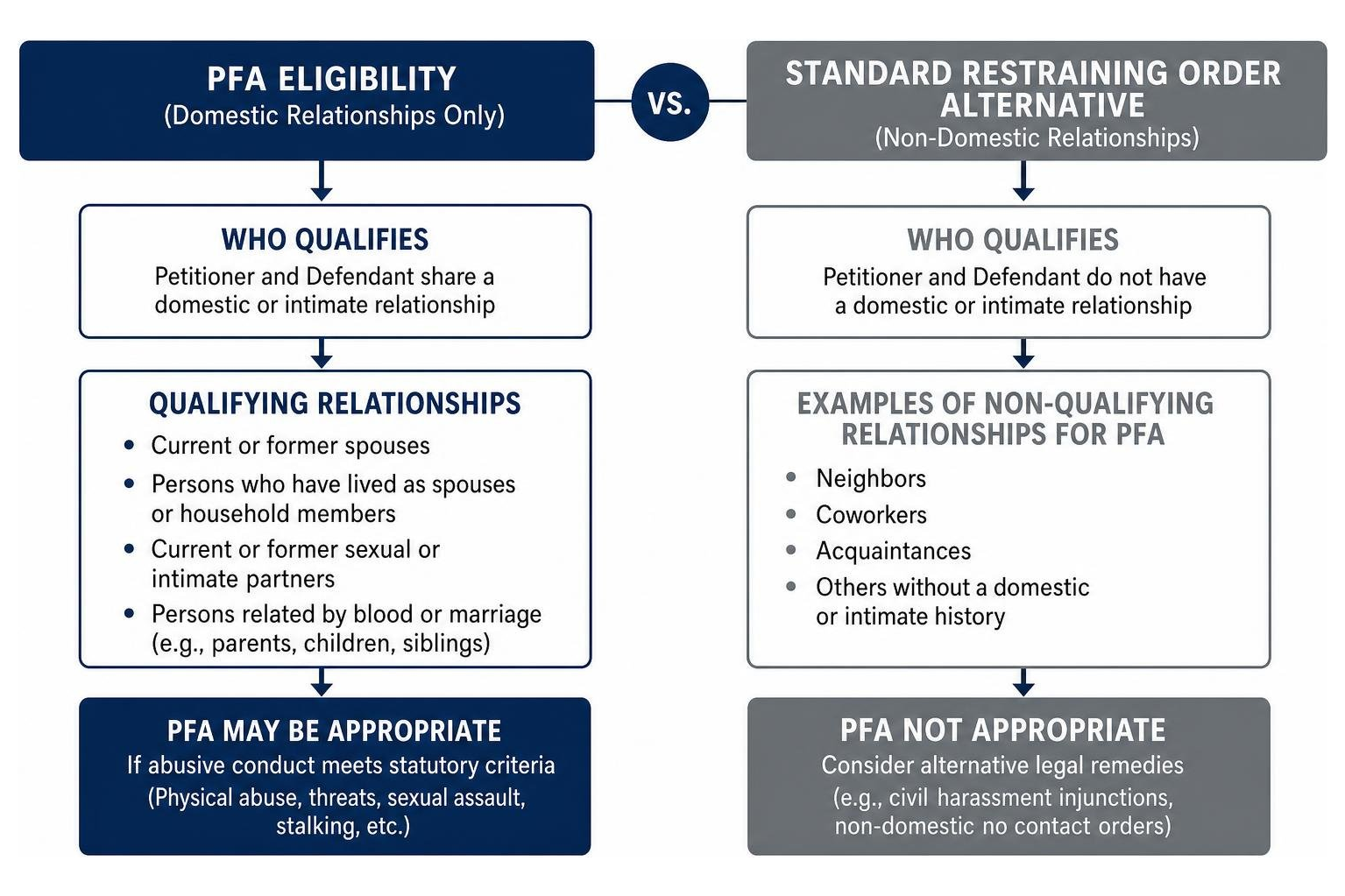
If the alleged misconduct involves a neighbor, coworker, or acquaintance without a domestic or intimate history, a PFA is not the correct legal instrument. Individuals in those scenarios must look toward alternative legal remedies, such as civil harassment injunctions or non-domestic no contact orders. Local procedures vary across jurisdictions like Luzerne County, Lackawanna County, Susquehanna County, and Wyoming County. For a deeper breakdown of basic statutory rules, view our comprehensive guide to PFA explained.
Pennsylvania vs. Delaware PFA Rules
| Feature / Metric | Pennsylvania (PA) | Delaware (DE) |
|---|---|---|
| Maximum Final Duration | Up to 3 years | Typically 1 year (Can be permanent/lifelong in egregious cases) |
| Filing Costs | Zero fee for petitioner | Zero fee for petitioner |
| Qualifying Relationships | Spouses, intimate partners, blood/affinity relatives | Spouses, intimate partners, family members |
| Court System | Court of Common Pleas | Family Court of Delaware |
Types of PFA Orders: Emergency, Temporary, and Final
The Pennsylvania court system relies on a three-tiered structure to deliver protective relief:
- Emergency PFA Orders: Issued when local courts are closed (nights, weekends, holidays) by a Magisterial District Judge. These orders provide immediate, ex parte safety cover until the Court of Common Pleas opens for standard business.
- Temporary PFA Orders: Granted during regular court business hours after a judge reviews the initial written petition ex parte (without the defendant present). A temporary order remains in force until the full evidentiary court hearing.
- Final PFA Orders: Entered after a formal trial before a Court of Common Pleas judge where both sides present testimony, submit evidence, and cross-examine witnesses. A final PFA can last up to three years under Pennsylvania law.
For more details on navigating each phase, see the ultimate Pennsylvania PFA survival guide.
Scope of Protections: Eviction, Custody, Support, and Financial Assets
A final PFA order carries extensive remedies. The court can award immediate protective relief including:
- Residential Eviction: Mandating that the defendant vacate a jointly occupied residence immediately, regardless of whose name appears on the lease or deed.
- Prohibition of Contact: Ordering zero direct, indirect, digital, or third-party communication.
- Temporary Child Custody & Support: Granting temporary custody of minor children and directing temporary child or spousal support pending formal family court proceedings.
- Relinquishment of Firearms: Requiring the immediate surrender of firearms, ammunition, and concealed carry licenses.
Why You Need a Qualified PFA Attorney Near Me

Whether you are seeking a protective order or responding to a petition, hiring a skilled pfa attorney near me is essential. PFA hearings move rapidly, leaving little room for error. The petitioner bears the burden of proof under a preponderance of the evidence standard. To succeed, clear legal arguments, direct witness examinations, and concrete physical evidence (text messages, photos, medical records) must be organized and presented effectively.
How to Select a Top PFA Attorney Near Me
When searching for the best pfa attorney near me, look for key qualities that impact court performance:
- Deep Trial Experience: Broad courtroom advocacy and comfort presenting evidence under strict judicial rules.
- Prosecutorial Background: As a former District Attorney, our lead counsel understands how law enforcement and judges analyze witness credibility and domestic violence allegations.
- Local Court Familiarity: Every county court administration—from Lackawanna County to Wyoming County—operates with distinct daily scheduling protocols and petition processing mechanics.
If you are filing or defending in Scranton or surrounding areas, check our local resources on finding a PFA lawyer in Scranton, exploring PFA in Scranton, reviewing our full PFA lawyer guide, or managing a PFA in Lackawanna County.
When to Hire a PFA Attorney Near Me for Defense
If you have been served with a temporary PFA, securing experienced legal defense immediately is critical. Unfounded or exaggerated accusations are sometimes weaponized to gain leverage in pending divorce or child custody disputes.
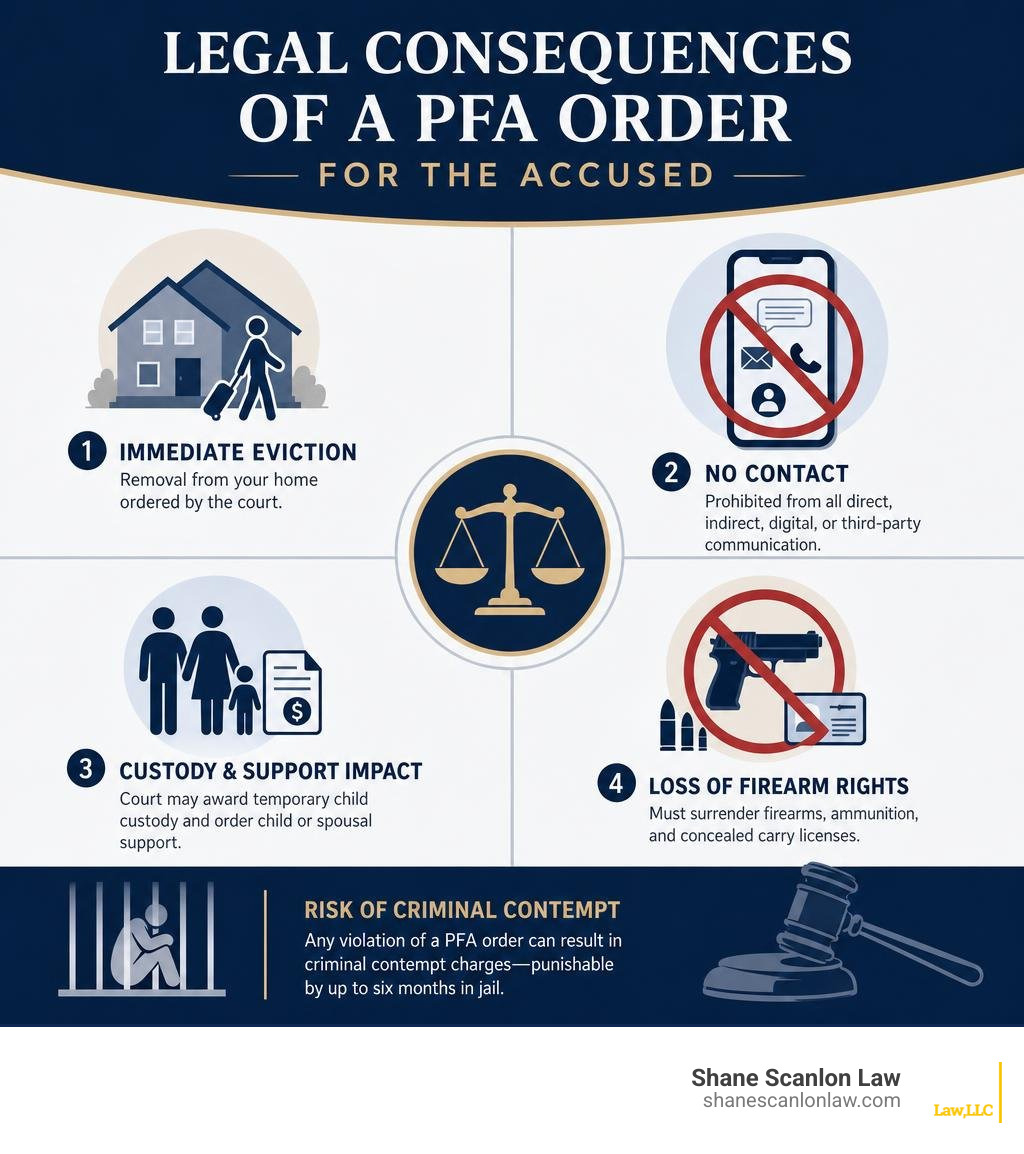
A final PFA order entered against you creates serious collateral damage:
- Immediate eviction from your home.
- Evidentiary records impacting child custody evaluations.
- Loss of Second Amendment firearm rights for up to three years.
- Exposure to indirect criminal contempt charges—punishable by up to six months in jail—for any alleged contact breach.
Review our dedicated guides on false accusations PFA defense and the severe legal consequences for the accused to safeguard your rights.
Step-by-Step Process: Filing, Hearings, and Legal Impact

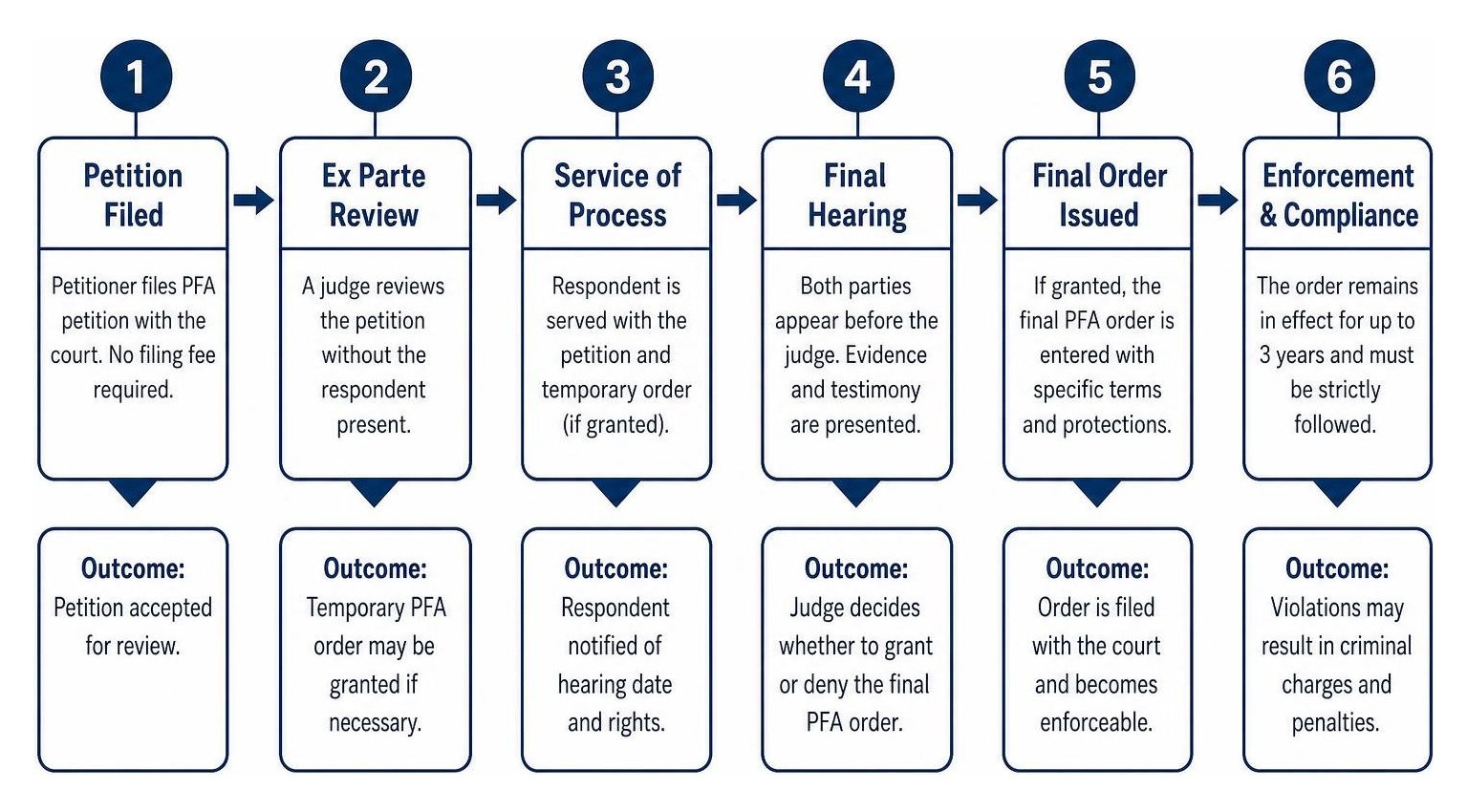
Understanding the administrative sequence of a PFA case ensures you are never caught unprepared during court proceedings.
Navigating Local Court Requirements and Zero Filing Fees
In Pennsylvania, there is zero filing fee required to file a PFA petition. Victims can file walk-in petitions during regular court intake hours through county court administration or specialized PFA coordinators.
The step-by-step process follows these milestones:
- Drafting the Petition: Detailing explicit factual instances of physical abuse, threats, or stalking.
- Ex Parte Judicial Review: Presenting the initial petition to a judge for a temporary order without the defendant present.
- Formal Sheriff Service: Official service of the temporary order and notice of hearing on the defendant by local law enforcement or sheriff’s deputies.
- Final Evidentiary Hearing: Conducting a full hearing within 10 business days where both parties present evidence and legal arguments.
Whether filing for a PFA in Wilkes-Barre or reviewing general steps on getting a PFA order, legal representation ensures your rights are protected throughout the PFA hearing process.
Long-Term Impacts on Divorce, Child Custody, and Retirement Division
While a PFA is a civil order, its findings carry substantial weight in family court. A court finding of domestic violence directly influences child custody factors under Pennsylvania law, making full custody awards to the accused far more difficult.
Furthermore, dynamic family disputes involving domestic restraining orders often overlap with complex property division and retirement distributions. When divorces involve high-value assets, proper legal drafting via Qualified Domestic Relations Orders (QDROs) or state-specific financial tools requires distinct statutory compliance so that asset divisions align properly with underlying support and custody decrees.
Frequently Asked Questions About PFA Representation
Can I file a PFA order against a neighbor or acquaintance?
No. Pennsylvania PFA statutes strictly limit eligibility to domestic, family, or intimate partners. If an abusive or harassing party is a neighbor, former friend, or non-intimate acquaintance, you must explore non-domestic civil restraining orders or criminal harassment charges through local law enforcement.
What happens if a PFA order is violated in Pennsylvania?
Violating a PFA order is classified as Indirect Criminal Contempt (ICC). If the defendant violates any term—such as sending a single text message or approaching the victim—law enforcement can immediately arrest the offender. Upon conviction, punishment includes mandatory fines and up to six months in jail.
How does a PFA impact marital property division and retirement plans?
A temporary PFA order can mandate immediate residential eviction and grant exclusive possession of joint property to one party. However, long-term division of marital debts, real estate, and pension accounts (including 401k and QDRO asset splits) are formally resolved in underlying divorce litigation, even though the PFA court record heavily informs temporary spousal support allocations.
Protecting Your Future With Trusted NEPA Representation
Navigating a Protection From Abuse matter requires clear guidance, whether you are seeking immediate protection from physical violence or defending your parental rights and public reputation against unproven allegations.
At Shane Scanlon Law, we bring over two decades of courtroom trial experience, including executive leadership as a former District Attorney, to client representation in Scranton, Lackawanna County, Wilkes-Barre, Luzerne County, Susquehanna County, and Wyoming County. We provide steady, trial-tested advocacy at every stage of the legal process.
Because PFA hearings are often scheduled quickly, waiting until the last minute can limit your ability to gather text messages, photographs, medical records, witness information, police reports, and other evidence that may affect the outcome. Early legal guidance can also help you understand what conduct is allowed while a temporary order is pending, how to prepare for testimony, and how a final order may affect housing, custody, firearms, employment, and related family law issues.
If you need a reliable pfa attorney near me, contact our office today to secure dedicated representation for your court hearing. Visit our pillar resource on Protection From Abuse Defense and Representation to take control of your legal outcome.