
 Call Anytime
833.722.6566
Call Anytime
833.722.6566
The Definitive Guide to PFA Order
What a PFA Order Means for You — and What to Do Next
A PFA order — short for Protection From Abuse order — is a civil court order that legally prohibits an abuser from contacting, harassing, or coming near you or your children. Here’s what you need to know at a glance:
- What it does: Forbids the abuser from contacting you, entering your home, and in some cases, requires them to surrender firearms
- Who can get one: Victims of abuse by an intimate partner, spouse, family member, or someone they share a child with
- How long it lasts: Up to three years in Pennsylvania for a final order
- Cost to file: Free for the person seeking protection
- What happens if it’s violated: The abuser can be arrested, fined up to $1,000, and jailed for up to six months in Pennsylvania
- Is it valid in other states: Yes — under the Violence Against Women Act (VAWA), a PFA is enforceable across all U.S. states and tribal lands
Whether you need protection or you’ve just been served with an order, understanding how the PFA process works is critical. The stakes are high on both sides — your safety, your family, your housing, and your record can all be affected.
I’m Shane Scanlon, founder of Shane Scanlon Law and a former Lackawanna County District Attorney with over 20 years of Pennsylvania courtroom experience — including cases directly involving PFA order proceedings on both sides of the aisle. In this guide, I’ll walk you through everything you need to know, from filing to enforcement to your rights as a respondent.
Understanding the Legal Scope of a PFA Order
To understand how a PFA order works, we must first look at its legal boundaries. A Protection From Abuse order is a civil remedy designed to prevent domestic violence. It is not a criminal conviction, though violating it immediately crosses into criminal territory.
To learn more about protection orders and their civil nature, it is helpful to look at how Pennsylvania defines abuse and how these orders compare to other protective options.
| Feature / Order Type | Protection From Abuse (PFA) | Sexual Violence Protection Order (SVPO) | Protection From Intimidation (PFI) |
|---|---|---|---|
| Relationship Requirement | Must be family, household member, or intimate partner | No relationship required | No relationship required |
| Target Population | Adults and minors abused by family/partners | Victims of sexual violence | Minors under 18 harassed by adults over 18 |
| Maximum Duration | Up to 3 years | Up to 3 years | Up to 3 years |
| Primary Focus | Domestic abuse and physical safety | Protection from sexual assault/stalking | Protection from harassment/intimidation |
Defining Abuse and Qualifying Relationships
Under Pennsylvania law, “abuse” is not limited to physical violence. It includes acts such as:
- Causing or attempting to cause bodily injury
- Placing another in fear of imminent serious bodily injury
- False imprisonment (preventing you from leaving a room or house)
- Stalking or repeatedly committing acts that place you in reasonable fear of bodily injury
- Physical or sexual abuse of minor children
However, you cannot file a PFA order against just anyone. The law requires a specific relationship between the victim (petitioner) and the accused (respondent). To qualify, the parties must be:
- Current or former spouses
- Persons who live or have lived together as spouses or intimate partners
- Parents of a child together
- Blood relatives or relatives by marriage (in-laws)
- Current or former sexual or intimate partners
If a neighbor, a stranger, or a standard roommate with whom you have no romantic relationship is harassing you, a PFA is not the correct legal tool. To explore the exact boundaries of these rules, you can read the official PA guide on protection orders.
How a PFA Order Differs from SVPO and PFI
When a domestic relationship does not exist, other protective orders come into play. Pennsylvania provides two primary alternatives:
- Sexual Violence Protection Order (SVPO): This order protects victims of sexual violence from their perpetrators when there is no qualifying domestic relationship. It does not require you to have lived with or dated the person.
- Protection From Intimidation Order (PFI): A PFI is designed specifically to protect minors (under 18) who are being stalked or harassed by an adult (18 or older) with whom they do not share a domestic relationship.
Understanding these distinctions ensures that victims file the correct paperwork and do not have their petitions dismissed on a technicality. You can understand the differences between no-contact orders and PFAs in our detailed breakdown of non-domestic restrictions.
The Multi-Stage Process of Obtaining Protection
Filing for protection is a structured, multi-stage legal process. It is designed to provide immediate, short-term safety while ensuring that the accused has a fair opportunity to present a defense before long-term restrictions are imposed.
If you are navigating this system in Northeastern Pennsylvania, you can explore the step-by-step guide to PFA orders to help you prepare.
Step-by-Step Process for Filing a PFA Order
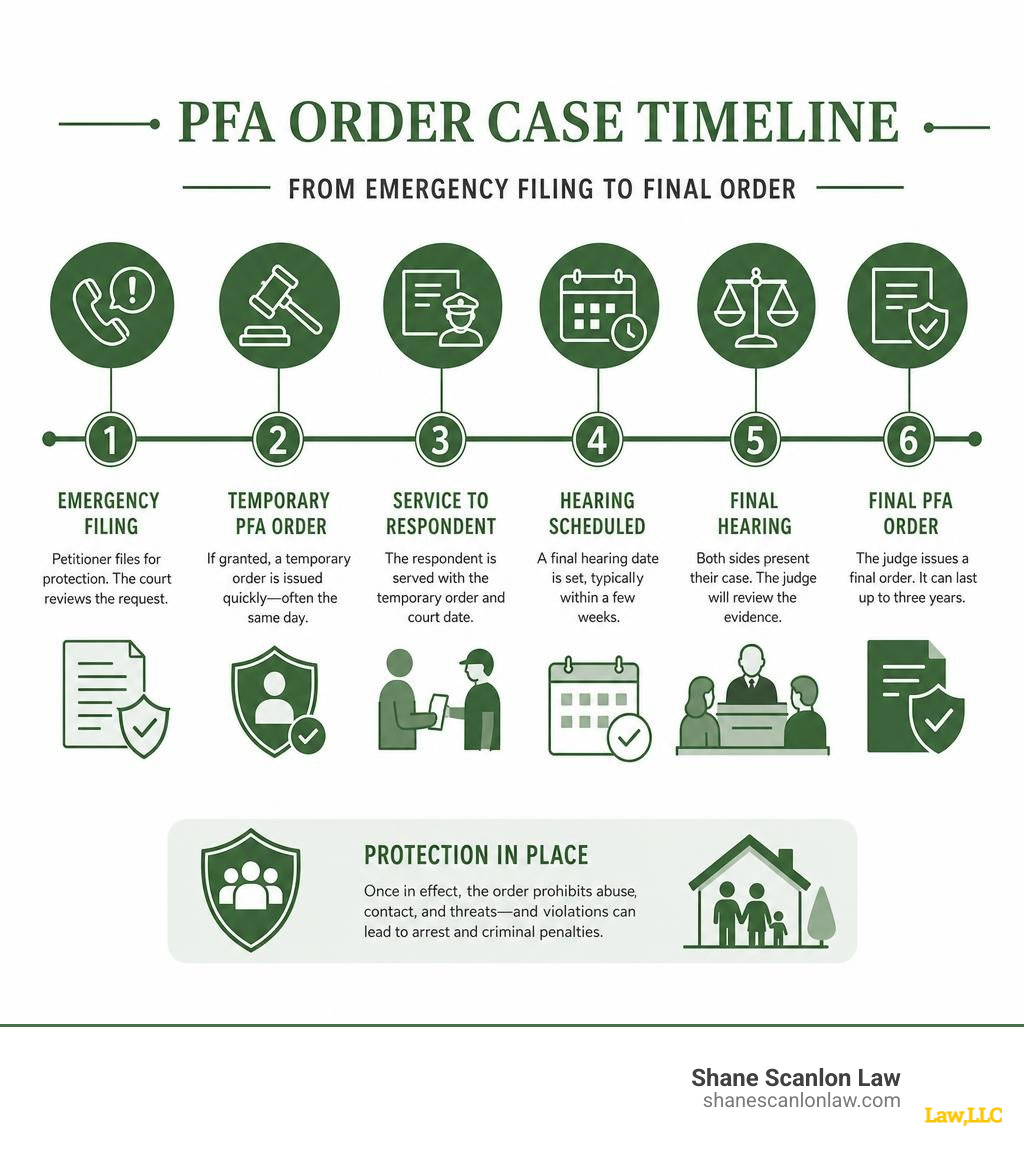
To secure a PFA, a petitioner must follow these essential steps:
- Complete the Petition: You must fill out a detailed petition at your local county courthouse. In Lackawanna County, this is typically handled through the Family Court division, while in Luzerne County, you will coordinate with the local PFA office. You must write down specific, detailed instances of physical abuse, threats, or stalking.
- Ex Parte Review: A judge will review your written petition and speak with you briefly. The respondent is not present for this. If the judge believes you are in immediate danger, they will grant a Temporary PFA.
- Service of Process: The local sheriff’s department must personally serve the respondent with the Temporary PFA and the notice for the final hearing. The petitioner must never attempt to serve these papers themselves.
- The Final Hearing: Within 10 business days, both parties must appear in court. This is a formal evidentiary hearing where both sides can present witnesses, text messages, photos, and police reports. The judge will then decide whether to grant a Final PFA.
To see how these steps translate to local courtrooms, you can discover how the Pennsylvania PFA process works in our comprehensive procedural overview.
Emergency, Temporary, and Final Orders
There are three distinct stages of protection, each with its own timeline and requirements:
- Emergency PFA (EPFA): If the courthouses are closed (nights, weekends, or holidays), you can seek an Emergency PFA through a Magisterial District Judge. This order is highly temporary and only lasts until the next business day when the regular court opens.
- Temporary PFA: Issued during normal court business hours, this order remains in effect until the final hearing is held. By law, the final hearing must be scheduled within 10 business days of the temporary order’s issuance.
- Final PFA: Granted after a full hearing (or by agreement of both parties), a Final PFA can provide comprehensive relief—including ordering the abuser to move out of a shared home, establishing temporary child custody, and prohibiting contact—for up to three years.
To prepare for what happens when you step into the courtroom, you can learn about the PFA hearing process from petition to final order.
Enforcement, Violations, and Interstate Validity
A protective order is only as strong as its enforcement. Law enforcement officers in Pennsylvania take PFA violations incredibly seriously, and the legal system treats any breach of these orders as a direct challenge to judicial authority.

To learn more about how local authorities handle these situations, you can read about police enforcement of PFA orders.
Consequences of Violating a PFA Order
If a respondent violates any provision of a PFA order—whether by sending a “simple” text message, having a third party contact the victim, or showing up at their workplace—the victim should call the police immediately.
The police have the authority to arrest the respondent on the spot without a warrant. The violation is prosecuted as Indirect Criminal Contempt (ICC).
In Pennsylvania, a conviction for violating a PFA order can result in:
- Up to six months in jail for each violation
- Fines between $300 and $1,000
- Extension of the original PFA order
- A permanent criminal record for the contempt conviction
It is important to note that the victim cannot “give permission” to violate the order. Even if the petitioner invites the respondent over, the respondent can still be arrested and jailed because only a judge can legally modify or dismiss the order. You can understand the legal consequences of a PFA violation in our in-depth article.
Cross-Border Enforcement and the Violence Against Women Act
A common concern for victims is what happens if they must travel or relocate. Fortunately, under the federal Violence Against Women Act (VAWA), all valid PFA orders are granted “full faith and credit” across state lines.
This means that if you have a valid PFA issued in Lackawanna County, it is fully enforceable by law enforcement in New York, Florida, California, or any other U.S. state or tribal land.
While not legally required, it is highly recommended to keep a certified copy of your PFA with you when traveling. If you move permanently, you can register your order at the local county courthouse in your new state to ensure local police have it on file. To learn more about interstate protections and crime victim services, you can Review PA crime victim protection order resources.
Rights and Legal Defenses for the Respondent
Being served with a PFA petition can be an incredibly stressful and disruptive experience. Suddenly, you may be forced to leave your home, prevented from seeing your children, and ordered to surrender your firearms. However, as a respondent, you have constitutional rights to due process.
If you have been served, it is vital to speak with an attorney immediately. You can learn about defending against emergency and temporary PFAs to protect your rights.
Challenging False Accusations in Court
Unfortunately, PFA petitions are sometimes weaponized during heated divorce or child custody battles. Because the standard of proof at the final hearing is a “preponderance of the evidence” (meaning the abuse was more likely than not to have occurred), a petitioner can sometimes secure an order based largely on testimonial evidence.
To defend against false accusations, a respondent must present a meticulous, evidence-backed case. This can include:
- Text messages, emails, or social media messages showing a different context or proving the accusations are fabricated
- GPS data or alibi witnesses proving you were not present during an alleged incident
- Security camera footage
- Inconsistencies in the petitioner’s prior statements or police reports
Having an experienced trial attorney to cross-examine the petitioner is often the turning point in these hearings. If you are facing false allegations in Northeastern Pennsylvania, you can explore defense options for false PFA accusations in Lackawanna County.
Collateral Consequences for the Accused
The consequences of having a Final PFA entered against you extend far beyond the immediate stay-away restrictions. Some of the major collateral impacts include:
- Eviction: If you share a home with the petitioner, you can be forced to move out immediately, even if your name is the only one on the lease or deed.
- Child Custody: A PFA can temporarily suspend your custody rights or restrict you to supervised visitation.
- Firearm Ownership: Under federal and Pennsylvania law, a Final PFA typically requires you to surrender all firearms and ammunition, and prohibits you from purchasing new ones.
- Employment: While a PFA is a civil order, it appears on background checks. This can lead to job loss or prevent you from obtaining employment in healthcare, education, law enforcement, or any field requiring a security clearance.
To understand how these consequences might affect your future, you can understand the legal consequences for the accused.
State-by-State Variations in Protection Laws
While the general concept of a protective order is consistent across the United States, the specific rules, durations, and names of these orders vary significantly by state.
Here is a quick breakdown of how long protective orders can last across different states:
- Pennsylvania: Final PFA orders can last up to 3 years.
- Delaware: Protective provisions can last up to 2 years (or longer under aggravating circumstances).
- Maryland: Final Protective Orders generally last up to 1 year.
- Oregon: Family Abuse Prevention Act (FAPA) orders remain in effect for 2 years unless renewed.
Pennsylvania, Delaware, and Maryland Rules
In Pennsylvania, a Final PFA provides some of the longest-lasting protections in the country, running for up to three years, with the option for the petitioner to request an extension before it expires. To understand how local county courts manage these timelines, you can read about PFA rules in Luzerne County.
In Delaware, the process is handled through the Family Court. While Delaware’s protective provisions can last up to 2 years, any “ancillary” provisions—such as temporary child support or division of personal property—are strictly limited to 1 year.
In Maryland, the system utilizes Interim, Temporary, and Final Protective Orders. Maryland’s Final Protective Orders are much shorter than Pennsylvania’s, typically lasting for only 1 year, though they can be extended under specific circumstances.
Kansas and Oregon Restraining Orders
In Oregon, protective orders are governed by the Family Abuse Prevention Act (FAPA). These FAPA orders last for 2 years. To see how these petitions are structured, you can review the Oregon FAPA restraining order form.
In Kansas, the courts issue Protection From Abuse (PFA) and Protection From Stalking (PFS) orders. While they serve similar safety purposes, they are legally distinct. Violating a protective order in Kansas is a serious offense that frequently results in a sentence of 12 months of probation or active jail time.
Recent Legal Developments and Court Rulings in 2026
The intersection of due process and protective orders is constantly evolving. A landmark ruling by the Kansas Supreme Court in late May 2026 highlighted the strict procedural standards courts must maintain.
In that case, the state prosecuted and convicted a man for violating a PFA order. However, on appeal, his legal team discovered a major administrative blunder: a PFA order had never actually been issued against him; instead, only a Protection From Stalking (PFS) order existed.
The state argued this was a “harmless error” because the terms of the orders were similar. However, the Kansas Supreme Court rejected this argument and threw out the conviction, ruling that due process requires the state to accurately charge the exact order a defendant is accused of violating. You can read about the 2026 Kansas Supreme Court ruling on protective order violations to see how crucial procedural accuracy is in these cases.
Frequently Asked Questions about PFA Orders
Navigating the legalities of a PFA order can feel overwhelming. Here are answers to some of the most common questions we hear at our firm.
How much does it cost to file a PFA order?
It costs absolutely nothing for a victim to file for a PFA order. Under Pennsylvania law, filing fees and court costs are waived for the petitioner. If a Final PFA is granted, the judge will typically order the respondent to pay all court costs and filing fees associated with the case.
Can a PFA order be modified or terminated early?
Yes. If circumstances change, either party can file a motion with the court to modify or terminate the order. For example, if parents need to adjust communication rules to facilitate child visitation, they can request a modification.
However, you must never try to change the terms on your own. Any changes must be signed by a judge to be legally binding. You can learn how to modify or terminate a PFA through our step-by-step guide on the process.
What resources are available for victims filing a PFA?
Victims in Northeastern Pennsylvania do not have to go through this alone. There are several excellent, confidential resources available, including:
- The Women’s Resource Center (WRC): Serving Lackawanna and Susquehanna counties, providing free advocacy, shelter, and legal accompaniment.
- Domestic Violence Service Center (DVSC): Serving Luzerne and Wyoming counties.
- County Victim/Witness Offices: Local courthouse advocates who help victims fill out PFA petitions and accompany them to hearings.
Conclusion
Whether you are seeking safety through a PFA order or defending yourself against false allegations, the legal decisions you make today will shape your life for years to come. These are highly emotional, fast-moving cases where having an experienced advocate in your corner makes all the difference.
At Shane Scanlon Law, we bring over 20 years of local courtroom experience to every case. As a former District Attorney in Lackawanna County, Shane Scanlon understands both sides of the protective order process and provides fierce, strategic, and compassionate representation across Scranton, Wilkes-Barre, and all of NEPA.
Do not leave your safety or your future to chance. Contact Shane Scanlon Law for Protection From Abuse representation today, and let us help you navigate the system with confidence.