
 Call Anytime
833.722.6566
Call Anytime
833.722.6566
Understanding the Legal Term PFA and How Orders Work

What PFA Means in Law — and Why It Matters
Understanding pfa meaning law starts with a simple definition:
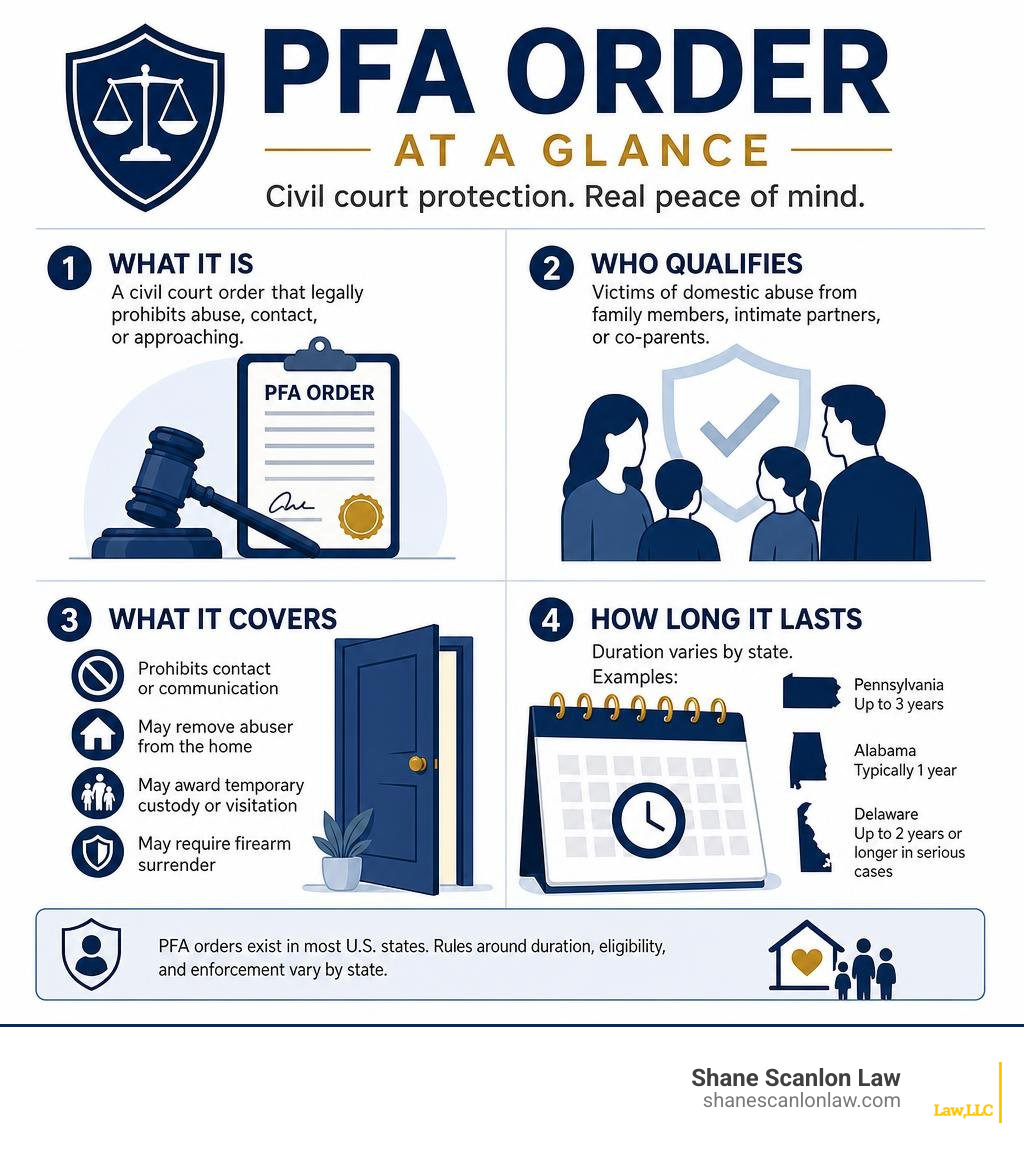
A PFA (Protection From Abuse) order is a civil court order that legally prohibits one person from abusing, contacting, or approaching another person — most commonly issued in domestic violence situations.
Here is a quick breakdown of the key facts:
- What it stands for: Protection From Abuse
- What type of order it is: Civil (not criminal)
- Who it protects: Victims of domestic abuse from family members, intimate partners, or co-parents
- What it can do: Ban contact, remove an abuser from a shared home, award temporary custody, and require firearm surrender
- What happens if it is violated: Criminal penalties, including jail time and fines
PFA orders exist in most U.S. states, but the rules around duration, eligibility, and enforcement vary significantly depending on where you live. In Pennsylvania, for example, a final PFA order can last up to three years. In Alabama, it is typically one year. In Delaware, protective provisions can last up to two years or longer in serious cases.
Whether you are seeking protection or you have been served with a PFA petition, knowing how these orders work — and what they legally require — is critical. The wrong move in either direction can have serious consequences.
I’m Shane Scanlon, founder of Shane Scanlon Law and a former Lackawanna County District Attorney with over 20 years of trial experience in Pennsylvania courts, including cases directly involving pfa meaning law and the enforcement and defense of protection orders. That background on both sides of the courtroom gives me a practical understanding of how these cases unfold that I’ll share throughout this guide.
Pfa meaning law terms explained:
PFA Meaning in Law and Core Legal Purpose
When diving into pfa meaning law, the core purpose is straightforward: to create a quick, enforceable legal wall between a victim of domestic violence and an alleged abuser.
In Pennsylvania, the statutory foundation for protection orders is codified under 23 Pa. C.S. § 6101 et seq.. Known formally as the Protection From Abuse Act, this body of law gives civil courts the power to grant immediate relief without waiting for a criminal conviction.
Because domestic violence moves quickly, civil protection orders provide emergency mechanisms that standard civil lawsuits simply cannot match. For a deeper dive into local statutory specifics, read our complete guide on PFA Explained: Everything You Need to Know About Protection Orders in Pennsylvania.
Key Definitions: PFA Meaning in Law vs Restraining Orders
People frequently use “restraining order” and “PFA order” interchangeably, but in legal terms, there are important distinctions:
- Restraining Order: A generic legal term used across civil litigation (such as divorce proceedings or business disputes) to instruct someone to do or refrain from doing a specific action.
- Protection From Abuse (PFA) Order: A specialized civil protective order exclusively designed for domestic violence, family relationships, or intimate partner disputes.
- Civil Nature, Criminal Teeth: Although a PFA is filed in civil court (often handled within the Domestic Relations or Family Division), violating its terms is a criminal offense known as Indirect Criminal Contempt.
This combination gives PFAs instant law enforcement support. If a defendant breaks a standard civil contract, you sue them. If a defendant breaks a PFA, police can immediately arrest them.
Qualifying Relationships and Statutory Acts of Abuse
You cannot get a PFA against a random stranger, a hostile neighbor, or a difficult co-worker. Under Pennsylvania law, a qualifying relationship must exist between the plaintiff (the person seeking protection) and the defendant (the accused party). Qualifying domestic relationships include:
- Current or former spouses
- Intimate or sexual partners
- Individuals who share biological parenthood
- Family members related by blood or marriage (parents, children, siblings)
- Same-sex partners and former domestic partners
Under 23 Pa. C.S. § 6102, statutory acts of abuse extend beyond physical hits. In court, “abuse” encompasses:
- Bodily Injury: Intentionally causing or attempting to cause physical injury.
- Reasonable Fear: Placing another person in reasonable fear of imminent serious bodily injury through threats, weapon brandishing, or aggressive acts.
- False Imprisonment: Unlawfully restraining a person against their will.
- Sexual Assault: Sexually molesting or assaulting an adult or child.
- Course of Conduct: Engaging in persistent stalking or harassment that creates substantial emotional distress or fear of harm.
Crucially, Pennsylvania appellate case law confirms that physical contact is not required to grant a PFA. Case precedents establish that psychological compulsion, blocking vehicles, threatening text messages, or property damage (such as smashing a phone or striking a vehicle) can legally create a “reasonable fear of imminent serious bodily injury.”
The PFA Court Process: From Petition to Final Hearing

Navigating a PFA court proceeding involves precise legal steps and tight timelines. Understanding these stages ensures you protect your legal rights from day one. To review the entire court procedure step-by-step, check out our guide on Step-by-Step Guide on How to Get a PFA Order.

Emergency Ex Parte, Temporary, and Final PFA Orders
Pennsylvania law establishes three progressive tiers of PFA protection:
- Emergency PFA Order: Issued when courthouses are closed (nights, weekends, or holidays). A petitioner contacts local law enforcement, who connects them with an on-call Magisterial District Judge. This order provides immediate shelter and safety, but lasts only until the next business day when the Court of Common Pleas opens.
- Ex Parte Temporary PFA Order: Filed in the county courthouse (such as Lackawanna or Luzerne County). “Ex parte” means the judge evaluates the petition and hears testimony from the petitioner without the defendant present or notified beforehand. If the judge finds an immediate risk of harm, a temporary order is granted. It remains active until the full hearing—typically scheduled within 10 business days.
- Final PFA Order: Issued after a full evidentiary trial where both sides have the right to present evidence, introduce police reports, cross-examine witnesses, and be represented by counsel.
If you are facing allegations or served with court papers unexpectedly, read our resource on Emergency and Temporary PFA Defense in Northeast Pennsylvania.
PFA Duration, Modifications, and Extensions
In Pennsylvania, a Final PFA order can last up to three years. However, circumstances change, and orders can be modified, extended, or terminated before their expiration date.
- Extensions: If the defendant violates the PFA during its term or continues abusive behaviors, the plaintiff can petition the court for an extension of up to another three years.
- Modifications: Either party can file a Motion to Modify to adjust specific provisions, such as custody exchange details or visitation locations.
- Termination: A plaintiff may petition the court to drop or vacate the order early if the threat has passed. However, only a judge can officially lift a PFA order.
For more information on legal options for changing or ending an active order, read Modifying or Terminating a PFA.
Legal Relief, Protections, and Firearm Restrictions
A PFA order is far more than a simple “stay away” directive. Judges have wide discretion to tailor protective orders to cover housing, children, support, and property.
| Provision Type | Emergency PFA | Temporary Ex Parte PFA | Final PFA Order |
|---|---|---|---|
| Duration | Until next business day | Up to 10 business days | Up to 3 years |
| No-Contact Orders | Yes | Yes | Yes |
| Exclusive Home Use | Yes | Yes | Yes |
| Temporary Child Custody | Limited emergency basis | Temporary ruling | Full temporary schedule |
| Firearm Relinquishment | Optional if threat shown | Discretionary by Judge | Mandatory / Standard |
| Financial Support / Rent | No | Rare | Yes |
Firearm Relinquishment and Second Amendment Rights
One of the most consequential aspects of pfa meaning law involves firearm restrictions. Under Pennsylvania law and federal statutes (18 U.S.C. § 922(g)(8)), an individual subject to a qualifying PFA order is legally prohibited from possessing, purchasing, or transporting firearms and ammunition.
- 24-Hour Surrender Deadline: Once served with an order mandating firearm relinquishment, the defendant must surrender all firearms, weapons, and ammunition to the local Sheriff’s Office or an authorized licensed gun dealer within 24 hours (or by the end of the next business day).
- Retrieval Background Checks: When a PFA expires or is dismissed, firearms are not automatically returned. The defendant must obtain a specific court order, wait at least 48 hours for state registry systems to update, and pass a state Sheriff background check before retrieving their property.
To understand how protective orders impact gun ownership rights, explore our guide on PFA Orders and Firearm Rights in Pennsylvania: What You Need to Know.
PFA Meaning in Law Across Different States
While PFA terminology is prominent in Pennsylvania, protection order rules vary across state borders:
- Pennsylvania: Governed by 23 Pa. C.S. § 6101 et seq., Final PFAs last up to 3 years. Plaintiffs pay zero filing fees, with court costs assessed against the defendant if the order is granted.
- Alabama: Initial temporary protection orders last 14 days, and final PFA orders generally remain in effect for 1 year. Violation is a Class A misdemeanor carrying mandatory minimum jail stays.
- Delaware: Managed through Family Court. Temporary ex parte orders last up to 15 days, while standard protective provisions last up to 2 years (or longer upon consent or proof of aggravating circumstances).
For detailed county-level filing guidelines across jurisdictions, consult Restraining Orders: In which county can I file for a PFA order?.
Respondent Rights, Order Violations, and Penalties
If you are named as a respondent (defendant) in a PFA petition, you have Constitutional due process rights. Being served with a temporary PFA does not mean you have been convicted of a crime, but ignoring it can turn a civil issue into a criminal conviction very quickly.
To understand defense strategies when facing accusations, read Accused of Abuse? Why You Need a PFA Defense Attorney.
Notice Rules and Due Process
Before a defendant can be held liable for violating a PFA order, they must have legal notice of its terms:
- Personal Service: Typically, county sheriff deputies or law enforcement officers physically serve the petition and temporary order on the defendant.
- Actual Notice via Telephone: Under established Pennsylvania case law (Commonwealth v. Padilla), personal physical service is not strictly required if a law enforcement officer contacts the defendant by phone, reads the order’s provisions, and explains the consequences of a violation. This legal verbal notice constitutes “actual notice.”
Consequences of Violating a Protection Order
Violating any term of a PFA order—whether by visiting a home, sending a text message, using a third party to pass messages, or coming within restricted spaces—is treated as Indirect Criminal Contempt (ICC) under 23 Pa. C.S. § 6114.
Penalties in Northeast Pennsylvania (including Lackawanna and Luzerne counties) can be severe:
- Jail Time: Up to six months in county prison for each violation.
- Fines: Fines ranging up to $1,000 per violation.
- Criminal Record: An ICC conviction creates a permanent criminal record.
- Extended Order: A violation gives the court statutory authority to extend the PFA order for up to an additional three years.
If you are accused of violating a protection order, review our detailed page on PFA Violation Defense Lawyer in Northeast Pennsylvania.
Frequently Asked Questions About PFA Orders
What does PFA stand for in legal terms?
In legal terms, PFA stands for Protection From Abuse. It refers to a specialized civil court order designed to shield domestic partners, family members, and biological co-parents from physical violence, sexual assault, threats, stalking, and harassment.
Does a PFA order appear on a criminal record?
A civil PFA order itself does not appear on a standard criminal record because it is a civil proceeding. However, active PFA orders are entered into law enforcement databases (such as the Pennsylvania State Police registry and national databases). Furthermore, if a respondent violates the order and is found guilty of Indirect Criminal Contempt, that conviction will appear on their permanent criminal record.
Can a PFA order be dismissed or lifted early?
Yes. A PFA order can be dismissed early, but only by a court judge. The plaintiff must file a formal petition requesting to modify or vacate the order. A respondent cannot simply rely on verbal agreements or informal texts from the plaintiff; until a judge signs an official court order lifting the PFA, the restrictions remain fully legally binding.
Conclusion
Understanding pfa meaning law is essential whether you are seeking immediate protection from domestic violence or defending your reputation, custody rights, and clean record against unproven claims. PFA proceedings move quickly—often going from an initial temporary petition to a final three-year trial in just ten business days.
At Shane Scanlon Law, we bring over 20 years of trial experience—including extensive background as a former District Attorney—to guide clients through complex PFA hearings in Scranton, Wilkes-Barre, Lackawanna County, Luzerne County, Susquehanna County, and Wyoming County.
Whether you need urgent help securing a protection order or robust representation to defend against false claims, do not navigate the court system alone. Contact our experienced legal team today through our Shane Scanlon Law PFA Legal Services page to schedule a confidential consultation.