
 Call Anytime
833.722.6566
Navigating Protection From Abuse Cases in Susquehanna County PA

Why Prompt PFA Defense Matters in Susquehanna County
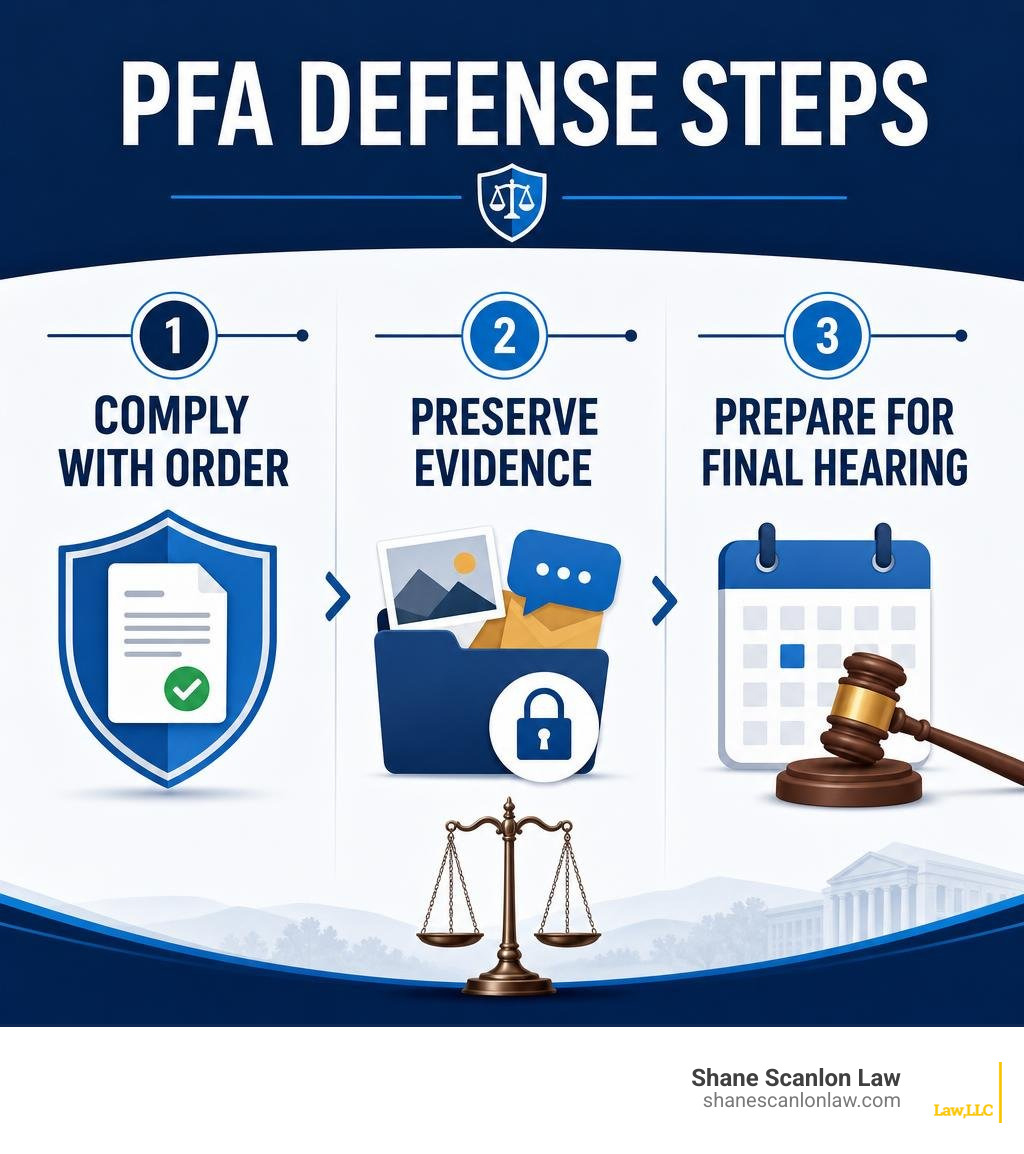
If you have been served with a Protection From Abuse order, speak with a PFA attorney in Susquehanna County as soon as possible. A temporary order can affect where you live, contact with family members, firearm possession, and your ability to respond to allegations at a final hearing. Save messages and other records, follow every part of the order, and get legal advice before the hearing date.
PFA cases are civil court matters, but the consequences can be serious. A final PFA order may remain in place for up to three years, and an alleged violation can lead to an indirect criminal contempt case. The Susquehanna County Court of Common Pleas handles these proceedings in Montrose.
I am Shane Scanlon, a Pennsylvania trial lawyer with more than 20 years of courtroom experience and former Lackawanna County District Attorney. As a PFA attorney serving Susquehanna County and Northeast Pennsylvania, I bring prosecutor-side insight and trial preparation to clients facing high-stakes protection-order allegations.
Pfa attorney susquehanna county word roundup:
- Protection from Abuse Act Pennsylvania
- PFA Defense Lawyer Luzerne County
- PFA False Accusation Defense
Understanding Protection From Abuse (PFA) Orders in Susquehanna County
The Pennsylvania Protection From Abuse Act (23 Pa.C.S. § 6101 et seq.) creates a civil court process to protect alleged victims from domestic violence, harassment, stalking, and threats. While filed in civil court rather than criminal court, the remedies under 23 Pa.C.S. § 6108 can alter your life immediately.
When a court grants an order, it can evict you from your home, award temporary child custody to the petitioner, prohibit all contact (direct, indirect, or third-party), order the immediate relinquishment of all firearms and ammunition, and order you to pay temporary financial support. If you are trying to understand how these civil rules intersect with daily life, reviewing The Ultimate Pennsylvania PFA Survival Guide provides crucial foundational knowledge.
Eligibility Criteria and Domestic Relationships
Not every dispute qualifies for a PFA petition. Pennsylvania law strictly limits PFA filings to domestic or familial relationships:
- Current or former spouses
- Persons who have lived together as intimate or sexual partners
- Current or former dating partners
- Parents, children, and persons related by blood (consanguinity) or marriage (affinity)
- Individuals who share biological parenthood of a child
Neighbor disputes, coworker conflicts, or disagreements between strangers do not fall under the PFA statute. Additionally, the petitioner must allege specific qualifying abuse under the law, such as intentional physical injury, credible threats placing them in reasonable fear of imminent serious bodily injury, sexual assault, involuntary deviate sexual intercourse, or persistent stalking behaviors that cause reasonable distress.
Three Stages: Emergency, Temporary, and Final Orders
Pennsylvania recognizes three distinct types of PFA orders. The following breakdown shows how a matter progresses through the legal system:
| Order Type | Issuing Authority | Standard Timeline / Duration | Hearing Requirements |
|---|---|---|---|
| Emergency PFA | Magisterial District Judge (MDJ) | Operates after business hours or weekends; lasts until the next regular business day of Common Pleas | Ex parte (petitioner only); respondent is not present |
| Temporary PFA (Ex Parte) | Court of Common Pleas Judge | Issued on regular business days; typically lasts 10 business days until the full hearing | Ex parte (petitioner presents petition without respondent present) |
| Final PFA Order | Court of Common Pleas Judge | Lasts for a designated period up to 3 years; can be renewed or modified by court order | Full evidentiary hearing; both parties present witnesses, cross-examine, and enter evidence |
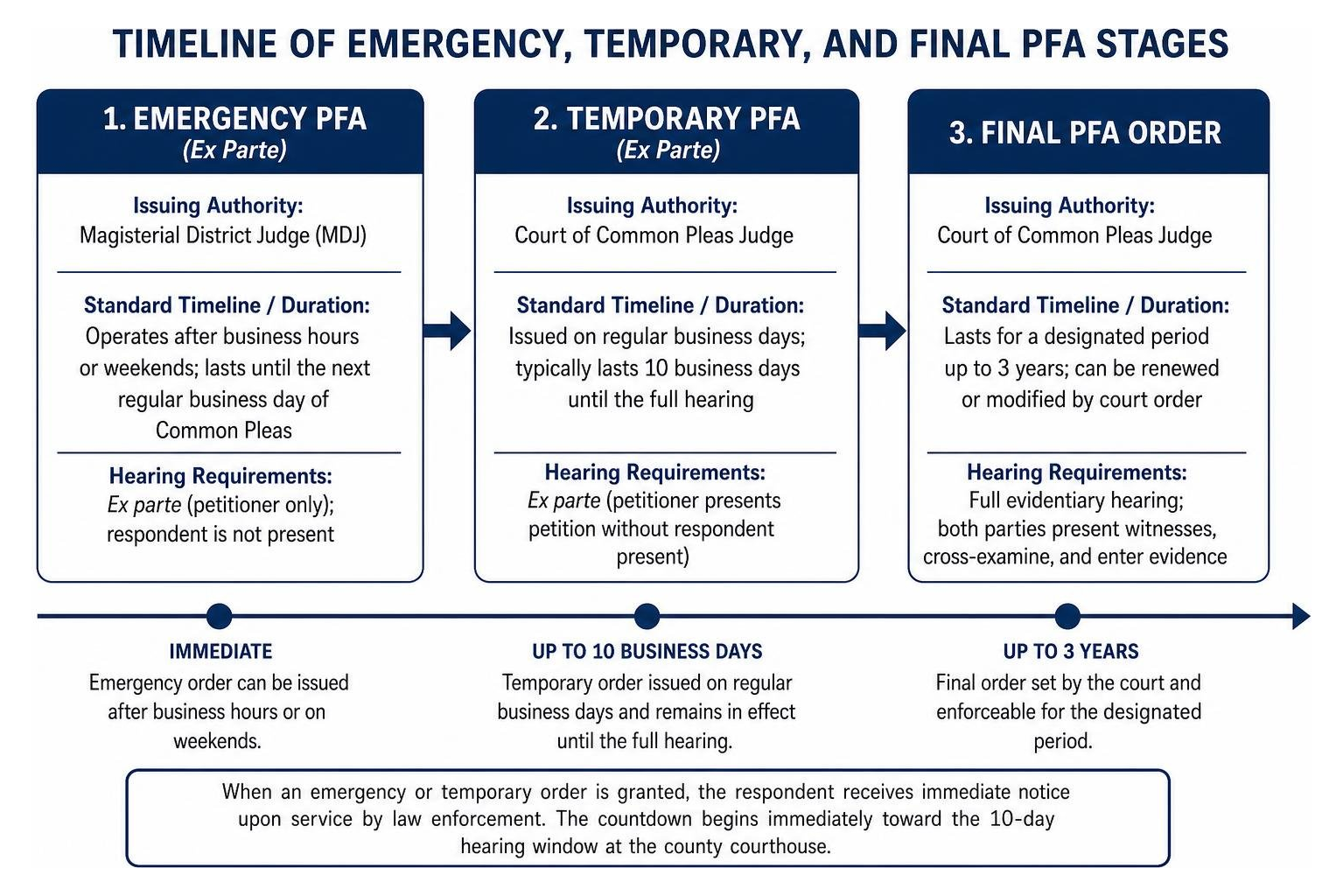
When an emergency or temporary order is granted, the respondent receives immediate notice upon service by law enforcement. The countdown begins immediately toward the 10-day hearing window at the county courthouse.
Susquehanna County Court Procedures and Local Legal Processes
In Susquehanna County, all formal PFA proceedings take place at the Susquehanna County Courthouse, located at 31 Lake Avenue (PO Box 218), Montrose, PA 18801. Local court administration operates during standard county business hours (9:00 a.m. to 4:30 p.m., Monday through Friday).

Montrose Courthouse Filing and Ex Parte Hearings
When an individual files a petition in Montrose, they submit their paperwork to the domestic relations or civil filing window of the Court of Common Pleas. Self-represented (pro se) litigants are held to the same legal rules and standards as licensed attorneys. Courthouse administrative personnel cannot offer legal advice or help complete paperwork beyond providing the blank state-approved forms.
For those who need access to legal research tools, public access to Westlaw is available in the Pro-Se Area of the Susquehanna County Courthouse, and the County Law Library is accessible during standard business hours. If a party lacks the funds for standard filing fees, Pennsylvania allows the submission of a Petition for In Forma Pauperis (IFP) to request a fee waiver from the presiding judge. You can also research regional family court resources via Susquehanna County Family Attorneys.
Once a Temporary PFA petition is granted ex parte, the sheriff’s office or designated local law enforcement serves the paperwork on the defendant. The temporary order remains fully enforceable from the moment of service.
Public Defender Scope vs. Private Defense Representation
Many people mistakenly assume the county public defender will automatically defend them at a civil PFA hearing. This is not the case.
The Susquehanna County Public Defender’s office handles indigent criminal defense. It provides representation to qualifying low-income individuals facing potential loss of liberty in criminal matters ranging from summary traffic offenses to criminal homicide. They accept applications obtained from their courthouse office or any local Magisterial District Court.
However, because a PFA petition is a civil matter, court-appointed public defenders do not represent respondents at standard PFA evidentiary hearings. If you want experienced counsel at your hearing, you must retain a private defense lawyer. Having strong legal counsel is just as important in Montrose as it is when Defending Against a PFA in Wyoming County PA.
Victim Rights and the Victims Compensation Assistance Program (VCAP)
For crime and domestic abuse victims navigating county matters, the Susquehanna County Victim/Witness Office assists individuals through criminal prosecutions and protective filings. Pennsylvania grants specific legal rights to crime victims, including:
- Mandatory notice of case developments, hearing schedules, and bail modifications
- The right to accompany advocates into courtroom proceedings
- Input on proposed plea agreements and sentencing determinations
- The ability to present oral or written victim impact statements before the court
- Court-mandated restitution for verified financial losses
Additionally, eligible individuals can apply for financial relief through the Pennsylvania Victims Compensation Assistance Program (VCAP). VCAP helps cover direct expenses such as medical treatment, professional counseling, lost wages, relocation costs, funeral bills, and crime-scene cleanup.
To remain eligible under state guidelines, an individual must report the crime or file a PFA petition within 72 hours (3 days) of the occurrence, unless good cause or minor status applies. The formal VCAP application must be filed within 2 years of the incident’s discovery.
Defense Strategies with a PFA Attorney in Susquehanna County
Facing a final PFA hearing without preparation can result in a three-year court order on your public record, firearm confiscation, and severe restrictions on your personal freedom. Whether managing proceedings in Montrose or examining Protection From Abuse in Lackawanna County, retaining private counsel allows you to mount a focused legal defense.

Challenging False Allegations and Evidentiary Burdens
In a final PFA hearing, the petitioner bears the burden of proof under the preponderance of the evidence standard (meaning the allegations are more likely true than not). While this evidentiary threshold is lower than the “beyond a reasonable doubt” standard used in criminal trials, allegations cannot stand without credible support.
We build a defense by methodically challenging unverified claims:
- Digital Evidence Audits: Gathering and authenticating time-stamped text messages, emails, social media interactions, and voicemails that contradict the petitioner’s timeline.
- Location Records: Using GPS data, toll records, receipts, and surveillance footage to establish alibis against false claims of stalking or physical presence.
- Witness Testimony: Calling third-party eyewitnesses who can provide objective accounts of contested events.
- Cross-Examination: Exposing internal contradictions, shifting stories, or underlying motives, such as using a PFA to gain leverage in a pending divorce or child custody dispute.
Working with a PFA Attorney in Susquehanna County During Hearings
A final hearing is not the only way to resolve a PFA matter. Depending on the strength of the evidence and your long-term goals, we explore multiple strategic pathways:
- Negotiated Civil Agreements: In many cases, we can negotiate a mutual civil agreement or a consent order “without an admission of abuse.” This avoids a formal judicial finding of domestic abuse on your record while setting reasonable boundaries for both parties.
- Petition Dismissal: If the petitioner fails to meet the domestic relationship criteria, misses statutory filing deadlines, or fails to appear in court, we move for immediate dismissal.
- Full Contested Hearing: When a petitioner refuses reasonable terms or makes fabricated claims, we proceed to trial before the Court of Common Pleas judge, cross-examining adverse witnesses and introducing physical and digital evidence on your behalf.
Consulting a PFA Attorney in Susquehanna County for Contempt Allegations
If you are served with a temporary or final order, strict compliance is required. Any alleged violation—even an accidental text message, an email through a third party, or brief contact in a public setting—can lead to an arrest for Indirect Criminal Contempt (ICC) under 23 Pa.C.S. § 6114.
ICC is a criminal charge. Law enforcement can arrest an individual without a warrant based on probable cause of a PFA violation. If convicted of ICC, you face:
- Up to six months in county jail
- Fines up to $1,000
- Extension of the original PFA order
- Revocation of bail or modified conditions of release
Because ICC is a criminal offense, prompt legal defense is vital to prevent jail time and criminal records.
Frequently Asked Questions About PFA Cases in Susquehanna County
Who qualifies to file or receive a PFA order in Susquehanna County?
To qualify for a PFA order, the parties must share a domestic or familial relationship (spouses, ex-spouses, cohabitants, parents, children, or current/former dating partners). The petitioner must establish that the respondent committed qualifying acts of domestic abuse, including physical violence, credible threats of imminent bodily harm, or persistent stalking.
What happens if someone violates a temporary or final PFA order?
Violating any condition of a PFA order constitutes Indirect Criminal Contempt (ICC). Police can immediately arrest the alleged violator without a warrant. An ICC conviction carries up to six months in jail, fines up to $1,000, and court-ordered extensions of the underlying protection order.
Can a Susquehanna County Public Defender represent me in a civil PFA hearing?
No. The Susquehanna County Public Defender’s office only represents qualifying indigent defendants in criminal matters where loss of liberty is at stake. Because initial PFA hearings are civil proceedings, respondents must represent themselves or retain private legal defense counsel. (Public defenders may only represent indigent individuals if they are subsequently charged with Indirect Criminal Contempt in criminal court).
Conclusion: Protecting Your Rights and Future in Northeast PA
A Protection From Abuse order can alter your personal life, your parental rights, and your professional career. When your reputation and freedom are on the line, you need dedicated legal representation that understands both civil court rules and criminal defense strategy.
At Shane Scanlon Law, our practice is grounded in more than 20 years of Pennsylvania trial experience, including serving as a former District Attorney. We provide strategic, aggressive defense representation across Susquehanna County, Scranton, Wilkes-Barre, and all of Northeast Pennsylvania. If you or a loved one is facing a protection order, review our comprehensive Protection From Abuse legal representation services and protect your future today.