
 Call Anytime
833.722.6566
Emergency PFAs in Pennsylvania and How They Actually Function

Emergency PFA Pennsylvania: How It Works When Courts Are Closed
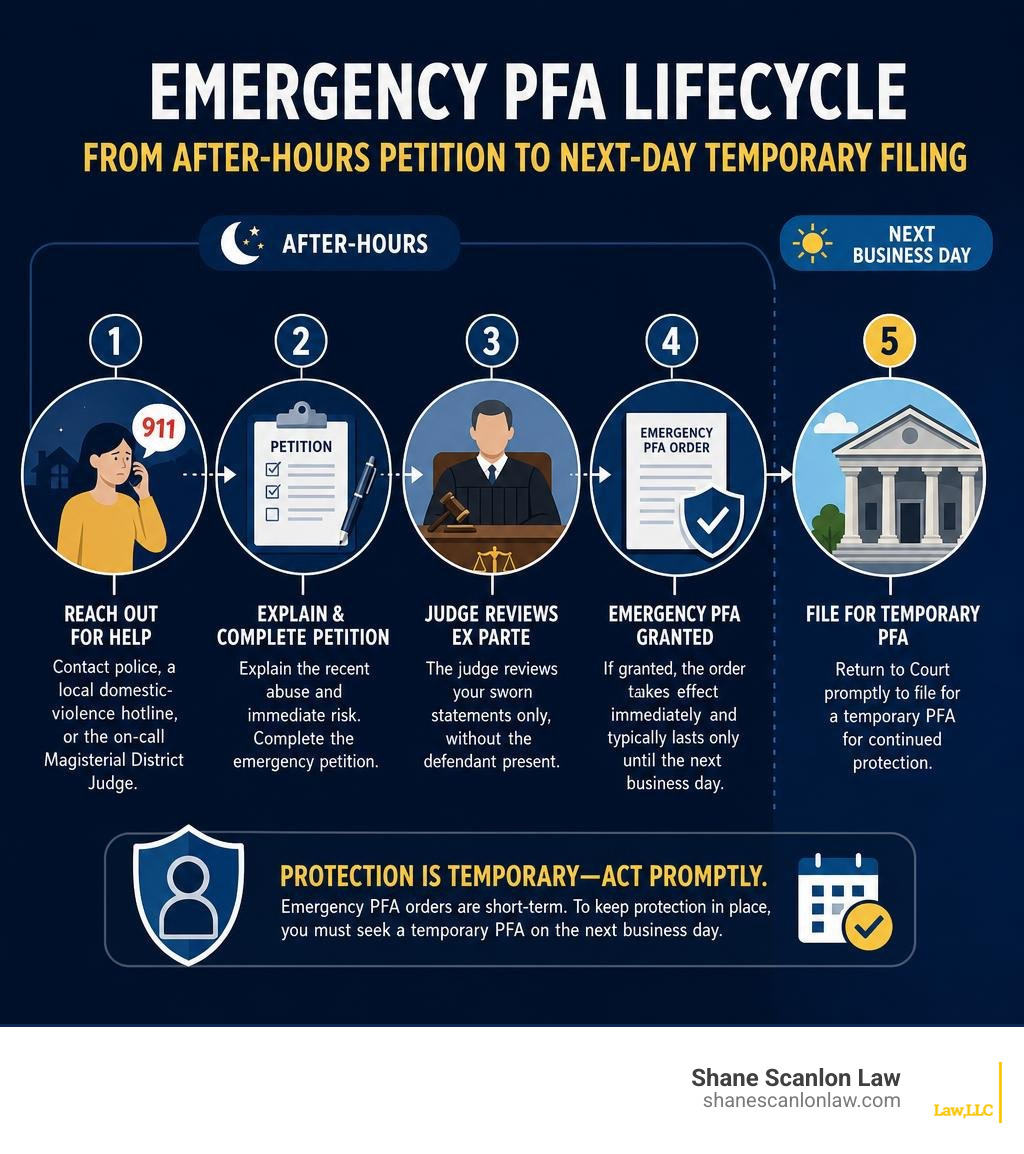
An emergency Protection From Abuse order, or Emergency PFA, is a short-term court order for someone facing immediate danger from a qualifying family or intimate partner when regular Family Court is closed. To get one, contact police, a local domestic-violence hotline, or the on-call Magisterial District Judge; explain the recent abuse and immediate risk, complete the emergency petition, and ask the judge for protection. If granted, the order generally lasts only until the next business day, when you must promptly seek a temporary PFA for continued protection.
An Emergency PFA can order the defendant to stop abusing, threatening, stalking, or contacting you. It may also require the defendant to leave a shared home. But emergency relief is limited: issues such as child custody, support, and weapons surrender are generally handled in the temporary or final PFA process. There is no filing fee for a PFA action in Pennsylvania.
I am Shane Scanlon, a Pennsylvania trial lawyer with more than 20 years of courtroom experience, including service as Lackawanna County District Attorney. I help clients understand emergency PFA Pennsylvania how it works, the fast deadlines involved, and the legal consequences that can follow for either party.
What Is an Emergency PFA in Pennsylvania?
Under the Pennsylvania Protection From Abuse Act (23 Pa.C.S. § 6102), the Commonwealth provides legal remedies to protect victims from domestic violence. Pennsylvania courts grant roughly 40,000 PFAs every year according to data tracked by the Pennsylvania Coalition Against Domestic Violence, demonstrating how essential these civil protections are across the state.
An Emergency PFA is an ex parte preliminary order granted when the Court of Common Pleas is closed. Ex parte means the judicial officer makes a rapid decision based solely on the petitioner’s sworn statement, without the defendant present to offer a defense. To qualify for any PFA in Pennsylvania, the parties must share a specific domestic relationship. Qualifying relationships include:
- Current or former spouses
- Persons who have lived together as spouses or intimate partners
- Current or former dating partners or sexual partners
- Persons related by blood or marriage (such as parents, children, or siblings)
- Parents who share a biological child
PFAs do not apply to non-related roommates, coworkers, or neighbors unless an intimate relationship exists. Additionally, the petitioner must demonstrate an imminent risk of bodily injury, physical assault, sexual assault, false imprisonment, or a threatening course of conduct such as stalking.
| Order Type | Issuing Authority | Standard Duration | Key Focus / Scope |
|---|---|---|---|
| Emergency PFA (EPFA) | Magisterial District Judge (on-call) | Until close of next business day (5:00 PM) | Immediate overnight/weekend safety, no-contact, residence eviction |
| Temporary PFA (TPFA) | Court of Common Pleas Family Division | Up to 10 business days | Bridge protection until full hearing, weapon surrender, temporary custody |
| Final PFA | Court of Common Pleas Judge | Up to three (3) years (renewable) | Comprehensive long-term relief, support, extended custody, final weapon ban |
Scope of Protections and Statutory Limitations
An Emergency PFA provides immediate, focused relief. An on-call Magisterial District Judge can grant directives such as:
- Ordering the defendant to cease all abuse, threats, stalking, and harassment
- Prohibiting all direct or indirect contact with the plaintiff and minor children
- Granting exclusive possession of the shared residence and directing police to immediately evict the defendant
However, because the emergency process is expedited and conducted without the defendant, the statute imposes strict limitations on what an after-hours magistrate can grant. As detailed in the Emergency Domestic Violence Brochure, emergency hearing officers cannot make formal determinations regarding legal child custody, establish child support, or direct complex property division. Additionally, mandatory long-term firearms forfeitures under state and federal law are typically formalized once the case enters the daytime Court of Common Pleas.
Emergency PFA Pennsylvania: How It Works Outside Regular Court Hours
When violence occurs at 2:00 AM on a Saturday or over a holiday weekend, the regular family court intake offices in Lackawanna County, Luzerne County, Susquehanna County, and Wyoming County are closed.
To bridge this gap, Pennsylvania maintains an on-call judicial framework. When normal courts close, jurisdiction shifts to on-call Magisterial District Judges (MDJs) or night-duty judicial officers. Local police departments and domestic violence crisis hotlines connect individuals directly with the on-call judge.
Filing for a PFA never involves a financial barrier: under Pennsylvania law, there are zero fees or costs assessed to plaintiffs seeking protection.
Filing After Hours: Emergency PFA Pennsylvania and How It Works
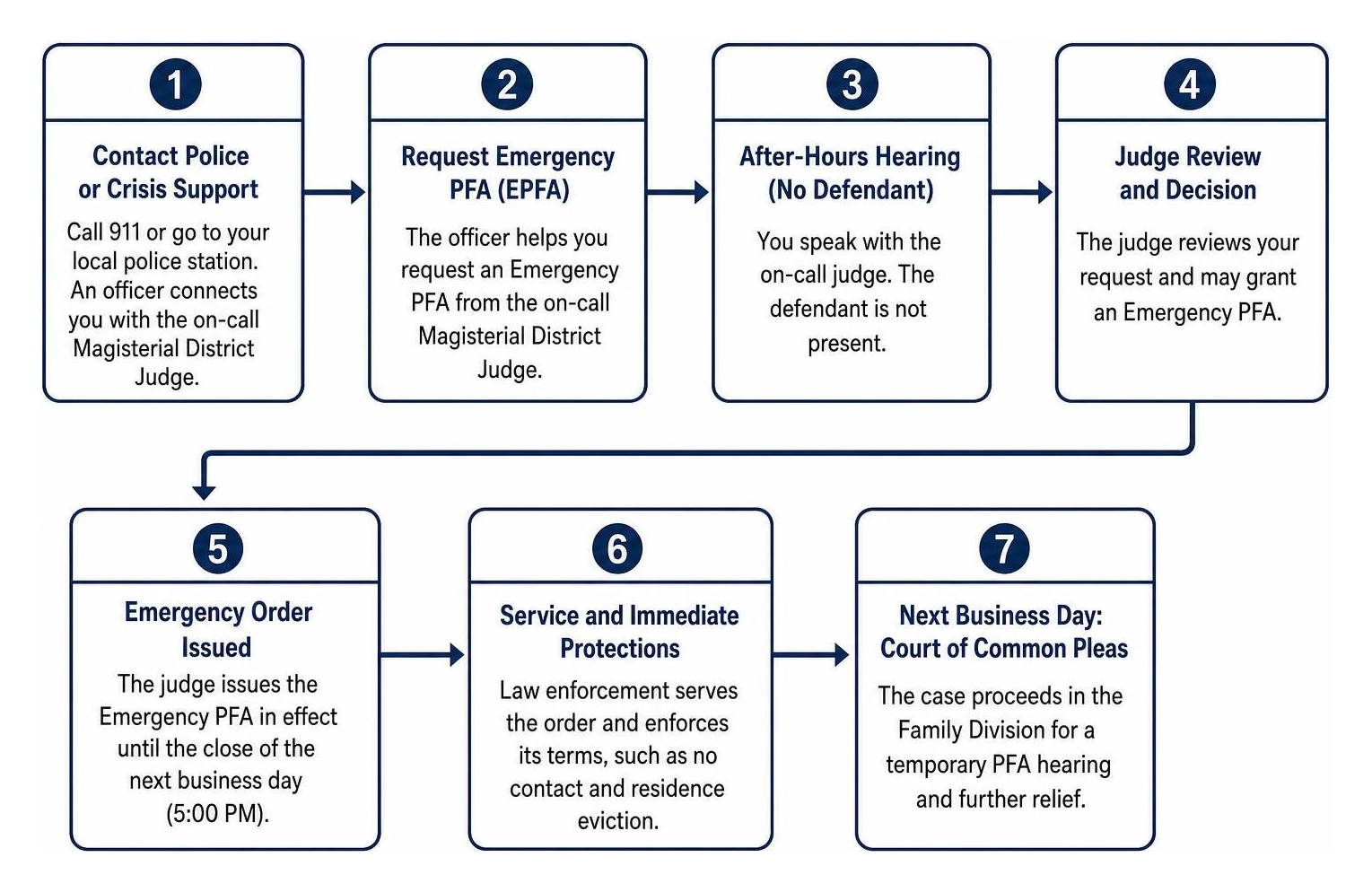
Securing an after-hours emergency order follows an urgent, multi-step process:
- Contact Law Enforcement or Crisis Support: Call 911 or visit your local police station. Law enforcement officers will contact the on-call Magisterial District Judge assigned to night duty.
- Complete the Emergency Petition: Complete the emergency petition paperwork, detailing the specific, recent acts of abuse, threats made, and reasons why waiting for normal court business hours poses an immediate physical danger. You can consult our step-by-step guide on how to get a PFA order for insights on how courts evaluate these statements.
- Sworn Judicial Review: The on-call judge reviews the petition and conducts a brief hearing—either in person at the magistrate’s office or telephonically. The judge evaluates the immediate risk under 23 Pa.C.S. § 6102.
- Order Issuance: If the judge finds reasonable grounds to believe the plaintiff is in immediate danger, they issue the Emergency PFA order immediately. For additional procedural details on after-hours filing, refer to How to File an Emergency PFA Petition | Lehigh County Court of Common Pleas, PA.
Service of Process and Immediate Enforcement

An Emergency PFA order is not legally enforceable against a defendant until formal service of process occurs.
Once the on-call judge signs the emergency order, law enforcement personnel or county sheriffs locate the defendant, serve a copy of the order, and complete a formal Verification of Service form. If the order includes an eviction directive, responding officers will escort the defendant from the premises immediately, permitting them to gather only essential personal belongings (such as identification and medications).
All granted emergency orders are logged into the Pennsylvania State Police (PSP) Protection from Abuse Database. This ensures that every police department statewide has real-time access to active orders.
If a defendant violates any term of the order after being served, police must make a warrantless arrest based on probable cause. The defendant faces charges of Indirect Criminal Contempt (ICC). Under Pennsylvania law, an ICC conviction carries a mandatory minimum sentence of 3 days incarceration for a first offense, with maximum penalties reaching up to six months in jail and fines up to $1,000. For an in-depth breakdown of these legal standards, review our guide to the Pennsylvania PFA process explained.
Next Steps: Moving from an Emergency Order to Long-Term Protection
An Emergency PFA is strictly a stopgap measure. It does not replace the standard court process, and it carries an automatic expiration timeline.
Under Pennsylvania law, an Emergency PFA order remains in effect only until the next business day when the Court of Common Pleas reopens, typically expiring at 5:00 PM that afternoon. To maintain uninterrupted legal protection, the plaintiff must appear in person at the local county courthouse on that next business day to file for a Temporary PFA. The overarching legal framework is detailed in Pennsylvania Protection From Abuse Orders: Filing, Hearings, and Enforcement.
Transitioning Orders: Emergency PFA Pennsylvania and How It Works with Next-Day Filings
When the Court of Common Pleas opens on the next business day, the plaintiff must visit the Family Court Domestic Violence Filing Unit (such as the family courts in Scranton or Wilkes-Barre). More than 70 percent of petitions result in a temporary order being entered the same day.
At this stage, a Common Pleas judge reviews the initial emergency order alongside the daytime petition. The judge can expand initial protections—incorporating temporary child custody arrangements, spousal/child support, and mandatory firearm surrender.
Once the Temporary PFA is granted, the court schedules a formal Final PFA hearing, which typically occurs within 10 business days. At the final hearing, both parties have the right to be represented by counsel, introduce exhibits, call witnesses, and undergo cross-examination. If the plaintiff meets the preponderance of the evidence standard, the judge can issue a Final PFA order that remains in effect for up to three (3) years.
For those navigating these proceedings locally, our practice provides dedicated representation for protection from abuse in Scranton PA.
Legal Considerations for Defendants Served with an Emergency Order
Being served with an Emergency PFA requires immediate, careful compliance. Disregarding any provision—even answering a text message or asking a third party to retrieve belongings—can lead to criminal contempt charges and immediate arrest.
Defendants served with an emergency order should keep several legal steps in mind:
- Comply Immediately with Eviction Directives: Vacate the property peacefully if ordered to do so. Do not return without law enforcement accompaniment.
- Surrender Weapons Promptly: When transitioned to a Temporary PFA, state and federal statutes require the surrender of all firearms, ammunition, and weapons to the sheriff’s department within 24 hours.
- Avoid All Communication: Do not call, message, or approach the plaintiff, even if the plaintiff initiates contact. The court order binds the defendant regardless of the plaintiff’s actions.
- Prepare for the 10-Day Hearing: Work with legal counsel to gather relevant evidence, such as text records, location data, or eyewitness testimony. In some cases, counsel can negotiate a formal Consent Agreement without an admission of abuse, avoiding a formal finding on public records while resolving custody and property access.
For individuals confronting these proceedings across Northeastern Pennsylvania, our firm provides aggressive emergency and temporary PFA defense in Northeast Pennsylvania.
Frequently Asked Questions About Pennsylvania Emergency PFAs
How long does an emergency PFA last in Pennsylvania?
An Emergency PFA order issued after hours or over a weekend remains in effect only until the next business day that the Court of Common Pleas Family Division is open, with a statutory cutoff of 5:00 PM. To avoid any lapse in legal protection, the plaintiff must go to the county courthouse on that next business morning to petition for a Temporary PFA.
What happens if an emergency PFA petition is denied?
If an on-call Magisterial District Judge denies an emergency PFA petition, it simply means the magistrate did not find sufficient evidence of immediate, overnight danger requiring emergency intervention before normal court hours.
A denial at the emergency stage does not prevent you from filing for a standard Temporary PFA during normal business hours. You can still present your petition to the Court of Common Pleas Family Division, where judges evaluate the broader history and pattern of abuse.
Are there any fees for filing an emergency PFA in Pennsylvania?
No. Under Pennsylvania law, there are no filing fees, court administration costs, or sheriff service fees assessed to plaintiffs seeking an Emergency, Temporary, or Final PFA. Court costs and service expenses may ultimately be assessed against the defendant if a final order is granted.
Conclusion
When domestic safety is threatened outside regular business hours, Pennsylvania’s emergency PFA statutes provide an immediate legal mechanism to halt abuse, secure safe shelter, and initiate formal court oversight. Because an emergency order is short-lived, understanding how to navigate the immediate transition to temporary and final orders is critical to ensuring lasting protection and protecting your legal rights.
Whether you need to secure long-term protection or defend against contested allegations before the Court of Common Pleas, experienced legal guidance makes all the difference. Contact our team at Shane Scanlon Law for trusted local counsel and fierce advocacy throughout Scranton, Wilkes-Barre, Lackawanna County, Luzerne County, Susquehanna County, and Wyoming County through our dedicated Pennsylvania protection from abuse legal representation.