
 Call Anytime
833.722.6566
Call Anytime
833.722.6566
Accused of a PFA Violation? Why You Need a Pennsylvania Lawyer Fast

When a Civil Order Becomes a Criminal Crisis: What You Need to Know
If you are accused of a PFA violation in Pennsylvania, a lawyer is not optional — it is urgent. What starts as a civil protection order can become a criminal charge almost instantly, with consequences that include jail time, heavy fines, a permanent record, and for legal professionals, the loss of a law license.
Here is what you need to know right away:
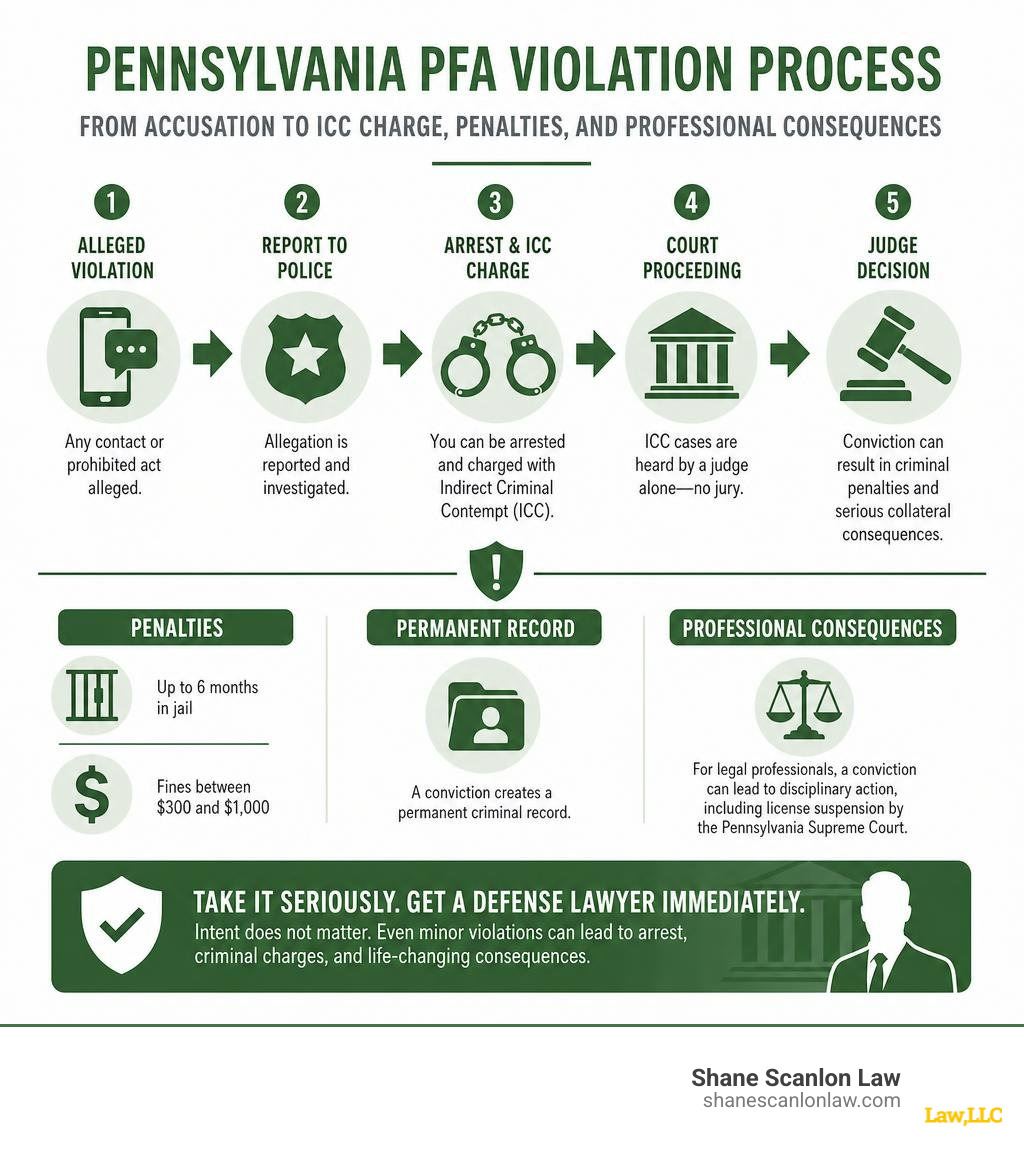
- A PFA violation is a criminal matter. Any alleged breach of a Protection From Abuse order triggers a charge called Indirect Criminal Contempt (ICC).
- Intent does not matter. Pennsylvania courts do not require proof that you meant to violate the order — only that a violation occurred.
- Penalties are serious. An ICC conviction carries up to 6 months in jail and fines between $300 and $1,000.
- Lawyers face extra consequences. A conviction can lead to disciplinary action by the Pennsylvania Supreme Court, including license suspension.
- You need a defense attorney immediately. ICC cases are decided by a judge alone — no jury — which makes skilled representation critical from day one.
Even something as minor as responding to a text message sent by the protected party, or running into them at a grocery store, can result in an arrest and a criminal record.
I’m Shane Scanlon, founder of Shane Scanlon Law and a former Lackawanna County District Attorney with over 20 years of courtroom experience — including direct knowledge of how prosecutors build ICC cases against those accused of a PFA violation in Pennsylvania. That inside perspective is exactly what your defense needs.
Understanding PFA Violations and Indirect Criminal Contempt (ICC) in Pennsylvania

In Pennsylvania, a Protection From Abuse (PFA) order is a civil court order designed to shield individuals from domestic abuse, harassment, or stalking within family or intimate relationships. However, the moment you are accused of breaching any term of that order, the matter crosses the line from a civil dispute into a serious criminal proceeding.
When a violation is alleged, law enforcement does not issue a simple warning. Instead, you face a specialized criminal charge known as Indirect Criminal Contempt (ICC).
To understand how this transition occurs, it helps to look at the overall legal framework. You can read more about how these orders are established in The Pennsylvania PFA Process Explained. Once an order is active, the court expects absolute compliance, as detailed in our guide on the Enforcement of a PFA Order.
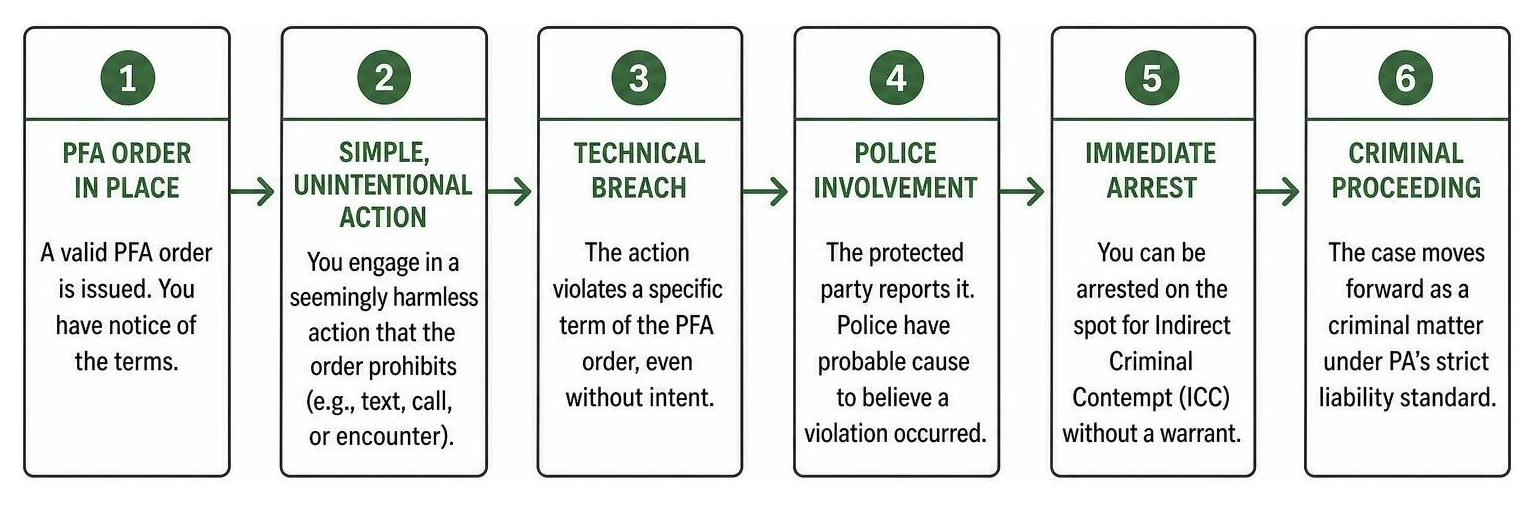
The “indirect” part of Indirect Criminal Contempt means the alleged violation occurred outside the direct presence of the court. The “criminal contempt” part means you are accused of knowingly disobeying a clear, valid order issued by a judge. Because this is treated as a criminal offense, you can be arrested immediately without a warrant if a police officer has probable cause to believe you violated the PFA.
What Constitutes a Technical PFA Violation?
Many people mistakenly believe that they can only violate a PFA by committing an act of physical violence or making direct threats. In reality, the vast majority of ICC charges stem from minor, non-violent actions known as technical violations.
Common scenarios that trigger an arrest include:
- Direct Digital Contact: Sending a “harmless” text message, email, or direct message on social media, even if it is just to say “I’m sorry” or “Can we talk?”
- Third-Party Communication: Asking a mutual friend, coworker, or family member to pass along a message to the protected party.
- Child Custody Exchanges: Attempting to coordinate parenting schedules or child drop-offs directly when the PFA order explicitly mandates that all communication must go through legal counsel or a designated third party.
- Social Media Interaction: Liking a post, commenting on a photo, or sending a friend request to the plaintiff.
The Role of Intent in ICC Charges
One of the most dangerous traps for anyone accused of a PFA violation is the issue of intent. Under Pennsylvania law, prosecutors do not need to prove that you intended to violate the court order. The court’s primary focus is whether a valid order was in place, whether you had notice of it, and whether the terms of that order were technically breached.
This means that “accidental” contact can easily lead to a criminal conviction. For example, if you reside in a tight-knit community in Lackawanna County or Luzerne County and accidentally walk into the same grocery store or diner as the protected party, you are technically in violation the moment you notice them and fail to leave immediately.
Because intent is not a required element, judges in the Court of Common Pleas have wide discretion during these bench trials. Self-representation is incredibly risky because a single judge—rather than a jury of your peers—will decide your fate based solely on the technical facts of the encounter.
The Severe Penalties and Professional Consequences of a PFA Violation

The consequences of an ICC conviction are swift and severe. Because a PFA violation is treated as a criminal matter, a conviction will result in a permanent criminal record, which can severely restrict your future employment, housing options, custody rights, and professional opportunities. You can review the broader legal landscape in our article on the Legal Consequences for the Accused PFAs.
Criminal Penalties: Jail Time and Fines
If a judge finds you guilty of Indirect Criminal Contempt in Pennsylvania, you face the following statutory penalties:
- Incarceration: Up to 6 months of jail time in a county correctional facility.
- Financial Penalties: Fines ranging from $300 to $1,000 per individual violation.
- Supervised Probation: Up to 6 months of court-supervised probation.
- Mandatory Programs: Court-ordered anger management classes, domestic violence counseling, or substance abuse evaluations.
- Extension of the PFA: The court can extend the active PFA order for up to an additional three years, prolonging the restrictions on your life.
- Loss of Constitutional Rights: You will be ordered to immediately relinquish all firearms and ammunition, and you may be barred from owning or possessing firearms for the duration of the order.
Professional License Impact: The Case of Pennsylvania Lawyers
For licensed professionals—and attorneys in particular—the fallout of a PFA violation goes far beyond jail time and fines. The Disciplinary Board of the Supreme Court of Pennsylvania holds lawyers to the highest ethical standards. An ICC conviction serves as a major red flag, often triggering an immediate investigation into an attorney’s fitness to practice law.
Under the Pennsylvania Rules of Professional Conduct, any criminal conviction or finding of contempt must be reported to the disciplinary board. Failing to do so only compounds the trouble.
Recent real-world cases from across the state illustrate how personal misconduct, domestic disputes, and PFA violations can destroy a legal career:
- The Case of James F. Logue: A Pennsylvania attorney who practiced for nearly 20 years was indefinitely suspended by the state Supreme Court. His disciplinary issues escalated after he failed to disclose multiple DUI convictions, faced domestic harassment charges involving his spouses, and was eventually jailed for probation violations stemming from his personal misconduct. For more details on this case, you can read the report on how the Supreme Court suspends Pa. attorney for failing to disclose DUIs, embezzlement.
- The Case of Timothy Reitz: A 51-year-old Lycoming County attorney agreed to a three-year law-license suspension by the state Supreme Court after admitting to severe professional and personal misconduct. His actions, which included exploiting vulnerable clients facing domestic violence and dependency issues, ultimately led to criminal charges of official oppression. Read more on this case: Pa. attorney admits misconduct, agrees to 3-year law-license suspension.
Whether you are a lawyer, a doctor, a teacher, or a business owner, a PFA violation conviction can result in the immediate suspension or revocation of your professional license, ending the career you worked for decades to build.
Why You Must Hire an Accused of PFA Violation Pennsylvania Lawyer Immediately
When you are facing an ICC charge, the deck is stacked against you. The court process moves incredibly fast, and the state’s rules of evidence apply strictly. Attempting to explain your side of the story to a judge without an experienced attorney is a recipe for disaster. To protect your rights, you need a dedicated PFA Violation Defense Lawyer in Northeast Pennsylvania.
How an Accused of PFA Violation Pennsylvania Lawyer Protects Your Rights
A skilled defense attorney will carefully analyze the facts of your case to build a robust defense strategy. Key defense methods include:
- Challenging the Credibility of the Accuser: In many domestic disputes, temporary PFAs are filed under false pretenses or used as leverage in ongoing divorce or child custody battles. We expose these ulterior motives during cross-examination.
- Proving Lack of Proper Service: To be guilty of violating a PFA, you must have been officially served with the order or had actual notice of its terms. If the police failed to properly serve you, the contempt charge cannot stand.
- Identifying Ambiguous Terms: If the language of the PFA order is vague or confusing, we can argue that you did not knowingly violate a clear mandate of the court.
- Exposing Plaintiff-Initiated Contact: While the plaintiff’s consent does not legally excuse a violation, proving that the protected party repeatedly initiated contact, set up “accidental” meetings, or sent baiting messages can heavily influence the judge’s final ruling and lead to mitigated penalties or dismissed charges.
Choosing the Right Accused of PFA Violation Pennsylvania Lawyer for Your Case
Not all criminal defense attorneys are equipped to handle the unique, nature of PFA violations. You need a local advocate who understands the specific procedures of the courts in Northeast Pennsylvania.
At Shane Scanlon Law, we regularly represent clients in the Court of Common Pleas across Lackawanna County, Luzerne County, Susquehanna County, and Wyoming County.
As a former District Attorney, Shane Scanlon knows exactly how local prosecutors evaluate ICC files and what evidence they look for to secure a conviction. We use this unique inside knowledge to stay one step ahead, identifying weaknesses in the state’s case and presenting compelling arguments directly to the presiding judge in Scranton or Wilkes-Barre.
Case Studies: How Mitigation and Defense Strategies Shape PFA and Domestic Violence Outcomes
Every domestic allegation is unique, and the strategy your lawyer employs can mean the difference between active jail time and a complete dismissal of the charges. The table below outlines how proactive defense strategies and mitigation can dramatically alter the outcome of a case in Pennsylvania:
| Case Scenario | Potential Charges / Consequences | Defense & Mitigation Strategy | Final Outcome |
|---|---|---|---|
| Accidental Public Contact (e.g., running into plaintiff at a Scranton grocery store) | ICC Charge, up to 6 months jail, permanent criminal record | Documented immediate exit; proved lack of intent and absence of communication | Charges Dismissed |
| Baiting & Custody Setup (Plaintiff text-messages defendant to arrange child pickup, then calls police) | ICC Charge, PFA extension for 3 years, probation | Presented full text-history showing plaintiff initiated contact and set up the exchange | Acquitted at Bench Trial |
| High-Profile Domestic Dispute (Allegations of physical assault and harassment) | Aggravated Assault, Strangulation, Simple Misdemeanor | Voluntary entry into inpatient alcohol rehab; extensive proactive mitigation | All Charges Withdrawn |
| Subsequent Offense / Bail Violation (Arrested for DUI while out on bail for domestic assault) | Bail Revocation, immediate incarceration, probation violation | Negotiated structured treatment program; contested out-of-state arrest details | Bail Reinstated with Monitoring |
Proactive Mitigation and Withdrawn Charges
In high-stakes domestic cases, taking immediate, voluntary steps toward self-improvement can completely change the trajectory of your case. Prosecutors and judges appreciate defendants who take accountability and address underlying issues, such as substance abuse or anger management, before being ordered to do so.
A prime example of this occurred in the highly publicized case of Philadelphia Family Court Judge Michael Fanning. After being accused of assaulting his wife and daughter, prosecutors ultimately withdrew all charges.
The District Attorney’s office cited “extensive mitigation”—specifically, the judge’s voluntary entry into and completion of a 30-day inpatient alcohol treatment program—alongside the victims’ wishes not to proceed, as the primary reasons for dropping the case. You can read the full account of how Prosecutors withdraw all charges against Family Court Judge Michael Fanning in alleged attack on wife and daughter.
The Intersection of PFA Violations, DUIs, and Bail Revocation
If you are already facing domestic violence charges or are out on bail, a subsequent arrest—such as a DUI—can trigger a catastrophic chain reaction. In Pennsylvania, a standard condition of any bail agreement is that you must remain law-abiding.
If you commit another offense, the District Attorney’s office will immediately move to revoke your bail, landing you back in a county jail like the Lackawanna County Prison until your trial.
This intersection of offenses was demonstrated when a Pennsylvania police officer, who was out on bail for a domestic assault charge, was arrested for a DUI in Maryland. Because he violated his bail conditions by committing a new crime, the local DA promptly filed a motion and successfully revoked his bail. This case highlights how critical it is to maintain absolute compliance with all court mandates while your legal matters are pending.
Frequently Asked Questions About PFA Violations in Pennsylvania
Can a PFA violation charge be dropped if the victim doesn’t want to press charges?
Unlike civil matters, once an allegation of a PFA violation is made and an ICC charge is filed, the case belongs to the Commonwealth of Pennsylvania, not the victim. The District Attorney’s office has sole prosecutorial discretion over whether to move forward. While a victim’s request not to prosecute carries significant weight—especially when paired with proactive mitigation on your part—the prosecutor can still force the case to trial if they believe a danger exists.
Do I have the right to a jury trial for an ICC charge in Pennsylvania?
No. In Pennsylvania, Indirect Criminal Contempt charges are decided via a bench trial. This means your case will be heard and decided solely by a judge in the Court of Common Pleas. Because you do not have a jury to appeal to, having an attorney who knows local county court procedures and understands how local judges rule on evidentiary matters is absolutely critical.
Can accidental contact lead to a PFA violation conviction?
Yes, because Pennsylvania treats PFA orders with a strict liability standard regarding contact. However, if you accidentally encounter the protected party in public, you can protect yourself by immediately turning around and leaving the area. If you are arrested, we can use security footage, witness statements, and GPS data to prove that the contact was brief, accidental, and that you took immediate steps to distance yourself.
Conclusion
An accusation of a PFA violation is not something you can afford to ignore or handle on your own. With your freedom, your clean record, your custody rights, and potentially your professional license on the line, you need aggressive, local representation immediately.
At Shane Scanlon Law, we bring more than 20 years of experience to the table. As a former District Attorney, Shane Scanlon understands both sides of the courtroom, giving our clients a distinct advantage when fighting ICC charges in Scranton, Wilkes-Barre, and throughout Lackawanna, Luzerne, Susquehanna, and Wyoming counties.
Do not let a technical misunderstanding or a false accusation derail your life. Contact us today to secure the fierce defense you deserve by visiting our Shane Scanlon Law PFA Defense Services page and scheduling your consultation.