
 Call Anytime
833.722.6566
Call Anytime
833.722.6566
DUI Expungement in Pennsylvania: Your Ticket to a Fresh Start

A DUI Record in Pennsylvania Can Follow You for Life — Unless You Act
DUI expungement in Pennsylvania is possible, but the rules are strict and the path depends entirely on how your case was resolved. Here is a quick breakdown:
- ARD program (first-time offenders): Completing the Accelerated Rehabilitative Disposition (ARD) program allows for expungement of your DUI arrest record after successful completion.
- DUI conviction (no ARD): A conviction generally cannot be fully expunged, but may be sealed from public view after 7 years under Pennsylvania’s Clean Slate law.
- Summary DUI offenses: May be eligible for expungement after 5 years arrest-free.
- Acquittals or dismissed charges: Can be expunged, often automatically.
- Age 70 or older, arrest-free for 10 years: May qualify for expungement of a conviction.
A DUI arrest or conviction in Pennsylvania stays on your criminal record for life unless you take formal legal steps to remove or seal it. That record shows up on background checks run by employers, landlords, and licensing boards. It can double your auto insurance rates and limit your options for years after the arrest itself.
The good news is that real options exist — if you know which path applies to your situation.
I’m Shane Scanlon, founder of Shane Scanlon Law and a former Lackawanna County District Attorney. My years prosecuting DUI cases — and now defending them — give me a unique inside view of how DUI expungement in Pennsylvania actually works at every stage, from ARD eligibility to filing the petition in your local courthouse. That experience shapes everything in this guide.

Navigating DUI Expungement in Pennsylvania: Expungement vs. Sealing
When people talk about clearing their record after a drunk driving arrest, they often use “expungement” and “sealing” interchangeably. However, under Pennsylvania law, these are two entirely different legal mechanisms with distinct consequences.
An expungement is the gold standard of record clearing. When a record is expunged, the physical and digital records of your arrest, charges, and court proceedings are ordered to be destroyed by the court. It is as close as the law can get to pressing a “rewind” button on your mistake.
By contrast, record sealing (legally referred to as “limited access” under Pennsylvania’s Clean Slate framework) does not destroy the record. Instead, it places a digital padlock on it. The general public, including private landlords, prospective employers, and credit agencies, can no longer see it. However, the record remains fully visible to law enforcement, prosecutors, and certain state licensing boards.
Under Section 9122.0 – Title 18 – CRIMES AND OFFENSES, the state outlines exactly when a record can be destroyed or sealed. If you are facing a first-time DUI charge in Pennsylvania, understanding these paths early in your case is critical to protecting your future.
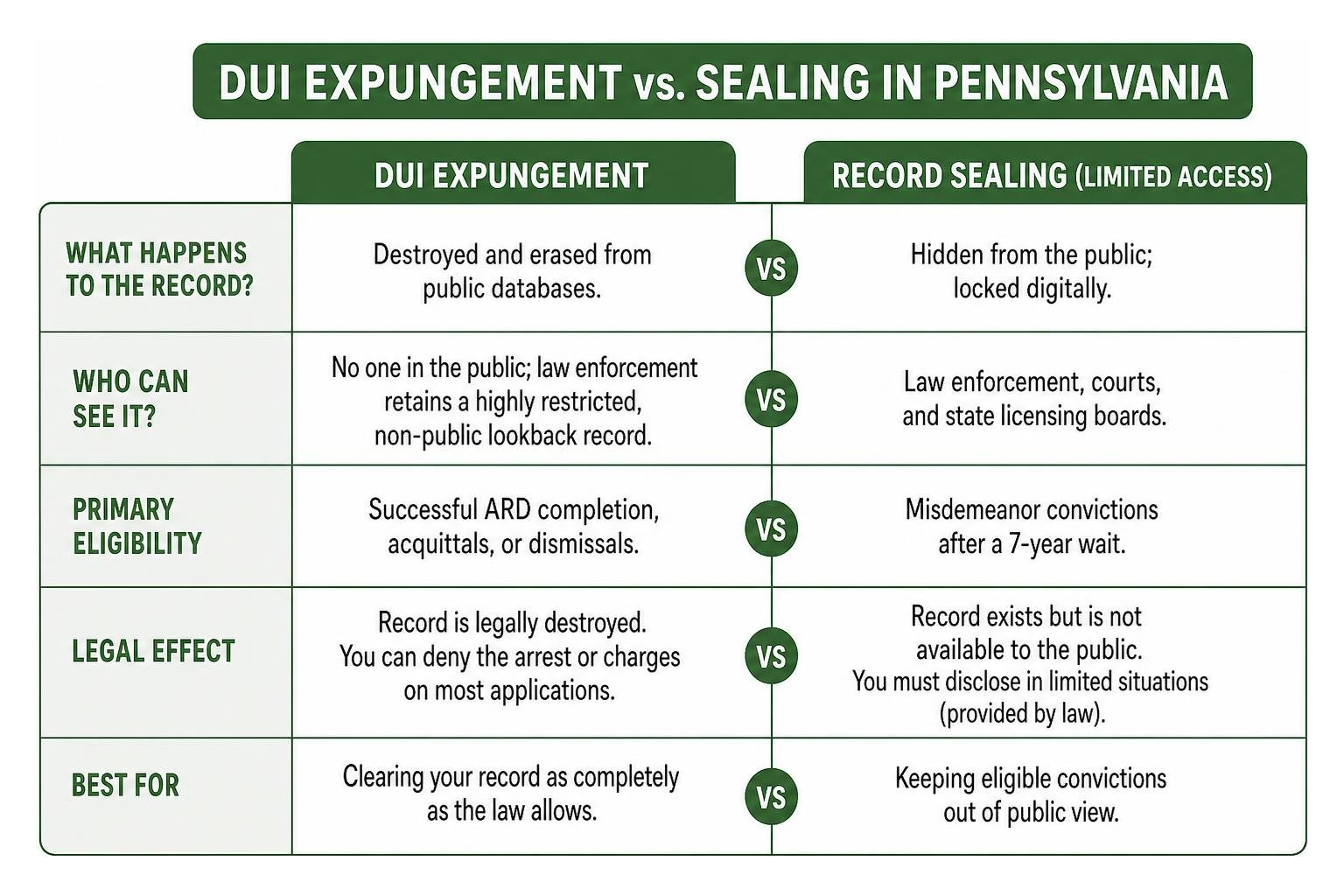
| Feature | DUI Expungement | Record Sealing (Limited Access) |
|---|---|---|
| What happens to the record? | Destroyed and erased from public databases | Hidden from the public; locked digitally |
| Who can see it? | No one in the public; law enforcement retains a highly restricted, non-public lookback record | Law enforcement, courts, and state licensing boards |
| Primary Eligibility | Successful ARD completion, acquittals, or dismissals | Misdemeanor convictions after a 7-year wait |
| Impact on Background Checks | Completely clean for employment and housing | Clean for standard jobs/leases; visible for government/security roles |
Who Qualifies for a DUI Expungement in Pennsylvania?
Full expungement is not a universal right. It is a specific legal remedy reserved for cases that did not result in a conviction. You may qualify for a dui expungement pennsylvania petition if your case meets one of the following criteria:
- Successful ARD Completion: This is the most common path for first-time offenders. If you enter and successfully complete the Accelerated Rehabilitative Disposition (ARD) program, your charges are dismissed, making you eligible for expungement.
- Non-Conviction Records: If your charges were dismissed by a magisterial district judge, withdrawn by the District Attorney, or if you were found “not guilty” (acquitted) at trial, you are eligible to have the arrest record expunged.
- The Age 70 Rule: Under Pennsylvania statute, if you are 70 years of age or older and have remained free of arrest or prosecution for 10 years following your release from court supervision, you can petition to expunge a conviction.
- Deceased Individuals: If an individual has been deceased for at least three years, their family or estate administrator can petition to expunge their record to clear their name and ease estate administration.
Understanding your eligibility is the first step. According to resources like Can a DUI Be Expunged in Pennsylvania? – LegalClarity, attempting to navigate these rules without a clear strategy can lead to delays. Knowing how a DUI lawyer can help reduce or dismiss your charge before you plead can make the difference between a lifetime conviction and a clear record.
Can a DUI Conviction Be Expunged Without ARD?
A common question we hear at our Scranton office is: “I pleaded guilty to a DUI five years ago without ARD. Can I get it expunged?”
The short, hard truth is no. If you were convicted of a misdemeanor DUI—meaning you pleaded guilty, pleaded no contest, or were found guilty at trial—you cannot have that conviction fully expunged from your record unless you receive a rare gubernatorial pardon.
However, you are not entirely out of luck. While full expungement is off the table, Pennsylvania’s Clean Slate law offers a secondary lifeline: record sealing. If you were convicted of a first- or second-offense misdemeanor DUI (graded as a low- or tier-one offense), you can petition to seal your record after a 7-year waiting period, provided you have remained completely free of arrests and convictions during those seven years.
For summary offenses (such as low-level traffic infractions or minor offenses associated with a stop), the wait time to petition for expungement is 5 years arrest-free.
If you are dealing with DUI charges in Lackawanna County, we can review your original court docket to determine if you qualify for Clean Slate sealing or if a summary expungement is within reach.
The ARD Pathway and the New 12-Year PennDOT Rule
For most people arrested for a DUI in Northeastern Pennsylvania, the Accelerated Rehabilitative Disposition (ARD) program is the best way to avoid jail time and secure a clean record. ARD is a pretrial diversionary program designed for first-time, non-violent offenders. Instead of going to trial or pleading guilty, you enter a period of court-supervised probation.
Upon successful completion of the program, the court dismisses your charges. Under Rule 320. Procedure for Expungement Upon Successful Completion of ARD Program, the court is instructed to initiate the expungement of your arrest record.
However, a major statutory change enacted under Act 58 of 2025 has fundamentally altered how ARD records are tracked by PennDOT.
Historically, PennDOT maintained a record of your ARD participation for 10 years to ensure you did not try to use the “first-time offender” program again if rearrested. Under Act 58 of 2025, which is in full effect as of July 2026:
- The 12-Year Rule: PennDOT is now legally required to maintain the record of your ARD acceptance and completion for 12 years before it is automatically expunged from their database.
- The “DUI After Diversion” Offense: The law created a strict new criminal offense (Section 3802(h)(1)) targeting anyone who is arrested for a subsequent DUI within 10 years of successfully completing ARD.
- CDL Exclusions: Commercial Driver’s License (CDL) holders are completely excluded from automatic PennDOT expungements; the state must keep these records permanently to comply with federal highway safety regulations.
If you have been arrested in Lackawanna County, navigating this new 12-year window requires careful planning.
Standard ARD Program Requirements
To successfully complete ARD and earn your right to an expungement, you must satisfy several strict court-ordered conditions:
- Probationary Period: Typically 6 to 12 months of active, law-abiding supervision.
- Alcohol Highway Safety School (AHSS): Mandatory 12 hours of classroom instruction.
- CRN Evaluation: A Court Reporting Network evaluation to assess your relationship with alcohol or drugs.
- Community Service: A designated number of volunteer hours in the local NEPA community.
- License Suspension: A mandatory suspension of your driving privileges (ranging from 0 to 90 days, depending on your Blood Alcohol Concentration at the time of arrest).
- Financial Restitution: Paying all court costs, supervision fees, and program fines in full.
How to File for a DUI Expungement in Pennsylvania: Step-by-Step
If your DUI charges were dismissed, withdrawn, or resolved through successful completion of the ARD program, the record does not always vanish automatically. While some counties have automated parts of the Rule 320 process, administrative gaps are common. To guarantee your record is clear, you must often file a formal petition.
The administrative journey to clear your name in Northeastern Pennsylvania involves several precise legal steps.
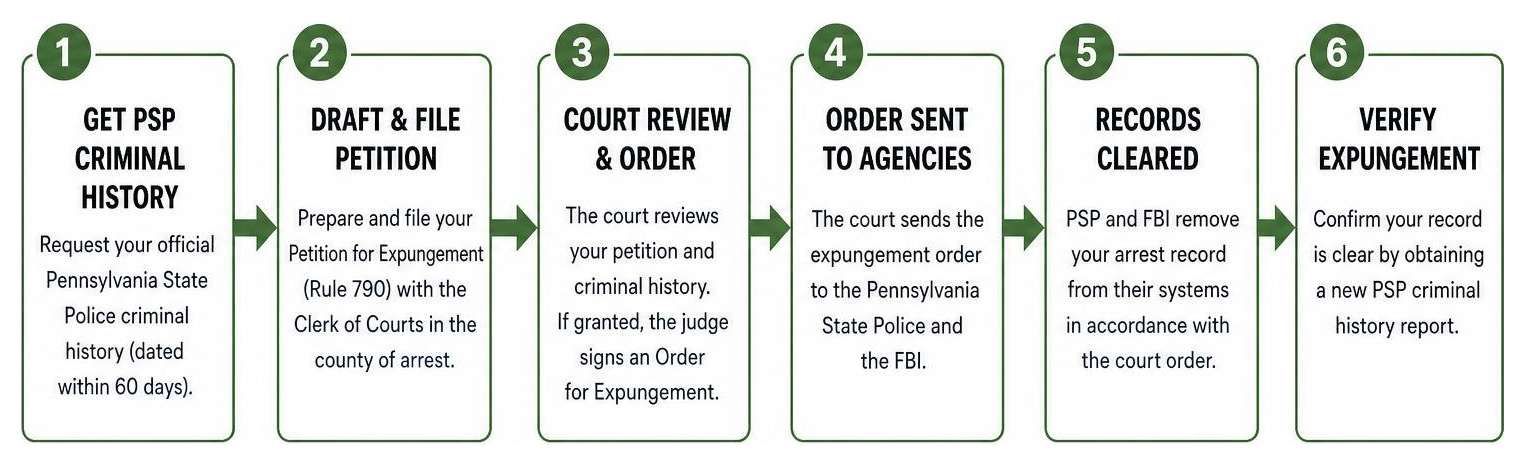
Step 1: Secure Your Official State Police Criminal History
Before you can ask a judge in Lackawanna, Luzerne, Susquehanna, or Wyoming County to clear your record, you must obtain a certified copy of your background check directly from the state. You must use the official portal or mail Form SP 4-170 to the Pennsylvania State Police Central Repository. This step ensures there are no matching errors or open, unresolved charges on your record. You can learn more about this step via the Apply for Criminal Record Expungement official portal.
Step 2: Draft and File the Formal Expungement Petition
Once you have your PSP record (which must be dated within 60 days of your filing), you must draft a formal Petition for Expungement under Rule 790. This petition is filed with the Clerk of Courts in the county where your arrest occurred. For example, if your arrest occurred in Wilkes-Barre or Hazleton, you will file through the Expungements | Luzerne County, PA office. The petition must include your name, aliases, Social Security Number, the Offense Tracking Number (OTN), the date of your arrest, and the exact disposition of your charges.
Step 3: Serve the District Attorney’s Office
A copy of your filed petition must be formally served to the local District Attorney. In Pennsylvania, the Commonwealth has exactly 60 days to review your petition and decide whether to file an official objection. As a former District Attorney, I know exactly what prosecutors look for during this window—such as outstanding court costs or incomplete restitution. Having a dedicated DUI lawyer in Luzerne County ensures your paperwork is flawless, minimizing the risk of a prosecutor’s objection.
Step 4: Secure the Court Order and Monitor Compliance
If the District Attorney does not object, or if the judge rules in your favor after a hearing, the court will issue an Expungement Order. Certified copies of this order must be served to all arresting agencies, the Pennsylvania State Police, and PennDOT to ensure your records are systematically purged.
What Does a DUI Expungement in Pennsylvania Actually Remove?
It is vital to understand the limits of what a court-ordered expungement can accomplish.
What is removed:
- Your public arrest record, fingerprints, and mugshot from the Pennsylvania State Police Central Repository.
- All local police department records and incident reports associated with the arrest.
- Publicly searchable court dockets on the Unified Judicial System of Pennsylvania (UJS) portal.
What is NOT removed:
- PennDOT Driving Records: As established by Act 58 of 2025, PennDOT keeps an internal notation of your ARD completion for 12 years to track subsequent offenses.
- Law Enforcement Databases: Under 18 Pa.C.S. § 9122, prosecutors and police retain a secure, non-public index of your ARD or diversion program participation solely for lookback grading if you are arrested again.
- Private Background Check Databases: Private background check companies buy public records in bulk. If they do not update their systems frequently, an expunged record may still show up on their reports. Under the federal Fair Credit Reporting Act (FCRA), these companies can be held civilly liable if they continue to report an expunged record after being formally notified of the court order.
What Are the Costs and Timeline for a DUI Expungement in Pennsylvania?
Clearing your record is an investment in your career, housing options, and peace of mind. However, it does come with unavoidable administrative and legal costs.
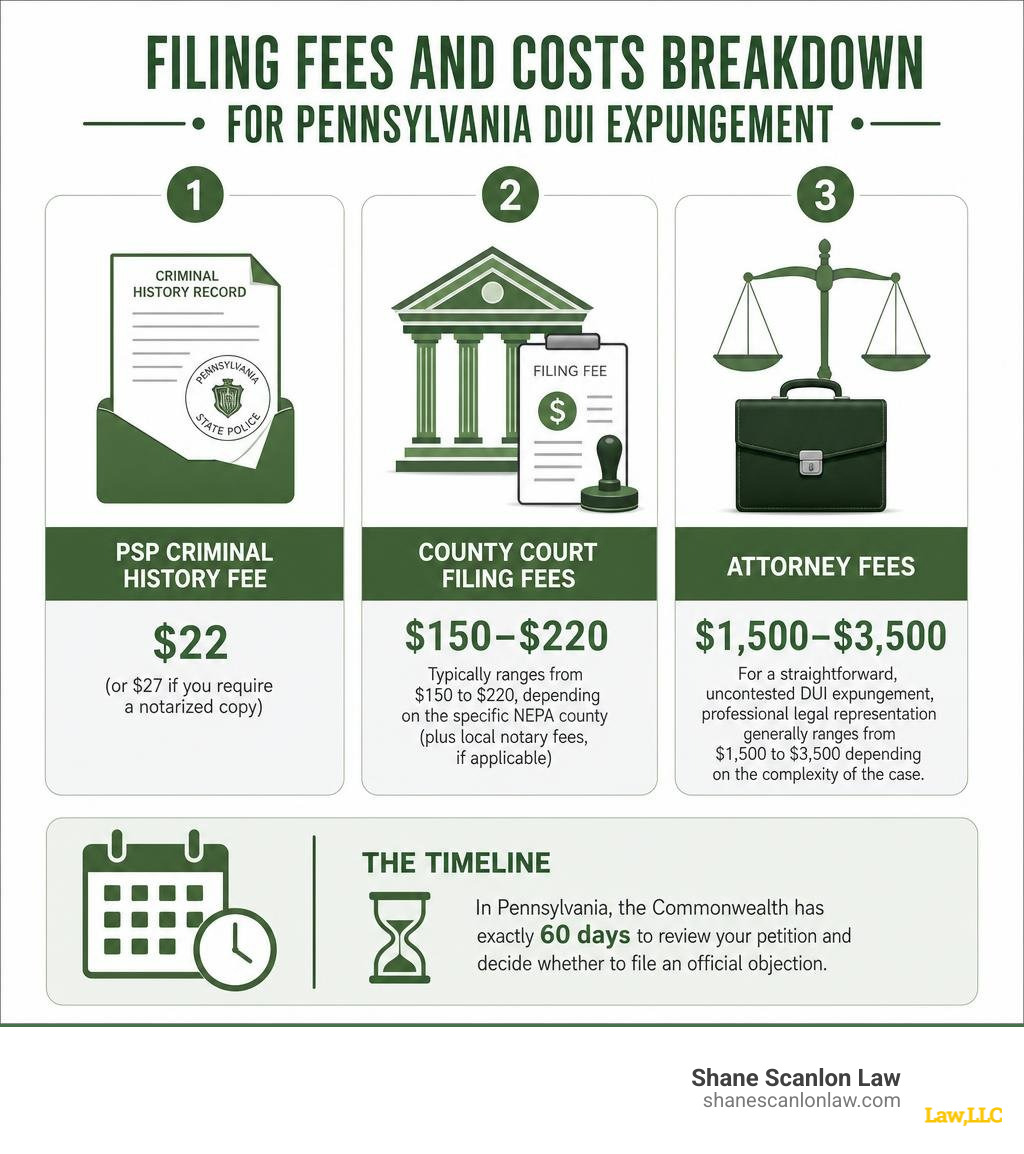
- PSP Criminal History Fee: $22 (or $27 if you require a notarized copy).
- County Court Filing Fees: Typically ranges from $150 to $220, depending on the specific NEPA county (plus local notary fees, if applicable).
- Attorney Fees: For a straightforward, uncontested DUI expungement, professional legal representation generally ranges from $1,500 to $3,500 depending on the complexity of the case.
The Timeline: The expungement process is not instant. From the day we file your Form 790 petition with the Clerk of Courts to the day the Pennsylvania State Police and local departments officially destroy the records, the process typically takes several months to a year. Court backlogs, the mandatory 60-day DA review window, and administrative processing times at the state repository all contribute to this timeline.
Frequently Asked Questions about DUI Expungement in Pennsylvania
Can I get a DUI expunged if I have multiple offenses?
No. Full expungement is reserved for non-conviction outcomes (like ARD, dismissals, or acquittals). If you have multiple DUI convictions, you are considered a repeat offender and do not qualify for ARD or summary expungements. Furthermore, multiple misdemeanor convictions are generally excluded from Clean Slate sealing, meaning those convictions will remain on your public record for life.
Does a DUI expungement clear my commercial driver’s license (CDL) record?
No. Federal highway safety regulations are incredibly strict. Even if you complete ARD and successfully expunge your criminal record, PennDOT is federally mandated to maintain a record of your commercial driving violations. An ARD or DUI conviction will remain visible on your commercial driving history and will impact your employment options in the trucking and logistics industries.
How does the Clean Slate law apply to sealing a DUI conviction?
If you did not go through ARD but were convicted of a low-tier, misdemeanor DUI, Pennsylvania’s Clean Slate law allows you to petition the Court of Common Pleas to seal the record. You must wait a full 7 years from the date of your conviction, pay all court-ordered fines and restitution in full, and remain completely free of any new arrests or convictions during that entire 7-year period.
Conclusion
A DUI arrest in Northeastern Pennsylvania does not have to define the rest of your life. Whether you recently completed the ARD program in Lackawanna County, had your charges dismissed in Luzerne County, or are hoping to seal a past mistake under the Clean Slate law, taking the step to clear your record is the key to your fresh start.
At Shane Scanlon Law, we provide fierce litigation and trusted local representation across Scranton, Wilkes-Barre, Susquehanna County, and Wyoming County. As a former District Attorney with over 20 years of experience on both sides of the courtroom, I understand the local procedures, the prosecutors, and the exact steps required to successfully clear your name.
Don’t let a past mistake hold back your career, your family, or your future. Contact us today to secure your Scranton DUI defense and start the expungement process.
Schedule Your Free Consultation with a Scranton DUI Attorney