
 Call Anytime
833.722.6566
Call Anytime
833.722.6566
Violating a PFA Order: Legal Penalties in Pennsylvania

When a PFA Order Is Violated, the Consequences Are Serious
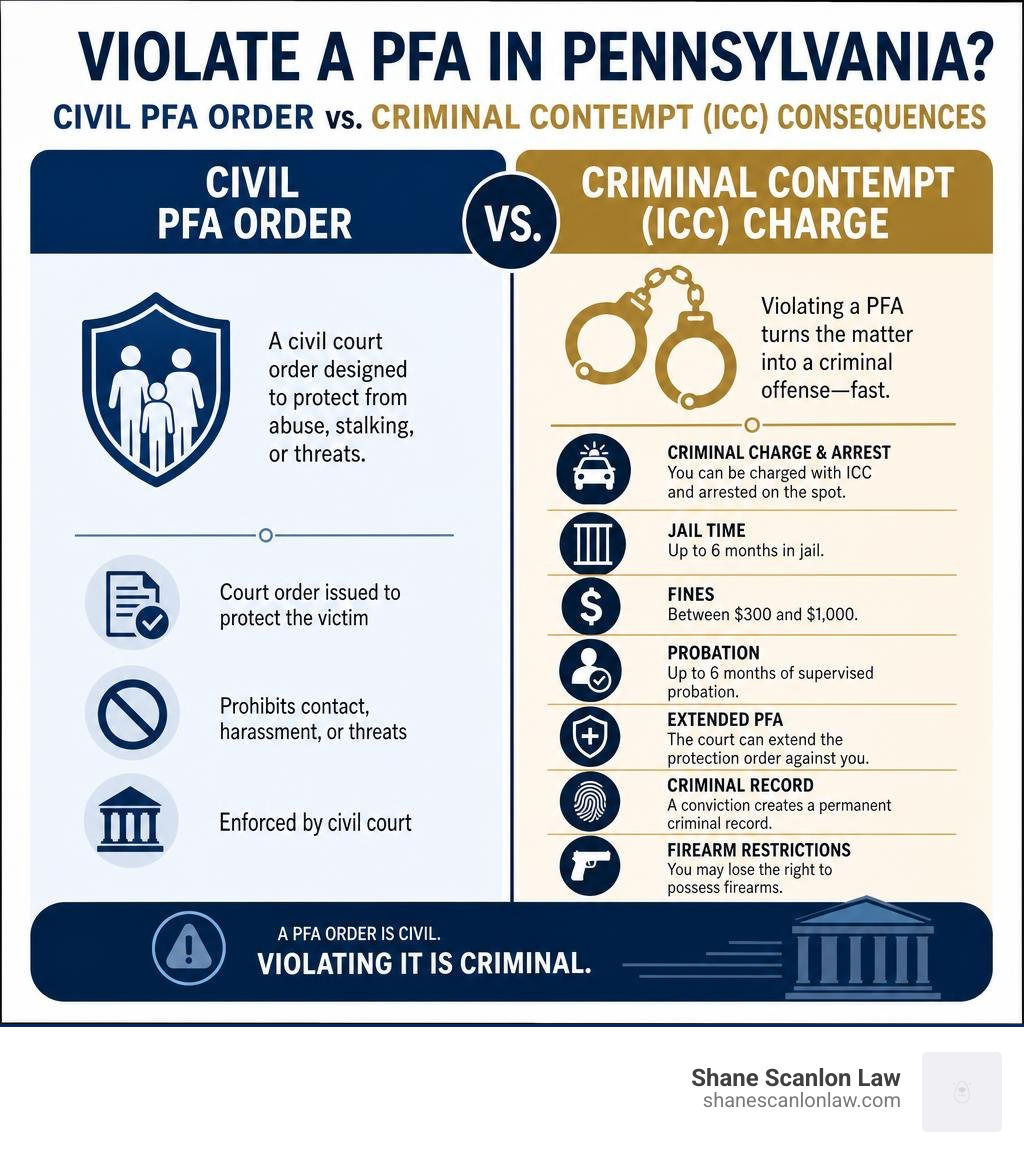
What happens if you violate a PFA in Pennsylvania is one of the most urgent questions someone can face after being served with a Protection From Abuse order. The short answer: a violation turns a civil court order into a criminal matter — fast.
Here is a quick overview of what to expect:
- Criminal charge filed: You can be charged with Indirect Criminal Contempt (ICC) under Pennsylvania law
- Arrest: Police can arrest you on the spot, with or without a warrant
- Jail time: Up to 6 months in jail
- Fines: Between $300 and $1,000
- Probation: Up to 6 months of supervised probation
- Extended PFA: The court can extend the protection order against you
- Criminal record: A conviction creates a permanent criminal record
- Firearm restrictions: You may lose the right to possess firearms
A PFA order starts as a civil matter. But the moment you are accused of breaking it, you are in criminal court territory. Pennsylvania courts take these charges seriously, and so should you.
I’m Shane Scanlon, founder of Shane Scanlon Law and a former Lackawanna County District Attorney with over 20 years of courtroom experience — including prosecuting and defending cases involving exactly what happens if you violate a PFA in Pennsylvania. That background on both sides of the courtroom gives me a clear picture of how these cases unfold, and I want to walk you through what you need to know.
What Happens If You Violate a PFA in Pennsylvania?
Under Pennsylvania law, a Protection From Abuse (PFA) order is a civil injunction designed to protect victims of domestic violence. However, the enforcement mechanism is strictly criminal. If you are accused of violating any of the protective provisions in a temporary or final PFA, you will not face a simple civil fine. Instead, the Commonwealth will charge you with Indirect Criminal Contempt (ICC).
This charge is governed by 23 Pa.C.S. § 6114, which outlines the specific statutory procedures and penalties for contempt of PFA orders. The law is designed to give judges immediate, powerful tools to punish violators.
When analyzing the legal consequences for the accused, a conviction for ICC carries several severe penalties:
- Incarceration: A judge can sentence you to up to 6 months in a county jail (such as the Lackawanna County Prison or Luzerne County Correctional Facility).
- Fines: You will face a mandatory fine of no less than $300 and up to $1,000.
- Supervised Probation: The court can place you on supervised probation for up to 6 months.
- Extension of the PFA: Upon conviction, the court shall grant an extension of the protection order for an additional term at the plaintiff’s request. This means a PFA that was set to expire could be extended for up to another three years.
- Firearm Restrictions: You will be ordered to surrender all firearms, other weapons, and ammunition to law enforcement.
Furthermore, any fines collected under this statute are distributed through a strict legal formula:
- $100 goes directly to the Commonwealth for the Statewide registry of protection orders.
- $100 is retained by the county ($50 for the sheriff’s office and $50 for the court system).
- $100 is forwarded to the Department of Human Services (formerly the Department of Public Welfare) to fund services for domestic violence victims.
Importantly, the defendant does not have a right to a jury trial on a charge of indirect criminal contempt. Your case will be decided entirely by a single judge. However, you are absolutely entitled to counsel, and having an experienced attorney is crucial because the disposition of an ICC charge does not prevent the state from prosecuting you for other criminal charges associated with the incident (such as stalking, terroristic threats, or simple assault).
| Penalty Category | PFA Violation (Indirect Criminal Contempt) | Standard Misdemeanor (e.g., Simple Assault) |
|---|---|---|
| Right to Jury Trial | No (Decided solely by a judge) | Yes (Entitled to a trial by jury) |
| Max Jail Time | Up to 6 months | Varies (Up to 1 to 5 years depending on grade) |
| Fines | $300 to $1,000 | Varies by misdemeanor class |
| Impact on Civil Order | Automatic extension of PFA upon request | No automatic effect on civil orders |
| Double Jeopardy | Does not preclude other criminal charges | Standard double jeopardy protections apply |
What Happens If You Violate a PFA in Pennsylvania Accidentally?
One of the most common misconceptions we hear in Scranton and Wilkes-Barre is, “I didn’t mean to violate the order, so I can’t be convicted.”
Unfortunately, Pennsylvania law does not require specific “malicious intent” to violate a PFA. To secure an ICC conviction, the Commonwealth only needs to prove that you had actual knowledge of the PFA order and that you engaged in conduct that violated its terms.
The Pennsylvania Supreme Court recently examined the strict nature of notice requirements in PFA cases in the landmark ruling Pennsylvania v. Stevenson. In this case, the court clarified that actual knowledge of a PFA order is sufficient to support a conviction, regardless of how that knowledge was obtained.
The court ruled that formal service by law enforcement is not an absolute prerequisite for an ICC conviction. If you receive verbal notice—even from a third party, a family member, or a phone call from a police officer—and you proceed to violate the terms of the PFA, you can still be found guilty of contempt.
This strict standard makes “accidental” violations incredibly dangerous:
- Accidental Public Encounters: If you walk into a grocery store in Lackawanna County and spot the plaintiff, you must leave immediately. Remaining in their presence once you realize they are there constitutes a violation.
- Social Media Interactions: Sending a direct message, tagging the plaintiff, or even hitting “Like” on an old photo can be ruled a violation of a “no-communication” provision.
- Third-Party Communication: Asking a mutual friend to ask the plaintiff, “Are they still mad at me?” is a direct violation of the standard third-party communication ban.
Common Scenarios That Lead to PFA Violations
In our years of practicing law across NEPA, we have seen that most PFA violations do not involve dramatic confrontations. Instead, they usually stem from everyday situations where boundaries get blurred:
- Child Custody and Parenting Exchanges: Even if a PFA allows contact for child custody exchanges, arguments during the handoff can quickly cross the line into a violation. If the PFA says “only text message communication regarding the children,” sending a text about child support or personal matters is a breach.
- Responding to the Protected Party: It is a trap as old as time. The plaintiff texts you: “Can you please bring over the dog’s medication?” You reply: “I’ll drop it off.” You have just violated the PFA. Legally, the plaintiff cannot give you permission to violate a court order. Only a judge can modify or lift a PFA.
- Returning to a Shared Residence: If the PFA grants the plaintiff exclusive possession of a residence in Susquehanna or Wyoming County, you cannot return to the home to grab your work boots or personal belongings without a police escort or explicit court authorization. Doing so, even for five minutes while the plaintiff is away, is a violation.
To understand how these rules are strictly applied by local law enforcement, read our guide on the enforcement of a PFA order.
The Legal Process: From Arrest to the Contempt Hearing

Understanding the mechanics of police enforcement of PFAs is critical. If a police officer in Scranton or Wilkes-Barre has probable cause to believe you violated a PFA, they are authorized—and often mandated—to conduct a warrantless arrest.
If the police do not witness the violation or decline to make an immediate arrest, the plaintiff can still pursue charges. They do this by filing a private Complaint for Indirect Criminal Contempt with a Magisterial District Judge.
Once arrested or served with a complaint, the process moves forward quickly:
- Arraignment: You will be brought before a Magisterial District Judge for an preliminary arraignment, where bail will be set. Depending on the allegations, the judge may set cash bail or impose strict non-monetary conditions.
- Scheduling: The court will schedule an ICC contempt hearing. According to the Unified Judicial System of Pennsylvania, these hearings are fast-tracked to ensure swift administration of justice.
- No Jury, But Right to Counsel: As established under Title 23, you do not have the right to a jury trial for an ICC charge. A single judge will hear the evidence, rule on your guilt, and issue your sentence. You have an absolute right to be represented by an attorney at this hearing.
Understanding What Happens If You Violate a PFA in Pennsylvania: The Legal Process
The contempt hearing is essentially a mini-trial. Because ICC is criminal in nature, the Commonwealth carries the burden of proving the violation beyond a reasonable doubt.
During the hearing:
- The prosecution will present evidence, which may include text messages, call logs, home security footage, or testimony from the plaintiff and responding officers.
- Your defense attorney will have the opportunity to cross-examine witnesses, challenge the credibility of the evidence, and present your side of the story.
- The judge will make an immediate decision.
If the judge finds you guilty, they have the authority to sentence you on the spot to jail time, probation, or fines. Additionally, the judge can immediately extend the duration of the original PFA order to ensure the ongoing safety of the plaintiff, often referencing resources provided by organizations like the PCADV resources to justify the necessity of continued court supervision.
How a PFA Violation Impacts Custody and Other Family Law Matters
A PFA violation conviction does not just carry immediate criminal penalties—it acts as a wrecking ball to other family law matters you may be navigating simultaneously.
If you are involved in a divorce or custody dispute in Lackawanna, Luzerne, Susquehanna, or Wyoming County, an ICC conviction can completely alter the landscape:
- Custody and Visitation Rights: Under Pennsylvania custody law, judges must consider 16 distinct factors when determining the “best interests of the child.” Several of these factors focus directly on domestic violence, abuse, and the safety of the child. An ICC conviction is formal, legal proof of abusive behavior and a disregard for court orders. It can result in a judge stripping you of physical custody, ordering supervised-only visitation, or suspending your visitation rights entirely.
- Separation and Support Agreements: A history of PFA violations can heavily influence a judge’s discretion during equitable distribution and alimony negotiations. While PA is technically a “no-fault” divorce state, a spouse’s conduct—especially criminal behavior directed at the other spouse—can impact how a judge views arguments regarding financial support and asset division.
- Character Evidence: In any family court proceeding, credibility is everything. If a family court judge sees that a criminal court judge has already found you guilty of violating a court order, your credibility is severely compromised. Any future testimony you give regarding custody, assets, or co-parenting behavior will be viewed through a highly skeptical lens.
Frequently Asked Questions About PFA Violations
Can a PFA violation be expunged from my record in Pennsylvania?
Generally, no. Because Indirect Criminal Contempt (ICC) is a criminal conviction, it will appear on your permanent criminal record. In Pennsylvania, expunging a misdemeanor or contempt conviction is incredibly difficult and usually only possible under very narrow circumstances (such as reaching the age of 70, or being free of arrest for 10 years following the completion of your sentence).
An ICC conviction on your record can severely impact your employment opportunities, housing applications, and ability to obtain professional licenses. This is why defending against the initial charge at the hearing is so critical.
What should I do if I am falsely accused of violating a PFA?
Falsely accused individuals often make the mistake of trying to “explain things” directly to the plaintiff or the police. This almost always backfires. If you are falsely accused:
- Do not contact the plaintiff. Do not text, call, email, or use third parties to ask why they are lying. This will only result in actual, documented violations.
- Preserve all evidence. Save every text message, email, social media interaction, and GPS location log from your phone. If you have an alibi or security footage proving you were elsewhere during the alleged violation, secure it immediately.
- Identify witnesses. Note anyone who can testify to your whereabouts or confirm that the accusations are fabricated.
- Contact a professional. Immediately retain a skilled PFA violation defense lawyer who can build a strategic defense and represent you at the contempt hearing.
Can the victim drop the PFA violation charges?
No. This is a very common point of confusion. A PFA order is a civil agreement between you and the plaintiff, but a violation of that order is a crime against the Commonwealth of Pennsylvania.
Once the police make an arrest or a private complaint is formally processed, the case is prosecuted by the District Attorney’s office. The victim does not have the legal authority to “drop” the charges. While the prosecutor may take the victim’s wishes into consideration, they can—and frequently do—choose to prosecute the ICC charge anyway, especially if there is independent evidence of the violation.
Conclusion
Facing an allegation of a PFA violation in Northeastern Pennsylvania is an incredibly high-stakes situation. With the potential for immediate jail time, a permanent criminal record, and devastating impacts on your family law cases, you cannot afford to navigate this complex system alone.
At Shane Scanlon Law, we bring a deep understanding of the local court systems in Lackawanna, Luzerne, Susquehanna, and Wyoming counties. As a former District Attorney with over 20 years of experience, Shane Scanlon knows exactly how prosecutors build these cases and how local judges evaluate ICC allegations. We provide fierce, strategic litigation and trusted local representation to protect your rights, your freedom, and your future.
If you or a loved one is facing charges or accusations of a PFA violation, contact us today to learn more about our Protection From Abuse (PFA) legal services and schedule a consultation.