
 Call Anytime
833.722.6566
Call Anytime
833.722.6566
Need a PFA Lawyer in Scranton? Here is Your Guide

When You Need a Protection From Abuse Lawyer in Scranton, Here Is What to Do First
If you are looking for a protection from abuse lawyer in Scranton, here is a quick answer:
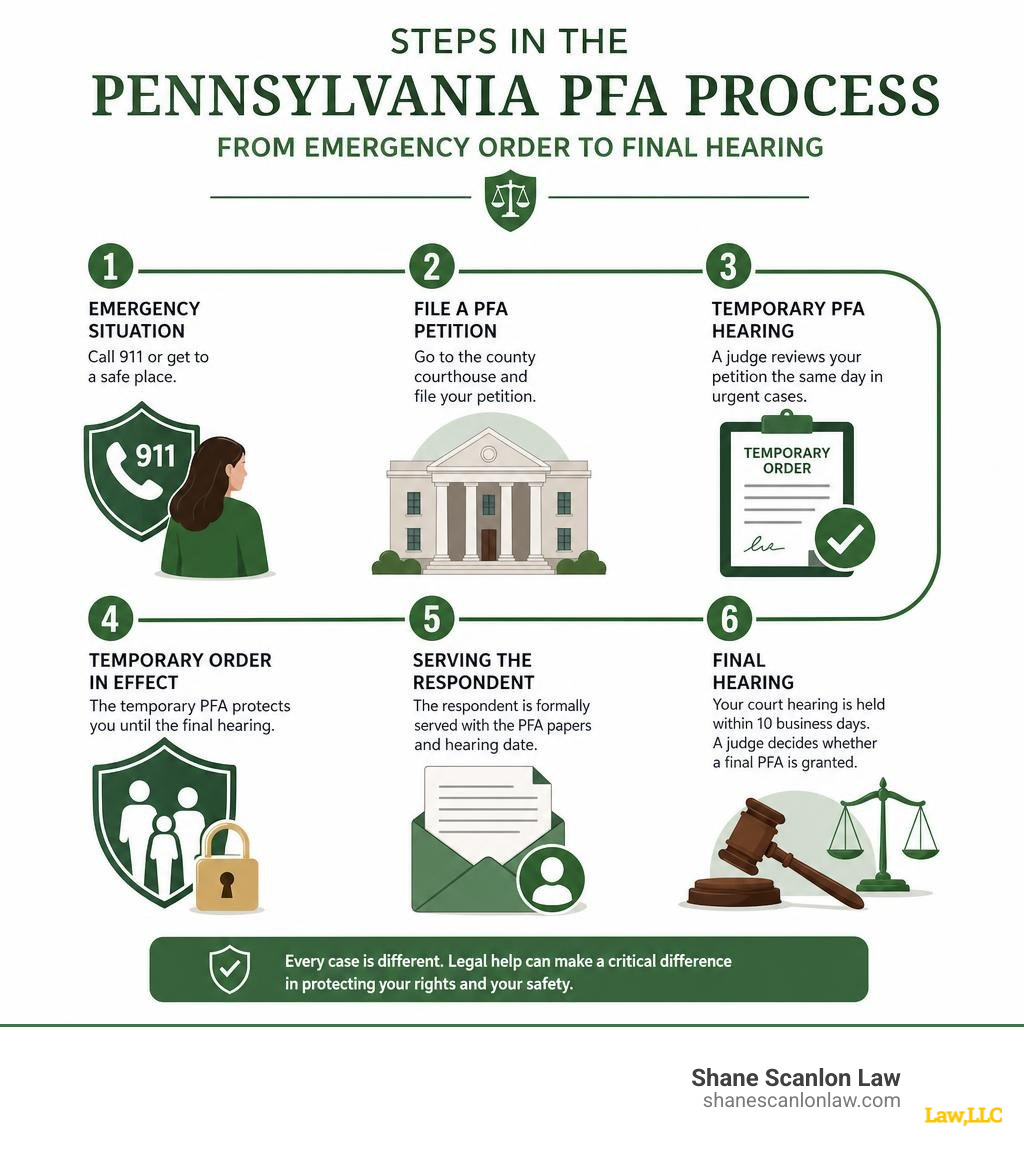
- Go somewhere safe immediately if you are in danger.
- Call 911 if you need emergency help right now.
- Go to the Lackawanna County Family Courthouse at 123 Wyoming Avenue to file a PFA petition — it costs nothing to file.
- A judge can issue a temporary PFA the same day in urgent cases.
- Contact a local PFA attorney to help you prepare evidence and represent you at your final hearing within 10 business days.
Domestic abuse is a deeply personal crisis — but when your safety is at risk, taking legal action becomes essential. Pennsylvania’s Protection From Abuse Act gives victims a real legal tool to stop contact, remove an abuser from a shared home, and protect their children. The process can feel overwhelming, especially when you are already scared and stressed. That is why knowing exactly what steps to take — and having the right legal support — makes all the difference.
I’m Shane Scanlon, founder of Shane Scanlon Law and a former Lackawanna County District Attorney with over 20 years of courtroom experience in Pennsylvania. My background prosecuting serious cases — including domestic violence matters — gives me a understanding of what it takes to be an effective protection from abuse lawyer in Scranton. This guide will walk you through every step of the PFA process so you know what to expect.
Protection from abuse lawyer scranton terminology:
- false allegations lawyer
- protection from abuse act pennsylvania
- protection from abuse defense attorney
Understanding PFA Orders and Who Qualifies in Pennsylvania

A Protection From Abuse (PFA) order is an official court directive designed to protect victims of domestic violence from their abusers. In Pennsylvania, a PFA is a civil order, but violating it carries immediate criminal consequences. If you are facing safety concerns in Northeastern Pennsylvania, working with a dedicated Protection From Abuse in Scranton, PA lawyer ensures your petition is drafted correctly and backed by strong evidence.
Under the Protection From Abuse | Luzerne County, PA framework and Pennsylvania state law, “abuse” is defined as the occurrence of one or more of the following acts between family or household members, sexual partners, or intimate partners:
- Intentionally, knowingly, or recklessly causing bodily injury, serious bodily injury, rape, involuntary deviate sexual intercourse, sexual assault, statutory sexual assault, aggravated indecent assault, indecent assault, or incest.
- Placing another in fear of imminent serious bodily injury by physical menace.
- Inflicting false imprisonment (interfering with an individual’s freedom of movement).
- Physically or sexually abusing minor children.
- Engaging in a course of conduct or repeatedly committing acts toward another person under circumstances which place the person in reasonable fear of bodily injury (such as stalking or severe harassment).
What is a PFA and Who Qualifies for Protection?
To qualify for a PFA in Pennsylvania, there must be a specific relationship between the victim (the plaintiff) and the alleged abuser (the defendant). Unlike general harassment laws or restraining orders that might apply to neighbors or strangers, the PFA Act specifically targets domestic relationships.
You can file a PFA against someone if they are:
- Your current or former spouse.
- A person with whom you have lived as a spouse.
- Your current or former sexual or intimate partner (including boyfriends, girlfriends, and dating partners).
- A sibling, parent, child, or other person related to you by blood or marriage.
- A person with whom you share a biological child.
If your relationship does not fit into one of these categories, you may still be protected under other statutes, such as the Protection from Sexual Violence and Intimidation (PSVI) Act. A local attorney can help you determine which legal avenue fits your situation.
The Three Types of PFA Orders in PA
Pennsylvania law establishes three distinct stages of protection to address immediate emergencies while preserving due process for the accused.
- Emergency PFA Orders: These are issued when the regular courts are closed—such as overnight, on weekends, or during holidays. You can obtain an Emergency PFA by contacting local law enforcement or visiting an on-call Magisterial District Judge. These orders are temporary and typically expire at the end of the next business day when the Court of Common Pleas opens.
- Temporary PFA Orders (Ex-Parte): When you file a PFA petition during normal business hours, a judge will review your paperwork and hold an ex-parte hearing. “Ex-parte” means the judge hears only your side of the story to make an immediate safety determination. If the judge believes you are in immediate danger, they will grant a Temporary PFA, which remains active until the final hearing.
- Final PFA Orders: A final PFA is only issued after a formal court hearing where both parties have the opportunity to present evidence, call witnesses, and testify under oath. In Pennsylvania, this final hearing must be scheduled within 10 business days of the temporary order’s issuance. A final PFA can last for up to three years and can be extended if the threat of abuse persists.
| PFA Order Type | Who Issues It? | When Is It Available? | How Long Does It Last? | Is a Full Hearing Required First? |
|---|---|---|---|---|
| Emergency PFA | Magisterial District Judge | After hours, weekends, holidays | Until the next business day (typically 5 to 7 days max over long holidays) | No, granted based on immediate danger |
| Temporary PFA | Court of Common Pleas Judge | Regular business hours | Until the final hearing (typically scheduled within 10 business days) | No, granted ex-parte (victim’s testimony only) |
| Final PFA | Court of Common Pleas Judge | Scheduled final hearing | Up to three years (can be extended) | Yes, both parties present evidence and testimony |
How to File for a PFA in Lackawanna County

Filing a PFA in Scranton requires navigating the local court system. In Lackawanna County, the process is centralized to ensure victims can access safety resources quickly and efficiently. Knowing where to go and what forms to complete can save you valuable time during a crisis.
When filing for protection, you will start at the Protection From Abuse in Lackawanna County intake office. There is no cost to file a PFA petition in Pennsylvania. The law ensures that financial barriers never stand in the way of a victim’s physical safety.
Step-by-Step Filing Process at the Lackawanna County Courthouse
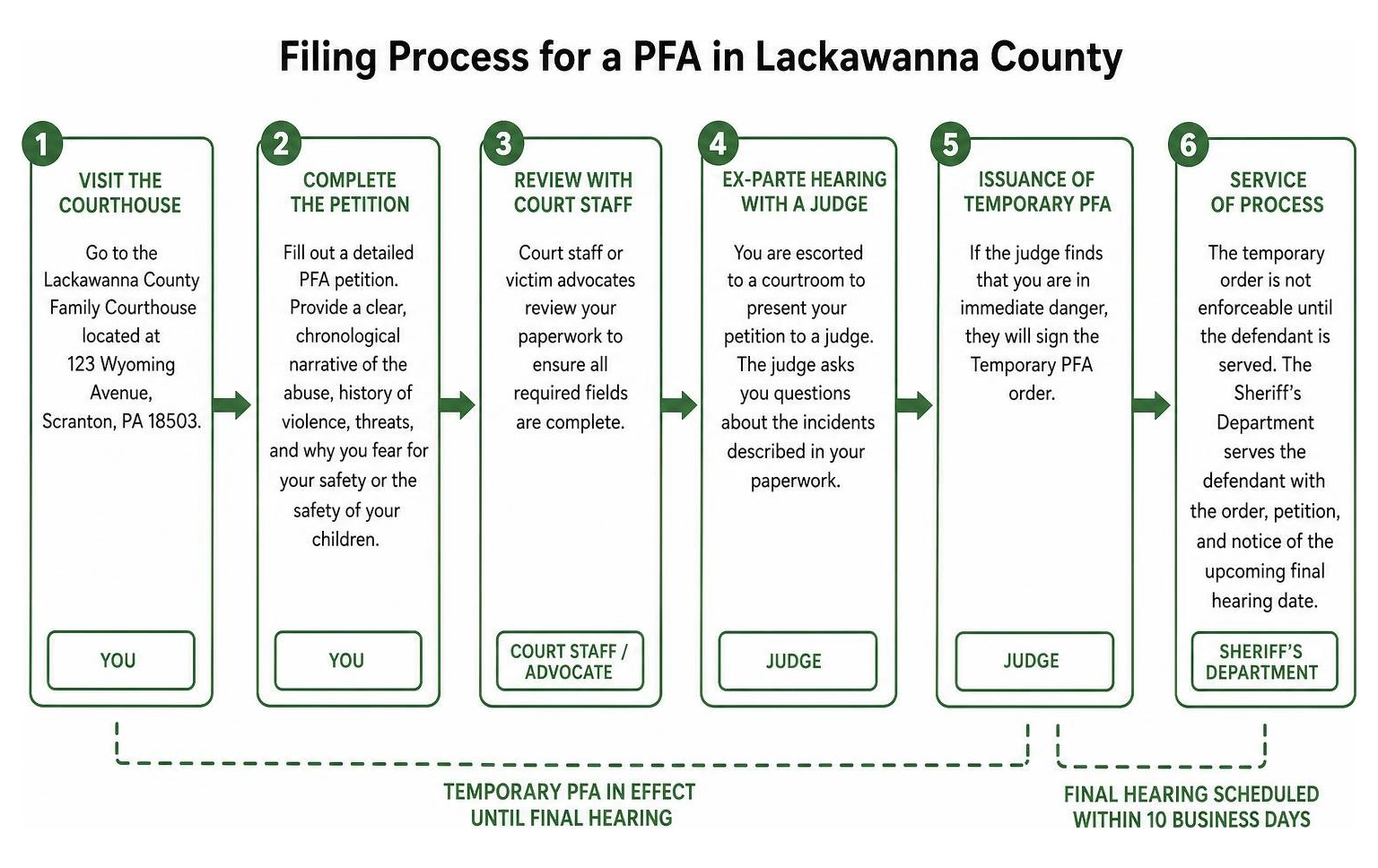
To file for a PFA in Scranton, follow this step-by-step procedure:
- Visit the Courthouse: Go to the Lackawanna County Family Courthouse located at 123 Wyoming Avenue, Scranton, PA 18503.
- Complete the Petition: You will fill out a detailed PFA petition. You must write down a clear, chronological narrative of the recent abuse, any history of violence, threats made, and why you fear for your safety or the safety of your children.
- Review with Court Staff: Court staff or victim advocates will review your paperwork to ensure all required fields are complete.
- Ex-Parte Hearing with a Judge: You will be escorted to a courtroom to present your petition to a judge. The judge will ask you questions about the incidents described in your paperwork.
- Issuance of Temporary PFA: If the judge finds that you are in immediate danger, they will sign the Temporary PFA order.
- Service of Process: The temporary order is not enforceable until the defendant is officially served. The Lackawanna County Sheriff’s Department will locate the defendant and serve them with a copy of the temporary order, the petition, and the notice of the upcoming final hearing date.
For a deeper look at this process, check out our guide on Filing and Obtaining a PFA Order.
Preparing for Your Hearing with a Protection From Abuse Lawyer Scranton
While obtaining a temporary PFA is relatively straightforward, securing a final PFA is a formal legal trial. The defendant has a constitutional right to defend themselves, meaning they can hire an attorney, present counter-evidence, and cross-examine you on the witness stand. Preparing for this hearing with an experienced protection from abuse lawyer in Scranton is critical to securing long-term protection.
If you are facing allegations yourself, it is equally important to secure representation immediately. You can read more about defense options in our resource on Emergency and Temporary PFA Defense in Northeast Pennsylvania.
Gathering Crucial Evidence for Your PFA Case
To win a final PFA, you must meet the burden of proof, which in civil court is a “preponderance of the evidence.” This means you must prove to the judge that it is more likely than not that the abuse occurred.
A skilled attorney will help you gather and organize the following types of evidence:
- Text Messages and Emails: Saved conversations showing threats, harassment, or admissions of physical violence.
- Social Media Posts: Public or private messages, posts, or comments containing threatening language.
- Medical Records: Documentation of hospital or clinic visits resulting from physical abuse.
- Police Reports: Official records of 911 calls, police responses, and domestic incident reports.
- Photographs: Clear, dated photos of physical injuries, bruises, or property damage caused by the abuser.
- Witness Testimony: Statements or live testimony from family members, neighbors, or coworkers who witnessed the abuse or heard the threats.
What to Expect During a Lackawanna County PFA Hearing
On the day of your final hearing at the Lackawanna County Courthouse, both you and the defendant must appear. If the defendant does not show up after being properly served, the judge may grant a final PFA by default.
If both parties are present, the hearing will proceed like a mini-trial:
- Opening Statements: Both sides (or their lawyers) briefly outline their cases.
- Plaintiff’s Case: You will take the stand to testify about the abuse. Your lawyer will present your evidence and question any witnesses you brought.
- Cross-Examination: The defendant’s attorney has the right to ask you questions to challenge your credibility or point out inconsistencies.
- Defendant’s Case: The defendant can testify and present their own evidence or witnesses to deny the allegations.
- Closing Arguments: Final summaries of the case are presented to the judge.
- The Decision: The judge will rule immediately on whether to grant a final PFA order, its duration (up to three years), and its specific terms.
Violations, Enforcement, and Related Legal Issues
A PFA order is only as strong as its enforcement. Once a final or temporary PFA is served, the defendant must follow every term of the order. Any contact—whether in person, through text, social media, or via a third party—constitutes a violation.
If you find yourself in a situation where the order has been violated, or if you are accused of a violation, we highly recommend reading our detailed breakdowns on the Enforcement of a PFA Order and the Legal Consequences for the Accused PFAs.
Consequences of Violating a PFA Order
Violating a PFA order in Pennsylvania is treated with extreme seriousness. It is classified as indirect criminal contempt.
If a defendant violates a PFA order, the consequences can include:
- Immediate Arrest: Police have the authority to make a warrantless arrest if they have probable cause to believe a PFA violation occurred.
- Incarceration: A conviction for indirect criminal contempt can result in up to six months in prison for each violation.
- Fines: The court can impose fines ranging from $300 to $1,000.
- Loss of Firearm Rights: Under both Pennsylvania law and the federal Lautenberg Amendment, individuals subject to active protective orders or convicted of qualifying domestic violence offenses are prohibited from possessing firearms or ammunition.
How PFAs Impact Child Custody and Criminal Charges
A PFA order does not exist in a vacuum. It frequently intersects with other legal matters, particularly family law and criminal law:
- Child Custody: A PFA judge can award temporary sole custody of shared children to the plaintiff and suspend or severely restrict the defendant’s visitation rights if there is a threat of abuse to the children. These temporary custody arrangements remain in place until a formal custody hearing is held in family court.
- Child Support: The judge can order the defendant to pay temporary financial support to the plaintiff and children.
- Concurrent Criminal Charges: The same conduct that justifies a PFA can lead to separate criminal charges, such as simple assault, aggravated assault, stalking, harassment, or strangulation. While the PFA is a civil matter handled in family court, the criminal charges will be prosecuted separately by the District Attorney’s office.
Frequently Asked Questions About Scranton PFA Cases
Why should I hire a protection from abuse lawyer scranton instead of representing myself?
While you are legally permitted to represent yourself, navigating a PFA hearing alone can be highly stressful and legally risky. An experienced PFA attorney understands the rules of evidence, knows how to cross-examine an abuser without letting emotion take over, and is deeply familiar with the local procedures of the Lackawanna County court system. Having professional advocacy ensures your story is presented clearly, professionally, and persuasively to the judge.
Can a PFA order be modified or terminated early by a protection from abuse lawyer scranton?
Yes. Circumstances change, and either party can petition the court to modify or terminate an active PFA order. This might involve changing custody terms, allowing contact for co-parenting purposes, or terminating the order early if the parties reconcile. However, you should never attempt to resume contact or ignore a PFA order without a formal court modification, as doing so can still result in arrest. Learn more about this in our guide to Modifying or Terminating a PFA.
Where can I find local domestic violence support resources in Scranton?
If you are dealing with domestic violence, you do not have to go through it alone. Scranton and the surrounding counties offer excellent resources, including:
- The Women’s Resource Center (WRC): Serves Lackawanna and Susquehanna counties, providing emergency shelter, crisis intervention, safety planning, and legal advocacy.
- Luzerne County Domestic Violence Service Providers: Offers local support and shelter options for those in Wilkes-Barre and surrounding communities.
- Legal Aid and Pro Bono Services: For low-income individuals seeking legal help, resources like Wyoming County Family Legal Aid & Pro Bono Services – Justia provide critical assistance.
Conclusion
When your safety, your family, and your peace of mind are on the line, you need trusted legal representation that understands both sides of the courtroom. At Shane Scanlon Law, we bring more than 20 years of local legal experience to your corner. As a former District Attorney in Lackawanna County, Shane Scanlon has spent decades handling complex domestic violence and criminal matters from both sides of the aisle.
We provide fierce litigation, compassionate support, and trusted local representation throughout Scranton, Lackawanna County, Wilkes-Barre, Luzerne County, Susquehanna County, and Wyoming County.
If you need a dedicated protection from abuse lawyer in Scranton to help you secure a PFA or defend against one, contact us today to schedule a confidential consultation. Let us help you take the next step toward safety and justice. Explore our Protection From Abuse (PFA) services page to learn how we can protect your rights.