
 Call Anytime
833.722.6566
Call Anytime
833.722.6566
The Parole Violation Lawyer Playbook: What to Expect and How to Choose

What Parole Violation Lawyers Do — and Why You Need One Now
Parole violation lawyers defend people accused of breaking the conditions of their release from prison — and the stakes couldn’t be higher. If you’re facing a violation, here’s what you need to know right away:
- You can be arrested and detained before any hearing takes place
- You have the right to legal representation at your revocation hearing
- The standard of proof is lower than a criminal trial, making it easier for the state to win
- A lawyer can challenge the allegations, present mitigating evidence, and fight to keep you out of prison
- Acting fast matters — the sooner you get legal help, the more options you have
Each year, thousands of people on parole are sent back to prison — many for violations that an experienced attorney could have challenged or minimized. Whether you missed a meeting with your parole officer, failed a drug test, or are facing a new arrest, the process moves quickly and the consequences can follow you for years.
You don’t have to face this alone.
I’m Shane Scanlon, founder of Shane Scanlon Law, LLC, and a former Lackawanna County District Attorney with over 20 years of courtroom experience — including prosecuting and defending the exact kinds of cases that lead to parole complications. My background on both sides of the system gives me a clear-eyed view of how parole violation lawyers can make a real difference in your outcome.
Parole violation lawyers glossary:
Understanding the Legal Landscape with parole violation lawyers
Navigating parole in Northeastern Pennsylvania can feel like walking through a minefield. One wrong step, and you’re back behind bars. To defend yourself effectively, we first need to look at what exactly constitutes a “violation.” In our experience serving Scranton, Wilkes-Barre, and the surrounding counties, violations generally fall into two categories: technical and substantive.

Technical Violations
These are breaches of the administrative rules set by the Pennsylvania Board of Probation and Parole. You haven’t necessarily committed a new crime, but you’ve failed to follow the “fine print” of your release. Common examples include:
- Missing Meetings: Failing to report to your parole officer (PO) at the scheduled time.
- Curfew Breaches: Being away from your approved residence during restricted hours.
- Drug Testing Issues: Testing positive for controlled substances or refusing to provide a sample.
- Travel Restrictions: Leaving Lackawanna or Luzerne County without prior written permission.
- Employment Failures: Failing to maintain a job or notify your PO of a change in employment status.
Substantive Violations (New Criminal Charges)
These are much more serious. A substantive violation occurs when you are arrested for a new crime while on parole. This triggers a “double whammy”: you face the new criminal charges in court, and you simultaneously face a parole revocation hearing. Even if the new charges are eventually dismissed, the mere arrest can be enough to trigger a parole hold.
Absconding
This is the “big one” in the eyes of the Board. Absconding means the Board no longer knows where you are. If you stop reporting and move without notice, you are considered a fugitive. Parole violation lawyers are essential here because “turning yourself in” needs to be handled delicately to avoid immediate and long-term re-incarceration.
| Violation Type | Common Examples | Potential Consequences |
|---|---|---|
| Technical | Missed meetings, failed drug test, curfew breach | Warning, increased supervision, short-term “flash” incarceration, or revocation |
| Substantive | New DUI, assault, or drug possession arrest | Immediate parole hold, full revocation, return to prison for the remainder of the original sentence |
Immediate Steps: When to Call parole violation lawyers
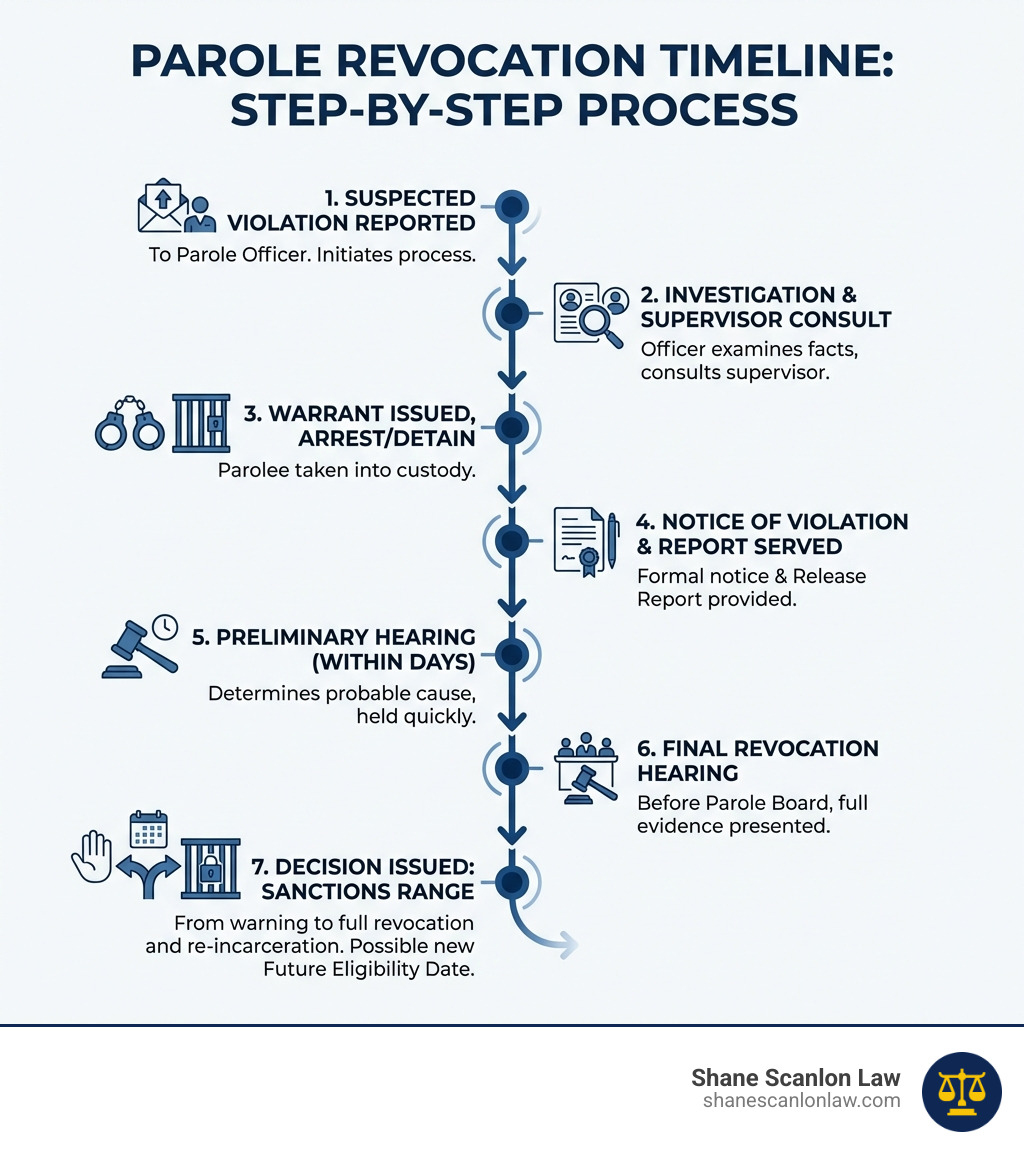
The moment you suspect a violation has been reported, the clock starts ticking. Usually, the process begins when a Parole Officer investigates an allegation and confers with a supervisor. If they decide to move forward, a warrant is issued.
If you are approached by law enforcement or your PO regarding a violation, remember these three steps:
- Stay Silent: You have the right to remain silent. Anything you say to your PO “to explain things” can and will be used against you in a revocation hearing.
- Request the Paperwork: You should be served with a Notice of Violation and a Violation of Release Report. These documents detail exactly what you are accused of doing.
- Call Us Immediately: Do not wait for the preliminary hearing. We need time to preserve evidence, such as GPS data, text messages, or witness statements that can prove your innocence or provide context.
For more details on the arrest process, see our guide on What Happens After a Probation Violation Arrest.
Due Process and Your Rights at the Hearing
Many people mistakenly believe that because they are “on parole,” they have no rights. That is false. While you have fewer protections than a person who hasn’t been convicted of a crime, the U.S. Supreme Court has established that you are entitled to due process.
When we represent you, we ensure the state respects your:
- Right to Counsel: You have the right to be represented by parole violation lawyers.
- Right to Confrontation: You generally have the right to cross-examine people who are testifying against you.
- Right to Present Evidence: You can bring your own witnesses and documents to tell your side of the story.
The process typically involves two stages:
- The Preliminary Hearing: Held shortly after your arrest to determine if there is “probable cause” to believe you violated parole.
- The Final Revocation Hearing: A more formal proceeding where the Board decides if the violation occurred and what the penalty should be.
Crucially, the “burden of proof” here is the preponderance of the evidence. This means the state only has to prove it is “more likely than not” (51%) that you violated parole. This is a much lower bar than the “beyond a reasonable doubt” standard used in criminal trials. Furthermore, hearsay evidence (like a PO testifying about what a neighbor said) is often admissible, which is why having an aggressive lawyer to challenge the reliability of that evidence is vital.
The Parole Revocation Process and Potential Penalties
In Pennsylvania, the Board of Probation and Parole has significant discretion. If a warrant is issued, a “parole hold” is often placed on you. This means even if you could post bail on a new charge, you cannot leave jail because the Board is “holding” you for the violation.
Graduated Sanctions and Flash Incarceration
Not every violation results in a trip back to state prison. Depending on the severity, the Board may use graduated sanctions, such as:
- Increased Reporting: Meeting your PO more frequently.
- Electronic Monitoring: Being placed on a GPS ankle bracelet.
- Flash Incarceration: A short-term stay in a county jail (often 1 to 10 days) designed to “shock” you back into compliance without revoking your parole entirely.
Full Revocation and New FEDs
If the violation is serious or repeated, the Board may revoke your parole. This means you are sent back to prison to serve the “backtime” of your original sentence. When this happens, the Board will set a New Future Eligibility Date (FED). This is the earliest date you can apply for parole again. For substantive violations, you might not even get credit for the time you spent “on the street” successfully, potentially adding years to your incarceration.
Protecting your freedom requires a deep understanding of these rules. As we discuss in our article Don’t Violate Your Rights: Why You Need a Probation Defense Attorney, the system is designed to be efficient, not necessarily fair. Our job is to force the system to be fair.
Defense Strategies and Mitigation Packages
When parole violation lawyers take on a case, we don’t just wait for the hearing; we go on the offensive. Our goal is to present you as a person, not just a case number on a violation report.
Challenging the Allegations
Sometimes, the PO just has it wrong. We investigate:
- Factual Defenses: Were you actually at the location where the violation allegedly occurred? We use work logs, receipts, and witness testimony to prove your whereabouts.
- Lack of Willfulness: If you missed a meeting because you were in the hospital or your car broke down, we gather the medical records or towing receipts to show the violation wasn’t intentional.
- Substantial Compliance: We highlight that you have passed 20 drug tests, held a job for six months, and paid all your fines, arguing that one minor slip-up shouldn’t outweigh your overall progress.
The Mitigation Package
A “mitigation package” is a comprehensive binder we present to the Board to argue against re-incarceration. It typically includes:
- Employment Verification: Letters from your boss in Scranton or Wilkes-Barre confirming you are a valued employee.
- Treatment Success: Certificates showing you completed drug and alcohol counseling or anger management.
- Release Plans: A rock-solid plan for where you will live and how you will support yourself if allowed to stay on parole.
- Community Support: Letters from family, pastors, or mentors in Lackawanna County who vouch for your character.
By showing the Board that you have a support system and a plan, we make it much easier for them to choose a sanction other than prison. If you’re wondering how to start this process, check out How to Get a Probation Violation Attorney in 3 Simple Steps.
Recent Reforms and Legislative Changes
The legal landscape for parole is constantly shifting. While Pennsylvania continues to refine its own systems, we keep a close eye on national trends and local legislative updates that affect our clients in the Susquehanna and Wyoming County areas.
The Shift Toward Rehabilitation
Recent years have seen a push toward reducing the number of people returned to prison for technical violations. Legislatures across the country are realizing that sending someone back to prison for 60 days because they missed a meeting often costs the taxpayer more and makes the person more likely to re-offend because they lose their job and housing.
While “Less Is More” acts (like those seen in New York) specifically limit sanctions for technicalities, Pennsylvania has also moved toward earned time credits and more robust reinstatement options. These reforms aim to reward positive behavior. As your parole violation lawyers, we stay updated on these changes to ensure you receive every benefit the law allows.
Parole vs. Probation: Key Differences in Supervision
It is very common for people to use the terms “parole” and “probation” interchangeably, but in the eyes of the law, they are very different animals.
Sentencing Origins
- Probation: This is a sentence imposed by a judge instead of prison time. You are supervised by the county probation department (like Lackawanna County Probation).
- Parole: This is the period of supervised release after you have served at least the minimum portion of a state prison sentence.
Jurisdictional Authority
If you violate probation, you go back before the sentencing judge in the local courthouse. If you violate parole, you deal with the Board of Parole, an administrative body that operates independently of the trial courts.
Eligibility for Release
Probation is often easier to manage because you are dealing with a local judge who may know your history. Parole is generally stricter, as the Board is focused on the risk you pose to the state at large. Whether you are facing issues with a judge or a board, you can learn more about local representation on our Probation Violation Attorney in Scranton page.
Selecting the Best parole violation lawyers for Your Defense
Choosing the right attorney is the most important decision you will make. Here is what we believe you should look for:
- Trial Experience: You want someone who isn’t afraid to litigate. Many lawyers just want to “make a deal.” You need someone ready to fight.
- Former Prosecutor Insights: At Shane Scanlon Law, our experience as a former District Attorney means we know how the state builds its case. We can anticipate their moves before they make them.
- Local Familiarity: Knowing the POs and the local court systems in Wilkes-Barre and Scranton is an invaluable advantage.
- Clear Communication: You need a lawyer who answers the phone and explains things in plain English, not “legalese.”
Frequently Asked Questions about Parole Violations
Can I be sent back to prison for a first-time technical violation?
Yes, it is possible, but it is less common than it used to be. The Board prefers to use graduated sanctions (like extra classes or travel bans) for a first-time technicality. However, if the technicality is “absconding” or if you have a history of non-compliance, they may move straight to revocation.
What is the difference between a preliminary and a final revocation hearing?
The preliminary hearing is a “quick check” to see if there is enough evidence to hold you. The final hearing is where the real battle happens—where witnesses testify, evidence is presented, and the Board makes a final ruling on your freedom.
How does a new arrest affect my current parole status?
A new arrest almost always triggers an immediate “parole hold.” Even if you are innocent of the new charge, the Board can keep you in jail while they investigate. This is why having parole violation lawyers involved from day one is critical—we can often work to get the hold lifted or expedited.
Conclusion
A parole violation doesn’t have to be the end of your story. While the system is designed to move quickly and decisively, an experienced legal team can slow things down, protect your rights, and present a compelling case for your continued release.
At Shane Scanlon Law, we understand that people make mistakes, and we believe that one mistake shouldn’t necessarily erase years of hard work and progress. Whether you are in Scranton, Wilkes-Barre, or anywhere in Northeastern PA, we are here to provide the fierce, local representation you deserve.
If you or a loved one are facing a violation, don’t wait for the warrant to be served. Contact a Probation and Parole Violation Attorney in Scranton today for a free consultation. Let’s work together to keep your future on track.