
 Call Anytime
833.722.6566
Call Anytime
833.722.6566
Don’t Violate Your Rights: Why You Need a Probation Defense Attorney
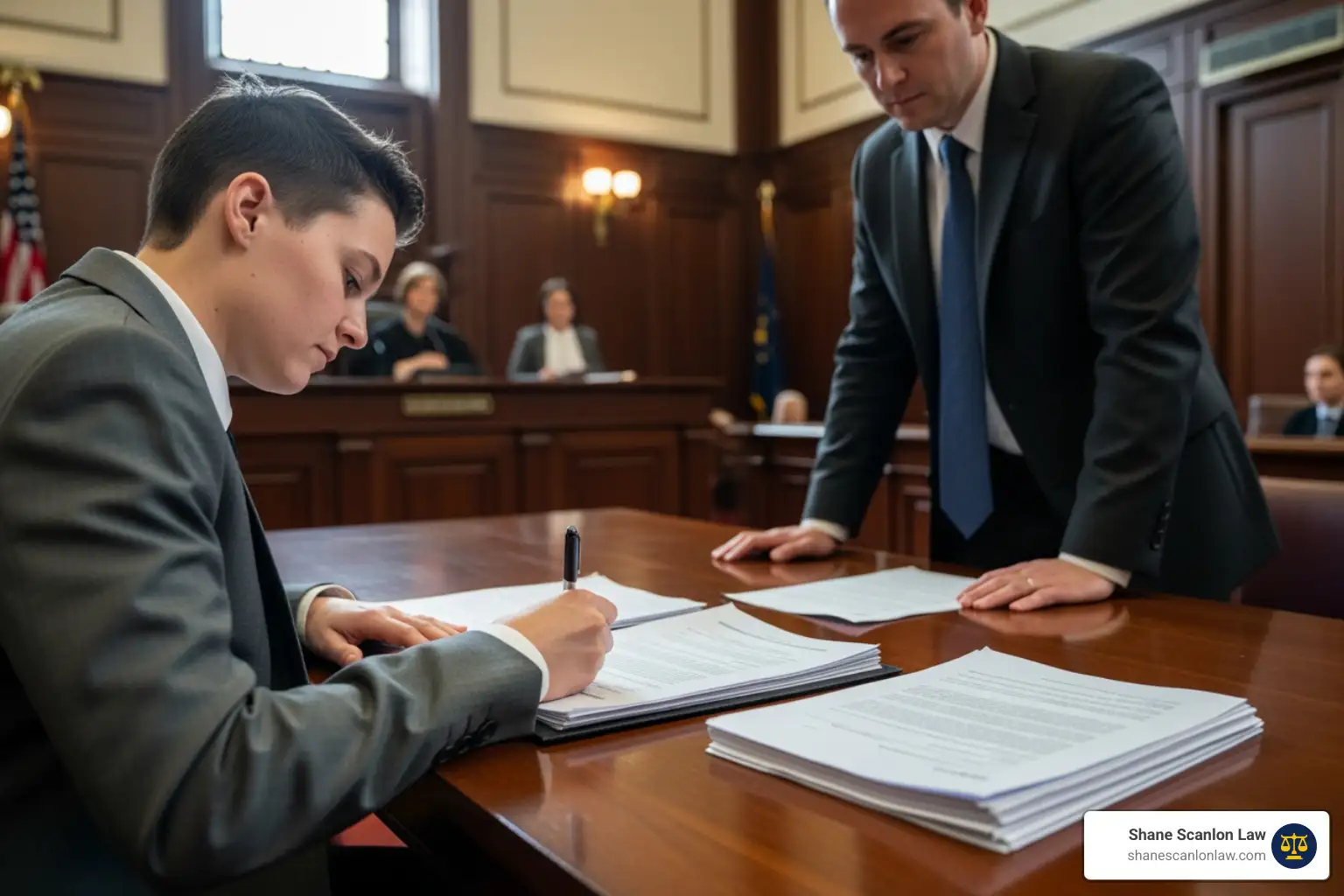
Why a Probation Violation Can Put Your Freedom at Immediate Risk
A criminal defense attorney for probation violation is a legal advocate who protects your rights when you’re accused of breaking the terms of your probation, defends you at violation hearings, challenges the evidence against you, argues for alternatives to jail time, and works to prevent revocation of your probation.
What a Criminal Defense Attorney Does for Probation Violations:
- Investigates the Allegation – Reviews the facts to determine if a violation actually occurred
- Challenges the Evidence – Questions the reliability and sufficiency of the prosecution’s proof
- Presents Your Defense – Argues that the violation was not willful or that you had a valid reason
- Negotiates Alternatives – Seeks outcomes like modified conditions or extended probation instead of jail
- Protects Your Rights – Ensures proper legal procedures are followed at every stage
- Argues Mitigating Factors – Highlights your compliance efforts and personal circumstances to the judge
Probation is an alternative to incarceration that allows you to remain in the community under court supervision. But when you’re accused of violating its terms—whether by failing a drug test, missing a meeting, or being arrested—your freedom is immediately at risk. Unlike a criminal trial, probation violation proceedings have fewer protections: the prosecution’s burden of proof is lower (“preponderance of the evidence”), you have no right to a jury, and a judge has wide discretion to revoke your probation and send you to jail or prison.
The stakes are extraordinarily high. A seemingly minor misstep, like traveling without permission or falling behind on court costs, can spiral into serious legal consequences. Once a probation officer files a violation petition, you’ll face a court hearing where a judge will decide your fate, which could mean the difference between staying home and being incarcerated.
I’m Shane Scanlon, and as a former Lackawanna County District Attorney who spent years prosecuting cases, I understand exactly how the system works from the inside and that insight is invaluable when I’m representing clients who need a criminal defense attorney for probation violation. Today, I use that prosecutorial experience to build aggressive, strategic defenses for individuals in Scranton and throughout Northeast Pennsylvania who are facing the threat of probation revocation.

What Constitutes a Probation Violation in Pennsylvania?
Probation is a privilege that comes with a legally binding set of conditions. Failing to meet these requirements, even accidentally, can lead to a probation violation accusation. In Pennsylvania, these violations range from minor oversights to serious new criminal charges.
Common Conditions That Can Lead to a Violation
Probation conditions are designed to ensure public safety and rehabilitation. They fall into general conditions (for everyone) and special conditions (specific to your case). Violating any of the following is common grounds for a violation:
- Reporting to a probation officer: Missing scheduled meetings or failing to maintain contact as required.
- Paying court costs and restitution: Failing to pay fines, fees, or restitution on time, unless you can prove a genuine inability to pay despite good faith efforts.
- Completing community service: Not finishing your required hours by the deadline.
- Attending counseling or treatment: Skipping sessions or failing to complete court-ordered programs for substance abuse, anger management, or mental health.
- Avoiding new arrests: Committing any new crime, from a misdemeanor to a felony, is a serious “substantive” violation. A DUI while on probation is a common and severe example.
- Remaining within the jurisdiction: Traveling outside the county or state without your probation officer’s permission.
- Abstaining from drugs and alcohol: A positive drug test or being caught using alcohol can lead to a probation violation for failing a drug test if your conditions prohibit it.
- Maintaining employment or education: Failing to hold a job or stay in school if required.
- Avoiding contact with certain individuals: Violating a no-contact order, often in cases involving domestic violence or co-defendants.
- Not possessing firearms: If prohibited, possessing a firearm or other dangerous weapon is a serious violation.
Technical vs. Substantive Violations
Understanding the difference between these two types of violations is crucial, as they can lead to different responses from the court.

Technical Violations: These are breaches of the rules of your probation that do not involve a new crime. Examples include missing an appointment, failing a drug test, or traveling without permission. While seemingly minor, a pattern of technical violations can lead to incarceration.
Substantive Violations: These occur when you are accused of committing a new criminal offense while on probation, such as a DUI, theft, or assault. A substantive violation almost always triggers a formal revocation process and significantly increases your risk of serving jail or prison time, as the court views it as a direct failure to obey the law.
Judges often view substantive violations with greater concern, but even repeated technical violations can demonstrate a lack of commitment to rehabilitation and lead to severe penalties. This is why having a strong criminal defense attorney for probation violation is so important, regardless of the type of violation alleged.
The Legal Maze: What Happens After a Probation Violation Accusation
Once an alleged probation violation occurs, the legal process in Pennsylvania unfolds in several stages, which can be confusing and intimidating without legal guidance. Your probation officer (PO) plays a central role in initiating these proceedings.
The Probation Officer’s Role
If your PO believes you’ve violated a condition, they have several options, from issuing a warning for a minor issue to filing a formal “Violation of Probation” (VOP) report with the court. If a VOP report is filed, the court may issue a summons for you to appear at a hearing or, more commonly, an arrest warrant. If a warrant is issued, you could be arrested and held without bail until your hearing, a challenging situation that underscores the seriousness of the accusation.
The Hearing Process
In Pennsylvania, probation violation hearings are often divided into two stages, commonly known as “Gagnon I” and “Gagnon II” hearings, based on landmark Supreme Court decisions.
- Gagnon I (Preliminary Hearing): If you are detained, this first hearing determines if there is “probable cause” to believe a violation occurred. If probable cause is found, you will likely remain in custody until the final hearing.
- Gagnon II (Final Revocation Hearing): This is the main hearing where the court decides if you violated your probation and, if so, what the consequences will be.
Your due process rights are critical during this process. These rights are rooted in Supreme Court decisions and are reflected in both state and federal rules for revocation hearings. They include:
- Written notice of the alleged violation.
- Disclosure of the evidence against you.
- An opportunity to appear, present evidence, and question adverse witnesses.
- The right to legal counsel.
The Probation Violation Hearing Explained

A probation violation hearing is very different from a criminal trial:
- Lower Burden of Proof: The prosecution only needs to prove the violation by a “preponderance of the evidence” (more likely than not), a much lower standard than “beyond a reasonable doubt.”
- No Right to a Jury Trial: Your case will be decided solely by a judge.
- Presenting Evidence and Questioning Witnesses: You have the right to present your own evidence, call witnesses, and question the prosecution’s witnesses (like your PO).
- Judge’s Role: The judge has significant discretion. They will determine if a violation occurred and, if so, decide on the appropriate outcome, which can range from a warning to revoking your probation and imposing a jail sentence.
Why You Need a Criminal Defense Attorney for a Probation Violation
Facing a probation violation in Scranton, Wilkes-Barre, or anywhere in Lackawanna or Luzerne County, demands immediate legal attention. A criminal defense attorney for probation violation is essential to:
- Steer Complex Procedures: An experienced attorney understands the rules, timelines, and evidentiary standards of VOP hearings.
- Protect Your Rights: We ensure your due process rights are respected and challenge any procedural errors.
- Present Mitigating Factors: We can effectively present explanations for the alleged violation, such as a medical emergency or job loss, to give the judge a complete picture.
- Argue Against Incarceration: Our primary goal is to prevent you from going to jail. We will vigorously argue for alternatives, such as continued probation or a treatment program.
- For a deeper dive into the immediate steps, read our guide on What Happens After a Probation Violation Arrest?.
The Critical Role of a Criminal Defense Attorney for Probation Violation
When your freedom is on the line, you need someone who knows the system inside and out. For us at Shane Scanlon Law, our advantage is clear: Shane Scanlon’s 20+ years of experience includes serving as a former District Attorney in Lackawanna County. This background gives us a unique perspective on how the prosecution approaches these cases, allowing us to anticipate their moves and build a stronger defense for you.
Building a Defense: How a Criminal Defense Attorney for Probation Violation Can Help
A criminal defense attorney for probation violation does more than just show up to court; we actively build a defense custom to your specific situation.
- Understanding Prosecution Tactics: As a former prosecutor, Shane Scanlon understands the strategies used to secure revocations. This insight is invaluable in crafting a proactive defense, as we can anticipate the prosecution’s arguments and evidence.
- Investigating the Allegation: We don’t take the PO’s report at face value. We conduct our own investigation, gathering evidence and interviewing witnesses to challenge the accuracy of the alleged violation.
- Negotiating with the Probation Officer and Prosecutor: Sometimes, a resolution can be reached before a formal hearing. We can negotiate with your probation officer or the prosecutor to agree to a less severe outcome.
- Arguing in Court: If the case goes to a hearing, we will represent you fiercely, presenting your side of the story, highlighting mitigating circumstances, and challenging the state’s evidence.
- Seeking Alternatives to Jail: Our primary goal is to keep you out of jail. We will argue for alternative dispositions such as reinstatement of probation, modification of conditions, or an extension of the probation term.
Here’s how we specifically build your defense:
- Challenging the Evidence: We can challenge the reliability of drug tests, the accuracy of witness statements, or the sufficiency of the evidence. If the evidence is weak, we can argue that the state has not met its “preponderance of the evidence” burden.
- Proving the Violation Was Not Willful: A key defense is showing the violation was not intentional. For example, missing an appointment due to a medical emergency or failing to pay fines because of a job loss may not be considered “willful” if you made good faith efforts to comply.
- Demonstrating Factual Innocence: If you are accused of a new crime, we can defend you against that underlying charge. If the new charge is dismissed or you are found not guilty, the substantive probation violation based on that charge would also fall away.
- Presenting Mitigating Circumstances: We gather all relevant information about your life and circumstances—such as sudden illness, job loss, or family emergencies—that might explain the alleged violation and present it to the judge.
- Highlighting Your Compliance Efforts: We emphasize all the ways you have complied with your probation, showcasing your commitment to rehabilitation and demonstrating that the alleged violation is an isolated incident.
For more detailed strategies, you can explore our page on Defenses Against a Probation Violation Charge in Pennsylvania.
Potential Outcomes and Judicial Discretion
When a judge hears a probation violation case, they don’t just rubber-stamp the probation officer’s recommendation. They weigh several factors to make a decision that is fair, promotes rehabilitation, and protects the community. This is where the skill of your criminal defense attorney for probation violation becomes critical, as we aim to influence the judge’s discretion in your favor.
Judge’s Considerations
Judges in Lackawanna County, Luzerne County, and throughout Northeast Pennsylvania consider a range of factors when deciding the outcome of a probation violation case:
- The seriousness of the violation (technical vs. substantive)
- Your prior criminal history
- Your history and performance while on probation
- Whether the violation was willful or accidental
- Any risk you may pose to public safety
- Your rehabilitative efforts (e.g., treatment, employment)
- The probation officer’s recommendation
Possible Dispositions After a Violation is Found
If the judge finds that you have violated your probation, they have several options, ranging from lenient to severe. These are the primary dispositions we aim to achieve or avoid:
| Outcome | Description |
|---|---|
| Probation Reinstatement | Probation continues under the original terms. This is a common outcome for minor, first-time violations. |
| Probation Modification | Probation continues, but with new or stricter conditions, such as more frequent reporting, counseling, or an extended probation term. |
| Probation Revocation | The most severe outcome. The court terminates probation and imposes the original suspended sentence, which often means jail or prison time. |
The judge’s decision is not punitive for the violation itself, but rather an enforcement of the original sentence. If probation is revoked, you could face the maximum sentence for your original offense, even if your initial plea bargain was for a shorter period. This highlights the truly serious nature of a probation violation.
Frequently Asked Questions about Probation Violations
It’s natural to have many questions when facing a probation violation. Here, we address some of the most common concerns we hear from clients in Scranton, Wilkes-Barre, and across Northeast Pennsylvania.
What is the difference between a probation and parole violation?
While both involve community supervision, they occur at different stages of the criminal justice system:
- Probation is a sentence served in the community instead of jail time. It is a pre-incarceration form of supervision.
- Parole is a conditional release from prison after serving part of a sentence. It is a post-incarceration form of supervision.
The key difference is when supervision begins, but the consequences of violating either are similar: both can lead to revocation and incarceration.
Can a probation violation be dismissed?
Yes, a probation violation can be dismissed. It is not an automatic conviction. A criminal defense attorney for probation violation can work to achieve dismissal by:
- Challenging the Evidence: If the prosecution cannot prove a violation occurred by a “preponderance of the evidence,” the judge must dismiss the allegation.
- Proving Non-Willfulness: If we can show the violation was not intentional or that you had a legitimate reason for the breach, the judge may dismiss it.
- Negotiating with the Prosecutor: We can often negotiate with the probation officer and prosecutor to have the violation withdrawn, especially for minor technical issues.
- Judge’s Discretion: Even if a violation is proven, a judge has the discretion to dismiss the charge and allow your probation to continue.
Will I automatically go to jail for a first-time probation violation?
No, you will not automatically go to jail for a first-time probation violation. This is a common misconception. While a violation is serious, the judge has significant discretion.
Here’s why jail isn’t automatic:
- Type of Violation: A first-time technical violation (like a missed appointment with a good excuse) is far less likely to result in jail time than a new criminal arrest.
- Mitigating Factors: This is where an attorney is crucial. We present a compelling case to the judge, highlighting your compliance efforts, personal hardships, and commitment to rehabilitation to show you deserve another chance.
- Alternatives to Incarceration: We will argue for outcomes like a warning, additional community service, or an extension of your probation rather than jail.
While jail is a possibility, it is by no means an automatic consequence, particularly for a first-time technical violation. Your best chance of avoiding it is to have an experienced criminal defense attorney for probation violation advocating for you.
Conclusion: Protect Your Freedom with an Experienced Advocate
The threat of a probation violation can feel like walking on eggshells, with your freedom constantly hanging in the balance. We understand the immense stress and uncertainty that comes with an accusation of breaking your probation terms. The stakes are incredibly high, potentially leading to the revocation of your probation and a return to incarceration.
However, you don’t have to face this daunting challenge alone. Immediate action and experienced legal representation are your strongest defenses. At Shane Scanlon Law, we bring more than two decades of legal experience to your side, including Shane Scanlon’s invaluable time as a former District Attorney in Lackawanna County. This unique perspective means we understand how the prosecution thinks, how they build their cases, and, most importantly, how to dismantle them effectively.
We are dedicated to providing fierce litigation and trusted local representation for individuals in Scranton, Wilkes-Barre, Lackawanna County, Luzerne County, Susquehanna County, and Wyoming County. If you’re accused of a probation violation, don’t hesitate. Let us put our experience to work for you, protecting your rights and fighting for your freedom.
Contact an experienced Scranton probation violation attorney today for a confidential consultation.