
 Call Anytime
833.722.6566
Call Anytime
833.722.6566
Protection From Abuse Orders: A Step-by-Step Guide
Why Protection From Abuse Orders Matter
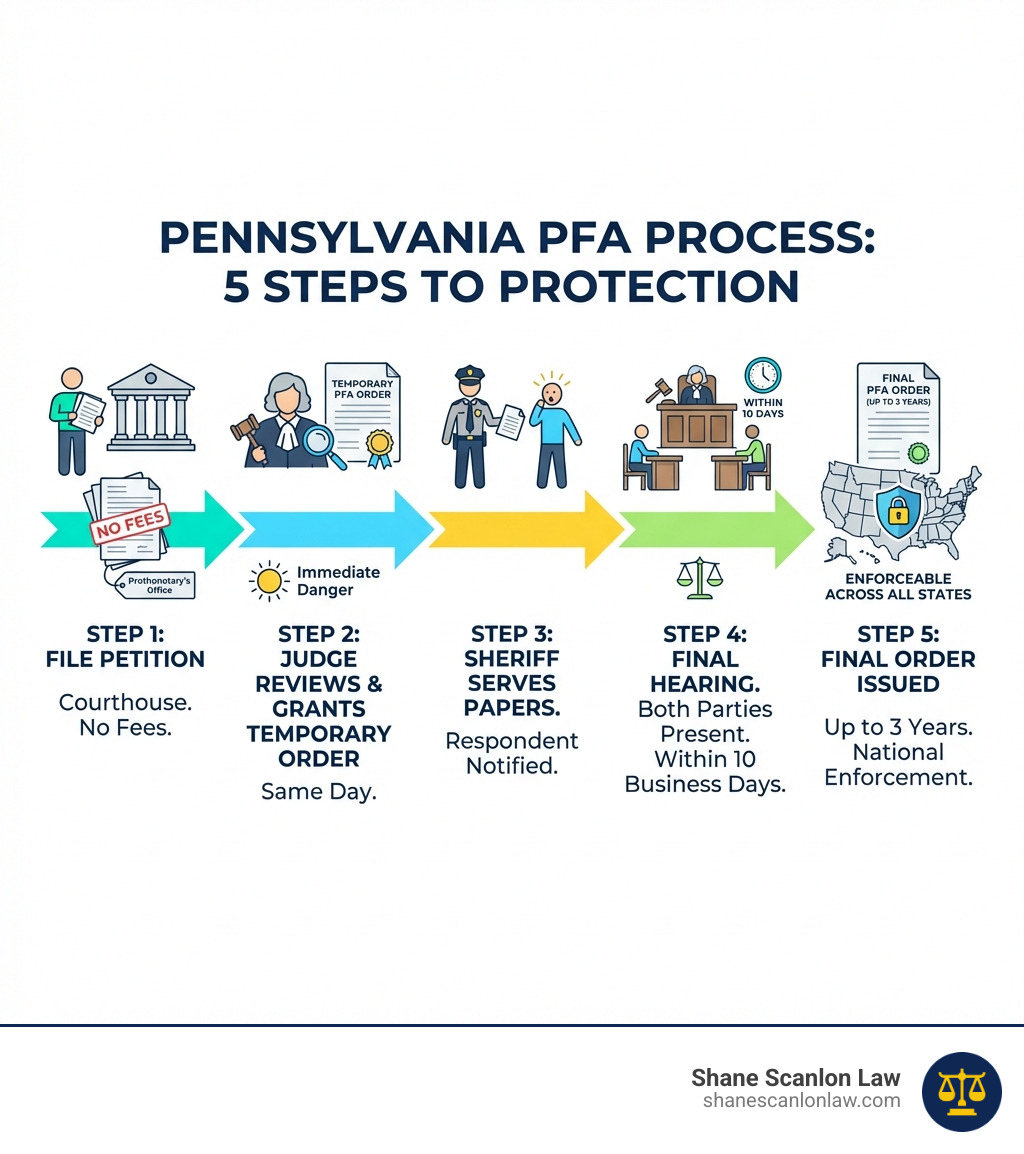
How to get a protection from abuse order in Pennsylvania involves a straightforward five-step legal process designed to protect victims of domestic violence:
- File a PFA Petition at your county courthouse (Prothonotary’s office) with no filing fee required.
- Receive a Temporary PFA Order from a judge, typically granted the same day if immediate danger exists.
- Serve the Abuser through the sheriff’s office with notice of the temporary order and final hearing date.
- Attend the Final Hearing within 10 business days to present evidence and testimony before a judge.
- Obtain the Final PFA Order which can last up to three years and is enforceable across all 50 states.
If you’re facing abuse from a spouse, ex-partner, family member, or someone you share a child with, Pennsylvania’s Protection From Abuse (PFA) Act provides immediate legal protection. A PFA order can stop contact, remove an abuser from your home, establish temporary custody, and require them to surrender firearms. Violating a PFA is a crime that can result in immediate arrest.
When you’re in crisis, the legal system can feel overwhelming. Understanding the PFA process is the first step toward securing safety and legal protection for you and your children.
As Shane Scanlon, a former Lackawanna County District Attorney with over 20 years of courtroom experience, I’ve seen the critical importance of getting a protection from abuse order quickly. My background prosecuting and defending cases throughout Northeast Pennsylvania provides a unique insight that I now use to help clients steer these urgent legal matters.
Understanding the Protection From Abuse (PFA) Order
A Protection From Abuse (PFA) order is a powerful civil court order in Pennsylvania designed to provide safety for victims of domestic violence. Issued under the Pennsylvania PFA Act, its primary purpose is to instruct an abuser to stop harmful behavior or face severe legal consequences. For victims in Scranton, Wilkes-Barre, and throughout Lackawanna, Luzerne, Susquehanna, and Wyoming Counties, a PFA can be a lifeline.
What is a PFA and What Does It Do?
Specifically, a PFA order can:
- Stop Abuse: It legally prohibits the abuser from committing further acts of abuse.
- Prohibit Contact: The abuser is forbidden from contacting you, your children, or other protected individuals, whether in person, by phone, text, email, or through third parties.
- Prevent Harassment and Stalking: It explicitly bars the abuser from engaging in any form of harassment or stalking.
- Provide Immediate Safety: By setting clear boundaries and legal repercussions, it offers a crucial layer of safety.
If the abuser disobeys any part of the PFA order, they can be immediately arrested and charged, underscoring the seriousness of this legal document.
Who is Eligible and What Types of Abuse Are Covered?
To be eligible for a PFA in Pennsylvania, the abuse must come from an intimate partner or family member. This includes:
- Spouses and ex-spouses
- Domestic partners
- Same-sex partners
- Parents and children
- Persons related by blood or marriage
- Current or former sexual or intimate partners
A PFA specifically addresses abuse within these defined relationships and generally does not protect victims abused by strangers or non-intimate roommates.
The types of abuse covered by a PFA are broad. According to Pennsylvania law, “abuse” for PFA purposes includes:
- Attempting to cause or causing bodily injury.
- Rape, sexual assault, or other forms of sexual violence.
- Placing another in reasonable fear of immediate serious bodily injury.
- False imprisonment.
- Physical or sexual abuse of a child.
- A course of conduct or repeated acts that place the person in reasonable fear of bodily injury.
This comprehensive definition ensures that many forms of harm, not just physical violence, can lead to a PFA order. Recognizing the signs of abuse is the first step towards seeking protection.

If you are experiencing any of these forms of abuse, we are here to help you understand your options.
What Protections Can a PFA Provide?
A judge can customize a PFA order with specific protections to create a safe environment, including provisions that:
- Order No-Contact: Prohibit the abuser from contacting you, your children, or other household members by any means.
- Require Eviction from a Shared Home: Mandate that the abuser leave a shared residence, even if they own or lease it.
- Award Temporary Child Custody: Grant you temporary sole physical and legal custody of your minor children.
- Mandate Financial Support: Order the abuser to pay temporary child support, spousal support, or other financial obligations like rent.
- Order Return of Personal Property: Require the abuser to return essential personal property, such as keys or identification.
- Require Firearm Surrender: Order the abuser to surrender all firearms, other weapons, and ammunition to the sheriff.
- Order Payment for Losses: Require the abuser to pay for reasonable losses from the abuse, such as medical bills or lost wages.
- Grant Other Appropriate Relief: Include any other conditions necessary to protect you and your family.
These protections are legally binding and enforceable, offering concrete steps toward your safety.
How to Get a Protection From Abuse Order: The 5-Step Process
Navigating the legal system to obtain a PFA order can seem daunting, but it’s a structured process designed to protect you. We will walk you through each step.
Step 1: Filing the PFA Petition
The journey to securing a PFA begins at your local county courthouse. For residents of Lackawanna, Luzerne, Susquehanna, and Wyoming Counties, this means visiting the Prothonotary’s office to request the court’s protection.

- Locate Your Courthouse: You must file in the county where you live, where the abuse occurred, or where the abuser can be served. To have an abuser removed from your home, you must file in the county where the home is located. You can find your local courthouse here: Find your local court house.
- Obtain the PFA Petition Form: These forms are available at the Prothonotary’s office. Court staff can provide forms but cannot give legal advice.
- Detail the Abuse: In the petition, you must clearly describe the abuse, including dates, locations, specific threats, injuries, and any fear for your safety. Note if the abuser has weapons.
- Specify Desired Protections: The form will ask you to indicate the specific protections you are seeking, such as a no-contact order, eviction, or temporary custody.
- No Filing Fee for the Petitioner: There is no filing fee for the person seeking protection (the petitioner). This ensures financial barriers do not prevent victims from seeking safety.
The act of filing this petition formally initiates the legal process. We are well-versed in the specifics of filing and obtaining a PFA order in our local courts.
Step 2: The Emergency or Ex Parte Temporary PFA Order
Once your petition is filed, the court moves quickly if you are in immediate danger. This is where a Temporary PFA order comes into play.
- Immediate Danger Assessment: A judge will review your petition, often the same day, to determine if there is an immediate danger of abuse. If the courts are closed and you need immediate protection, dial 911. Law enforcement can help you reach an on-call judge for an emergency order, which lasts until the next business day.
- Ex Parte Granting: An “ex parte” order means it can be granted without the abuser being present or notified beforehand, allowing for swift protection.
- Service of Process by Sheriff: If a temporary PFA is granted, the county sheriff’s office will serve the abuser with the order and a notice of the final PFA hearing date.
- Temporary Protection: This temporary order provides legal protection until the final PFA hearing, which is usually scheduled within ten business days.
This temporary order provides a crucial window of safety while you prepare for the final hearing.
Step 3: Preparing for the Final PFA Hearing
The final PFA hearing is your opportunity to present your case to a judge for a longer-term protection order. Thorough preparation is key.
- Gathering Evidence: The judge considers evidence from both sides, so gather everything that supports your claim of abuse. This can include:
- Text messages, emails, and social media posts
- Photos of injuries
- Police reports
- Medical records
- Witness lists
- Journals or logs of abusive incidents
- Importance of Legal Counsel: While you can represent yourself, a PFA hearing is legally complex. An experienced attorney, especially one familiar with protection from abuse in Lackawanna County and surrounding areas, can make a significant difference. We can help you organize evidence, prepare testimony, and present your case effectively to ensure your voice is heard and your safety is secured.
Step 4: Attending the Final PFA Hearing
The final PFA hearing is a formal court proceeding where a judge hears from both you (the plaintiff) and the alleged abuser (the defendant).
- Both Parties Present: Unlike the temporary order, both parties are expected to be present.
- Testimony Under Oath: You, the abuser, and any witnesses will provide sworn testimony.
- Presenting Evidence: This is where you present your gathered evidence, such as photos and text messages, to support your allegations.
- Cross-Examination: Both parties or their attorneys can question the other party and their witnesses.
- Judge’s Decision: After hearing all testimony and reviewing the evidence, the judge will decide if abuse has occurred and if a final PFA order is necessary.
- Consent Agreement Option: Instead of a full hearing, both parties may agree to a “consent agreement.” This is a PFA order agreed upon by both sides and signed by the judge, carrying the same legal weight as a contested order.
If the judge finds that abuse has occurred, a Final PFA Order will be issued.
After the PFA Order is Issued: Enforcement and Safety
Obtaining a PFA order is a significant step, but understanding enforcement and safety is equally important.
What Happens if the Abuser Violates the PFA?
A PFA order carries the full force of the law. Violating any condition results in serious legal consequences.
- Call 911 Immediately: If the abuser violates the PFA, call 911 immediately. Do not confront the abuser.
- Immediate Arrest: Police are authorized to arrest the abuser immediately for any violation of the PFA order.
- Indirect Criminal Contempt (ICC): The abuser will be charged with Indirect Criminal Contempt (ICC), a criminal charge for violating the civil PFA order.
- Criminal Penalties: If found guilty, the abuser faces penalties including jail time (up to six months), probation, and fines (up to $1,000.00).
The only exception to immediate arrest is typically for non-payment of support, which is handled through civil enforcement. The swift consequences for violations give a PFA its power. We can guide you through the enforcement of a PFA order if needed.
Can the Abuser Keep Their Guns?
A critical safety provision of Pennsylvania PFA orders is the mandatory relinquishment of firearms.
- Mandatory Firearm Relinquishment: If a final PFA order is issued, the abuser will be ordered to surrender any firearms, other weapons, and ammunition they possess.
- Surrendering Weapons to the Sheriff: The abuser must surrender these items to the county sheriff’s office, often within 24 hours. The sheriff’s departments in Lackawanna, Luzerne, Susquehanna, and Wyoming Counties handle this process.
- Public Safety: This provision is a cornerstone of PFA law, recognizing the increased danger when abusers have access to weapons.
Failure to surrender firearms is a violation of the PFA and can lead to additional criminal charges. We understand the serious implications of this provision and also handle the legal consequences for the accused, providing robust representation.
Enforcing Your PFA Across State Lines and Modifying the Order
Pennsylvania PFA orders are enforceable across state lines and can be modified to adapt to changing circumstances.
- Violence Against Women Act (VAWA): Thanks to federal laws like VAWA, a PFA order from Pennsylvania is valid and enforceable in every state and on tribal lands. You are protected even if you move.
- Full Faith and Credit Clause: The U.S. Constitution’s Full Faith and Credit Clause requires states to honor the judicial proceedings of other states, underpinning the nationwide enforceability of PFAs.
- Registering an Order (Optional): While your PFA is valid nationwide, registering it with a local courthouse in a new state can make enforcement easier for local police. However, this may notify the abuser of your new location. We can help you weigh the pros and cons.
- Petition to Modify or Extend: A final PFA lasts up to three years. If circumstances change or the threat continues, you can file a petition to modify or extend it. The court will hold a hearing to determine if changes are warranted. We can assist with modifying or terminating a PFA in Northeastern Pennsylvania.
Legal and Financial Aspects of a PFA
Navigating the PFA process brings up questions about costs, legal help, and safety. We aim to clarify these aspects.
How to get a protection from abuse order without paying fees
Financial barriers are removed at the initial filing stage of the PFA process.
- No Cost to File for the Petitioner: In Pennsylvania, there is no fee for the petitioner to file a PFA petition, ensuring victims can seek safety regardless of their financial situation.
- Court Costs and Defendant’s Responsibility: While filing is free for the petitioner, other court costs are typically assigned to the defendant (the abuser) if a final PFA is granted, shifting the financial burden away from the victim.
This means you can start the process to how to get a Protection from Abuse Order without worrying about upfront costs.
Finding Legal Assistance and Support Resources
You don’t have to go through the PFA process alone. Numerous resources are available for legal, emotional, and practical support.
- Domestic Violence Advocates and Local Shelters: Organizations like the Pennsylvania Commission Against Domestic Violence and the Pennsylvania Coalition Against Rape offer non-legal support, including counseling, safety planning, and help with paperwork. The National Domestic Violence Hotline (1-800-799-SAFE) and WomensLaw are also excellent national resources.
- Legal Aid Services: If you have a low income, you may qualify for free or low-cost legal services through Legal Aid organizations.
- Hiring a Private Attorney: For many, hiring a private attorney is the best course of action. An experienced lawyer provides comprehensive support, from preparing your petition to representing you in court. With over 20 years of experience, including as a District Attorney, Shane Scanlon Law offers dedicated representation for clients seeking a protection from abuse and throughout Northeast Pennsylvania.
How to get a protection from abuse order while staying safe
Your safety is paramount throughout the PFA process. It’s crucial to create and follow a safety plan.
- Creating a Safety Plan: A safety plan is a personalized plan to stay safe while in a relationship, planning to leave, or after you have left.
- Keeping a Certified Copy of the PFA: Always carry a certified copy of your PFA order. Keep extra copies in your car, at work, and with a trusted friend.
- Informing School and Work: Provide copies of the order to your children’s school and your employer, especially if the abuser knows these locations.
- Securing Your Home: If the abuser was ordered to leave your home, change the locks immediately.
- Blocking Digital Contact: Block the abuser’s phone number, email, and social media accounts. Be mindful of your online privacy settings.
- Trust Your Instincts: Remain vigilant. The period after a PFA is granted can be volatile. If you feel unsafe, call 911.
Frequently Asked Questions about PFAs in Pennsylvania
Here are answers to common questions about how to get a protection from abuse order in Pennsylvania.
How long does a final PFA last in Pennsylvania?
A final PFA order lasts for up to three years. You can petition the court to extend the order if there is an ongoing threat or if further abuse occurs. A hearing will be held to determine if an extension is warranted.
What happens if I don’t show up for my final PFA hearing?
If you are the petitioner and do not attend the final PFA hearing, the temporary order will expire, and the case will likely be dismissed. You will lose the order’s legal protection. It is crucial to attend all court dates or communicate with your attorney if a conflict arises.
Can I get a PFA against a stranger or a roommate?
Generally, no. A PFA requires a specific family or intimate relationship (e.g., spouse, partner, family member). It does not apply to strangers or non-intimate roommates. For harassment or stalking by someone outside these relationships, other legal options like a Sexual Violence Protection Order (SVPO) or a Protection From Intimidation Order (PFI) for minors may be available. We recommend seeking legal guidance to determine the correct path for your situation.
Conclusion
Understanding how to get a Protection from Abuse Order is a critical step toward safety from domestic violence in Pennsylvania. A PFA is a powerful legal tool providing immediate and long-term protection. However, navigating the legal system during a crisis can be complex and challenging.
At Shane Scanlon Law, we believe no one should face abuse alone. With Shane Scanlon’s 20+ years of experience, including his background as a former District Attorney, we bring a unique perspective and fierce litigation skills to every case. We are dedicated to providing trusted local representation to victims in Scranton, Wilkes-Barre, and throughout Lackawanna, Luzerne, Susquehanna, and Wyoming Counties. Our goal is to ensure your safety and advocate for your rights with care and professionalism.
For expert legal representation in your PFA case, contact us to learn more about our Protection From Abuse services.