
 Call Anytime
833.722.6566
Call Anytime
833.722.6566
The Legal Lowdown on PFAs: What You Need to Know About Protection From Abuse
Understanding Protection From Abuse Orders in Pennsylvania
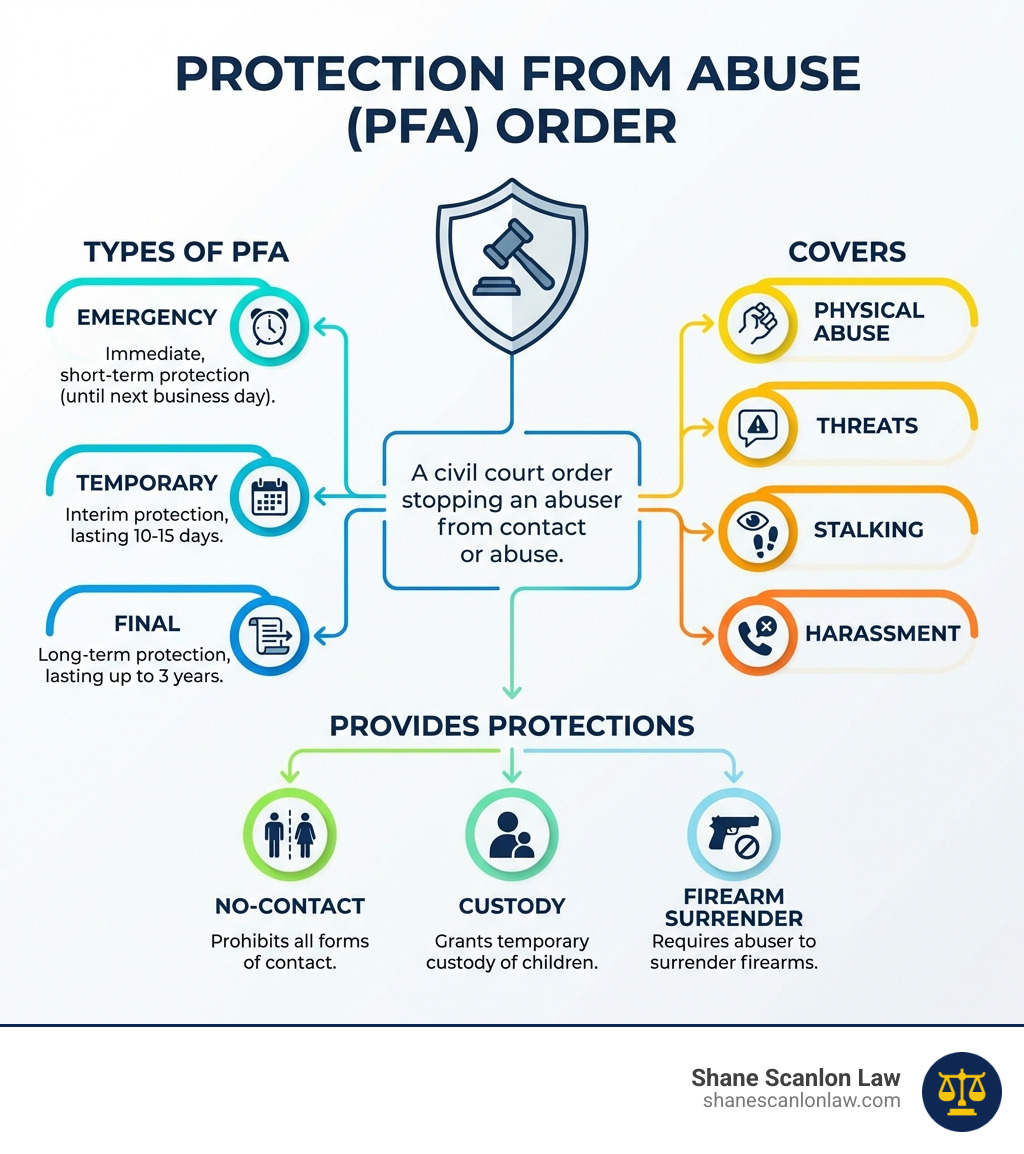
What is a PFA in legal terms? A Protection From Abuse (PFA) Order is a civil court order from a Pennsylvania judge that legally prohibits an abuser from contacting, harassing, stalking, threatening, or abusing you. It is specifically for victims of domestic abuse who have a qualifying relationship with their abuser, such as a spouse, family member, or intimate partner.
Key Facts About PFAs:
- What it stands for: Protection From Abuse
- Type of order: Civil (not criminal)
- Who can file: Victims in domestic or intimate relationships
- Duration: Emergency orders last until the next business day; temporary orders last up to 10 days; final orders can last up to 3 years.
- Violations: Breaking a PFA is a criminal offense punishable by up to 6 months in jail and a $1,000 fine.
A PFA gives law enforcement the power to intervene before more harm occurs. Police can arrest the abuser for merely making contact, without waiting for physical violence. The order can also grant you temporary child custody, exclusive use of your home, and force the abuser to surrender firearms.
While a PFA is a powerful tool, obtaining one means navigating the court system during a frightening time. The process involves filing detailed paperwork and testifying before a judge.
As Shane Scanlon, a former Lackawanna County District Attorney with over 20 years of courtroom experience, I’ve seen how critical it is to understand what is a PFA in legal terms and how to use this protection effectively. My background prosecuting domestic violence gives me unique insight into how these orders work and how to help clients secure the safety they desperately need.
What is a Protection From Abuse (PFA) Order?
At its heart, a Protection From Abuse (PFA) Order is a legal shield. It’s a civil court order in Pennsylvania designed to protect you from abuse, threats, or harassment by someone with whom you have a specific domestic relationship. Unlike criminal charges that punish past actions, a PFA aims to prevent future harm by creating a legal barrier against contact or other abusive behaviors.

In Pennsylvania, a PFA is a specific type of restraining order limited to domestic relationships, while a general restraining order (like a Protection from Sexual Violence or Intimidation Order) can apply to non-domestic disputes between neighbors or coworkers. The key difference is the relationship between the parties.
Here’s a quick comparison:
| Feature | Protection From Abuse (PFA) | General Restraining Order (e.g., PSVI) |
|---|---|---|
| Relationship Required | Domestic, family, household member, intimate partner | No specific relationship required (e.g., coworker, stranger) |
| Types of Abuse Covered | Physical, sexual, threats, stalking, harassment, emotional | Primarily sexual violence or intimidation |
| Scope of Protections | Broad: no-contact, housing, custody, firearms, support | Often limited to no-contact, stay-away, no harassment |
| Primary Purpose | Protect victims of domestic violence | Protect victims of sexual violence or general intimidation |
| Jurisdiction | Family Court (Court of Common Pleas) | Family Court (Court of Common Pleas) |
Who is Eligible to File for a PFA?
Eligibility for a PFA is tied to the relationship between you (the petitioner) and the alleged abuser (the respondent). You can file if you are being abused by:
- Spouses or Former Spouses
- Intimate Partners (current or former)
- Family Members (parents, children, siblings, etc.)
- Household Members (current or former)
- Parents of a Common Child
- Same-Sex Partners
If abuse occurs within a domestic or family context in Lackawanna County, Luzerne County, or anywhere in Pennsylvania, you likely meet the relationship requirement. For more details, see our page on More info about Protection From Abuse (PFA).
What Types of Abuse Are Covered?
The law recognizes that abuse takes many forms beyond physical violence. A PFA can cover:
- Physical Injury: Causing or attempting to cause bodily injury (e.g., hitting, slapping, pushing).
- Threats of Harm: Placing someone in reasonable fear of immediate physical injury. A credible threat is enough to seek protection.
- Stalking: A course of conduct that causes serious alarm, annoyance, or harassment.
- Harassment: Repeated unwanted contact, such as calls, messages, or showing up at your home or work.
- Sexual Violence: Any sexual offense as defined by law.
- False Imprisonment: Unlawfully restraining a person against their will.
- Child Abuse: Abusing minor children. This should also be reported to Children & Youth Services.
- Emotional Abuse: While not a standalone category, conduct a reasonable person would find threatening or harmful, such as severe psychological abuse or controlling behavior, can be covered.
You do not need visible injuries or police reports to file for a PFA. The court takes emotional and psychological abuse seriously. For more information, Plain-language legal information for victims of abuse is a valuable resource.
What Protections Can a PFA Provide?
A judge can customize a PFA to your situation, including these legally binding protections:
- No-Contact Order: Prohibits any direct or indirect contact from the abuser.
- Eviction of Abuser: Orders the abuser to leave a shared residence, granting you exclusive possession.
- Stay-Away Provisions: Requires the abuser to stay a certain distance from your home, work, or children’s school.
- Temporary Child Custody: Grants you temporary sole physical and legal custody and can establish safe, supervised visitation.
- Financial Support: Orders the abuser to pay temporary child or spousal support.
- Firearm Surrender: Requires the abuser to surrender all firearms and ammunition to the Sheriff’s Office.
- Counseling Mandate: May order the abuser to attend anger management or counseling.
- Protection of Companion Animals: Can grant you exclusive care of pets and order the abuser to stay away from them.
The Process: How to File and Obtain a PFA
Understanding the steps to obtain a PFA can empower you during a vulnerable time. The process involves filing a petition, an emergency hearing if needed, serving the order on the abuser, and a final court hearing.

The process begins at your local Court of Common Pleas in counties like Lackawanna or Luzerne. You must complete a PFA petition, detailing the incidents of abuse with dates, locations, and specific descriptions.
A judge reviews your petition. If you are in immediate danger, the judge can hold an ex parte (emergency) hearing without the abuser present and grant a temporary PFA.
Next, the abuser must be officially served with the petition and temporary order by the Sheriff’s Office. This notifies them of the allegations and the final hearing date.
Finally, a final hearing is scheduled where both parties can present evidence and witnesses. The judge then decides whether to issue a final PFA order.
The Different Types of PFAs and How Long They Last
PFAs are issued in stages to provide continuous protection.
- Emergency PFA: Issued outside court hours by an on-call judge if you are in immediate danger. It lasts only until the next business day, giving you time to file for a Temporary PFA.
- Temporary PFA: Issued after you file a petition during court hours if a judge finds an immediate danger of abuse. It typically lasts up to ten days, until the final hearing. This allows time to serve the abuser and for both parties to prepare.
- Final PFA: Issued after a full court hearing where both sides present their case. A Final PFA can last up to three years, providing long-term protection. The exact duration is set by the judge.
A Final PFA is not automatically renewed. You must file a petition to extend it before it expires if you still fear for your safety. For more procedural details, see our page on Details on Filing and Obtaining a PFA Order.
What Evidence is Needed to Get a PFA?
To get a PFA, you must prove to the court that abuse has occurred. The standard of proof is lower than in a criminal case, and evidence is not limited to physical injuries.
The court considers:
- Credible Testimony: Your sworn, detailed account of the abuse is the most crucial evidence. Consistency is key.
- Communications: Text messages, emails, voicemails, or social media posts from the abuser containing threats or harassment.
- Photographs: Date-stamped photos of any injuries or property damage.
- Witness Statements: Testimony from friends, family, or neighbors who witnessed the abuse or threats.
- Police Reports: Official documentation of incidents, even if no arrest was made.
- Medical Records: Doctor or hospital records detailing injuries or stress related to the abuse.
- Journals: A personal log of abuse incidents can help demonstrate a pattern of behavior.
Your credible testimony is often the most important factor. An experienced attorney can help you gather and present the most compelling evidence for your case.
What is a PFA in Legal Terms: Enforcement and Consequences
A PFA is a powerful legal tool because violating it has serious consequences. It is a court order, and disregarding it leads to immediate legal repercussions for the abuser in Scranton, Wilkes-Barre, and throughout Pennsylvania.
Any breach of the PFA’s terms—from making contact to failing to surrender firearms—is a violation that can lead to charges of Indirect Criminal Contempt (ICC), a criminal offense. Firearm restrictions are a critical component; failure to surrender weapons is a violation and can lead to additional criminal charges.
What Happens if the Abuser Violates a PFA?
If an abuser violates any condition of a PFA, it is a criminal offense. While a PFA is not a guarantee of safety, it provides a legal framework for swift intervention.
Here’s what happens:
- Immediate Arrest: Police can arrest the abuser without a warrant upon being notified of a violation. You just need to show them your PFA order.
- Criminal Charges: The abuser will be charged with Indirect Criminal Contempt (ICC).
- Penalties for Violation: A conviction can result in up to six months in jail and a fine of up to $1,000. Penalties increase for repeat offenses.
- Reporting Violations: Report every violation to the police, no matter how minor. Document the date, time, and what happened. Call 911 for emergencies.
The PFA remains in effect unless changed by a judge. Even if the abuser contacts you to apologize, it is a violation. Do not respond and report it to the police. For more on enforcement, visit our page on Learn about Enforcement of a PFA Order.
Can a PFA Be Extended or Modified?
Pennsylvania law allows PFAs to be extended or modified with court approval.
- Petition to Extend: Before a Final PFA expires (up to three years), you can file to extend it if you still fear for your safety. A previous violation by the abuser is strong grounds for an extension.
- Petition to Modify: Either party can file to modify the PFA’s terms due to a significant change in circumstances, such as a move or new custody needs.
- Court Approval Required: Any changes to a PFA must be approved by a judge. You cannot privately agree to alter the order’s terms.
Modifying or extending a PFA is a complex legal process. Experienced counsel can help you steer it effectively. Our firm offers guidance on modifying or terminating a PFA.
Navigating the PFA Landscape: Common Questions and Misconceptions
Misunderstandings about PFAs can prevent people from seeking help. We aim to clarify these points for residents of Scranton, Wilkes-Barre, and surrounding areas.
It’s important to remember that a PFA is a civil tool, but violating it is a criminal offense. Understanding how PFAs work with divorce or criminal charges is key to a comprehensive safety plan. For local support, see our page on Information on local resources in Lackawanna County.
Common Misconceptions About PFAs
Let’s debunk some common myths:
- Myth: PFAs Are Only for Women.
- Reality: False. Pennsylvania’s PFA laws are gender-neutral and protect any victim who meets the relationship criteria.
- Myth: You Must Have Physical Injuries to Get a PFA.
- Reality: Not true. The court recognizes emotional, psychological, and sexual abuse, as well as threats, stalking, and harassment. Evidence like text messages and witness testimony is often sufficient.
- Myth: PFAs Automatically Send the Abuser to Jail.
- Reality: No. A PFA is a civil order to prevent future abuse. However, violating a PFA is a criminal offense that can lead to arrest and jail time.
- Myth: PFAs Are Permanent.
- Reality: A Final PFA in Pennsylvania lasts up to three years. It is not permanent but can be extended if there is a continued threat.
- Myth: PFAs Are Easy to File Falsely.
- Reality: The legal system has safeguards. Judges require credible evidence and testimony, and filing a false PFA can lead to perjury charges.
- Myth: You Can’t Change or Drop a PFA.
- Reality: You can petition the court to modify or withdraw a PFA, but a judge must approve the change. This ensures victims are not coerced into dropping protection.
- Myth: PFAs Guarantee Complete Safety.
- Reality: No legal document can guarantee 100% safety. A PFA is a vital tool that allows police to intervene, but it should be part of a broader personal safety plan.
Can a PFA be Used with Divorce or Criminal Charges?
Yes. A PFA is often used alongside other legal actions for an added layer of protection.
- PFA and Divorce: It is common to seek a PFA during a divorce. It can provide immediate safety, grant temporary child custody, and establish financial support while the divorce proceeds. PFA provisions can significantly impact the final divorce decree.
- PFA and Criminal Charges: A PFA is a civil order, separate from any criminal charges. An abuser can face both a PFA and criminal prosecution for the same act (e.g., assault). The PFA provides immediate protection, while the criminal case seeks punishment for the crime.
Navigating these overlapping legal systems is complex. For additional support, the National Domestic Violence Hotline is an excellent resource.
Frequently Asked Questions about PFAs
We understand that you might still have lingering questions about what is a PFA in legal terms and how it applies to your situation. Here are answers to some of the most common inquiries we receive:
What is the main difference between a PFA and a general restraining order?
In Pennsylvania, a PFA (Protection From Abuse) is specifically for victims of domestic abuse by a family member, household member, or intimate partner. It offers broad protections like housing, temporary custody, and firearm surrender. A general restraining order (like a PSVI order) applies to non-domestic situations (e.g., neighbors, coworkers) and typically focuses on preventing stalking or harassment.
Do I need a lawyer to file for a PFA?
While you can file on your own (pro se), the process is complex and emotionally draining. An experienced attorney can significantly increase your chances of success by helping you complete paperwork, gather evidence, and represent you in court. Having legal counsel means you don’t have to face the abuser alone and have an advocate fighting for your safety.
What happens if the person I filed against contacts me, even if it’s to apologize?
Any contact from the abuser—a call, text, email, or showing up in person—is a violation of the PFA, regardless of their intent. The act of contact itself is the violation.
Your immediate action should be:
- Do NOT respond.
- Document everything. Save messages and note the date, time, and details of the contact.
- Report the violation to the police immediately. Show them your PFA order and the evidence of the violation.
The no-contact rule is dictated by the court order, not your personal feelings or the abuser’s intentions.
Securing Your Safety with Legal Protection
Understanding what is a PFA in legal terms is the first step toward securing your safety and reclaiming control over your life. A Protection From Abuse Order is a critical legal tool in Pennsylvania, offering a lifeline to individuals experiencing domestic abuse in Scranton, Wilkes-Barre, Lackawanna County, Luzerne County, Susquehanna County, and Wyoming County. It empowers victims by providing legal boundaries, immediate protection, and a pathway to stability.
The legal process, from filing the initial petition to navigating court hearings and enforcing the order, can be complex and emotionally challenging. However, with the right support, it can also be a profound step toward empowerment and healing.
At Shane Scanlon Law, we believe that no one should have to endure abuse or face the legal system alone. My 20+ years of experience, including my time as a former District Attorney, means we bring a unique perspective and fierce litigation skills to every case. We understand the nuances of domestic violence law and are dedicated to providing trusted local representation to ensure our clients receive the protection they deserve.
If you or someone you know is in need of protection, don’t hesitate. Take the first step toward safety and learn more about Protection From Abuse (PFA) orders. We are here to help you steer this challenging journey with confidence and unwavering support.