
 Call Anytime
833.722.6566
Call Anytime
833.722.6566
The Defense You Deserve: Choosing Your Drug Crime Attorney Wisely

Why You Need a Drug Crime Lawyer When Your Future is on the Line
A drug crime lawyer is a criminal defense attorney who specializes in representing individuals charged with offenses related to controlled substances, including possession, trafficking, manufacturing, and distribution. They challenge evidence, negotiate with prosecutors, and pursue alternatives to incarceration.
What a Drug Crime Lawyer Does:
- Challenges illegal searches and seizures that violate your Fourth Amendment rights
- Negotiates with prosecutors for reduced charges or case dismissal
- Explores diversion programs like ARD, Drug Treatment Court, or Section 17
- Defends against trafficking charges by contesting intent and challenging evidence
- Protects your future by fighting for outcomes that avoid criminal records
Drug charges carry serious weight. In 2022 alone, there were over 1.2 million arrests for drug possession in the United States and more than 230,000 arrests for drug trafficking. A conviction can result in mandatory jail time, hefty fines, loss of professional licenses, and permanent damage to your employment and travel opportunities. Even first-time offenders face consequences that can follow them for life.
The system is complex. Prosecutors must prove knowledge, control, and intent beyond a reasonable doubt. Evidence often relies on confidential informants, search warrants, and circumstantial factors. A skilled attorney knows how to challenge questionable evidence, expose flaws in police procedures, and negotiate for better outcomes.
I’m Shane Scanlon, and as a former Lackawanna County District Attorney and Chief Prosecutor of the County’s Narcotics Unit, I spent years prosecuting drug crimes before dedicating my practice to defense. Now, I use that insider knowledge to provide strategic, trial-ready representation as a drug crime lawyer for clients throughout Northeast Pennsylvania.
Classifying Drug Offenses: Possession, Trafficking, and Production
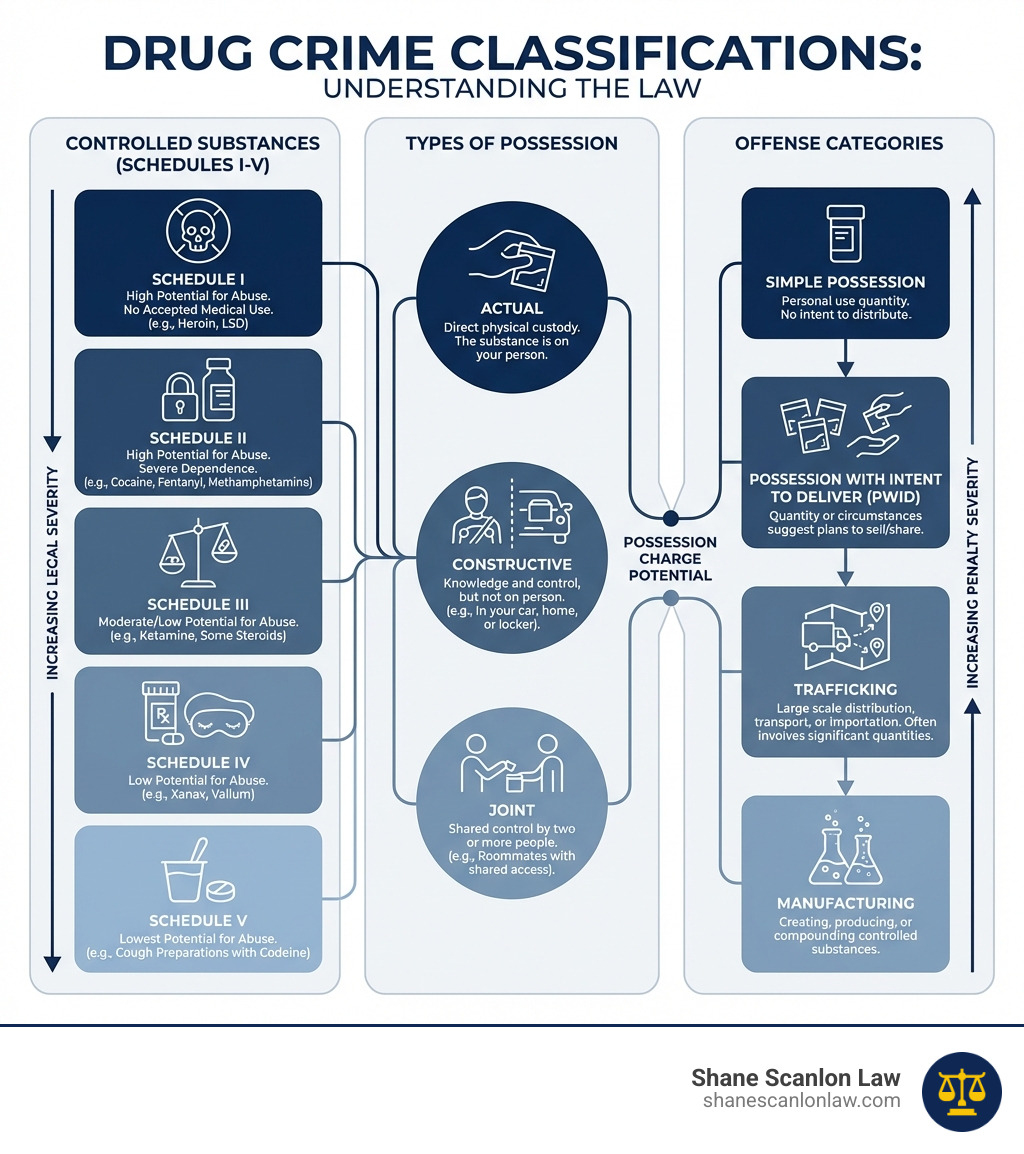
When we talk about drug offenses, it’s not a single, monolithic charge. The law categorizes these crimes based on the type and quantity of substance, your role, and your intent. Understanding these distinctions is crucial, as they directly impact the potential penalties you face.

In Pennsylvania, drug offenses are outlined in the Controlled Substance, Drug, Device and Cosmetic Act. These offenses can range from simple possession to felony trafficking, each carrying its own set of consequences.
Legal Definitions of Possession
The concept of “possession” in drug cases is more nuanced than simply having a substance on your person. Prosecutors must prove that you had both knowledge and control over the illegal substance. There are three primary ways the law defines possession:
- Actual Possession: This is the most straightforward. You are in actual possession if the drug is physically on your person, such as in your pocket, hand, or backpack.
- Constructive Possession: This applies when the drug isn’t directly on you, but it’s in an area you control and you have knowledge of its presence. For instance, if drugs are found in your car’s glove compartment, your bedroom, or your locker, and you knew they were there and had the ability to control them, you could be charged with constructive possession.
- Joint Possession: This occurs when two or more people share control and knowledge of a drug. If you’re with friends and drugs are found in a common area—like a shared apartment or a vehicle you’re all occupying—everyone present could potentially face joint possession charges.
To secure a conviction, the prosecution must prove beyond a reasonable doubt that you had both the knowledge of the illegal substance and the intent to control it. Mere presence near a drug is often not enough to establish possession, but it can be used as circumstantial evidence.
For more detailed information on misdemeanor drug offenses, we have resources available on our site: More info about misdemeanor drug offenses
Trafficking vs. Simple Possession
One of the most critical distinctions in drug law is between simple possession and possession with intent to traffic (PWID) or deliver. This differentiation hinges on intent and quantity, and it often means the difference between a misdemeanor and a serious felony charge.
- Simple Possession: This is generally the least severe drug charge, involving possession of smaller amounts of a controlled substance for personal use. In Pennsylvania, for example, possessing less than 30 grams of marijuana can lead to penalties of up to 30 days in jail and a $500 fine, though jail time is seldom imposed for small amounts.
- Possession with Intent to Deliver (PWID) / Trafficking: This charge indicates that you possessed drugs with the plan to sell, distribute, or deliver them to others. Even if no actual sale occurred, intent can be inferred from several factors:
- Quantity: Possessing amounts exceeding what would typically be for personal use (often referred to as “felony weight”). For example, in Pennsylvania, possessing two pounds of marijuana can result in a minimum of one year in prison, while two grams of Schedule I or II drugs can lead to two years in prison and a $5,000 fine.
- Packaging: Drugs packaged in multiple small baggies, often indicative of distribution.
- Paraphernalia: Possession of items like scales, large amounts of cash, or ledgers.
- Statements: Any statements made by you or others indicating an intent to sell.
The penalties for trafficking and distribution are significantly harsher than for simple possession, often including mandatory minimum prison sentences. Manufacturing and cultivation of drugs also fall under severe trafficking offenses, with legal ramifications that can lead to lengthy incarceration.
Here’s a simplified comparison:
| Feature | Simple Possession | Possession with Intent to Deliver (PWID) / Trafficking |
|---|---|---|
| Intent | Personal use | Sell, distribute, or deliver |
| Quantity | Small amounts | Larger quantities (“felony weight”) |
| Packaging | Typically bulk or single container | Multiple small baggies, often pre-portioned |
| Associated Items | None, or personal use paraphernalia | Scales, large cash, ledgers, weapons |
| Charge Type (PA) | Misdemeanor (for small amounts) | Felony |
| Potential Penalties | Fines, probation, short jail time (rare for small amounts) | Mandatory prison sentences, substantial fines |
We dig deeper into the specifics of simple drug possession charges for residents of Luzerne County: More info about simple drug possession charges
The High Stakes of Conviction: Penalties and Long-Term Consequences
A drug conviction can cast a long shadow over your life, extending far beyond the immediate legal penalties. The consequences can be severe, impacting your freedom, finances, and future opportunities.
In Pennsylvania, the potential penalties for drug offenses vary widely based on the type and quantity of the drug, your prior criminal record, and whether the offense is classified as a misdemeanor or felony. Even for first-time offenders, drug possession can lead to mandatory jail time and substantial fines. For example, possessing two pounds of marijuana can result in a minimum of one year in prison. If you possess two grams of Schedule I or II drugs, you could face two years in prison and a $5,000 fine.
Felony drug offenses, particularly those involving trafficking, distribution, or manufacturing, carry even more stringent penalties, often including mandatory minimum prison sentences. If a drug offense tragically results in death, the charges and penalties can be catastrophic, potentially leading to life imprisonment under federal law if you dispensed a controlled substance that led to another’s death.
A prior criminal record will almost certainly affect sentencing, often leading to improved penalties under career-offender or Armed Career Criminal statutes. Beyond incarceration and fines, a conviction can also lead to asset forfeiture, where property believed to be connected to drug activity can be seized by the government.
For a comprehensive understanding of felony drug offenses in Pennsylvania, please visit: More info about felony drug offenses
Impact on Employment and Travel
The ramifications of a drug conviction don’t end when you’ve served your time or paid your fines. A criminal record can significantly impede your ability to secure employment, as many employers conduct background checks. Certain professions, especially those requiring professional licenses (e.g., healthcare, teaching, law), may suspend or revoke your license upon conviction.
Travel opportunities can also be severely affected. A drug conviction, even for a misdemeanor, can lead to visa restrictions, making it difficult or impossible to enter other countries, including Canada. This can be a devastating blow for personal and professional aspirations.
The Statutes of Pennsylvania outline the severe penalties, and we understand how these can directly impact your career and reputation.
Consequences for Non-Citizens
For non-citizens, a drug conviction carries particularly severe and often irreversible consequences. Even minor drug offenses can lead to:
- Deportation: Non-citizens, including lawful permanent residents (green card holders), can be deported from the United States after a drug conviction.
- Inadmissibility: A drug conviction can render an individual inadmissible to the U.S., preventing them from obtaining a visa or green card, or re-entering the country after travel abroad.
- Loss of Legal Status: Existing visas or legal statuses can be revoked.
These immigration consequences are often more devastating than the criminal penalties themselves. It’s crucial for non-citizens facing drug charges to consult with a drug crime lawyer immediately, as specific plea bargains or alternative sentencing options might help mitigate these risks.
Learn more about how drug crimes can impact individuals in our community: More info about drug crimes in Scranton
Proven Defense Strategies Used by a Drug Crime Lawyer
Facing drug charges can feel overwhelming, but with an experienced drug crime lawyer on your side, numerous defense strategies can be employed. Our goal is always to protect your rights, challenge the prosecution’s case, and achieve the best possible outcome.
One of the most powerful lines of defense often involves challenging the legality of how evidence was obtained. The Fourth Amendment to the U.S. Constitution protects you from unreasonable searches and seizures. Law enforcement must have “probable cause” or your permission to conduct a search, or they must obtain a search warrant signed by a judge. If police fail to follow these procedures, any evidence obtained illegally may be dismissed by the courts, which can be a game-changer for your case.
This is a fundamental constitutional right that we vigorously uphold for our clients. We explore every avenue to ensure your rights were respected during the police investigation.
For a deeper dive into common defenses for drug crimes in Luzerne County courts, see: More info about common defenses for drug crimes in Luzerne County Courts
Challenging Evidence with a Drug Crime Lawyer
A significant part of our work as a drug crime lawyer involves scrutinizing every piece of evidence the prosecution plans to use against you. This can include:
- Motion to Suppress: If we believe evidence was obtained in violation of your constitutional rights (e.g., through an illegal stop, search, or seizure), we can file a motion to suppress that evidence. If successful, the evidence cannot be used against you, often leading to a dismissal of charges.
- Illegal Stop or Arrest: We examine whether the police had reasonable suspicion to stop you or probable cause to arrest you. If not, the entire case might be compromised.
- Warrant Validity: We scrutinize search warrants to ensure they were properly issued, based on accurate information, and executed within their legal scope.
- Confidential Informants: Cases often rely on information from confidential informants. We challenge the reliability and credibility of these informants, as their motives can be questionable.
- Chain of Custody: The prosecution must prove that the drugs seized are the same drugs tested and presented in court, and that they haven’t been tampered with. Any breaks in the chain of custody can lead to evidence being inadmissible.
- Certificate of Analysis: While often relied upon by prosecutors, we can challenge the scientific methods used to identify the substance or the qualifications of the analyst.
Challenging a Search Warrant
A search warrant is a powerful tool for law enforcement, but it’s not infallible. As your drug crime lawyer, we carefully review the warrant and the affidavit used to obtain it. We look for:
- Unreliable Information: Was the warrant based on false, misleading, or unreliable information provided by an informant or officer?
- Inaccurate Affidavits: Did the affidavit contain material misstatements or omissions that would have altered the judge’s decision to issue the warrant?
- Lack of Probable Cause: Even with a warrant, was there sufficient probable cause for its issuance?
- Execution Errors: Was the warrant executed within its scope, during the specified time, and in a lawful manner?
If we can demonstrate that the search warrant was invalid or improperly executed, the evidence obtained through that warrant may be excluded from your case. This often results in a significant weakening of the prosecution’s position, potentially leading to reduced charges or even dismissal.
If you’ve been charged with a drug crime, act quickly. Find out more here: More info about being charged with a drug crime
Alternatives to Incarceration: Diversion Programs and Drug Courts
We understand that not every drug offense warrants incarceration. For many, particularly first-time offenders or those struggling with addiction, alternatives to traditional sentencing can offer a path to rehabilitation and a fresh start. As your drug crime lawyer, we actively explore these options for our clients in Northeast Pennsylvania.
Pennsylvania offers several diversionary programs that can help eligible individuals avoid jail time and a permanent criminal record:
- Accelerated Rehabilitative Disposition (ARD) Program: This program is typically for first-time, non-violent offenders. If accepted, you would undergo a period of probation, possibly complete community service, and may be required to abstain from drugs and alcohol. Upon successful completion, the charges are dismissed, and you can petition for expungement of your record.
- Section 17 Program: Similar to ARD, this program is for individuals charged with a misdemeanor drug offense who have a documented drug issue and no prior criminal record or ARD participation. It involves pleading guilty, completing a treatment program, and a period of probation. Upon successful completion, the charges are dismissed and eligible for expungement.
- Pennsylvania Drug Court: These specialized courts focus on rehabilitation rather than punishment for individuals struggling with drug addiction. Participants undergo intensive treatment, regular drug testing, and judicial supervision. Successful completion can lead to reduced sentences, probation, or even dismissal of charges.
- Probation Without a Verdict: In some cases, a judge may impose probation without entering a formal verdict of guilt. If the probation is successfully completed, the charges can be dismissed.
These programs are invaluable opportunities for individuals to address underlying issues, avoid the severe consequences of a criminal conviction, and prevent future offenses. Eligibility criteria vary, and acceptance is not guaranteed, but our firm will work tirelessly to present a compelling case for your inclusion.
For more details on drug crimes in Luzerne County and the options available, please visit: More info about drug crimes in Luzerne County
The Importance of Early Legal Intervention
The moment you are charged with a drug offense, time becomes a critical factor. Early legal intervention by a skilled drug crime lawyer can significantly impact the trajectory of your case.
- Preserving Options: The sooner we get involved, the more options remain available. We can begin investigating immediately, gather crucial evidence, and identify potential defense strategies before evidence is lost or memories fade.
- Prosecutor Negotiation: Early intervention allows us to engage with prosecutors before positions harden. We can present mitigating factors, challenge the initial evidence, and negotiate for reduced charges or favorable plea bargains that might include diversion programs instead of incarceration.
- Case Dismissal: In some instances, a strong, early defense can lead to a case dismissal, saving you from the stress and expense of a prolonged legal battle.
The legal process is complex and unforgiving. Having an experienced drug crime lawyer from the outset ensures that your rights are protected, your voice is heard, and every possible defense is explored.
For a broader understanding of criminal defense strategies, explore our resources: More info about criminal defense
Frequently Asked Questions about Drug Crime Lawyers
It’s natural to have many questions when facing drug charges. Here, we address some of the most common inquiries we receive as drug crime lawyers.
What is the difference between actual and constructive possession?
This is a crucial distinction in drug cases.
- Actual possession means the illegal substance is physically on your person or within your immediate reach and control. For example, if drugs are found in your pocket, wallet, or hand, you are in actual possession.
- Constructive possession means the drugs are not physically on you, but they are in a place you control (like your car, home, or locker) and you have knowledge of their presence and the ability to exercise dominion or control over them. For instance, if police find drugs in your glove compartment and you knew they were there, that’s constructive possession.
The key elements the prosecution must prove for any type of possession are your knowledge of the drug and your ability to control it. Simply being near drugs is generally not enough; there must be evidence linking you to the intent to control them.
For more information on drug crimes in Wilkes-Barre, you can visit: More info about drug crimes in Wilkes-Barre
How can a drug crime lawyer help if I failed a drug test on probation?
Failing a drug test while on probation is a serious matter and constitutes a probation violation. This can lead to severe consequences, including revocation of your probation and being sent to jail or prison to serve your original sentence.
A drug crime lawyer can help by:
- Challenging the Test Results: We can investigate the validity of the drug test, including chain of custody issues, potential lab errors, or the possibility of false positives.
- Presenting Mitigating Factors: We can present evidence to the court regarding the circumstances of the failed test, your efforts in treatment, or any personal challenges you are facing.
- Negotiating with the Probation Officer and Prosecutor: We can attempt to negotiate for alternative sanctions, such as increased drug counseling, stricter reporting, or a short “shock” incarceration, instead of full probation revocation.
- Advocating for Treatment: If addiction is an underlying issue, we can advocate for continued or improved drug treatment programs as an alternative to incarceration, demonstrating your commitment to rehabilitation.
Our goal is to protect your freedom and prevent the most severe outcomes of a probation violation.
For more details on probation violations for failing a drug test, see: More info about probation violations for failing a drug test
What should I do immediately after being charged with a drug offense?
The moments immediately following a drug charge are critical and can significantly impact the outcome of your case. Here’s what you should do:
- Remain Silent: You have the right to remain silent. Exercise it. Do not answer any questions from law enforcement without your drug crime lawyer present. Anything you say can and will be used against you.
- Do Not Resist Arrest: Even if you believe your arrest is unlawful, do not physically resist. Resisting arrest can lead to additional charges.
- Do Not Consent to Searches: You have the right to refuse a search of your person, vehicle, or home unless officers have a warrant or probable cause. Clearly state, “I do not consent to this search.”
- Contact a Drug Crime Lawyer Immediately: This is the single most important step. As your drug crime lawyer, we can advise you on your rights, review the charges, and begin building your defense. Early intervention is key to preserving all your legal options.
- Preserve Evidence: Make a mental note of everything that happened: time, location, officers involved, what was said, and any witnesses. This information will be vital for your lawyer.
An arrest is not a conviction. You have legal rights that must be protected.
For more localized information regarding drug crimes, refer to our page on: More info about drug crimes in Susquehanna County
Conclusion
Navigating the complexities of drug crime charges in Pennsylvania requires an experienced and strategic legal approach. From understanding the nuanced definitions of possession to challenging illegally obtained evidence and exploring alternatives to incarceration, a knowledgeable drug crime lawyer is your most important ally.
At Shane Scanlon Law, we bring over 20 years of experience, including years spent as a former District Attorney and Chief Prosecutor of the Lackawanna County Narcotics Unit. This unique insider perspective allows us to anticipate prosecution tactics and build robust defense strategies for our clients. We are committed to providing fierce litigation and trusted local representation throughout Northeast Pennsylvania, including Scranton, Wilkes-Barre, Luzerne County, Lackawanna County, Susquehanna County, and Wyoming County.
When your future is on the line, you deserve a dedicated defense. Contact us today for a confidential consultation.