
 Call Anytime
833.722.6566
Call Anytime
833.722.6566
How to Get a Probation Violation Attorney in 3 Simple Steps

Why a Probation Violation is a Serious Matter
A probation violation attorney is a criminal defense lawyer who represents individuals accused of breaking the terms of their probation, helping them avoid jail time, negotiate lesser penalties, or fight the allegations at a violation hearing.
When You Need a Probation Violation Attorney:
- You’ve been accused of violating probation – Missing appointments, failing drug tests, or committing new offenses.
- You received a notice or warrant – Your probation officer filed a violation report.
- You’re facing a revocation hearing – The court will decide whether to send you to jail or modify your probation.
- You need to protect your freedom – Hundreds of thousands of probationers are sent to prison each year for violations.
Probation allows individuals to serve a sentence in the community instead of behind bars, but it comes with strict conditions. According to the Bureau of Justice Statistics, millions of people in the U.S. are on probation. Violating any condition, even a minor one, can lead to serious consequences like probation revocation, fines, and jail time.
The legal process for probation violations differs from a regular criminal trial. The burden of proof is lower—prosecutors only need to show a “preponderance of the evidence” rather than “beyond a reasonable doubt.” Hearsay evidence is often admissible, and you could be held in jail without bond while awaiting your hearing. The stakes are high, and the system moves fast.
I’m Shane Scanlon, and as a former Lackawanna County District Attorney with over 20 years of courtroom experience, I’ve handled countless probation violation cases from both sides. This gives me unique insight into how prosecutors think and how to build the strongest defense as a probation violation attorney. Now, I use that experience to help clients in Scranton and throughout Northeast Pennsylvania fight to protect their freedom.
Step 1: Understand Your Situation – What is a Probation Violation?
Probation is a sentence allowing individuals to live in the community under court supervision instead of being incarcerated. This privilege comes with a strict set of rules. Failing to follow any of these terms, intentionally or not, constitutes a probation violation and can lead to the imposition of the original jail sentence.
In Pennsylvania, the laws governing probation are complex. We can help you steer these complexities and build a strong defense. To learn more, visit our page on Defenses Against a Probation Violation Charge in Pennsylvania. With good behavior, it’s sometimes possible to have probation terminated early.
Common Probation Conditions and How They Are Violated
Probation conditions vary by case and location, such as Scranton or Lackawanna County. Here are some common conditions and typical violations:
- Reporting to your probation officer: Missing scheduled meetings or failing to check in as required.
- Paying fines and restitution: Failing to make court-ordered payments on time.
- Drug and alcohol testing: Failing a test or refusing to take one is a direct violation.
- Completing community service: Not completing the required hours by the deadline.
- No new offenses: Committing any new crime, even a minor one, is a serious violation. An accusation alone can trigger a hearing.
- Travel restrictions: Leaving your county or state without permission from your probation officer. For more information, see Can You Travel While on Probation? What You Need to Know.
- Attending counseling or treatment: Failure to attend or complete court-ordered programs.
- Maintaining employment or school enrollment: Losing a job or dropping out of school without a valid reason.
- Not associating with prohibited individuals: Contacting co-defendants, known criminals, or victims.
- Not possessing firearms: A common condition, especially for felony convictions.
- Curfew violations: Not adhering to a court-ordered curfew.
“I didn’t know” is rarely an acceptable excuse. It’s vital to understand every condition. If you’re unsure, consult a knowledgeable probation violation attorney.
Technical vs. Substantive Violations
Probation violations fall into two categories:
Technical Violations These are breaches of the administrative rules of your probation, not a new crime. Common examples include:
- Failing a drug test: A common violation if abstinence is a condition. Learn more at Probation Violation for Failing a Drug Test: What Are Your Options?.
- Missing appointments with your probation officer.
- Failing to pay fines or restitution.
- Not completing community service hours.
- Violating curfew or travel restrictions.
While “technical,” a pattern of these violations can lead to probation revocation.
Substantive Violations These are more serious as they involve committing a new criminal offense while on probation.
Committing a new crime: Being arrested for any new offense will almost certainly trigger a probation violation charge, regardless of the new case’s outcome.
Substantive violations are viewed more severely and are more likely to result in incarceration.
Supervised vs. Unsupervised Probation
The level of oversight during probation can vary.
Supervised Probation This is common for more serious offenses and involves:
- Regular check-ins: You must report to an assigned probation officer regularly.
- Probation officer oversight: The officer monitors your compliance with all conditions.
- More stringent requirements: This type of probation usually has more detailed conditions.
Unsupervised Probation Typically for less serious offenses, this involves:
- Fewer requirements: You generally don’t have a probation officer or regular reporting duties.
- Violation triggers: The primary way to violate is by committing a new crime, though other conditions like paying fines still apply.
- Self-reporting responsibility: You are responsible for meeting all conditions without reminders.
A violation of either type can have serious consequences, making an experienced probation violation attorney essential.
Step 2: Know the Process and Potential Consequences
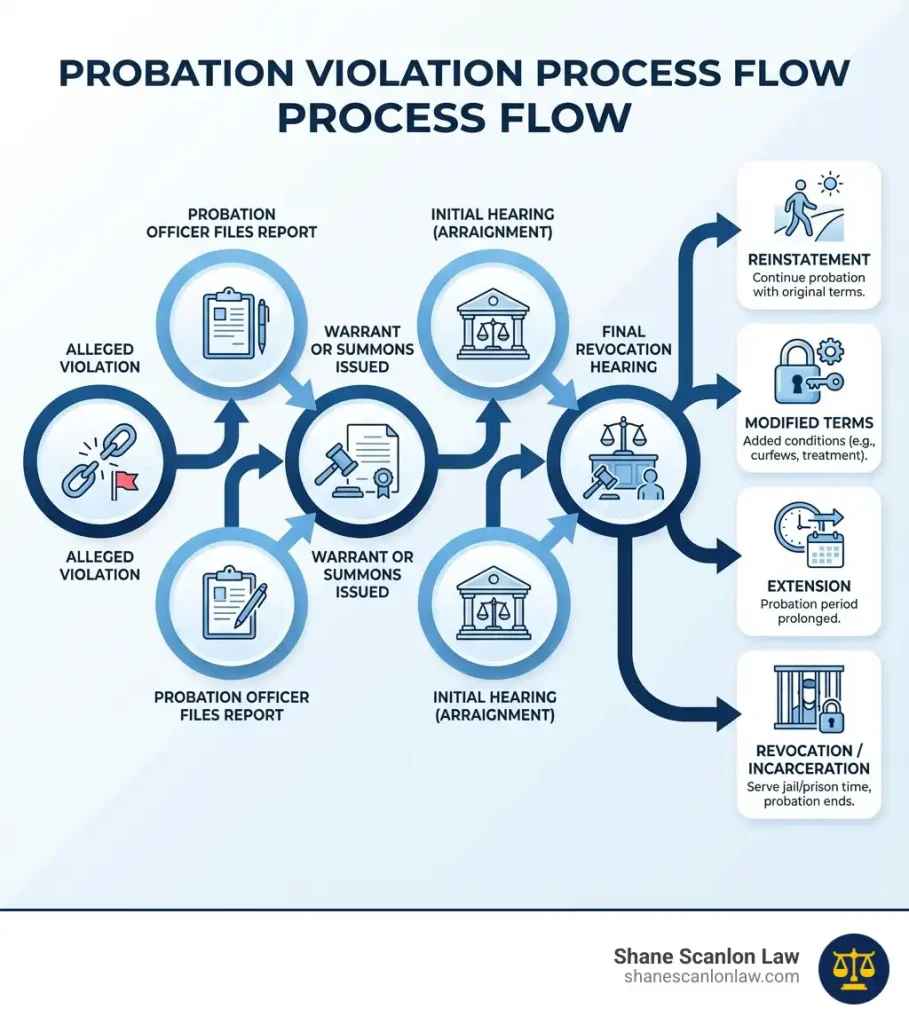
When a probation officer believes a violation has occurred, they file a notice with the court. The judge may then issue a summons for you to appear or, more often, an arrest warrant. If a warrant is issued, you could be taken into custody and held in a local jail without bond until your hearing.
This is a critical time to have an experienced probation violation attorney. If you’ve been arrested, understanding what’s next is vital. Visit our page on What Happens After a Probation Violation Arrest? for more details.
Probation violation hearings have a lower burden of proof than criminal trials. The prosecution only needs to prove the violation by a “preponderance of the evidence” (more likely than not). Hearsay evidence may also be allowed, making it easier for the prosecution to prove their case and highlighting the need for a skilled defense.
The Probation Violation Hearing Process
The process typically involves two main hearings:
Initial Hearing (Arraignment) At this first appearance, you will be:
- Formally notified of the alleged violations.
- Asked to admit or deny the allegations.
- The judge will decide on bail or detention pending the final hearing. Many are held without bond.
Final Revocation Hearing (Gagnon Hearing) If you deny the allegations, a final hearing is scheduled. This is your chance to present a defense.
- Not a criminal trial: A judge, not a jury, decides the outcome.
- Probationer’s rights: You have due process rights, including the right to written notice, the right to an attorney, the right to present evidence, and the right to cross-examine witnesses.
- Burden of proof: The prosecution must prove the violation by a preponderance of the evidence.
A dedicated probation violation attorney is critical to protect your rights during these hearings.
Potential Penalties and Outcomes
The outcome depends on the violation’s nature, your history, and the judge’s discretion. Possible penalties include:
- Probation reinstatement: Your probation continues on its original terms, often with a warning.
- Stricter conditions: The court may add new rules like more frequent reporting, counseling, or electronic monitoring.
- Extension of probation term: Your supervision period is made longer.
- Short jail stints: A judge may order a brief period of incarceration as a sanction.
- Revocation of probation: This is the most severe outcome, where your community supervision is terminated.
- Incarceration: Upon revocation, you are sent to jail or prison to serve your original suspended sentence.
- Fines: The court may impose additional fines.
The outcome depends heavily on the facts and the effectiveness of your defense. For more on your options in the Scranton area, visit Probation Violation in Scranton, PA: What Are Your Options?.
Step 3: Find the Right Probation Violation Attorney for Your Case
Facing a probation violation is a serious matter with your freedom at stake. Navigating the legal system alone is overwhelming, which makes finding the right probation violation attorney critical.
How a Probation Violation Attorney Can Defend You
A skilled probation violation attorney is your advocate, negotiator, and strategist. Here’s how we can defend you:
- Negotiating with the probation officer: We can intervene early to try and resolve the issue administratively, potentially avoiding a formal court hearing.
- Challenging evidence: We review the prosecution’s evidence, question its reliability, and identify procedural errors.
- Arguing for lesser penalties: If a violation is proven, we advocate for the least restrictive penalties, such as continued probation instead of jail.
- Presenting mitigating circumstances: We gather and present evidence explaining why a violation may have occurred, such as financial hardship or mental health issues.
- Highlighting positive behavior: We emphasize your successful compliance with other probation terms to show your commitment to rehabilitation.
- Seeking alternatives to jail: We explore all non-incarceration options, like house arrest or intensive treatment programs.
Our firm’s experience in Criminal Defense provides a comprehensive understanding of the strategies that work in local courts.
What to Look for in a Probation Violation Attorney
Choosing the right lawyer can make all the difference. When searching for a probation violation attorney in Northeast Pennsylvania, consider these factors:
- Criminal defense specialization: You need a specialist, not a general practitioner.
- Experience with local courts: A lawyer familiar with Lackawanna and Luzerne County courts has invaluable insight into local procedures and personnel.
- Positive client testimonials: Look for a track record of satisfied clients and favorable outcomes.
- Clear communication: Your attorney should explain complex issues clearly and keep you informed.
- Free consultation: Reputable firms, including ours, offer a free initial consultation to discuss your case and options without financial commitment.
Frequently Asked Questions about Probation Violations
We understand that facing a probation violation brings up many questions. Here are answers to some common concerns we hear from clients in Scranton and surrounding areas:
Can I avoid jail time for a probation violation in Pennsylvania?
Yes, it is often possible to avoid jail time. While incarceration is a risk, especially for serious violations, it is not automatic. An experienced probation violation attorney can argue for alternatives, such as:
- Reinstatement of probation with stricter conditions.
- An extension of the probation term.
- Mandatory enrollment in treatment or counseling.
- Short-term confinement followed by reinstatement.
Our goal is to show the court that incarceration is not the most appropriate outcome by highlighting mitigating factors and your commitment to rehabilitation.
What is the difference between probation and parole?
While both involve community supervision, they occur at different stages:
- Probation: A sentence given by a judge instead of jail time. It allows you to remain in the community from the start of your sentence under specific conditions.
- Parole: A conditional release from prison after serving part of an incarceration sentence. The decision is typically made by a parole board.
Violating either can result in being sent to (or back to) prison. Our team at Shane Scanlon Law is experienced in handling both probation and parole violation cases.
How much does a probation violation attorney cost?
The cost varies based on several factors, including the complexity of your case, the attorney’s experience, and the fee structure (hourly, flat fee, etc.). Highly experienced local attorneys may charge more, but their expertise often leads to better outcomes. We offer a free initial consultation to discuss the specifics of your case and provide a clear understanding of our fees with no obligation. We believe in transparency and ensuring our clients understand the value of fierce, local representation.
Conclusion: Take the First Step to Protect Your Freedom
Navigating a probation violation accusation in Pennsylvania can feel like walking a tightrope with your freedom hanging in the balance. We’ve walked you through the three crucial steps: understanding what a probation violation entails, knowing the legal process and its serious consequences, and recognizing the critical importance of finding the right probation violation attorney.
The statistics don’t lie: probation violations are a significant gateway to incarceration for many. With hundreds of thousands sent to prison each year for these violations, the stakes couldn’t be higher. The legal system moves quickly, operates with a lower burden of proof, and even allows hearsay evidence against you. This is not a situation to face alone.
At Shane Scanlon Law, we understand the profound impact a probation violation can have on your life, your family, and your future. With over 20 years of experience, including my time as a former District Attorney, we bring a unique perspective and fierce litigation skills to every case. We are committed to providing trusted local representation for clients across Scranton, Wilkes-Barre, Lackawanna County, Luzerne County, Susquehanna County, and Wyoming County.
If you are facing a probation violation, don’t delay. The sooner you act, the more options we may have to protect your freedom and secure the best possible outcome. Take the first, most important step today.